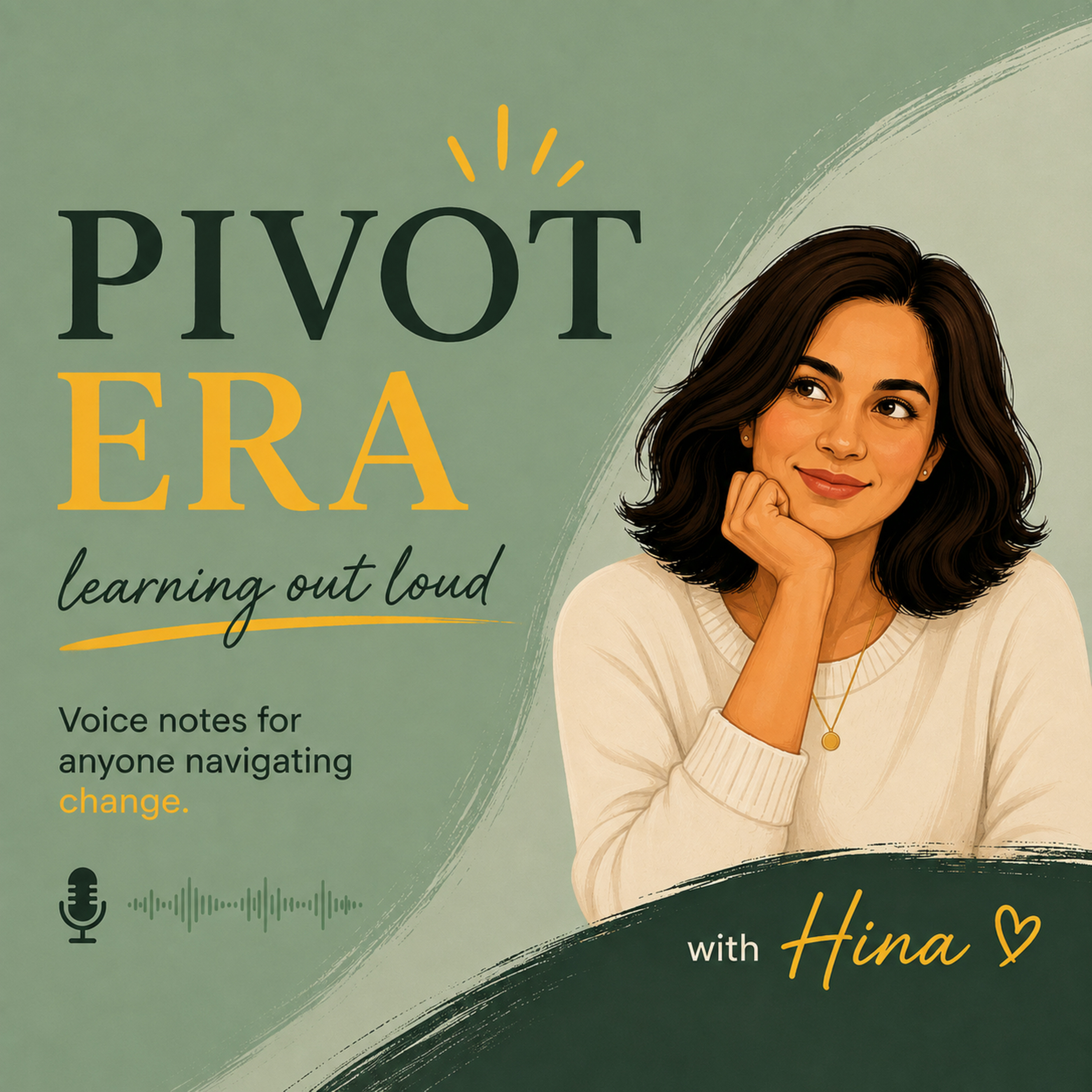
Hey, thanks for being here. Episode 35. Stop branding. Start practicing.
Let's think about this. A mug. Warm in your hands. A kitchen that's too quiet.
Maybe it's early morning before anyone else is awake. Maybe it's late at night when the day finally stops asking things from you. Your phone is faced down on the kitchen table. Like you're trying not to.
You know, negotiate with it. And in that quiet, you feel it. That pressure to figure it out. Your work, your direction, your identity.
Not just what you do, but what it says about you. Because careers don't live in a vacuum. They spill into our lives. They shape our relationships, our confidence, our time.
And yes. Today on PIVA-era Podcast. I want to talk about something that often changes depending on what generation you belong to and what stage you're in. How every stage of your career impacts your life and your brand differently.
And why it can help to stop chasing a perfect brand. And start building a practice that fits the season you're actually in. Here's the thing. A personal brand is often talked about like it's one universal task.
Like everyone should be doing the same thing at the same intensity, with the same goals. But that's not real life. A Gen Z early career professional trying to break in. Has a different kind of pressure than a millennial in mid career trying to pivot.
Which is different from Gen X managing leadership or family responsibilities. Which is different from a boomer navigating legacy, reinvention, or late career reinvention and new meaning. Same word, brand. But totally different weight.
And if we don't name that, we end up judging ourselves by someone else's season. Yikes, we don't want that. No thank you, right? So let's break this down.
What have we thought about career stages like weather? For example, early career can feel like spring, fast, messy growth. Mid career can feel like summer, heat, momentum, responsibility. Late career can feel like autumn, harvest, reflection, legacy.
None of these stages are better. But each one asks something different from you. And your generation changes the context. The economy you entered, the tools you grew up with, the rules you were taught to follow.
So of course, your life and brand will look different. Let's start with Gen Z, especially early career. If you're Gen Z, you've come up in a world where visibility feels like currency. You're not just applying for jobs, you're also managing LinkedIn, portfolios, side projects, and sometimes content.
And those in a job, you're navigating Gen Z work culture where proof matters. Proof your skilled, proof your adaptable, proof you're not falling behind. So branding pressure hits early. It can feel like, I need a clean identity before I've even lived it.
And that's where imposter syndrome creeps in. Quietly. I'm capable. But because you're being asked to perform certainty while you're still learning.
If that's you, here's a softer permission. Early career isn't for perfect branding. It's for practice. Practice builds evidence.
Evidence builds confidence. Confidence eventually becomes clarity. Now, millennials, often mid-career. A lot of millennials are carrying a different kind of brand pressure.
Not just who am I, but how do I stay relevant? How do I pivot without losing everything I've built? How do I make a career pivot when life is already full? Because mid-career isn't just work.
It's rent or a mortgage. It's potentially family dynamics. It's partnership, caregiving, burnout recovery, help. So branding can feel less like self-expression and more like survival.
And the emotional tension is real. You might be proud of what you've built and still feel a pull towards something else. That doesn't make you ungrateful. It makes you alive.
In mid-career, a brand can become a cage if it's based on who you used to be. So the practice you need might be smaller, but steadier. Not reinvent everything overnight. More like, try one new direction consistently enough to trust it.
So what about those who are Gen X? Often in leadership, responsibility, and complexity. For a lot of Gen X folks, the brand conversation is different again. It's kind of less about going viral.
More about credibility, consistency, and impact. The brand might be tied to your reputation. Years of being dependable, competent, the person who holds things together. But here's the hidden cost.
Sometimes the reliable identity becomes a quiet grief. Because if you're always the strong one, when do you get to explore? When do you get to be new again? Gen X often carries a brand shaped by responsibility.
So the practice here might look like reclaiming a creative self, a curious self, without needing it to be profitable right away. And to keep this real, earning a living is very much a balancing act between this. A practice can be a private room where you're not the role you've always been. And then boomers, late career, legacy, reinvention, or transition.
And here can mean something tender. What do I want to be remembered for? What did my work give me? And what did it cost?
What do I do with everything I know? There can be a cultural mismatch too. Branding today can feel loud, fast, performative. And if you didn't grow up with that language, it can feel strange, like you're being asked to turn your life into a marketing campaign.
But practice doesn't require performance. Practice is simply, what do I want to keep doing because it matters to me? And sometimes late career practice is about mentorship, or craft, or contribution. Or both, you get to decide.
Sometimes it's about a quieter kind of reinvention. So yes, I think your generation and career stage shape your life and your brand. But there's one thing that stays true across all of them. A brand faces outward.
A practice holds you inward. A brand says, here's who I am. A practice says, here's what I return to. And in any season, early, mid, late, practice is what keeps you grounded when your identity is shifting.
Here's a simple framework you can try, no matter your age or stage. Anchor, act, adjust. For anchor, what matters right now? Stability, growth, meaning, time, for act.
What's one small practice that fits your real life? And for adjust. After a week, what needs to change? Pace, tools, expectations.
Notice what this does. It doesn't ask you to build a brand that impresses strangers. It asks you to build a rhythm that supports your nervous system. And honestly, that's where real consistency comes from.
A few gentle questions for you to think about if you want to ponder on them. Think about what stage are you in? Early, mid, late, or something in between? What generation shaped the rules you were taught about work?
And are those rules still serving you? And are you trying to brand your way into confidence? Because what you actually need is practice-based evidence? Or if no one could see your progress for 30 days, what would you still want to return to?
Before we close, let's go back to that quiet kitchen. Mug in your hands. Phone-based down. That's soft ache of not knowing.
If you're in a transition. Any generation, any stage. Here's what I hope you remember. You don't have to build the perfect story today.
You just have to choose a practice that fits your season. Because the point isn't to look consistent online. Always. The point is to feel steady in your life.
This is pivot-era podcast. And wherever you are in your career timeline, may you build a practice that makes room for who you're becoming. And your brand can change with the season. But your practice is what helps you stay.
This is an AI voice-powered podcast shared by humans who simply want to connect across generations and normalize the art of starting again. New episodes drop every Wednesday and Sunday. Share it with someone who's navigating their own pivot. Or who needs to hear the beginnings aren't failures.
Your growth.