
EPISODE · Dec 16, 2025 · 1H 6M
Episode 379: Menopause Myths, Cortisol Belly, & The Truth About IUDs
from Barbell Medicine Podcast · host Barbell Medicine
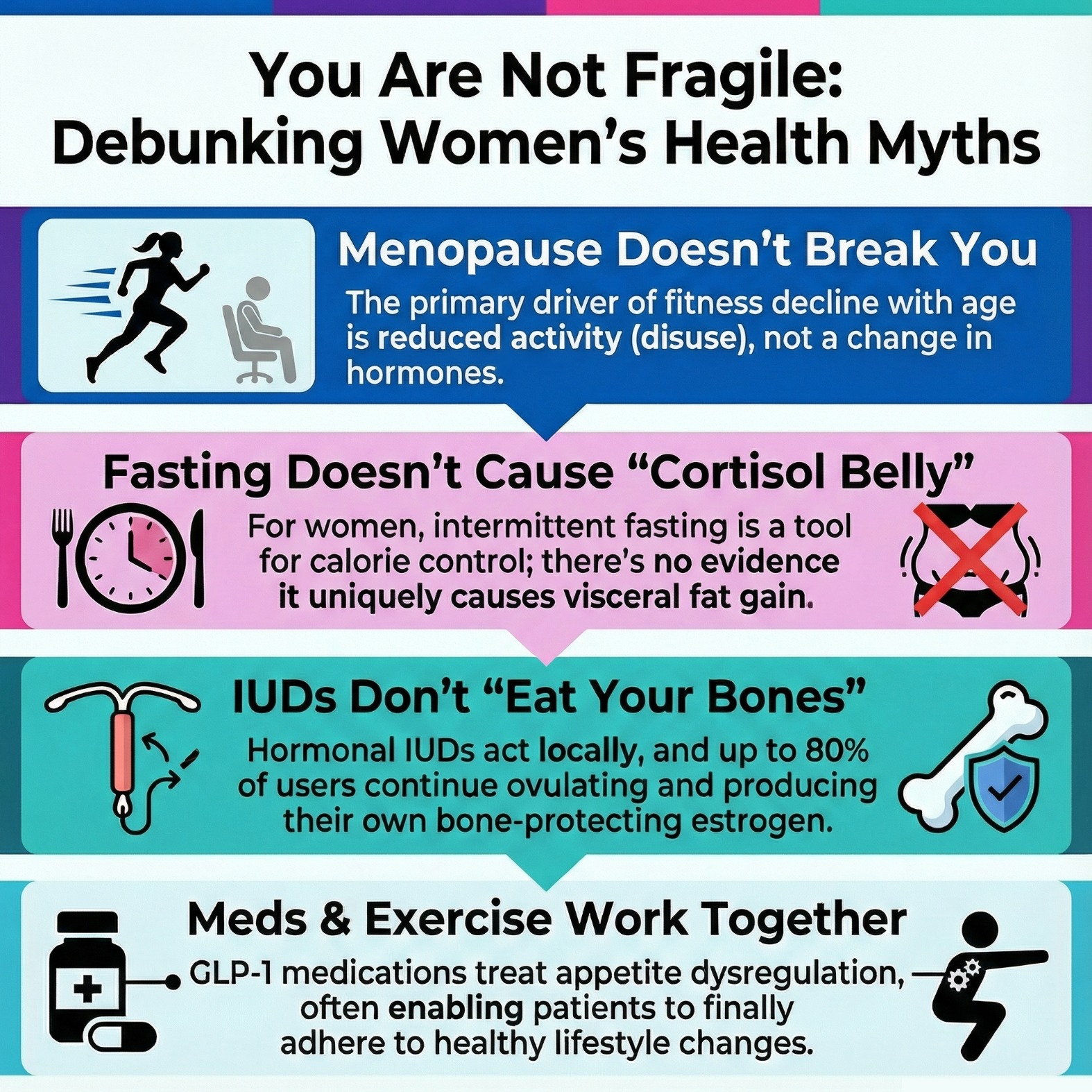
The wellness industry wants you to believe that menopause renders you fragile, fasting creates "cortisol belly," and birth control is silently destroying your skeletal health. These claims aren't just scientifically inaccurate; they act as "nocebo" barriers that scare women away from effective training and healthcare.We brought in the heavy artillery—Dr. Lauren Colenso-Semple, Dr. Loraine Baraki, and Dr. Spencer Nadolsky—to dissect the physiology behind these viral fears. Discover why your body remains resilient through hormonal transitions and why lifestyle or GLP-1s is a false dichotomy, Dr. Colenso-Semple: @drlaurencs1Dr. Loraine Baraki: @loraine_barbellmedicineDr. Spencer Nadolsky: @drnadolskyKey Learning PointsThe Menopause "Cliff" Myth: Menopause does not destroy your ability to recover or adapt to exercise.1 While aging may require programming adjustments, your muscles do not stop responding to tension and progressive overload simply because estrogen levels change.Cortisol Fear-mongering: There is no evidence that intermittent fasting or skipping breakfast causes pathological "cortisol belly" or visceral fat storage in women. Fasting is simply a tool for Calorie restriction, not a hormonal wrecking ball.IUDs & Bone Density: Levonorgestrel IUDs (hormonal) work primarily via local action on the uterus, not systemic suppression. Contrary to viral claims, they do not "eat your bones," and most users continue to ovulate and produce protective estrogen.The "Masking" Fallacy: Amenorrhea (lack of period) on an IUD is a known, harmless side effect of a thinned uterine lining. It is rarely "masking" a dangerous underlying condition like premature ovarian insufficiency.Birth Control & Performance: Population-level data shows that hormonal contraceptives do not clinically impair strength or athletic performance. While they increase SHBG and lower free testosterone, women are not "little men" dependent solely on testosterone for performance.GLP-1 Agonists (Ozempic/Mounjaro): Using medication to treat the appetite dysregulation of obesity is not "cheating." Muscle loss on these drugs is primarily a function of the Caloric deficit, not the drug itself, and can be mitigated with resistance training.Get More Value: Exclusive Content and ResourcesWant to support the show and get early, ad-free access to all episodes plus exclusive bonus content? Subscribe to Barbell Medicine Plus and get ad-free listening, product discounts, and more. Try it free for 30-days.Unsure which training plan is right for you? Take the free Barbell Medicine Template Quiz to be matched with the ideal program for your goals and experience level.For media, support, or general questions, please contact us at [email protected] Pearls & TakeawaysProgramming for Menopause: Stop treating menopause as a disability. Continue to lift heavy (RPE 6-9) and perform conditioning. If recovery lags, adjust volume (sets/reps) before blaming hormones.Protein Simplified: Ignore the complex "ideal body weight" math. Aim for ~1.6g/kg of total body weight, or simply add one extra serving of protein (like a shake) to your current daily intake.Medical Decisions: Do not remove an IUD or avoid birth control solely due to social media fear-mongering about bone density or "low T." These choices should be based on your contraceptive needs and symptom management (e.g., PCOS, endometriosis).Timestamps00:00 Intro: The "Fragile Female" Narrative01:00 Does Menopause Destroy Recovery?11:00 Muscle Fiber Types: Fact vs. Fiction24:00 Fasting, "Cortisol Belly," and Visceral Fat34:00 Protein Intake: Survival vs. Optimal41:40 Dr. Lorraine Baraki: Do IUDs Cause Bone Loss?50:00 Birth Control, Acne, and Athletic Performance59:00 Dr. Spencer Nadolsky: The Truth About GLP-1s & Muscle Loss01:05:00 Final Verdict: You Are Not FragileReferencesThomas, Ewan et al. “The effect of resistance training programs on lean body mass in postmenopausal and elderly women: a meta-analysis of observational studies.” Aging clinical and experimental research vol. 33,11 (2021): 2941-2952. doi:10.1007/s40520-021-01853-8 TWORoberts, Brandon M et al. “Sex Differences in Resistance Training: A Systematic Review and Meta-Analysis.” Journal of strength and conditioning research vol. 34,5 (2020): 1448-1460. doi:10.1519/JSC.0000000000003521Khalafi, Mousa et al. “The effects of exercise training on body composition in postmenopausal women: a systematic review and meta-analysis.” Frontiers in endocrinology vol. 14 1183765. 14 Jun. 2023, doi:10.3389/fendo.2023.1183765Staron, R S et al. “Fiber type composition of the vastus lateralis muscle of young men and women.” The journal of histochemistry and cytochemistry : official journal of the Histochemistry Society vol. 48,5 (2000): 623-9. doi:10.1177/002215540004800506 Hunter, Sandra K. “The Relevance of Sex Differences in Performance Fatigability.” Medicine and science in sports and exercise vol. 48,11 (2016): 2247-2256. doi:10.1249/MSS.0000000000000928Nuzzo, James L. “Narrative Review of Sex Differences in Muscle Strength, Endurance, Activation, Size, Fiber Type, and Strength Training Participation Rates, Preferences, Motivations, Injuries, and Neuromuscular Adaptations.” Journal of strength and conditioning research vol. 37,2 (2023): 494-536. doi:10.1519/JSC.0000000000004329Verdell, J. Tyler MD; Acker, Matthew MD. Does the LNG-IUD decrease BMD in adolescent females?. Evidence-Based Practice 23(4):p 10-11, April 2020. | DOI: 10.1097/EBP.0000000000000601Jäger, Ralf et al. “International Society of Sports Nutrition Position Stand: protein and exercise.” Journal of the International Society of Sports Nutrition vol. 14 20. 20 Jun. 2017, doi:10.1186/s12970-017-0177-8Tan, Yimei et al. “Effect of GLP-1 receptor agonists on bone mineral density, bone metabolism markers, and fracture risk in type 2 diabetes: a systematic review and meta-analysis.” Acta diabetologica vol. 62,5 (2025): 589-606. doi:10.1007/s00592-025-02468-5Our Sponsors:* Check out CovePure and use my code CovePure.com/bbm for a great deal: https://covepure.com* Check out FIGS and use my code FIGSRX for a great deal: https://wearfigs.com* Check out Factor and use my code factormeals.com/bbm50off for a great deal: https://www.factor75.com* Check out Quince and use my code quince.com/BBM for a great deal: https://www.quince.comAdvertising Inquiries: https://redcircle.com/brands
Embed this episode
NOW PLAYING
Episode 379: Menopause Myths, Cortisol Belly, & The Truth About IUDs
No transcript for this episode yet
Similar Episodes
No similar episodes found.
Similar Podcasts
No similar podcasts found.