
EPISODE · Oct 28, 2023 · 24 MIN
Episode 38: Insights into Human Rights and Democracy in Australia - Part 2
from The Australia Together Podcast · host Bronwyn Kelly
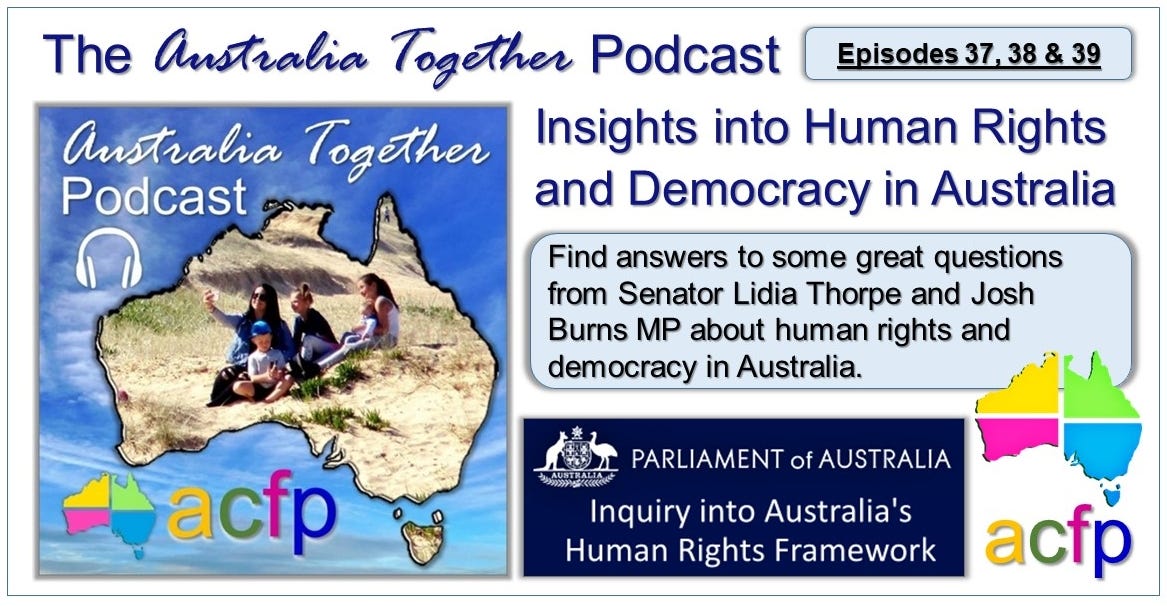
Introduction from Bronwyn Kelly:On 28 September 2023, representing Australian Community Futures Planning, I addressed the federal Parliamentary Joint Committee on Human Rights as a witness in its Inquiry into Australia’s Human Rights Framework. I made a case in support of a Human Rights Act but stated that the Constitution is a barrier to security of the human rights of Australians.After my appearance at the Inquiry, Indigenous independent Senator Lidia Thorpe asked me two Questions on Notice. They’re really great questions and the answers go to the heart of how we should understand: (a) the very limited form of democracy we have in Australia, (b) how that is impacting our human rights, and (c) what we can do to make the Constitution fit for a 21st century democracy – one where everyone has political equality and is secure in all the human rights they need. These answers have been published and are available on the federal parliamentary website at https://www.aph.gov.au/Parliamentary_Business/Committees/Joint/Human_Rights/HumanRightsFramework/Additional_DocumentsSenator Thorpe’s questions were: (1) Can you confirm your submission that unless a Bill or Charter of rights is constitutionally enshrined, there is no domestic legal way to hold the executive government accountable for passing laws that abuse human rights beyond the government of the day choosing how they are held accountable for breaches through [sic.]? and (2) What is the biggest danger in pursuing the weaker AHRC [Australian Human Rights Commission] proposal as opposed to the constitutional model?What’s in this Episode? In Episode 37 of this podcast series on I provided Part 1 of my answer to Senator Thorpe’s first question. In this Episode 38 I’m providing Part 2 of that answer. I’m also providing a more detailed answer to a question I received from the Chair of the Committee, Mr Josh Burns MP. He asked:"No member of the committee is a member of the executive but, in your submission and your opening statement, you talk about how a member of the committee would feel if a future executive were to make contrary decisions. I would put to you that absolutely they should have the right to; that any future government should have the right to completely disband any piece of legislation or make changes, as they see fit, and there shouldn't be a restriction on any future government making decisions as the government of the day. You speak about protecting the democratic rights of Australians, and to not have that would be a gross violation of the democratic rights of Australians, wouldn't it?" [My emphasis and Mr Burns’.]My answer to Mr Burns can be summarised as follows: he is describing autocratic rule, not democracy. Governments should not - and under Australia’s Constitution do not - have the power to “disband” any piece of legislation. That is the right of the parliament. Mr Burns’ rendering of “democracy” undermines the rightful balance of power that should pertain under the Constitution. Governments have been able to sideline the parliament and completely neuter the courts in their ability to protect Australians from abuses of human rights by governments. In this episode I explain how this idea of the supposed “absolute” power and rights of executive governments is fundamentally undemocratic and has opened the way for loss of human rights in Australia.I go on to make a suggestion about the type of constitutional reform we need to remedy the situation before Australians lose all access to their human rights in law. The mode of reform is not a Bill or Charter of Rights in the Constitution (partly beneficial though that may be). The necessary form of constitutional law on human rights is a National Agreement between all enfranchised Australians on Human Rights and Obligations. This is a different form of constitutional law to a charter or bill of rights. It is a much safer, fairer and just form of law on human rights in a democracy.Full transcript of this series on Insights into Human Rights and Democracy in Australia: Click here for a full transcript of Episodes 37, 38 and 39 on Insights into Human Rights and Democracy in Australia. Or find the transcript at the ACFP website at https://www.austcfp.com.au/supporting-activitiesFind the seven-step program of nation-wide community engagement and collaboration to build a Constitution fit for a 21st century democracy of political equals. This is a public episode. If you would like to discuss this with other subscribers or get access to bonus episodes, visit bronwynkelly.substack.com
Embed this episode
NOW PLAYING
Episode 38: Insights into Human Rights and Democracy in Australia - Part 2
No transcript for this episode yet
Similar Episodes
Jan 27, 2024 ·12m
Jan 19, 2024 ·9m
Jan 18, 2024 ·5m
Jan 14, 2024 ·6m
Jan 5, 2024 ·7m
Similar Podcasts
No similar podcasts found.