
Welcome to the Movement Movement, the podcast for people who want the truth about having a healthy, happy, strong body. Remember, your body was meant to move. Now here's your host, Stephen Sashin. What's the most important muscle group that you should work on and pay attention to if you want to run fast, efficiently, enjoyably?
Well, let's find out on today's episode of the Movement Movement, the podcast for people who want to know the truth about what it takes to have a happy, healthy, strong body starting with the feet first, because those things are your foundation, where we break down the propaganda, the mythology, and sometimes the outright lies that you've been told about what it takes to run, to walk, to hike, to dance, to play, to lift, to do whatever it is that you like to do, enjoyably and healthily and efficiently. I'm Stephen Sashin, the CEO of Zero Shoes dot com, your host for the Movement Movement podcast, and we call it the Movement Movement, because we here at Zero Shoes are creating a movement, trying to make natural movement the obvious, better, healthy choice, the way natural food currently is, and this is something that we don't do alone. We do with you. We are creating this movement together.
So thank you for being part of this, and if you want to help, you know what to do, just share and like and review and all those things. Go to jointhemovementmovement.com, jointhemovementmovement.com. You can find out all the ways you can interact with the podcast, find previous episodes, etc., etc., etc. So if you want to be part of the tribe, please subscribe.
Okay, let's jump in. This is going to be a kind of quickie, and given that Thanksgiving is upon us, you're going to really like the answer to what is the most important muscle group you can be working on, to run, to walk, to hike, etc., etc., better, faster, easier, more efficiently and more enjoyably. I'm going to tease it just a little bit and tell you that this is something that Usain Bolt's coach, Glenn Mills, said is what you saying from being a really good runner to being the world's fastest runner. And he spent about a year working on this particular muscle group.
Now think about it. You know, when you run, you use your glutes, you use your hamstrings, you use your quads, you use your calves. So which one do you think it is? That was a trick question, because it's none of the above.
The answer is the abs. Basically your core, everything from your nipples down to your other regions, if you will. And let me tell you a personal story about this. Some of you may know the story if you've heard how I got into natural running, natural movement.
I was on my second barefoot run ever. The first one I'd gotten a giant blister on the ball of my left foot, which was interesting to me because it was my left foot that got injured more often. My right foot was fine. So I was thinking, what was my right foot doing that my left foot wasn't doing?
Or more accurately, what was my left foot doing that my right foot wasn't? Because I figured if I could go on this second run and find a way to run that didn't hurt, in other words, I wasn't putting pressure on that gaping wound I had on my foot, then I probably wasn't doing the thing that caused the problem to begin with. I thought I'd give myself 10 minutes, just see what happened. And the first 9 minutes and 25, 28 seconds later was just sheer agony.
I was ready to stop and just try it again later. But then in a moment everything changed. And what changed first and foremost was I engaged my core. And we're going to talk about how to do that in just a second.
And the second thing is I changed my gate. I stopped doing something called over-striding. I stopped reaching out with my foot to have it lay on the way in front of my body. As a sprinter, I knew and I always ran on my toes, or not really my toes, but the ball of my foot.
But by over-striding, I was basically putting braking forces into the ground. So I'm adding all this horizontal friction into the ground every time my foot landed. And for some strange reason, my left foot did it and my right foot didn't. So I started paying attention to my right foot and my left foot kind of got along with the ride and then that went away.
And I stopped over-striding. I stopped pulling the ground underneath me and just lifting my foot off the ground instead. So I stopped applying all that pressure. But the thing that really changed, the thing that really made a difference was when I engaged my core muscles.
And there's more to your core than what you think it is. We'll again talk about that in just a sec. But that's the thing that really made everything feel light and fast and easy. The foot placement was what made it stop hurting.
But it was everything in between that's really what made the difference. So think about your core as not just the six-pack abs that you might see on other human beings. I got four of them tops. And think of your abs as just something that goes all around your entire waist.
So it's not just on the front, it's also on the side. It's also in the back kind of. That's your whole core. And what you want to do simply when you run is engage that.
So when you're running, what you want to be is an efficient tight spring. And if you're loose in your core, if you're collapsing every time you land, that's not an efficient tight spring and it's going to take more energy to work with that kind of spring than when you have one that's nice and taught. Now you don't want to go overboard here. You're not trying to tighten your abs like you're ready to get a baseball bat in the stomach.
But you want to come close actually. So what I want you to do the next time you're running. In fact, actually try this now. Just tighten your core as if someone is going to punch you lightly in the stomach.
See how that feels? Okay. Now let it go just a little bit. Loosen up a little bit.
You can still feel the engagement. That's the thing you want to do when you're running next. Try to really tighten it up so you can feel what that does. And then loosen it up just enough so that you know it's still engaged, but you're not putting in all that effort and all that extra tension.
Because frankly, you want to breathe into your stomach. When you breathe, you don't want it to be up in your chest. You want to engage your diaphragm, which means your diaphragm moves down, which means you're breathing fully into your abdomen, as it were. You're actually just breathing into your lungs, but your abdomen is extending because your diaphragm is pushing down on all of the contents.
And again, backing up to Thanksgiving, you'll have extra contents. So you might want to try this, you know, day after Thanksgiving, day after Thanksgiving. So if I say this thing, one, kind of tighten things up. Now the other thing to do, I don't even have to describe this.
So you have the transverse abdominis, which is the ab muscles that are really kind of going underneath into the side. They're going this way instead of this way, horizontal instead of vertical. And you really want to, boy, I know there's a cue for doing that. Oh, try sucking your stomach just a little bit.
Okay. And then without moving your stomach. So you want to keep it in the same place. Try to push out against your stomach.
So you're doing an isometric contraction. You're tightening, you're sucking it in a little and then try to push out without moving it. And what will happen because you're not moving, you should feel the side muscles, those transverse abdominis kicking in and you want to focus on those as well too. So when you tighten up everything, just think about kind of sucking it in a little, like you're bracing for an impact and then pushing out a little bit so that tightens up, you might even feel and you should even feel that in your lower back as well.
So you're getting this corset effect. It's holding your entire torso in place. And that's what you want to focus on as you run to make a nice tight spring. Again, don't go overboard.
You want to still be able to breathe, but you want to feel that engagement and see what that does to your running. Check it out. See what it does. So I just want to hear your comments, what you discover when you engage your abs.
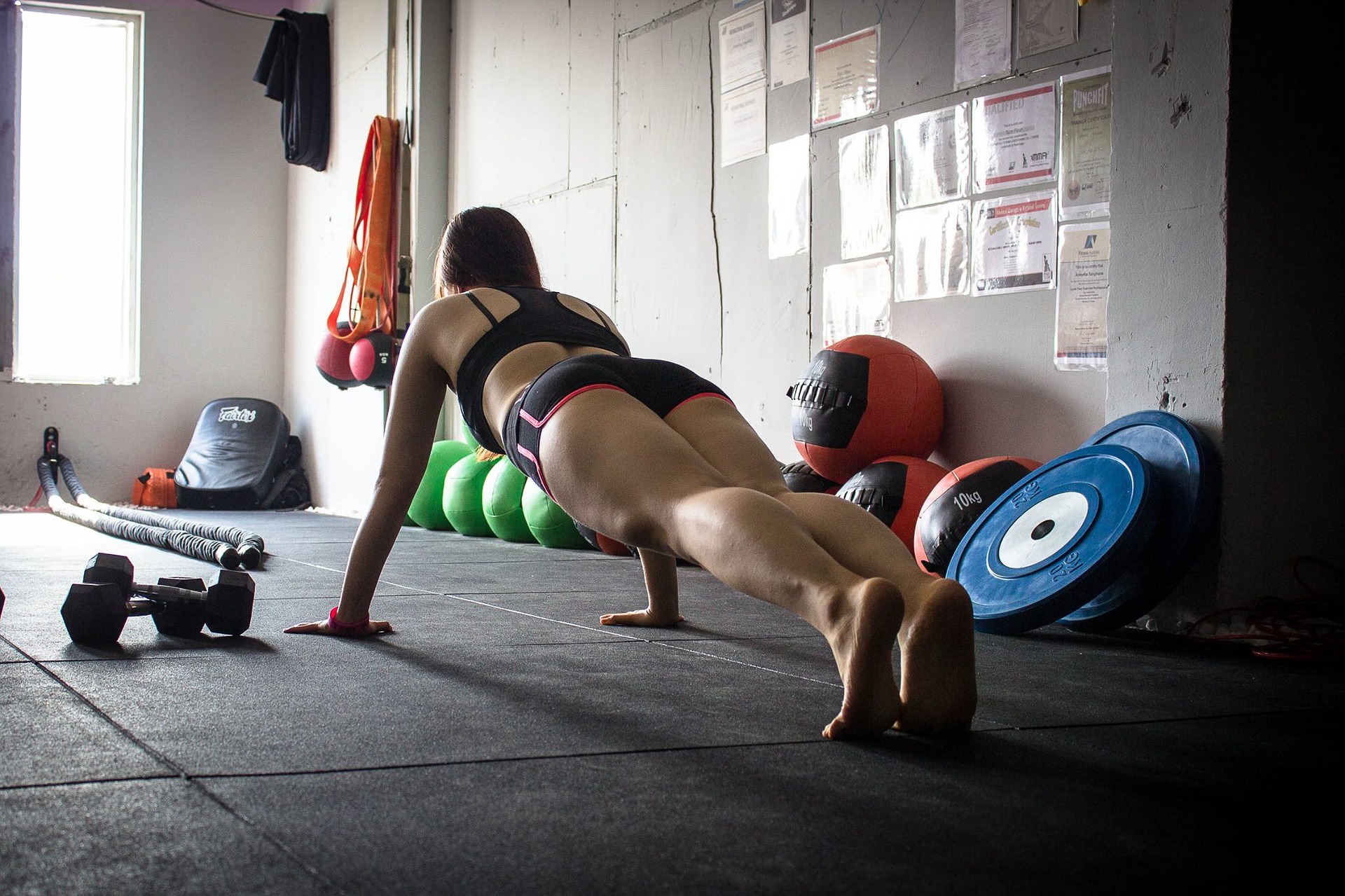
Now, if you want to, I'm going to add one other thing before we call it a day, if you want to do some other exercises to really feel what it's like to engage your abs, the classic exercise is the plank. Now, there's a couple different ways, a lot of different ways of doing planks. The simplest, if you're not really used to this at all, is just get down like you're going to do a push up. So your hands on the ground, your feet on the ground, your toes underneath, you know what a push up looks like.
I don't need to explain that. And then make sure you've got a nice flat back and then tighten up your abs and squeeze your butt together too. Squeeze your butt together. That sounds really wrong for reasons I can't even describe.
But you get the idea, squeeze your butt, squeeze your abs, again, tighten everything. Make sure you're nice and flat. You might want to get someone to take a picture of you doing this because most people when they hear flat, their butts are still up in the air pretty much. So just take a look and see what that looks like.
Then if you're more advanced than that, instead of being on your hands, you can get on your elbows, put your elbows on your shoulders. If you want an even more advanced plank, move your elbows about six inches in front of your shoulders. And then again, really tighten up everything from your nipples down to your nether regions. I have never used the word nether regions before, by the way.
And I think you know what I'm talking about. And then you can also use side planks. So this is where you're just literally perpendicular. You're facing the wall and you're totally facing the wall.
You've got one elbow on the ground or one hand on the ground, depending on how strong you are and your feet stacked, one on top of each other. And just again, make sure someone takes a picture so you can see that you're a nice straight line as you do planks on both sides. Now the idea really in doing a plank is not that you're going to get a whole lot stronger by doing them for running. You know, it can help.
But the real reason for doing it in this situation is just to feel what it's like to engage all those muscles around this core set, your core set. And ooh, I haven't thought of that before. I had to use core set from now on core set. So you want to just feel what it's like to engage those muscles and then when you go out for a run, try it, engage them, see what changes in your running, and then loosen it up a little bit so you're not, you know, too tense and see how that works.
All right. That's the lesson, if you will, for today. I really, really want to hear what you discover. As always, thank you for being part of the movement and helping people understand that natural movement is the better, obvious, healthy choice way.
Natural food currently is. If you want to be part of the tribe, please subscribe. Go to www.jointhemovement.com to find out all the ways you can interact with podcasts, find out where you can like it and share it. And if you're on YouTube, hit the bell so you hear about upcoming episodes which typically happen once a week and subscribe and share and review and all those things you know how to do with podcasts that you enjoy.
If you have any questions, feel free to drop me an email. Move at jointhemovementmovement.com. Hey, there's anyone you think should be on the show, drop me an email so I can get in touch with them. Happy to do that.
We have some very fun new guests coming on in the next couple of weeks that are people that I got introduced to from people like you. And let's see what else I'm going to say. That kind of covers it for now. So I hope you're having a great Thanksgiving.
I know this is plus or minus Thanksgiving depending on when you're listening to this. Actually, it could be way after Thanksgiving because that's the way podcasts work. Suffice it to say I'm recording it and releasing it right around Thanksgiving. That's the important part of why I'm saying that.
Oh, and a quick plug if you are getting this during the Thanksgiving time at zero shoes, we're having a 10 to 70% off sale. It's our black cyber thanks, Quonsimus, the Satterversary Warehouse Clearance and Terra for Leaf Sale. I won't tell you more than that. You can find out more if you go to zero shoes.
That's xeroshoes.com slash sale. And you can see how you can save up to 70% biggest sale we've ever had for our 10th anniversary, Black Friday, Cyber Monday, Small Business Satter Day Thanksgiving, Chris, Miss, Monica, Quonsa, Festivus for the rest of us warehouse clearance. We need to make room for new stuff and Terra for Leaf Sale. We paid a lot of money in Terrace that we didn't expect to have to pay and we might have to pay more so we're trying to bring the cash to be able to handle that so we don't have to pass on all of the increases in prices to you.
I guess I just explained most of it, but still go to zero shoes.com slash sale to find out all the details. Anyway, that's it for now. Have a wonderful, wonderful time. Have a good day.
Have a great run. Let me hear how it goes. And of course, live life, feet first. You've been listening to the Movement Movement Podcast with host Stephen Sashan.
Remember to join the tribe and subscribe at jointhemovementmovement.com.