
EPISODE · Jan 7, 2026 · 4 MIN
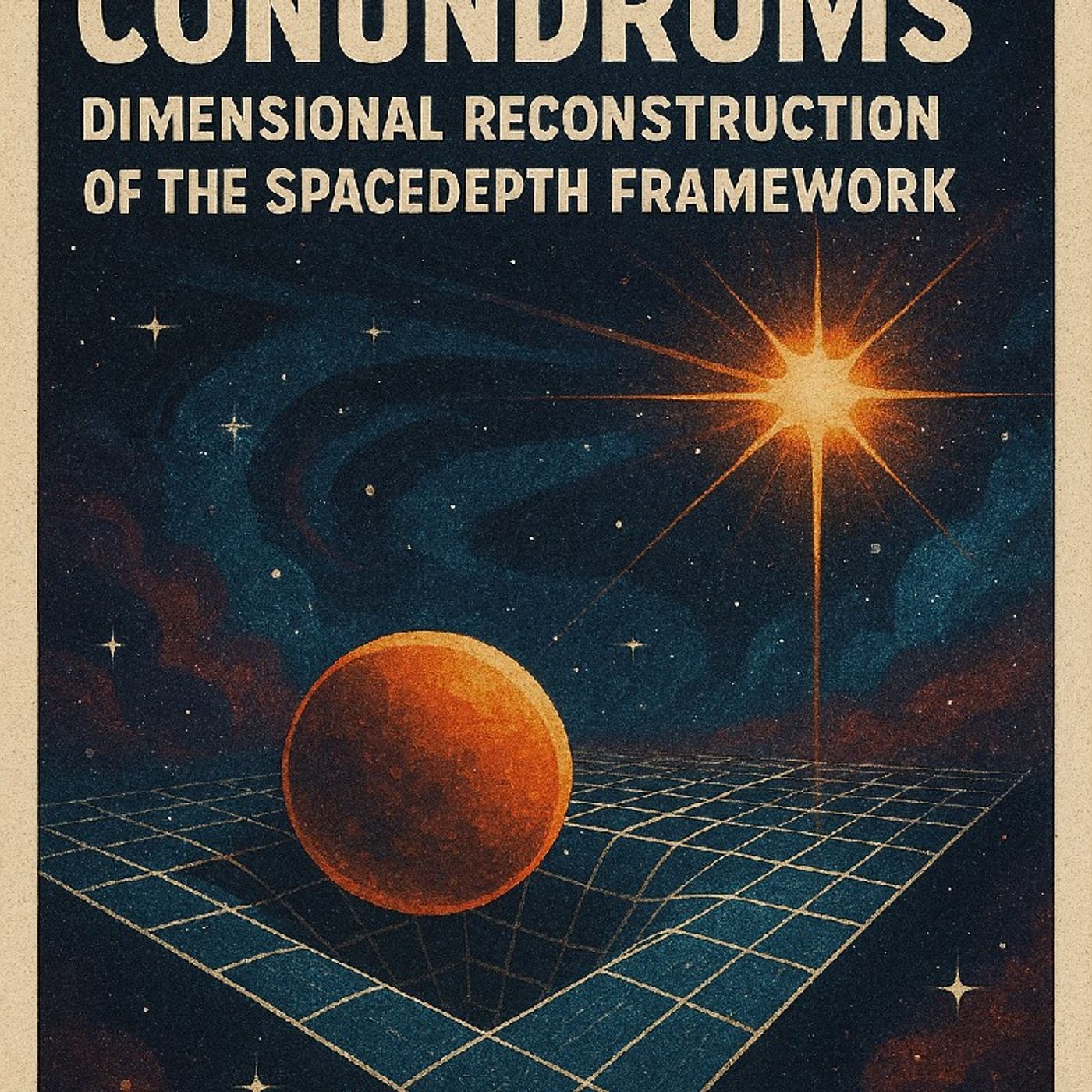
Episode 399 - Cosmic Conundrums
from Kevin McFarlane's podcast · host Kevin McFarlane
The contemporary landscape of theoretical physics is currently defined by a profound and persistent tension between the macroscopic certainty of general relativity and the probabilistic complexity of quantum mechanics. As observations from deep-space probes and high-resolution solar observatories reveal anomalies that resist explanation within the standard four-dimensional Minkowski spacetime, the necessity for a more expansive dimensional framework becomes increasingly evident. The 'spacedepth' theoretical framework, as articulated in foundational proposals, posits a radical restructuring of reality's dimensionality by substituting the temporal dimension t with a spatial-like coordinate designated as "depth" \lambda. This transformation shifts the four-dimensional manifold from a Lorentzian spacetime to a geometric spacedepth structure, intended to resolve pervasive inconsistencies in physics while integrating concepts of information and resonance into the foundational architecture of the universe. The core of this paradigm shift lies in the recognition that time, as traditionally measured through Earth-centric cycles, is a humancentric measurement that may not fit outside of the terrestrial environment. Within this context, the spacedepth model emerges as an extension of contemporary physics, suggesting that inconsistencies are not structural errors in physical laws but manifestations of a fundamental "dimensional blindness". This report provides an exhaustive analysis of the spacedepth model, focusing on the emergence of time from entropic and quantum structures, the reinterpretation of dark matter as a manifestation of the depth dimension, and the role of stellar source energy in shaping local manifold properties.
Embed this episode
NOW PLAYING
Episode 399 - Cosmic Conundrums
No transcript for this episode yet
Similar Episodes
No similar episodes found.
Similar Podcasts
No similar podcasts found.