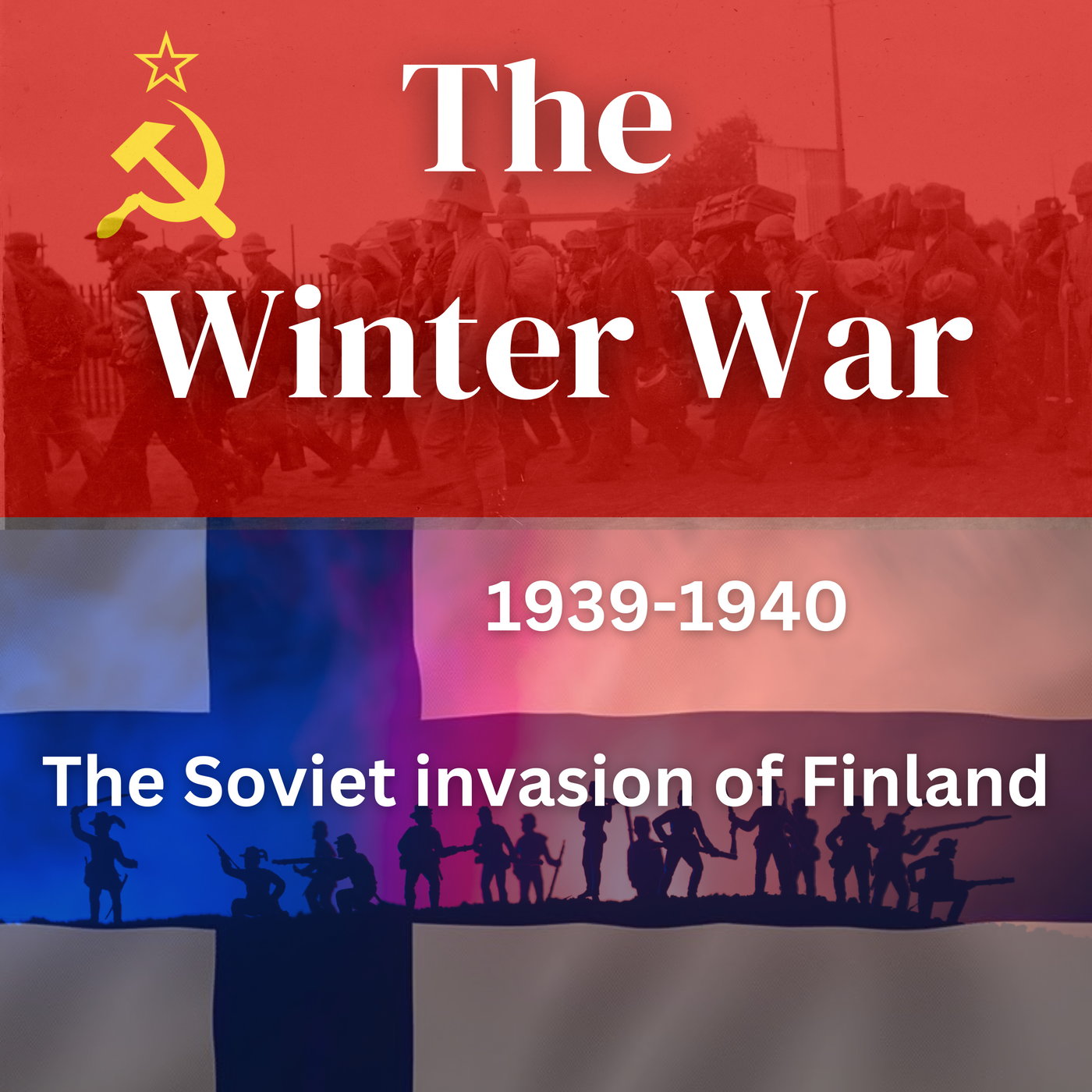
Episode 4 - Kollaa Still Stands and the snorting armoured train Hyöky goes to work episode artwork

EPISODE · Dec 14, 2023 · 27 MIN

Episode 4 - Kollaa Still Stands and the snorting armoured train Hyöky goes to work

from The Winter War · host Desmond Latham

The Russians have invaded on a broad front, stretching from the Karelia Isthmus all the war to the Arctic Sea, ten major incursions in all. When the Soviets attacked on November 30th, they did so without declaring war — they just rolled in. As you heard last episode, by day two of the Soviet invasion, December 2nd 1939 the Finns were facing the might of the Red Army and the prognosis was not good. But they had a chance to carry out Finnish General Gustaf Mannerheim’s master plan, allowing the Russians to invade, then striking them behind their lines. There wasn’t much else the Finnish Army could do, it was hopelessly outgunned and outmanned. However, within 48 hours of the invasion, however, the Russian mechanised columns had bunched up, their lines of supply jammed bumper to bumper. Heavy snowstorms were also lashing the advancing columns adding to the chaos. The token Finnish resistance also caused some of the Russian commanders pause, stopping when a single sniper opened fire, or a defensive position was spotted in the distance. Mannerheim wanted to throw his covering groups of 21 000 troops along the Isthmus forward of the defensive line, but his chief of staff General Hugo Ostermann thought this was a mistake. They were covering a string of villages here like, Uusikirkko, Kivinapa, Lipola, Kiviniemi and each day the remained behind these fortifications, was a day spent improving the defences, digging deeper, laying mines, blowing up bridges. The Soviet military leaders believed that a decisive strike across the Karelian Isthmus would be the key to victory. The Soviet Seventh Army was based south of this Isthmus, 120 000 infantry, 1 400 tanks and 1500 artillery pieces, all backed up by over 1000 planes of various sorts. The Finns along the Isthmus were led by lieutenant General Hugo Osterman who had 26 000 infantry, and 71 artillery pieces. The army was split with Two Army corps led by lieutenant General Harald Ohquist on the west side of the Isthmus and Three Army Corps on the east, led by Major General Erik Heinrichs. Another division of Finns was behind the covering groups, being held back in reserve near the lakes Suulajarvi and Valkjarvi. On the eastern side of the Isthmus, III Army Corps was made up of Task Force Rautu and the 11th Division Task Force Lipola — named after the villages there. A change began to take place in the Finnish consciousness, and this was going to be very bad news for the Russian soldiers. The first few days of fighting had actually given the Finns a good idea about some of the Russians weaknesses — their slow witted officer class, fearful of their political commissars, unimaginative and ponderous. The Finnish fox was outthinking the Russian bear. Stories began to circulate amongst the troops about how abysmally the Russians were fighting, despite their vast army, and this stiffened resolve. Sometimes morale is more important than ammunition. Desmond Latham blog

The Russians have invaded on a broad front, stretching from the Karelia Isthmus all the war to the Arctic Sea, ten major incursions in all. When the Soviets attacked on November 30th, they did so without declaring war — they just rolled in. As you heard last episode, by day two of the Soviet invasion, December 2nd 1939 the Finns were facing the might of the Red Army and the prognosis was not good. But they had a chance to carry out Finnish General Gustaf Mannerheim’s master plan, allowing the Russians to invade, then striking them behind their lines. There wasn’t much else the Finnish Army could do, it was hopelessly outgunned and outmanned. However, within 48 hours of the invasion, however, the Russian mechanised columns had bunched up, their lines of supply jammed bumper to bumper. Heavy snowstorms were also lashing the advancing columns adding to the chaos. The token Finnish resistance also caused some of the Russian commanders pause, stopping when a single sniper opened fire, or a defensive position was spotted in the distance. Mannerheim wanted to throw his covering groups of 21 000 troops along the Isthmus forward of the defensive line, but his chief of staff General Hugo Ostermann thought this was a mistake. They were covering a string of villages here like, Uusikirkko, Kivinapa, Lipola, Kiviniemi and each day the remained behind these fortifications, was a day spent improving the defences, digging deeper, laying mines, blowing up bridges. The Soviet military leaders believed that a decisive strike across the Karelian Isthmus would be the key to victory. The Soviet Seventh Army was based south of this Isthmus, 120 000 infantry, 1 400 tanks and 1500 artillery pieces, all backed up by over 1000 planes of various sorts. The Finns along the Isthmus were led by lieutenant General Hugo Osterman who had 26 000 infantry, and 71 artillery pieces. The army was split with Two Army corps led by lieutenant General Harald Ohquist on the west side of the Isthmus and Three Army Corps on the east, led by Major General Erik Heinrichs. Another division of Finns was behind the covering groups, being held back in reserve near the lakes Suulajarvi and Valkjarvi. On the eastern side of the Isthmus, III Army Corps was made up of Task Force Rautu and the 11th Division Task Force Lipola — named after the villages there. A change began to take place in the Finnish consciousness, and this was going to be very bad news for the Russian soldiers. The first few days of fighting had actually given the Finns a good idea about some of the Russians weaknesses — their slow witted officer class, fearful of their political commissars, unimaginative and ponderous. The Finnish fox was outthinking the Russian bear. Stories began to circulate amongst the troops about how abysmally the Russians were fighting, despite their vast army, and this stiffened resolve. Sometimes morale is more important than ammunition.

NOW PLAYING

Episode 4 - Kollaa Still Stands and the snorting armoured train Hyöky goes to work

0:00 27:05

No transcript for this episode yet

We transcribe on demand. Request one and we'll notify you when it's ready — usually under 10 minutes.

Frequently Asked Questions

How long is this episode of The Winter War?

This episode is 27 minutes long.

When was this The Winter War episode published?

This episode was published on December 14, 2023.

What is this episode about?

The Russians have invaded on a broad front, stretching from the Karelia Isthmus all the war to the Arctic Sea, ten major incursions in all. When the Soviets attacked on November 30th, they did so without declaring war — they just rolled in. As you...

Can I download this The Winter War episode?

Yes, you can download this episode by clicking the download button on the episode player, or subscribe to the podcast in your preferred podcast app for automatic downloads.
URL copied to clipboard!