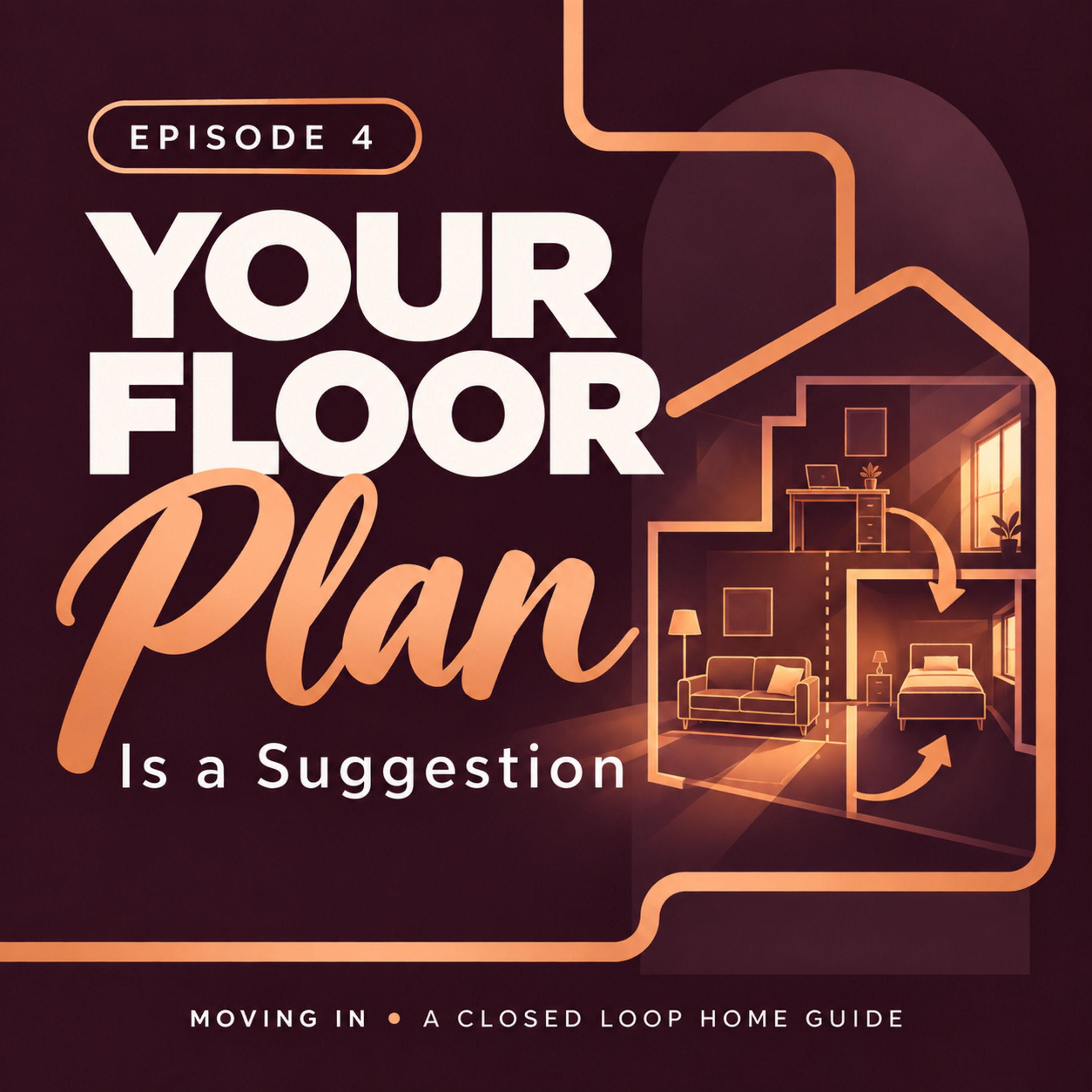
Episode 4 — Your Floor Plan Is a Suggestion
from MOVING IN: A Closed Loop Home Guide Hosted by Crystal Bright
The floor plan says dining room. But what if you never eat there? It says guest room. But what if guests visit three nights a year and you need a workspace every day? In this episode of Moving In: A Closed Loop Home Guide, we stop treating room labels like instructions and ask a more useful question: What does our life need this space to do? Room names are helpful shorthand. They do not know where the afternoon light is unbearable, which room is quiet enough for work, where your child naturally does homework, or which “secondary” room becomes the place everyone actually wants to be. That information comes from living. In the Closed Loop Home framework, repeated behavior is design data. Where you naturally sit matters. Which room you keep returning to matters. Which spaces you avoid matter. Where work migrates, where projects spread out, and where your body wants to rest are all clues about what the home is being asked to support. So instead of asking, “What is this room supposed to be?” we ask, “What needs to happen here?” Maybe your dining room really is the perfect dining room. Keep it. The goal is not to make your home unconventional. The goal is to make it accurate. But if the dining table mostly collects things while you work at an uncomfortable kitchen counter, notice that. If the guest room stays empty most of the year while your hobbies are packed away after every use, notice that too. We’ll also talk about giving rooms a primary job and a secondary job when one space has to support several parts of life. A dining room might function mostly as a project space while still hosting meals. A guest room might support work every day and visitors when they actually arrive. And furniture placement gets easier once you start with the activity instead of the object. Rather than asking, “Where does the sofa look best?” ask, “What is going to happen here most often?” If the room is for conversation, support conversation. If it is for movies, think about sightlines. If it is for work, think about light, power, storage, distractions, and how the workday ends. If it is for rest, pay attention to what actually helps the people using it settle. Because you are newly moved in, you also have permission to test. The sofa can move. The office can change rooms. A layout can work for a week and then be revised. The first arrangement does not have to become the final answer. In this episode, you’ll do a simple exercise: temporarily remove the inherited room labels and replace them with the functions your household actually needs. Instead of dining room, you might write: shared table, homework, projects, hosting. Instead of guest room: work, quiet, exercise, occasional guests. Instead of living room: rest, conversation, movies, play. Then ask which room actually supports those functions best. Think about light, noise, privacy, temperature, power, storage, proximity to other routines, how often the activity happens, and who else shares the space. The answer may match the original floor plan—or it may not. Either way, you are making the decision with better information. Listen while you move furniture, debate room assignments, or realize that the room everyone told you was supposed to be important is not actually the one you want to live in. Moving In is based on the Closed Loop Home framework created by interior designer Crystal Bright. The Closed Loop Home releases October 31st and goes deeper into open loops, the Closed Loop Code, the 20% House, point-of-need support, Activity Storage, and the full framework behind designing a home around the life that actually happens inside it. Follow @theclosedloophome on Instagram, TikTok, and YouTube, and follow or subscribe wherever you listen. In the next episode: we follow one of the most important paths in the whole house—your first morning—and start designing from waking up to getting out the door.
Embed this episode
No transcript yet.