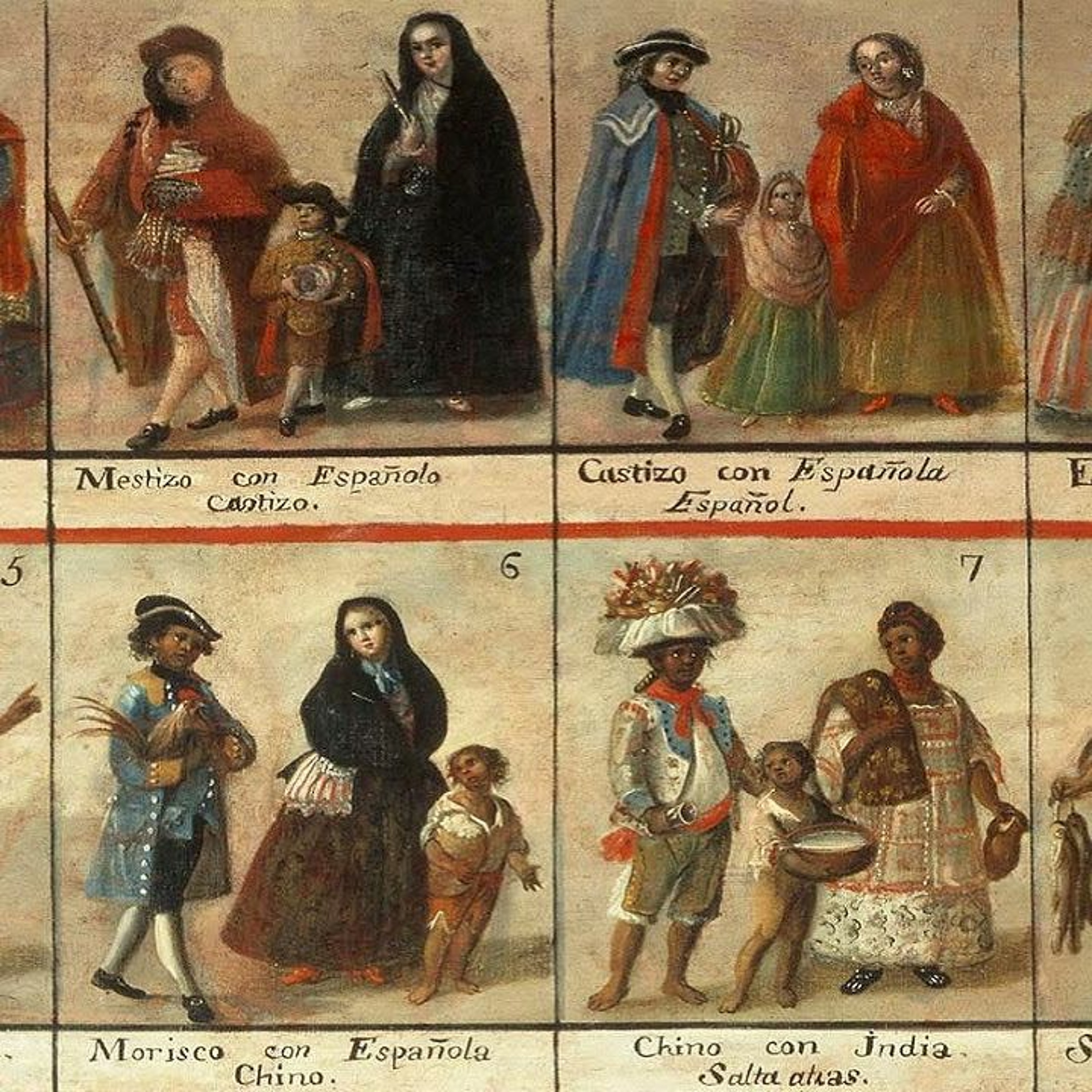
During the Spanish colonial period in the 1700s, the Spanish were very interested in pigeonholing people according to their racial background. This is Susan Vogel. And the Spanish in Spain were fascinated about all the different racial combinations in New Spain. New Spain was what the Spanish were calling Mexico at the time.
So they commissioned artists in the New World to create these costa paintings. Often these consisted of 16 separate paintings depicting 16 different racial combinations and the offspring that they produced. The most well-known said are these, and these are by Miguel Cabraera, who was an artist from Oaxaca, considered one of the greatest painters of New Spain. He was commissioned to create religious artwork by the Catholic Church and the social elite.
He painted these large scrolls. Some of them are life-sized. They were intended to be a manual to explain to people their racial hierarchy and social ranking. They had a caste system, so it was a hierarchy of where you stood socially, politically, economically, job-wise, everything.
And it went from the very highest, of course, where the people born in Spain. And then it went down from there. And it got really awful below where you went. Here's Luis Lopez.
As Susan mentioned, so if you were Spanish from Spain, you have the top spot from there. You could have a mix with the identified as a gusty soul. But typically, I believe if you went, there really isn't a way to go up the chart. I believe if you have a gusty soul, which is like a gusty soul, a Spanish mix, you can kind of get back to whiteness, if you will.
But anything lower down that chart, there's nothing you can do. And so it's extremely unfortunate, but based on the color of your skin and what they identified as racial mixes, predetermined what your life was going to be. And yeah, society was based off of the system and we still see it today in the sense of how racism plays out, even in this country as well. I'm Ross Chambliss.
This is Nueva's Vosius, part six. And in this episode, we're talking about how Mexican art reveals much of the racist legacy left behind by the Spanish. During the colonial period, the conversion of Mesoamericans to Catholicism also played a role in the caste system. Pope Paul III, in a 1537, promulgated a document that stated that the Indians were to were rational beings and should be brought peacefully to the faith.
So one thing that happens in Mexico is that rather than decimating, just wiping out the native populations which had happened in other areas, the conquerors were told to allow people to be baptized people and they allowed them to participate in society. So some people feel that that was a wonderful thing because it gave people a role, albeit a very low one, which we'll see in the cost of paintings. But when I've interviewed people, one of the diplomats I interviewed said that was a huge huge factor in shaping Mexico's history as a country of misdicos and as a country where everybody can participate in the society. But indigenous peoples didn't just want to go along with European domination and their biblical stories about Christ and the Virgin Mary.
A new story needed to be told to bring the native peoples along. After the conquest, there were enough rebellions that the Aztecs didn't stay quiet. There was a war. The Church, I guess, the Catholic Church, the Confistors, they were worried that they would convince this.
So they, with the respect of the Catholic people, they created this story that this woman had appeared to this Indian and this woman represented Virgin Mary. When the Indian, Juan Diego went back to the Church and explained to the priests what he had seen. It was a revelation of the true Church to manifest to the Indians. Up until then, the Virgin Mary appeared in old European paintings as a white, finely featured woman.
But the Virgin Mary that supposedly appeared in Mexico City looked like a native woman. Stark's skin, indigenous features, the elements of her outfits are all based on the cosmovision. The moon, the sun, the stars, everything. Cosmovision, of course, was the world view of the Aztecs held before Christianity was imposed on them.
So she was named Guadalupe. Nowadays, the version of Guadalupe is the most honored figure in Mexico. In Mexico City, we have a specific cathedral for her and millions, millions of people, pilgrims come to see this image every year. And what is surprisingly is that the majority of the pilgrims are indigenous people.
So when you think of how the Aztecs had everything taken away from them, the world view was squashed, their gods were defeated. They had this need to embrace to something. And this image was created and they embraced on this tonad scene. Tonad scene was the name of the Aztec mother Earth God from before.
Now Colby, the region of Guadalupe and they embraced on that. That's her mother, she's taking care of us. I mean if Catholicism is true, well, there is Virgin Mary appearing in the skin color, which is her color. Growing up in Catholic households, this definitely resonates with me.
To me, everything from the color of her outfit, the green is how we see everything in Guadalupe. To me right away, I connect that to the feathered serpents around Guathique, that green serpent full of its own feathers. And so even if the name is different, even if the ideology is different, you're going to recognize your mom when you see her. And so I think the Catholic Church was extremely smart.
And whether they didn't speak Spanish or not, they recognize their mother. And so I've got them to submit, if you will, and give it a little, if our mom is telling us that this is the way, then let's go ahead like she knows best. The art of the colonial era was all about teaching people Catholicism. And the Spanish had the indigenous craftsmen and artists take their materials like feathers and mother of pearl and use these in Catholic art.
So we see a lot of indigenous materials and that designs and patterns being transferred into Catholic art. And what was, and so there's this heavy, heavy influence and effort to get people to be loyal Catholics, religious Catholics. And also to stay within the bounds of their class system, the class system. That was extremely rigid.
So we see the cost of paintings, we see the religious art, and it's to keep people in their places. For what purpose? Basically this is fueling a huge, huge trade war in Europe. So thanks to the Americas, Europe was able to succeed Asia as the biggest trade partner in the world.
Thanks to all of these people who are active, who are faithful Catholics now and are performing in this basically what's called the incommendous system, where they are at serfs and they are producing products and mining and all these things for the Spanish. All these raw materials are going to Europe and Europe has now become the biggest trade source in the world. So this is a huge, huge economic project. Another image that touches the raw nerves of race relations in Mexico and Latin America is El Sopricio de Quotomo, painted in 1893.
Is really, really big. And it was painted for the Universal Columbus exhibition held in Chicago in 1893, celebrating 400 years since Columbus came to the Americas. So it's based on the torture of Quatémoc and his cousin by the Spanish. This painting is about 10 feet wide by 8 feet tall and it was painted as part of the celebration of Spanish dominance of the Americas.
And what would that be like in 1893? People looking at this painting in 1893. It seems very political, but I think it might have appealed to a sense at the time of intrigue about native topics. So I will ask you guys what it means to you when you see this.
Anger? Just because I guess I mentioned before both of these cultures are part of who I am and so there's that side of me that's like they're burning the feet of an indigenous person. For what reason? I just don't see that kind of torture being necessary in any way.
It's kind of a hard image to see just because I can't imagine the pain. I mean, there's a flame right up to his feet, like runner and his cousin. And this is the king. And so another thing that comes to mind, I know typically people think when the Spanish came, they completely took over these civilizations.
There's already preexisting hierarchies, so all they have to do is control the king and control the rest of the system. And so that's something else that comes to mind is that's actually what they're doing. We're breaking down the king to take over. Something really important that I find really amazing in this painting is the artist was able to produce communication through the eyes.
I actually read an article about this. When you look at the painting, look at the eyes of every character in the paint. Quote, the way he's looking at Cortes, he's not giving up. The eyes of the cousin of quote, the city on the right side, really asking quote, the stomach, just tell them.
Just tell them so they don't kill you. But quote, the stomach is challenging. The way he's looking at everyone here, he's challenging. And he said, and he's actually said that I, if you think that by doing that, I'm giving up the last part because he was the last emperor.
The last part of what it meant to give up his kingdom, his empire is not going to happen. And everybody else in the room is looking at him with a surprise face of what is wrong with this guy that is not even acting to the fact that we're burning his feet. I find that extremely powerful. Something else that I found powerful in this painting is the features of Guiltemol and his cousin.
His skin is not dark. It's almost white. And this was something that was predominant during the art of colonialism. European artists were making sure that they will paint indigenous people with fun features because they considered indigenous people unattractive.
So the image that they wanted to send to Europe is that they are really nice people and we're going to make it look a little bit more attractive. And we fall into this aspect of racism and not recognizing who we are. This is something that we are faced still on in Latin America. The darker you are, the less opportunities you have, the more indigenous features you have.
You know, you're not very attractive. And this is our reality. So these factors I find very interesting in this painting. In the Costa paintings, the people who are the darkest, the children of the people who are the darkest are actually called animals.
They're called Lobos. Some of them are going back, jumping backward. So it's pretty horrendous. Earlier we talked about the caste system and sort of the established hierarchy of people in that society imposed by the Spanish.
How much to what degree does those ideas persist now in Mexican culture? Oh, they're very much alive. For example, these ideas have been internalized. And you'll hear things like, for example, growing up someone with the Othina Scott of the Indio.
You have the face of an Indian, and that's supposed to be an insult. Or in the Bala Nafan, you have the cactus on your forehead. That's how we can tell how Mexican indigenous you are. And so that's meant to hurt.
I know for me personally, we've reclaimed those things. Yeah, my family's from Sacatecas, Mexico. We eat lots of cactus. It started as survival.
Now it's a tradition. And my son's middle name is N'Happalcy, which is little cactus. And so we've taken that term that was meant to be offensive, and we've reclaimed it. But at its root, it comes from this caste system, this idea of the more indigenous you look the darker you look, the less value you have in society.
There was an ad recently, I think maybe when Luis was without this, there was an ad for Idaho-Mexico, for flight attendants. And it said something like, Blanco, Como de Polanco. So it was basically, it was saying that they wanted to hire people who were white and were like from the fancy neighborhood of Mexico City. I can just give you an example.
In my own family, my grandfather was probably about a quarter Indian Aztec. And my grandfather, you could even see it more, darker skin, his features. My grandfather married to a very blonde, blue-eyed woman. And my mother's family is mostly European.
There is no trace of indigenous background. I grew up in a family with both sides. My grandfather was a native, indigenous, and now it's a language, although it was prohibited for him to speak the language, and he was little. On my mother's side, everybody looks white, light skin, eye-colored.
When I was dating a guy from Oaxaca, my mom's family was very concerned. They said, we have to improve the race. When I started dating my husband, it was an opportunity. It was a great thing that I was marrying a gringo and a American.
And it was really strong. I lived with my own family. In my own family, 450 years later. Wow.
So, help me understand that. So the idea that you are marrying a white person is somehow advancing you, advancing the family. I have very attracted children. Because they don't look like me.
They look more like they're that. I have been called to be the babysitter of my children. So you see that. What is the mental model that we establish here as in terms of ethnicities and race?
I really dislike the word race. When we think about race, we are one human race. One, that's it. We are different ethnicities.
But it's one race. There's not such a thing. And we have taken the political right to use the word race to establish these powerful distinctions in terms of economics and politics and social disabilities or abilities. And this is very real in Mexico.
And I would say most in Latin America. I think that's what I actually heard someone say a few weeks ago about my own own race. It really gets me going because they've internalized this so patriot sometimes for themselves. But that idea of improving the race ties directly to the caste system because they're moving back up that chart.
And the more white you have in your family, the higher up you can go and improve your condition, improve your quality of life. It's kind of how they've internalized that. Let me just stop the tape for a second. Let me tell you that I had no idea that our discussion of these paintings from centuries ago would cause such a visceral emotional response from everybody.
I had no idea how much these racist European introduced ideas of white supremacy that are embodied in these paintings still linger in our modern world and afflict people of Mexican descent today. Okay. I just needed to say that back to the discussion. And you can look at the television.
You can look at the ads in magazines in Mexico. You can look at movies and most of the high class, most of the people, the main characters are going to be look just like me. White, blonde hair, you look very European. And then in often the people that are household health or gardeners are going to be indigenous.
And there's all kinds of characters that come with them and not very intelligent and doing silly things. It's very ingrained in society in Mexico. I would argue even here as well. Yeah.
My experience I grew up in the California Public School System moved to Utah for my senior year and growing up I would hear things like, oh, you could be a construction worker. Well, if you work hard, you can own your own landscape company. And it's like, that's not really helping me. If anything, you're just kind of reinforcing the idea that my brownest mind degeneration is only good for physical labor.
Right? And so earlier especially for high school, I did take those labor jobs to get by, but that's especially why I think education is so important. In my family, we pushed so hard for it. We've never really had access to it.
I'm first generation college, graduate, first generation to work in office environment, right? Most of my family has worked labor their whole lives. And although I lived my way to work with myself, I said, oh, we've worked the land. So I definitely still connect myself to the land and I still have pride in knowing how to work it and how to work with my ease and make my own ideas at home and things like that.
But yeah, we constantly fight to break these stereotypes that exist today. I think for me as an immigrant, in terms of this class society, I came here because I married a white American. So because I came as an immigrant and not to diminish that idea, but I have been said, did you marry the people of the papers? Did you are Mexican?
You look different. You act different than those all those Mexicans. I have been asked by people, how do you know all this stuff? Is there universities in Mexico?
Do you have to be confronted just because the way you look based on these charts? Is it really an opportunity or did you take advantage of it or how did you make it there? And these are questions you're getting from here, from people of the predominant. Even from Mexicans, even from everybody.
I'm unfortunately going to be going back to Mexico on December to visit my family. My cousin of mine is getting married. Shout out to Bernardo. We'll see you in December.
But even back home, I call it home still. Luis works in high-end. Ooh, and you'll get something, oh, you think you're better off now. You think you're better than us.
It's my family. These are my three most of my first cousins who sometimes will still critique me based off of these systems. And where they see themselves on this chart as well. I think one of the things we all face here in the US, if my daughter is half Mexican, is raising our kids to be proud to be Mejicana and to identify.
And it's a real struggle. It's not going to happen naturally. I mean, I had to work really hard to make my daughter proud to be Mejicana. Because she can pass.
Sometimes she looks Mejicana and sometimes she doesn't. It depends on how she dies or how she dies or how she dies or how she lives or how she dies or how she lives or how she lives or how she lives or how she lives. But fortunately, I had the resources to take her to Mexico and spend summers with her cousins and to bring her a willipette from Mexico to spend a lot of time with us. Where like, she was assumed to be the nanny rather than the grandma.
But it's a struggle here in the US to raise our kids to be proud to be Mejicana. And part of what we do, all of us in San Francisco and Utah, is try to do that. Try to help people get a sense of pride. And Luis has done this.
He's worked in game prevention in the school system. And part of what he does, and of course, you know, he can say better than I, is to really show people that they should be proud of this great heritage and the history. And I think he can talk more about what effect it has to really feel proud of being of both cultures. And so my experience with the game prevention actually did that on Provost School District with Antonio Castillo and Coqui Klein, Guidino Ayaleid as well.
And one of the main things that we focused on was empowering students through their culture. We found that when students know who they are and are proud of who they are, the chances of someone else recruiting them into their gang is less likely. Because they're going to show up with, hey, we got a love for you. We're going to look out for you.
We don't got to worry about anything. But what happens when those needs are fulfilled by their own culture, by their own family? Then, oh, I don't need that. I know who I am.
And then when they face other challenges in their life, they're much more resilient and persistent. And so that's something that I was fortunate. I grew up in Southern California. Luckily, I wasn't in a gang of this neighborhood.
But we were always, we were hood adjacent. We saw it across the street. We saw it when we were with his family. My parents were always there.
And my father especially always pushed the Mexican narrative of history. He would always push culture. Be proud. Wear your watches.
Whereas I had that membership. Maybe we're shamed. And so by the time I hit my teen years, I knew I was. I knew I was very Mejikano.
I later on also latched onto the Chicano identity. But my culture is well rooted. And because of that, I think I've done well in my life. And it allowed me to help others.
I'm just saying that's really fascinating because I think that I don't know a lot about gang prevention at all. But I think that the concept of, in fact, let's not denigrate or let's not denigrate at ethnic minorities' culture because the consequence of the result of that is we will have more violence and more potential for gangs. So what I guess I'm here from you is that it's actually best to encourage understanding of those cultures so that we don't have gangs and violence. Is that kind of a concept?
I would say that's definitely correct. I put it to you this way. If I have limited resources, financial resources. And as Chicano or Mexican American, I'm not fully embraced by my culture or my community in the United States.
They seem as a foreigner, even though I'm from here. I go to Mexico. They don't seem as a Mejikano because I'm raised in the States. So you don't really have a home.
You don't have support. You don't have money. What do you do? You survive.
And if there's a group of people that's willing to offer you that support, you're going to latch onto it. That's just how it is. And so that's why for me I definitely say culture, education is huge. Otherwise, you get caught up in other things.
And at that point, you're just a product of your environment and one thing, at least another. And next thing, you know, you're caught up, you're in jail or something like that. And I think that's why culture is huge. I think if people know who they are, then they can push back against those other things that attract them to maybe live a lifestyle that is definitely dangerous for their health.
Go to the artist in Mexico and Utah website to see the images we've discussed in this episode. As always, thank you so much to our expert team, Luis Lopez, Fannie Blauer, and Susan Volgol for offering their diverse views on some very sensitive topics. This podcast is made possible by a grant from Utah Humanities. Music in this episode comes from Leo Sanchez, Frida Lopez, Gustavo Santo Olaya, Elliot Golden Ball, and the Latin Playboys.
Thanks to KCPW, Salt Lake Public Radio for letting us use their studios. I'm Ross Janlis.