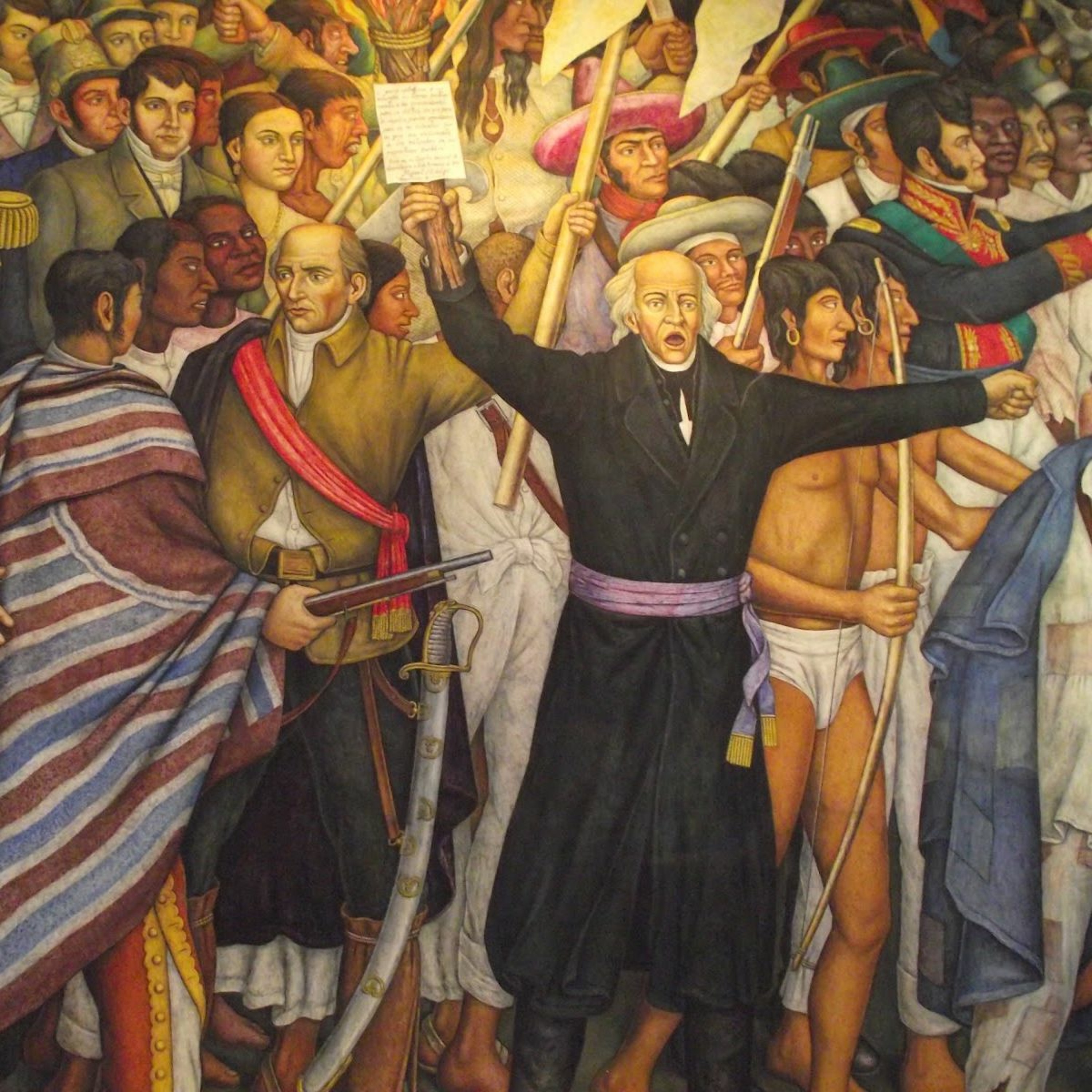
Every country has its own origin story. Mexico is no different. Just as the United States was born from a war for independence from Great Britain, Mexico, or New Spain as it was called, also fought and won, well, sort of won, its own war for independence from Spain. One of the most remarkable and detailed mural depictions of Mexico's war for independence was painted by Juan O'Gorman from 1960 until 61.
It's in the Museum of National History in Castillo de Chobultepec in Mexico City. I would say this mural is covered with a series of symbolism that go from the creation of the Mexican identity until the implementation of the principles that allow the existence of a country. Fannie remembers first seeing the mural in person as an elementary school student in Mexico on a field trip. My first impression was extremely confusing.
There is a lot of people in this mural. Nobody's smiling. There are many different colors of the skin, and I remember thinking about this because the idea of Jose Parthizo-Mingas, who was a main iconic female figure during the Mexican independence, she always appeared as a very serious, not very nice woman, and in fact, she was amazing. She's the woman wearing green, riding a white horse on the right side.
That was for me the number one confusing aspect of the Mexican history. Nobody looks happy. People are mostly men. Everybody, those who are mestizos or white, are dressed on their European outfits.
Indigenous people are still carrying their Indigenous clothes. The futures are very different, and something that really made me think of what is going on here is this man who is on his knees, who is either a viret, I don't know if it's Ito rubide, maybe Ito rubide, who's holding the hand of this Indigenous man, and makes me think of Jesus Christ. Back then, I didn't think of how the church played a huge role under the implementation of what the colonialism was. I see Virgin Mary, this woman who is crying for her son, and this man who is being held by the man who is going to save him, and he is on his knees, the arty skin.
This is Nueva's Vosseus, I'm Ross Chambalas. In this episode, we're talking about what a couple historic images can tell us about Mexico's war for independence. O'Gorman paints a picture of a new country already struggling with racial, social divisions from the beginning. Injustice, of course.
Inequality. Those two main characteristics represent the tyranny of the human creation. At the time, Fanny says the mural shows the early aspirations to create a new country that would treat everyone equally. Juan O'Gorman presents a series of documents I found this interesting in this mural as we look at it.
You can see that important figures in the history presented in this mural are holding different documents. If you look closely, you can see men holding pages of manuscripts containing the written ideas for what they thought would be best for governing a new nation of Mexico at the time. O'Gorman also divides his mural into three parts by signifying different colors for the sky overhead. O'Gorman painted the colonial period with a dark, overcast sky.
It was the implementation of his religious ideas and political values that eventually were creating a country of corrupted country. Over the middle of the mural, where the fight for independence takes place, the clouds begin to part. And then, the sky moves to a blue sky. Do you see that?
And which means the success of being independent now. I thought it was a very iconic way to show the evolution of this independence movement. So, what triggered this uprising in New Spain? Let's take a look.
For the first three centuries, the main function of New Spain's government, it seems, was to squeeze as much wealth from the country as possible and ship it back to Spain. Mexico really was just providing raw materials to Spain, which made it the most powerful economic force, trading force. Wealthy elite Spaniards could enjoy chocolate, colored dyes, and silver and gold exported from Mexico. People in Mexico basically put up with it.
It was a very racially divided, hierarchical society with Spanish and Spanish-born descendants known as Crayolas at the top of the social system. But beginning in 1808, after Napoleon conquered Spain and installed his brother as king, things started to change with the new authority. Spain's military presence was pretty low. They're trying to build that back up and essentially just get Spain back into its powerful position.
Of course, that's not going to sit well with the elites in the Americas because they're trying to make, you know, unable themselves. They're trying to stop themselves. The colonies are pretty self-sufficient at this point. I mean, they've been there for generations now, and that connection to Spain isn't so strong anymore.
Interestingly, it was not a peasant revolt or wasn't the indigenous people or the poorest of the poor. The people at the low levels of that caste system that sparked the independence. It was the more privileged people like Fr. Ivalgo, who enjoyed these privileges.
They're the ones who began the effort towards independence. In this clip from the documentary, The Cry of Independence, Fr. Hidalgo is shown bravely leading a crowd of machete-wielding Mexicans into revolt. He celebrated as the slightly bald, long white-haired, revolutionary leader of Mexico's fight for independence.
Fr. Ivalgo, Miguel Ivalgo, he was the university-trained, he was a priest, who questioned the virgin birth. He got in trouble a little with the church because of his ideas. He was also very much influenced by the Enlightenment.
He read banned books, which included those of Thomas Jefferson and Jean-Jacques Rousseau. He had these Enlightenment ideas that centered on reason as the primary source of authority and legitimacy rather than the church. He came to believe in ideas such as liberty, progress, and tolerance. So, he took, in fact, the independence movement from Spain took from the US raises such as all men are created equal and unalienable rights.
So, very much influenced by what was going on in the US or what had happened in the US. Wanno Gorman's mural of the revolution portrays many prominent figures from the period. You see Hidalgo carrying a banner of the Lady of Guadalupe very prominently. She became a unifying image for the indigenous peoples.
Here's Fanny. You see, Virgin O'Ivalgo being carried by Ivalgo. You see the indigenous people being punished in their own land. You see main figures such as Ivalgo, Morelos, Ivalos, Ivalos, Ivalos, and Lorna Vicario.
I always like to look in terms of how many women are in these paintings. We see Jose Fartez de Dominguez. We see an indigenous woman on the left side. The flags, many different flags, represented.
You see the flag of 1942 when America was discovered. This mural moves the viewers' eyes to the right. One of the last images we see is a group of men sitting in a half circle, again holding up what appears to be important documents. The man standing before them is revolutionary leader Jose Maria Morelos.
Morelos would assume power in the struggle for an independent Mexico after Hidalgo was captured and executed. It's probably the final day creation of the declaration of independence forming a constitution that belongs to Mexico, the documents that made what the new country was Mexico. The last figure sitting on a horse at the end of the mural is Itro Bide, gearing up for a fight with Guerrero, which, by the way, leads us to our next painting to discuss briefly. The Abrazo de Akatampan, painted by Roman, Sagredo in 1870, shows a meeting between two men, Agastín de Itro Bide and Vicente Guerrero, that happened in February 1821.
The lighter skinned Itro Bide on the left was the head of New Spain's Royalist Army. Guerrero, the darker skinned man on the right, with his arms held out on both sides, was the leader of the insurgent troops fighting for independence. Itro Bide had been a fierce and sometimes very cruel fighter against civilians and the insurgent rebels, and his mission had been to find and destroy Guerrero, the man now standing before him with his arms outstretched. He wanted to destroy the insurgent forces that Guerrero, Vicente Guerrero, represented, but he was not able to do it.
Guerrero, he knew his territory very well, which is the South region's Mexico. He knew how to ride those regions among the mountains he would hide, and Itro Bide was just not able to catch him. So, I just believe that Itro Bide sent a letter to Guerrero, saying, let's talk. This was a moment historians say it was critical for Mexico's fight for independence.
Itro Bide and Guerrero's meeting was known as the Embrace of Agatapon, named after the place where they agreed to discuss their plan for peace. I've seen some of these abrasos, these embraces before in the art, one with Cortez and Malince, and then the other one with the Spanish conquerors and the Aztec warrior. So, when I see a painting called Abraso, I'm always a little skeptical, thinking, is this going to be a happy union or an unhappy union? And when we see the power coming together with the weak or the people of the insurgents, you just wonder what the outcome is going to be.
And then especially when the indigenous person is standing like Christ on the cross in this Catholic country. She's talking about Guerrero with his arms outstretched. It almost reminds me of like a borderline pat now. Right?
Like you have the Spanish soldier kind of like, let me make sure you got nothing on you before we have this chat because we're here to work together, but I don't trust you. It does look like arms up, hands up, out of your pockets. It does, doesn't it? It could also look like a very passionate emotional discussion, right?
I mean, I tend to talk with my hands so that could very much be what Guerrero's doing right there. Like, I don't know what you're talking about, how it's going up. I also like the way the artist kind of represented each person. Guerrero's very much misty so even the way he stresses a little more about Quero, I would say, versus you know, like that aspect of this painting.
Right. And so it may not have turned out all that well either because it's what it would be. They become emperor. Right.
Thank you. I'll give you a slightly criticized later. This was not the end of fighting and violence for political power in Mexico. Far from it.
You look at all the events that took place after the independence, it was war after war, and the Mexicans are always looking for something that makes them feel happy and in peace in their own country. And the idea is that the Mexican independence and everybody who participated in the process of getting independence were the creoles, yes, but they didn't represent indigenous people. And that represented the people who wanted to become independent from Spain, but with the same ideology about Spain. And that I think tells a lot about the history of Mexico in terms of what has been achieved in the last 200 years.
Ultimately, the struggle was then and still now about control of resources, and as for that quaint notion about abolishing the Spanish social class system. Indigenous people always were seen or have been seen as this second-class group of people who are there to be farmers, to be producers, but not to have the same opportunities as they were. And this launched a period that was very tumultuous when we teach this period, where we're always, oh my gosh, we're going to have to talk about 31 presidents and two monarchs, two constitutions over a 55-year period. Many people, well, when I talk to kids, I say if you want to go back in history, you don't want to be a ruler of Mexico during this time, you're likely to have been executed.
Seven heroes of the independence movement were executed. So this is not uncommon when a country becomes independent. It's often the case that there's a lot of turmoil in establishing itself. Juan O'Gorman's mural, The Cry of Independence, can be seen in El Castillo de Chapultepec in Mexico City.
El Abrazo de Acetempán by Roman Sagrado is in the National Museum of History. You can see images of both of these works at the website and home for this podcast, ArtisMexUT.org. Thanks to Luis Lopez for his Chicano perspective, thanks to Fannie Blauer for her Mexican perspective. Thanks to Susan Vobel for her enlightened perspective as a scholar of Mexican art.
And as for me, Ross Chambliss, I'm just learning about all of this for the first time, and it is reshaping how I think and feel about the country south of the border. Music you heard in this episode comes from Elias Torres, Gustavo Santorlia, Antonio Pinto, Philip Glass, Elia de Boldenthal, and Jórje Samfir. This podcast is made possible by a grant from Utah Humanities, thanks to KCPW for the studio space. This is Nueva Svelce.