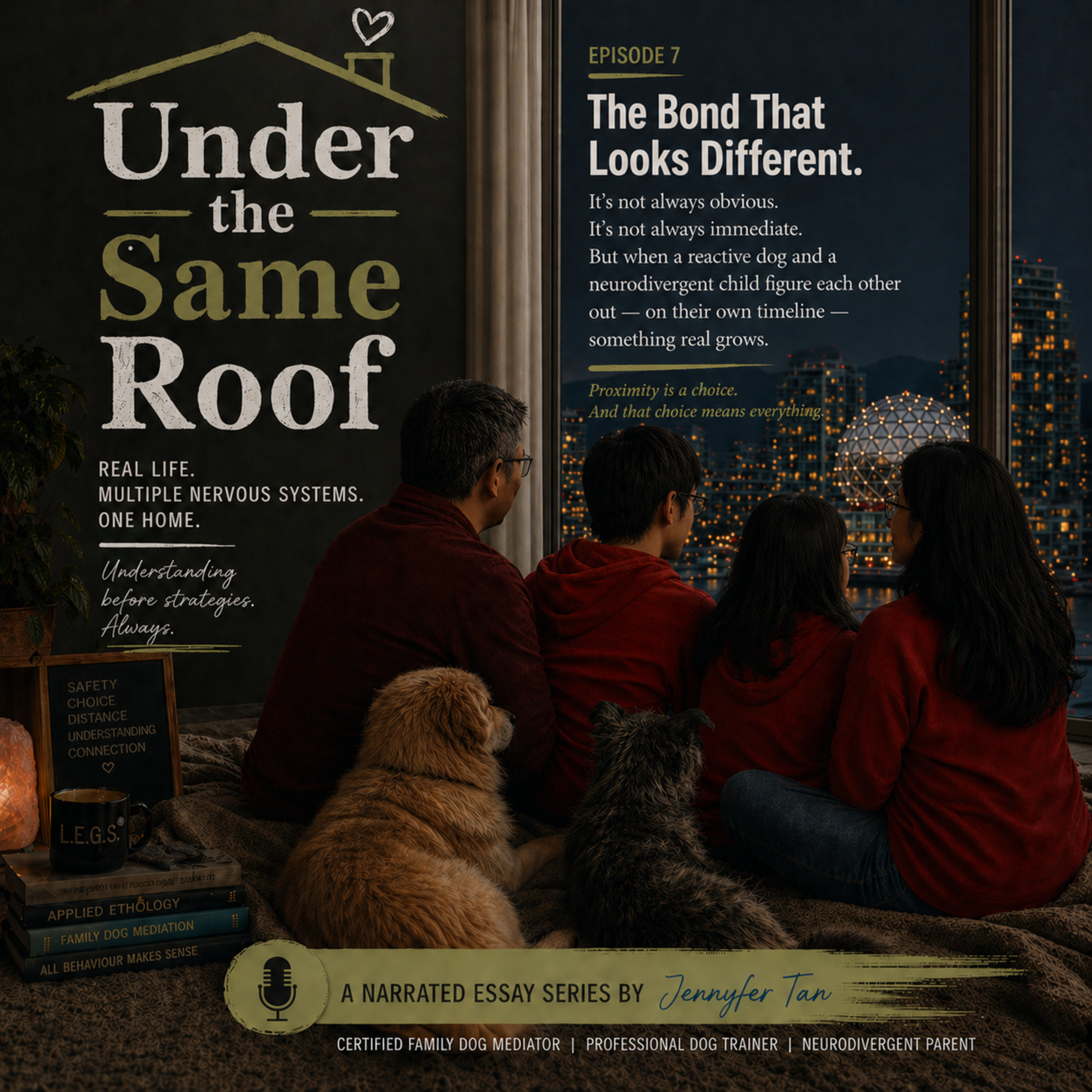
Episode 7: The Bond That Looks Different episode artwork

EPISODE · May 25, 2026 · 11 MIN

Episode 7: The Bond That Looks Different

from Under The Same Roof · host Jennyfer Tan

When Your Neurodivergent Child and Dog Finally Bond — And It Looks Different Than You ExpectedThe research says dogs are good for autistic children — improved communication, reduced anxiety. What it doesn't mention is the middle: the gap between outcome and reality. The puppy who overwhelms the child, the child who can't read the dog's signals, two beings coexisting but not connecting. This episode is about what the bond actually looks like in neurodivergent households — parallel existence, specific rituals, earned proximity — and why a dog choosing to be near your child, once, on an ordinary afternoon, is not a small thing.📍 If you're waiting for a bond that doesn't look like the articles promised: A Behavioral and Wellness Assessment at R+R Canine Consulting helps you see the connection that's already building. Book here.They got the dog for the right reasons.The research was consistent. Dogs are good for children with autism — improved communication, reduced anxiety, a relationship that asks less and offers more than most human ones do. The logic made sense. Their child was struggling. A dog, they thought, might be something uncomplicated.What the research didn't mention was the middle. The gap between the outcome it described and the reality of actually living it. The puppy who overwhelmed the child he was supposed to help. The child who couldn't read the dog's signals and the dog who couldn't predict the child's movement. The two of them coexisting in the same space, neither connecting in any of the ways anyone had promised they would.This episode of Under the Same Roof is for everyone who has stood in that gap.Jennyfer Tan got Rosco when her son was seventeen. Not a small child, easily redirected — a teenager, large and loud, with heavy hands and a voice that has almost no middle register. The easy, natural bond the articles had implied was almost inevitable didn't happen. Not then. Not for a long time.What happened instead was quieter, slower, and far more specific than anything she had imagined. Rosco began going to her son's room sometimes — not to sleep, not for any obvious reason, just to be there for a while and then leave. The two of them developed an ease with each other that arrived without announcement. And then one afternoon, Jennyfer walked into the living room and found Rosco tucked into the crook of her son's arm while he gamed. Asleep. Chosen.This episode is about that moment. What it took to get there. And what it was actually telling her — not sentimentally, but practically, through everything she understands about how dogs work and what they're reading in the humans around them.It's also about what these bonds actually look like in neurodivergent households — and why they so rarely match the version in the research summaries or the heartwarming videos. A neurodivergent child's connection to a dog might not look like affection. It might look like parallel existence. A very specific repeated ritual. Two beings in the same space who have figured out, without negotiating it explicitly, that they're okay with each other.Drawing on the L.E.G.S. model developed by Kim Brophey, Jennyfer explains what Rosco was actually reading in that moment — and why a regulated child is a completely different sensory environment than the one a cautious dog usually navigates around. Why proximity is a choice. And why a dog choosing it, once, on an ordinary afternoon, is not a small thing.The bond that looks different is still a bond. It just needs someone paying close enough attention to see it.Under the Same Roof is grounded in the L.E.G.S. model and Family Dog Mediation, and in lived experience that no certification can replace. For families navigating autism, ADHD, sensory processing differences, and reactive or anxious dogs in the real world.Understanding before strategies. Always.

Episode metadata supplied by the publisher feed · Published May 25, 2026

When Your Neurodivergent Child and Dog Finally Bond — And It Looks Different Than You ExpectedThe research says dogs are good for autistic children — improved communication, reduced anxiety. What it doesn't mention is the middle: the gap between outcome and reality. The puppy who overwhelms the child, the child who can't read the dog's signals, two beings coexisting but not connecting. This episode is about what the bond actually looks like in neurodivergent households — parallel existence, specific rituals, earned proximity — and why a dog choosing to be near your child, once, on an ordinary afternoon, is not a small thing.📍 If you're waiting for a bond that doesn't look like the articles promised: A Behavioral and Wellness Assessment at R+R Canine Consulting helps you see the connection that's already building. Book here.They got the dog for the right reasons.The research was consistent. Dogs are good for children with autism — improved communication, reduced anxiety, a relationship that asks less and offers more than most human ones do. The logic made sense. Their child was struggling. A dog, they thought, might be something uncomplicated.What the research didn't mention was the middle. The gap between the outcome it described and the reality of actually living it. The puppy who overwhelmed the child he was supposed to help. The child who couldn't read the dog's signals and the dog who couldn't predict the child's movement. The two of them coexisting in the same space, neither connecting in any of the ways anyone had promised they would.This episode of Under the Same Roof is for everyone who has stood in that gap.Jennyfer Tan got Rosco when her son was seventeen. Not a small child, easily redirected — a teenager, large and loud, with heavy hands and a voice that has almost no middle register. The easy, natural bond the articles had implied was almost inevitable didn't happen. Not then. Not for a long time.What happened instead was quieter, slower, and far more specific than anything she had imagined. Rosco began going to her son's room sometimes — not to sleep, not for any obvious reason, just to be there for a while and then leave. The two of them developed an ease with each other that arrived without announcement. And then one afternoon, Jennyfer walked into the living room and found Rosco tucked into the crook of her son's arm while he gamed. Asleep. Chosen.This episode is about that moment. What it took to get there. And what it was actually telling her — not sentimentally, but practically, through everything she understands about how dogs work and what they're reading in the humans around them.It's also about what these bonds actually look like in neurodivergent households — and why they so rarely match the version in the research summaries or the heartwarming videos. A neurodivergent child's connection to a dog might not look like affection. It might look like parallel existence. A very specific repeated ritual. Two beings in the same space who have figured out, without negotiating it explicitly, that they're okay with each other.Drawing on the L.E.G.S. model developed by Kim Brophey, Jennyfer explains what Rosco was actually reading in that moment — and why a regulated child is a completely different sensory environment than the one a cautious dog usually navigates around. Why proximity is a choice. And why a dog choosing it, once, on an ordinary afternoon, is not a small thing.The bond that looks different is still a bond. It just needs someone paying close enough attention to see it.Under the Same Roof is grounded in the L.E.G.S. model and Family Dog Mediation, and in lived experience that no certification can replace. For families navigating autism, ADHD, sensory processing differences, and reactive or anxious dogs in the real world.Understanding before strategies. Always.

PodParley-generated summary based on available episode metadata and transcript content.

NOW PLAYING

Episode 7: The Bond That Looks Different

0:00 11:05

No transcript for this episode yet

We transcribe on demand. Request one and we'll notify you when it's ready — usually under 10 minutes.

Frequently Asked Questions

How long is this episode of Under The Same Roof?

This episode is 11 minutes long.

When was this Under The Same Roof episode published?

This episode was published on May 25, 2026.

What is this episode about?

When Your Neurodivergent Child and Dog Finally Bond — And It Looks Different Than You ExpectedThe research says dogs are good for autistic children — improved communication, reduced anxiety. What it doesn't mention is the middle: the gap between...

Can I download this Under The Same Roof episode?

Yes, you can download this episode by clicking the download button on the episode player, or subscribe to the podcast in your preferred podcast app for automatic downloads.
URL copied to clipboard!