
EPISODE · May 16, 2026 · 5 MIN
Episode 704 - Cosmic Conundrums
from Kevin McFarlane's podcast · host Kevin McFarlane
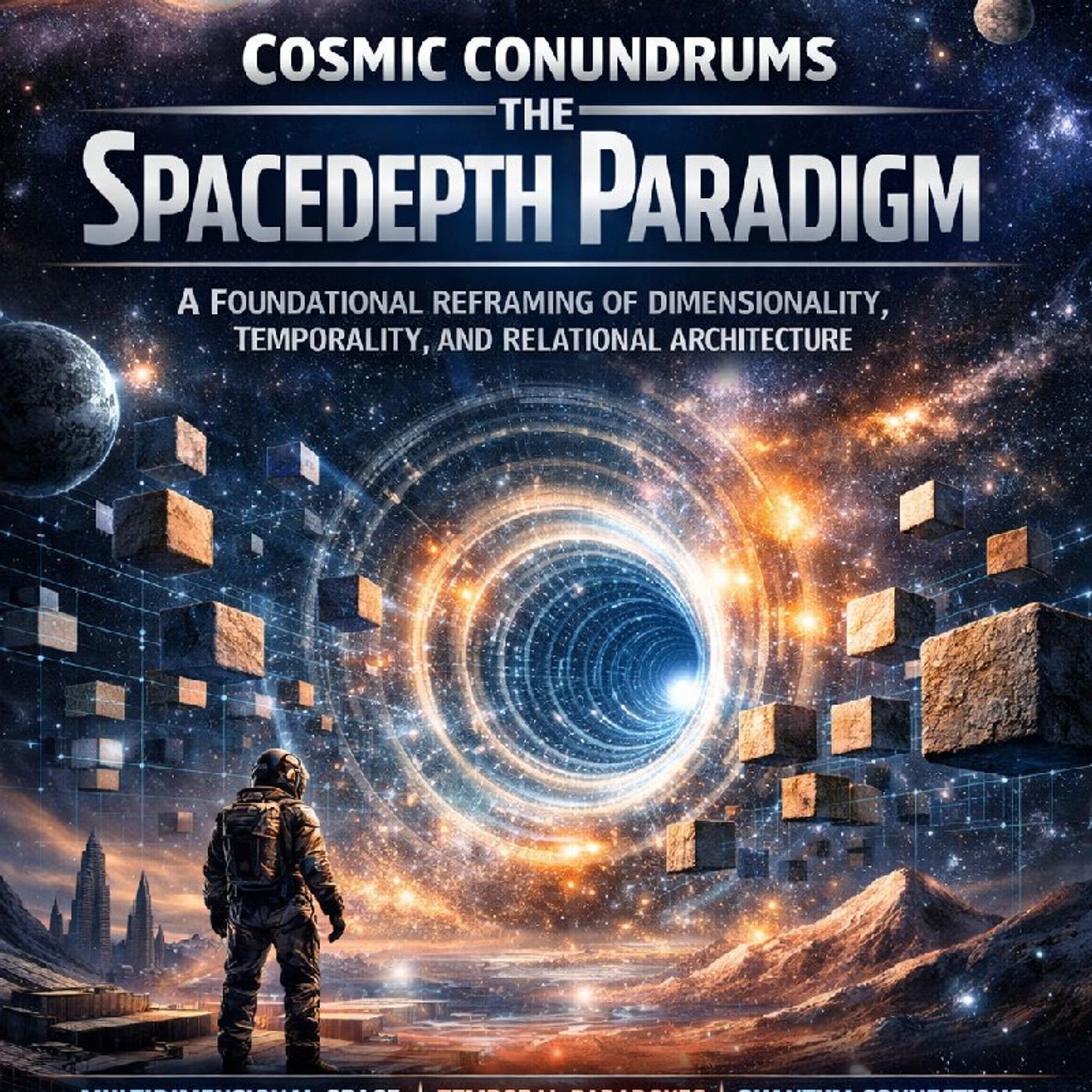
The formulation of a consistent quantum gravity framework is fundamentally obstructed by the disparity in the treatment of the temporal parameter between general relativity and quantum mechanics. In general relativity, time is integrated into the four-dimensional pseudo-Riemannian manifold as an observer-dependent coordinate, matching the role of space. Conversely, in standard quantum mechanics, time is treated as a classical, external parameter (\mathit{t}) of the Schrödinger equation, acting as a background variable rather than a quantum observable. This "problem of time" prevents the straightforward quantization of spacetime. To reconcile these frameworks, the Page-Wootters (PaW) mechanism proposes that the global universe is described by a completely static, timeless quantum state |\Psi\rangle\rangle, often referred to as the wavefunction of the universe. Within this global state, time is not an intrinsic background dimension but an emergent, relational phenomenon arising entirely from quantum entanglement between internal subsystems. One subsystem is selected as a reference clock (C), while the rest of the universe constitutes the evolving world (\Gamma). While an external observer would see a static configuration with no unfolding sequence, an observer situated inside the system, referencing \Gamma to C, experiences a smooth, continuous temporal evolution described by the Schrödinger equation.
Embed this episode
NOW PLAYING
Episode 704 - Cosmic Conundrums
No transcript for this episode yet
Similar Episodes
No similar episodes found.
Similar Podcasts
No similar podcasts found.