
EPISODE · Feb 12, 2026 · 1H 5M
Episode #76: Dear Hollywood, Give Up: Lessons from Napster, Netflix, and the Inevitable
from Stewart Squared · host Stewart Alsop II, Stewart Alsop III
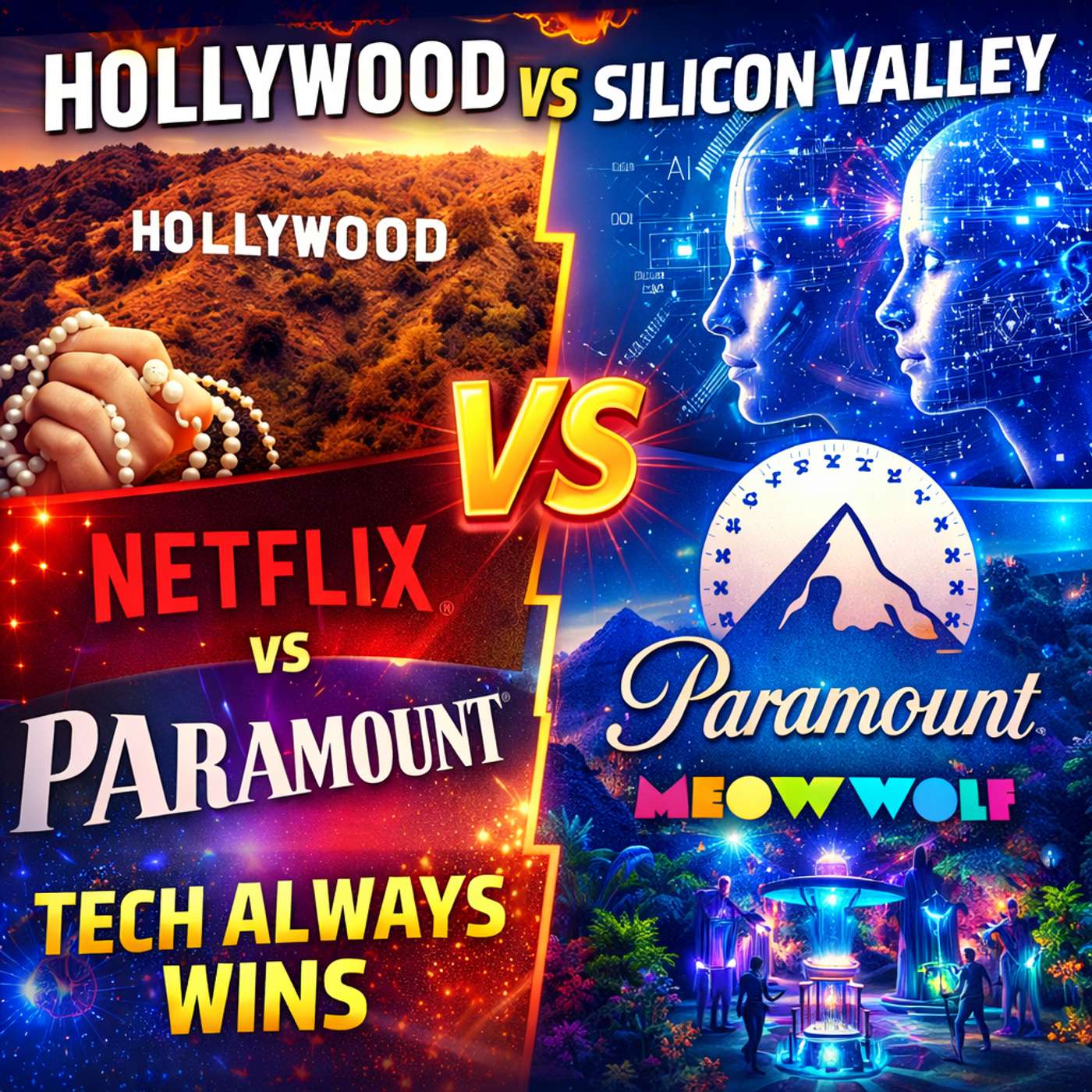
In this episode of the Stewart Squared podcast, host Stewart Alsop III speaks with his father Stewart Alsop II about the ongoing battle between Hollywood and Silicon Valley, focusing on the Warner Brothers Discovery saga involving potential buyers Netflix and Paramount (backed by tech investor David Ellison). Stewart Alsop II argues that Hollywood needs to stop "clutching their pearls" and accept that technology always wins in media—pointing to how this same pattern played out with Napster and the music industry. The conversation explores how the media landscape has shifted from broadcast television to cable to streaming, why Netflix's mastery of user experience gives it an edge over legacy studios, and how new immersive experiences like Meow Wolf represent the future of entertainment. They also discuss how AI coding tools are changing software development, the transition from large language models to world models, and why accepting technological defeat quickly is the only way forward for traditional media companies.Timestamps00:00 The Dynamic Between Hollywood and Silicon Valley09:42 The Evolution of Movie Experiences19:39 The Future of Media and Immersive Experiences29:33 The Intersection of AI, Video Games, and Coding33:54 Understanding World Models and Their Complexity40:04 The Shift from Producer to Consumer Control47:11 The Fragmentation of Media and Its Consequences51:09 Accepting Defeat in the Tech Business55:55 The Future of Media in a Streaming WorldKey Insights1. Technology Always Wins in Media Transformations: Throughout history, from the music industry's Napster revolution to newspapers and now Hollywood, the pattern is clear—technology fundamentally transforms every media sector it touches. The only viable strategy for legacy media companies is to stop resisting and adapt as quickly as possible. Those who clutch their pearls and defend old business models inevitably lose, while those who embrace technological change survive and sometimes thrive in the new landscape.2. The Paramount-Netflix Battle Represents a False Choice: Hollywood's preference for David Ellison's Paramount over Netflix to acquire Warner Brothers Discovery is misguided because both are fundamentally tech-driven companies. David Ellison, raised at the knee of Larry Ellison and Steve Jobs, is as much a "tech bro" as any Netflix executive. The real issue isn't choosing between Hollywood and Silicon Valley—it's that Hollywood has already lost and doesn't realize both options represent technology's dominance over traditional studio culture.3. Tech Value in Media Means Treating Users as Individuals, Not Cattle: The fundamental technological advantage Netflix has perfected is creating comprehensive user profiles and tailoring experiences to individual preferences. This manifests in details like the "skip intro" and "skip recap" buttons that minimize friction. Legacy services like Amazon Prime Video often fail at these seemingly small details, revealing they don't understand that technology's value lies in giving consumers control and personalized experiences rather than treating them as a mass audience in a factory farm model.4. The Music Industry Provides the Blueprint for Media's Future: When recorded music distribution collapsed with Napster, the industry had to return to music's fundamental economic drivers throughout human history: live performance, touring, and merchandise. Taylor Swift exemplifies this new model—owning her library as an asset while generating primary income through tours and merch. This same pattern will play out in film, where streaming handles distribution while new models emerge for creating value around content rather than distribution itself.5. Meow Wolf Represents a New Transcendent Media Form: Unlike traditional media that forces one dominant experience, Meow Wolf creates collaborative, multi-sensory experiences involving filmmakers, painters, welders, and every media type. Their upcoming Los Angeles exhibit in a former movie theater directly challenges Hollywood by offering agency to visitors rather than passive consumption. This represents where media is heading—beyond movies, beyond video games, into something entirely new that cannot be defined by comparing it to existing forms.6. Generational Differences in Information Processing Are Technology-Driven: Video games taught younger generations to process massive amounts of information rapidly ("twitchy"), fundamentally changing how people interact with media. Similarly, AI tools like Claude are now teaching a new generation how programming logic works, even without traditional coding skills. Each technological wave creates new cognitive capabilities, with younger generations naturally adapting to handle information flows that overwhelm older generations accustomed to different media paradigms.7. The Current AI Revolution Will Fragment Into Specialized Domains: While LLMs have revolutionized text-based tasks like coding, the next frontier is world models that can represent physical reality through pixels, movement, and spatial relationships rather than just language. Leaders like Yann LeCun and Fei-Fei Li recognize that LLMs are already legacy technology, and the competition has moved to who can build comprehensive world models first. Those still investing heavily in LLM infrastructure, like Meta, risk fighting yesterday's battle while the future moves beyond them.
Embed this episode
NOW PLAYING
Episode #76: Dear Hollywood, Give Up: Lessons from Napster, Netflix, and the Inevitable
No transcript for this episode yet
Similar Episodes
No similar episodes found.
Similar Podcasts
No similar podcasts found.