
Welcome to the Movement Movement, the podcast for people who want the truth about having a healthy, happy, strong body. Remember your body was meant to move. Now here's your host, Stephen Sashin. Can wearing running shoes make you stupid?
Well, we're going to take a look at that in today's episode of the Movement Movement, the podcast for people who want to know the truth about what it takes to have a healthy, strong body starting feet first because those things are your foundation. We look at the mythology, the propaganda, sometimes the outright lies you've been told about what it takes to run or walk or hike or play or lift weights or do yoga or whatever it is you enjoy doing and to do it enjoyably, efficiently. Effectively, and did I mention enjoyably? I know I did because that's the most important part.
If you're not having fun, just do something different till you are. I'm Stephen Sashin for zerosues.com, your host of the Movement Movement podcast. We call it the movement movement because we are creating a movement that involves you and I'll say more about that in a second. About movement, about natural movement.
Our goal is to have people rediscover that natural movement is the obvious, better, healthy choice, just the way natural food is. So here's how you become involved in the movement part of the movement and simple. Just share the word. You know, subscribe and like and give us a thumbs up and hit the bell on YouTube and all those other things you know how to do.
If you're not sure how to do that, just go to our website www.jointhemovementmovement.com and you'll see things you can click to do that. Subscribe. So let's jump into the question do's or do running shoes make you stupid. Now I'm not suggesting kind of that if you put on a pair of traditional running shoes, your IQ will go down, you won't get into the college of your choice, you won't be able to fill out a tax warmer across word puzzle, but I'm going to talk about two other kinds of stupidity.
And I'm being clear when I say that kind of that happens. That could happen because you're wearing traditional run shoes. So the first one is really simple. And when I talk about traditional run shoes, traditional is sort of a funny word to use because what most people think of as a running shoe, thick padded motion control, art support, you know, elevated heel, things like that don't even have one to show you frankly.
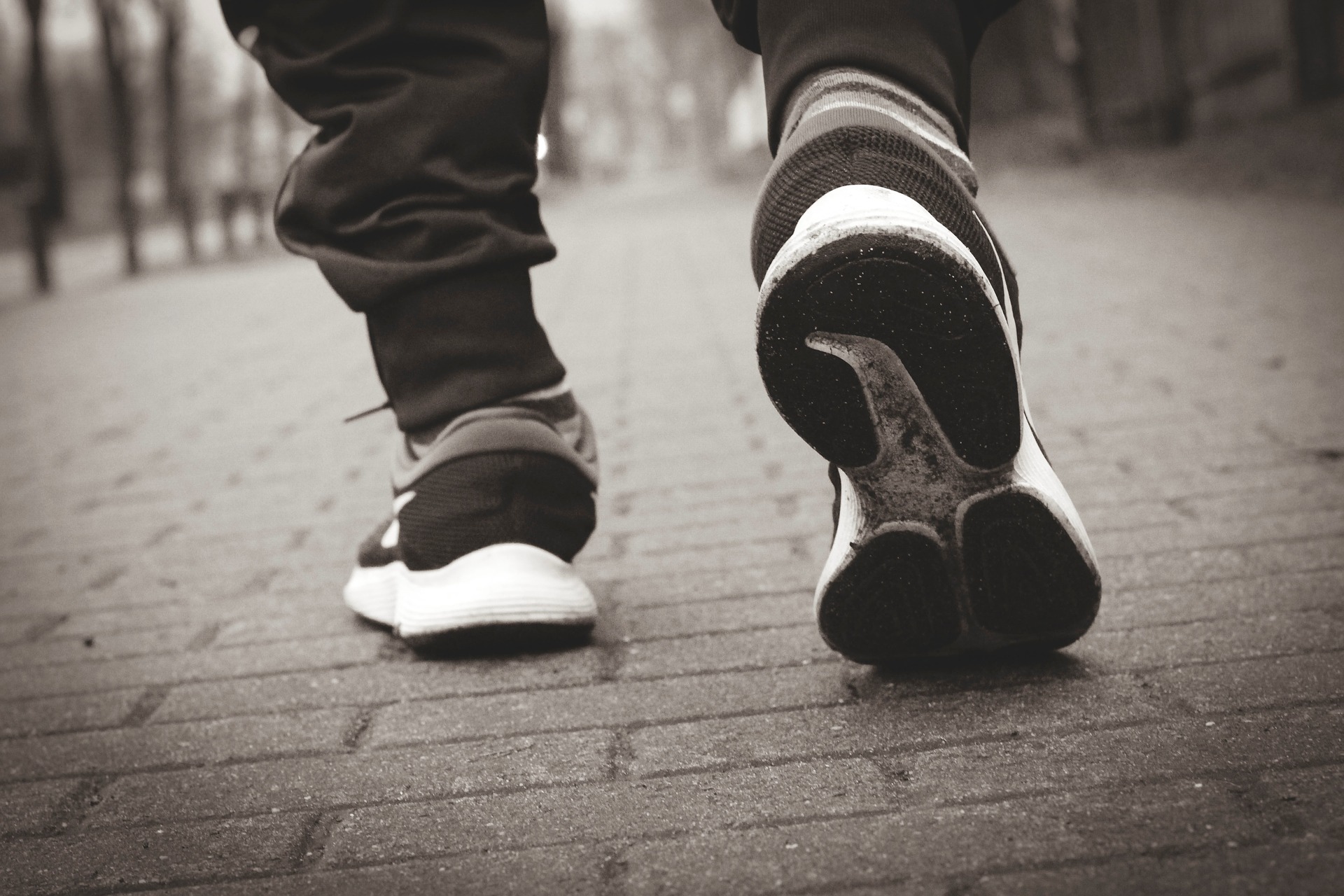
But that's actually not traditional. For most of human history, we ran in shoes that looked frankly more like the ones behind me, thin soles just enough to protect you from the ground and hold that protection onto your foot. The modern athletic shoe happened in basically the early 70s and has become ubiquitous, the fundamental design elevated heel, padded motion control, et cetera, squeeze your toes together because of marketing, frankly. So what I'm talking about is those shoes.
And here's one of the ways they make you dumber because they have all that cushioning, which we think we need. We think, well, cushioning is good because running must be hard on the joint. So we need cushioning. Well, it's a great idea, but the reality is it doesn't work that way at all because when you have all that cushioning, there are a number of things that happen.
One, you tend to land harder because your brain is trying to get feedback from the ground. And with all that cushioning, it can't feel it. You have more nerve endings in the sole of your feet than anywhere but your fingertips in your lips. That so that your brain knows how to use the rest of your body correctly.
So if you make it dumb by making it numb, sometimes you'll land harder just to get that feedback that you need for balance and agility. But of course, with all that extra padding, you don't have the balance. With all that extra height, you don't have the balance. I saw someone running on the track the other day in big thick shoes.
And the amount of time she was on the ground, the ground contact time was excessive because you could see, I'll see the shoes squishing and then her pushing off of that. So that's a whole mild tension. I wanted to get into that. Point being, you're supposed to feel things because that's what makes you move better.
And if you don't feel things, that can make you move less better, worse, dumber, stupider. Also related to that, your feet are supposed to bend and flex as well. And with a shoe that stiff, it doesn't let you do that, which also kind of makes your body dumber because you can't use your arch as the strengthening device that it's made to be or all those incredible ligaments and tendons you're putting your Achilles tendon. You can't use that properly with a big thick elevated heel shoe.
In a related note, when you are wearing an elevated heel, pad a shoe, you tend to land with your foot in front of your body. It's called over-striding. And you'll also tend to land on your heel. But frankly, if you're over-striding, if you're reaching out with your foot landing too far in front of your body, then you point your toes so that you land on the ball of your foot.
I don't know why I did air quotes for that, but I did. That's not good because when you land that way, you're not actually using your arch properly. You're not stabilizing your foot and ankle by landing with your foot more underneath your center of mass if you're going to land on the ball of your foot, which by the way is the way you should be running. And if you look at kids running before they get in shoes, that's how they naturally run.
They get their feet underneath them. They land on the ball of their foot. They don't keep staying on the ball of their foot. They'll let their whole foot and ankle flex the way it's supposed to.
But if you're landing on your heel with your foot outstretched in front of you, that sends what Daniel Lieberman from Harvard calls an impact transient force spike through your joints. So you're getting all that force going up through your joints instead of using your muscles and ligaments and tendons naturally to protect those joints. Lieberman's research also showed that if you run like a barefoot runner, like getting your foot underneath you, landing on the ball of your foot first, that impact transient disappears, that you actually are putting less force through your joints. And if you think, well, I need more cushioning, there's a bunch of research, including research from Dr.
Christine Pollard at OSU showing how all that extra cushioning, while it seems like it would make sense, wouldn't cushioning be better and wouldn't more be better? That's what one would think. In fact, that's what she thought when she did the study. But what the study revealed and it's been repeated a number of times is that you actually don't reduce impact forces without that cushioning.
And sometimes it gets larger for some of the reasons that I just mentioned. So that's one way that wearing shoes makes you dumber. You're not getting the right feedback to your brain to allow your brain to tell your body how to move correctly. Because the whole idea behind say minimalist footwear or barefoot running, it's not about the footwear.
It's about the form. It's learning to run where you're using your muscles, ligaments, and tendons as the natural springs and shock absorbers that are meant to be using your body most efficiently. It just so happens it's easier to do that if you're either barefoot or an issue like zero shoes because you're getting the feedback that you need to make those natural changes to your cake. Now, let me talk about the second way that running shoes make you stupid.
This one's actually a little more insidious. It's because the shoe companies, the big shoe companies, big shoe BS, they have brilliant marketers working for them. And I mean that legitimately. I'm envious of how smart these guys are.
They have over the last 50 years convinced people that you need art support, motion control, that you need to stop pronation and supination, that you need elevated heels, that you need padding, you need all the things they build into your shoe despite a 100% complete lack of any evidence that supports that. They do it by making you stupid, by telling you stories that are really, really easy to remember and compelling that make you stop thinking about, well, anything, that make you stop investigating, that make you put a little common sense into the mix. So let me give you my favorite example. My favorite example is when Adidas came out, and by the way, if you want to be hip, it's Adidas, and if you want to be really hip, it's just Audi.
And that's because the company was founded by Audidostler. Anyway, so Adidas came out with a new phone, a new cushioning called Boostphone. And the way they demonstrated it is they took a steel ball, it's like a two pound steel ball, and they showed how bouncy it was off a boost phone compared to how barely bouncy it was off quote, the other company's phone. Now, there are a couple of interesting things about this.
First, no other company uses that phone, or if they did it wasn't, you know, geez, for 50 years, because it's crap, frankly, and there have been many improvements to phone since then if you could call phone in any way an issue and improvement, but that's all other story. But the second thing is they show how bouncy that is. And you must think, well, yeah, I want to be bouncy like that. It talks about energy return, but there is no such thing as energy return.
Everything just sucks energy, and it's just a question of how badly it sucks. But you know, you look at that, you go, yeah, I want to be bouncy like that. Well, here's the problem. You, you may have noticed, are not a two pound steel ball.
A steel ball is perfectly elastic. And what that means from a physics perspective is that you get the most, if you bounce a two pound steel ball off of say, like a plate of diamond, it's going to get their most energy return back possible because it's so stiff that every, that all the energy that goes down comes right back up. So especially like two pounds, like a diamond ball on a diamond flat plane, that'll be like the most energy returning you can possibly get because those two things are totally in elastics. You get the most elastic return.
Hope that makes sense. Suffice it to say, you're not a two pound steel ball. You're not just falling at the rate of gravity and hitting the ground with a perfectly elastic, perfectly stiff body. You have muscles and ligaments and tendons.
And depending on your posture and if you're running uphill or downhill, you're going to change the way you move. The other thing, that foam breaks down over time. The moment you start using it, it breaks down. Most shoe companies say you need to replace your shoes every three to 500 miles.
And that's, that was developed because they say that the foam starts to wear out at that time and could lead to imbalances. It can have your foot over pronating or over supinating or just being out of alignment. And they also then made the outsole, the rubber material underneath the foam, wear out at around the same time they think you should replace your shoes. Now research from Brian Heitershite shows that the actual, the foam breaks down much faster than what they claim.
And it breaks down within as little as 150 miles. And some of the very new shoes, the super maximally pushed cushions shoes, they explicitly say that the shoes need to be replaced, replaced after as little as 100 miles. Crazy. So the whole point of that is that what I'm talking about how shoes make you stupid is that marketing is telling you a great story.
You want to bounce like a two pounds of the ball, this one is better than that foam. And once we hear a simple story, we lock onto it and we don't tend to do a little bit of logical checking. We don't tend to look for opposites of those stories to see if those could be as true or truer. Like, do you need this cushioning at all would be an opposite?
Are there other kinds of foam that produce better benefits even though the bouncy thing might not be the same? Or are there ways of getting those same benefits that we want through something completely different than more foam? The answer is yeah, by getting rid of entirely. If you look on our website at zero shoes.com, you'll see over, at this point, over 27,000 five star reviews, many of which talk about how getting out of their cushioning and padding is what allowed people to run or walk or hike better than ever before.
So the basic idea about how shoes make you stupid is footwear manufacturers look footwear, very competitive industry, extremely competitive industry. And if one company could prove or at least convince you that they're a little bit better than the other company that's basically making the exact same shoe, that's worth billions of dollars. And by the way, that exact same shoe thing, if you ever get a chance to go to a trade show that's for the outdoor industry or for the footwear industry, you could walk around in the booths and mostly take the logos off of any shoe and put it on almost any other shoe and you wouldn't be able to tell the difference. They're all fundamentally the same.
Again, elevated heel, padded, motion control, squeeze your toes, all these things that are, again, demonstrably shown to not provide the benefits that they claim they will give you. So by listening to marketing, you just turn off parts of your brain that could give you a better solution for what you're looking for, whether that's injury prevention or improved performance. I was at the American College of Sports and Medicine. I was on a panel discussion with some guys from Audi and from Brooks and a friend of mine from Topo Athletics.
And the guys from Audi and Brooks in particular kept talking about how what they were doing was designed to improve performance and reduce injury. One of them admitted that they didn't have research to back up that they could do that because it was time intensive and very expensive and had a lot of confounding factors that could confuse the research. Well, this is complete nonsense. They've had 50 years.
They have billions and billions of dollars and you can design a long-term study that takes out those confounding factors. But the simple thing, you know, at the end, someone said what's coming up in the future and they were all talking about personalization. So making custom made padding just for you or custom made out souls just because of how you run. And I asked a simple question, where's your proof that any of this actually improves performance or reduces injury or is it just more of the same?
Same story, told differently, totally shut down your brain so that you stop thinking and just buy their product. Here's a perfect example of one. Years ago, somebody I won't mention his name came up with an idea for a shoe. It was for Asics, I believe, that was for women to wear when they were having their period.
A shoe that women needed when they were on their period because you know their weight change and their center of mass changed. Thankfully, that did not catch on because it's complete nonsense. You may as well say you need a different shoe for walking into the bathroom as you do for walking out of the bathroom because your center of mass and your weight have changed. It's just not real.
But again, good stories make us dumb, not feeling, not using your body naturally to get the feedback that you need so you can then use your body correctly makes us dumb. I'm hoping that you decide to not be dumb. And look, obviously, I'm going to say one way of doing that is getting out of your shoes and trying zero shoes, but you don't even try the zero shoes. Just getting your regular shoes.
Spend as much time barefoot as you can. Reawaken those nerves and that nervous impulse so your brain can actually hear, quote unquote, hear what's happening with your feet. And that's going to engender some changes in your body. If you want to have some fun, walk barefoot on surfaces that are mildly unpleasant, like good gravel, not crazy unpleasant gravel, but just enough so that you can't, that you have to adopt a new movement pattern and just feel what that's feeling.
Like if you go to a track, actually walk barefoot on the track, most tracks are unpleasant enough that that'll make you walk differently as well. See what you discover from doing that. Most importantly, go out and have some fun and live life feet first. So that's the story.
I'd love to hear what you think. But of course, more importantly, I'd love to hear how you share the message, how you make the movement about natural movement, a movement by engaging more people who understand, who think logically, who think rationally, who realize that, you know, if you have a corner of the bones and your entire body and your feet and ankles and all those nerve endings and cells, your feet is probably something that you're supposed to use instead of making them numb and stupid and immobile. Because you know immobile makes things weaker over time. When is weaker better than stronger?
Using your body can make it stronger over time. Stronger is usually better. By the way, there's research that backs up both those things that I just said, but you don't need the research, did you? It was just obvious.
You know, you put your own accounts against weaker, you do bicep curls against stronger. Same idea with your feet. Makes sense, right? That's the kind of thinking that would counter the bouncy ball kind of thinking.
Share some other ideas of, you know, footwear marketing you've seen that looks convincing, that may not be. And if you're not sure, you know, just send it my way. And I'll let you know what I think. Speaking of which, if you have any questions or recommendations or suggestions, drop me an email.
All the different places you can engage with this content, download the podcast, wherever you get your podcast, find us on Facebook and Instagram and YouTube and everywhere else. And of course, join the movement movement.com. And I think that kind of covers it. So once again, thanks for joining us.
Have fun. Be well. Live life. Be first.
You've been listening to the Movement Movement Podcast with host Stephen Sashan. Remember to join the tribe and subscribe at jointhemovementmovement.com.