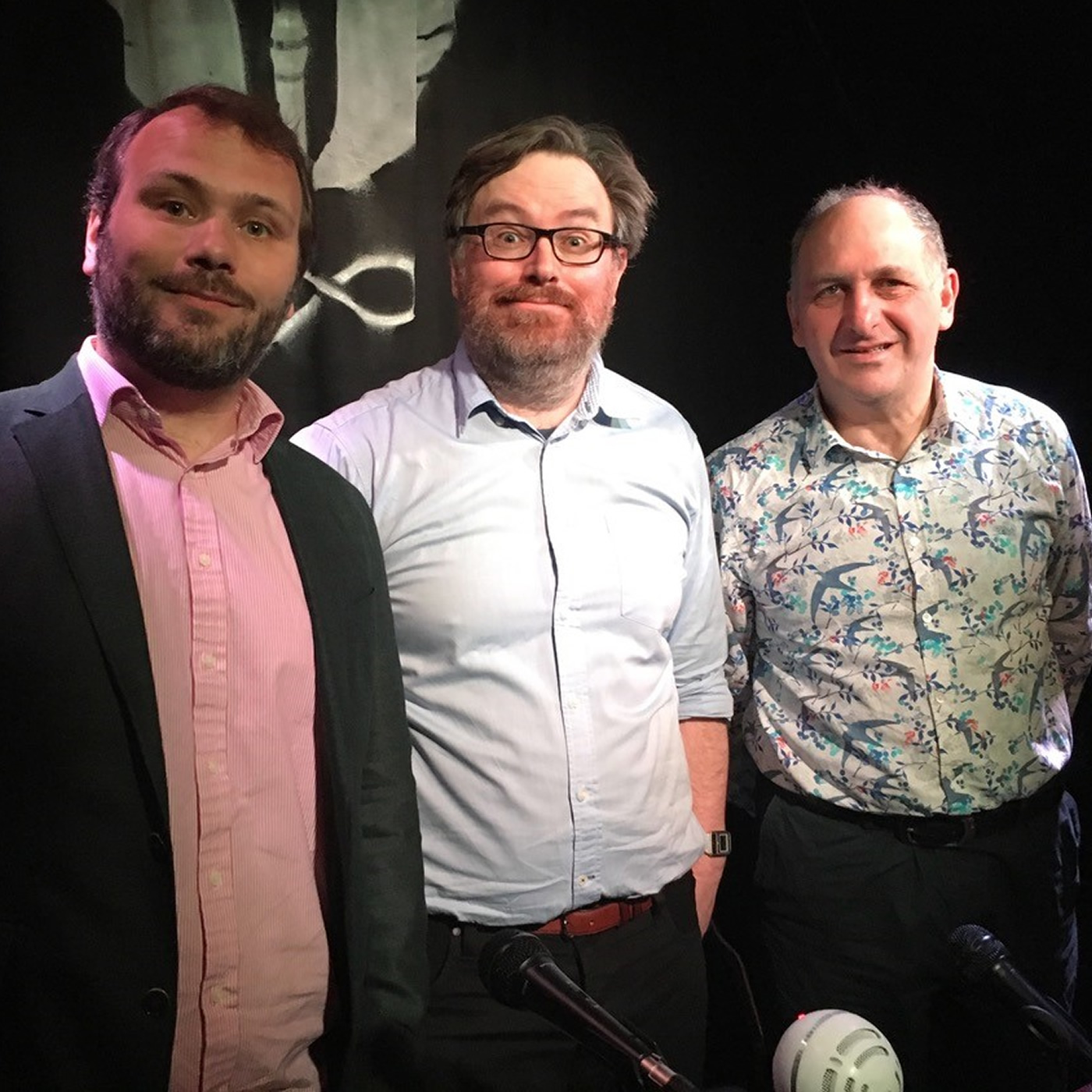
Hello and welcome to Sitcom Geeks. We're back with a second helping of John Finnamore. Let's go back to sketches then. I do read a lot of sketches for people and people often have a very good first idea of what if such and such.
But the thing where sketches always fall down is the second twist to get out of the sketch and to get to the punchline and out of the sketch. And that's what impresses me because myself writing sketches I always find that is so hard that anyone can have the ideas. Exactly. That is what makes it a sketch.
It's the premise and then there's the second idea. It doesn't have to be a twist in a straightforward unexpected punchline way. But more often it's a second angle on it that should really be kicking in before the end of the first page. Or you don't have a sketch as you say.
You've just got a sequence of jokes about on one premise. And in terms of your process, do you not even start writing a sketch until you know what that second angle or that punchline is? Or do you sometimes just start writing it and hope that something will turn out? No, more and more the first.
And these days almost entirely with sketches I wouldn't try writing it until I knew what the sketch was and where it was going. And the more I can do that with the narrative as well. Sometimes I've got a little less strict with myself lately. There's room, as long as you've got time, for writing before you know exactly what's happening.
Just to get the characters' voices. But I would not do that expecting any of that stuff to go into the final double act, for instance. I would just write it and go, hang on, I need to get a voice in my head, so let me write a scene which is not intended to go into this to find out who these people are. But I wouldn't otherwise write dialogue until I know the plot.
Because then you get lost in it. Because then you'll start writing stuff that you enjoy. There'll be jokes and gag memos that you really like. And then it'll become a crossword puzzle of trying to keep all of those in, even when you begin to realise that whole second bit's got to go.
Right, I love the bit about the rabbit, so can we get the rabbit back into the first... End up contorting the rabbit into the first act. And nobody wants the first act of looking thwarted rabbits. That's a scientific fact.
Yeah, absolutely. No, it is. Sometimes we can, when they're being quite prescriptive, I certainly am about planning and it feels like you also are a planner. The downside of that is you're slightly paralysed that the first time you start writing it, you're writing act one, scene one, as it were.
And you immediately have to get going on it. And actually, be fine about having your characters just talk nonsense for five pages. Whatever you do, don't broadcast that or even necessarily record it. And you realise that the show starts on page five.
Yeah, yeah. But now you can hear them talking. I'm not saying I wait until it's all planned out and then I write every golden word following in a number of children. Whatever others may say, I do that myself.
No, like everyone else, I do endless rewriting. And the first draft is utter garbage and I know it will be in it. That's the point of it. To fill something with words.
But to fill what with words? To fill the shape that you worked out in your little book. And then once you've got the big old ungainly sack of words in that vague shape, then you can go back to the book and read the draft and go, I don't know what this is, that was the funny bit. And this, as you say, almost inevitably the first six pages can go.
I've barely seen the first draft where the first six pages can go. So, yeah, you then go back and forth between them. But the longer you wait before you start dialogue, I think, the easier you make life in the future. Yes, that's true, that's true for me.
So you've got, you're doing the sketch show and you've got the double acts, presumably you're doing another series of double acts, or am I...? I just, I'm joking. We probably are, but we don't have... That was an assumption, that wasn't true.
I didn't tell you that you are. I clawed my way back into this conversation. But that, therefore begs the question null and void. Have you been getting, have you had one series all year or have you been having two series?
It's been two for a while. 12 episodes, six hours of comedy that have been appearing on the radio. Yeah, but that's my year's work, and that is quite a lot, but I work really hard after it. And, yeah, for a while now it's been a series of carbon pressure and a series of souvenir program, and then double acts of carbon pressure.
And I do other jobs around them, but those are the, those are the, yeah. And you're doing your tour, so you're starting to do it. Right, yeah, that's a new thing. We're doing a tour, so it's me and the souvenir program, Castle, four of them.
Laurie Lewin, Margaret Cable Smith, Carrie Quinn and Simon Kane and I are doing 13 dates between, 14 dates now, between the middle of May and the middle of June. So, yes, come and see. Yes, I've never done that before. I've done, we did a live stage show in London two years ago, and that was great.
And again, I just discovered, oh yes, I really enjoyed this. And this is the sort of thing I like, and this is going to be a bit more ambitious and, you know, more cast for sale. Exactly, exactly. So it's not a repeat of the previous show by Joe's brand new show?
No, no, no. Brand new show. There'll be some, you know, there'll be some sketches from TV No programming in it, but the more I come up with ideas, the more I realise what I love it will be new stuff. It's sort of weird, isn't it?
Because, in a way, you might feel like you don't want to do stuff that they might have already heard on the radio, except people sort of love hearing their favourite sketches on the radio as well. Yeah, and I really don't know what the balance is in comedy, because in music, I think people, I don't know much about music, but my sense is that people actually want it to be 80% old stuff and then, okay, do a couple of the new ones at the end if you must. Comedy, it's not that, is it? But I'm not certain that it would be, oh, we'd rather have 90% new stuff and then throw in an old favourite, if you like.
I think it's somewhere between, I don't quite know where. There's also the comedy equipment of doing covers. You know what I mean? There's no kind of like, oh, that'd be great, we could do the Great Train Robbery or...
Well, even just having a staff meeting, just sort of do the Eddie Izzard, you know, pants in the wash sketch. That's not a thing. Well, it used to be, you know, that used to be what in this country, certainly that's what stand up was. It was, well, we all have these jokes in common, it's where the, but when Ken Tull tells it, it's different from when, um, uh, Frank, who am I thinking of?
Frank? No, um, although him too, but more than actually meeting Frank. Oh, Frank Tulleson. You know, they would tell them, okay, well, we can do the parrot joke, but it's the way I tell them.
When they're on the build together, they do the jokes, I'm doing the parrot joke. I hope you can tell them, that means in any derogatory way at all, and the audiences would have known the jokes and would be looking forward to the punchline, and it was the journey on it's what I think Ronnie Corbett was trying to recapture with his in-the-chair monologues, that they were a pretty old joke as well, but he would, you know, embellish jokes on the way. Yes, embellish jokes about the producer in the canteen and stuff. Yes, now you say that, I happen to be writing a book about comedy and offence, and I ended up watching some Jim Davidson on YouTube, and some fairly early Jim Davidson, in particular his chalky white character, which I have to say, the voice is astonishing, and I think that is why initially people found it funny, bar the basic sort of implicit racism, is the fact that somebody like that does this extraordinary West Indian voice as quite something, and he felt this little story.
I've not heard it. You can actually do the accent. Oh, it's incredible. You've heard it on television.
Yeah, yeah, no, I was still old enough to remember him doing that on television, and it was fine back then. But, I mean, it probably wasn't funny, James. I see it really. Read the book, and I will tell you whether it was fine.
Oh, okay, I'll just get hang of it. Exactly. But the thing that sort of slightly offended me more than anything else was, at the end, he told this little story about his mate Jorky, and at the end there was a joke where I just thought, oh, that's a Jethro joke. You've nicked a joke.
Oh, that's wrong. That's awful. And I just thought, oh, I think I'm getting offended by the wrong thing. So, our listeners and viewers here, and assembled several, should think about a question on my phone, assuming it's actually recording, which it is.
Do you want me to ask one more question? And I'll stand up and start. That's a great idea. I was thinking because, and we're going to be touring with these guys, and I know Carrie writes, and I know Laurie and Margaret are both very good at improvising and things, and obviously you write, and the script is everything, but do you ever work up sketches, and will you be working up sketches with them for the live show?
Yeah, absolutely. We now do a day during the writing of every series, which we call Silly Voices Day, where we all get together, and it is mostly just, there's quite a lot of literal silly voices in it. There's quite a lot of, because I think it started about two or three when I was worried that it was all, because it was me, you know, alone in my room and writing for radio, was all a bit in my head, and I was sort of not doing, the radio reference of visual comedy, as it were, the silliness, the, you know, silly voices. So we started, and so many of the sketches came out of that, there's one about, uh, pirates who can't say, pirate cells, who can't say the word pirate, because when you haven't got any licks, there's one letter you can't say, and that letter is, I'm going to say the biggest pirate.
And that entirely came out of us just trying to talk for ages with our lips peeled as far away from our teeth as we could to see what it sounded like. Or the Basking Sharks, that was simply the Basking Sharks, a gang of upper-class shouts who work hard, they bask hard. And that, again, just came from speaking with a fixed smile on your face, and micking your mouth as wide as it can, and that's the noise that comes out. So yeah, there's plenty of that.
Right, right. Just then all showing off in front of each other, basically. Well, just mucking about playing, and they're trying to make each other laugh, um, yeah, and then I steal all their best jokes and don't even credit. And when you say your name, and what your best is.
I'm Lawrence, I was just wondering, the last episode of the latest series of the Souvenir Programme, all the sketches tied together at the end in some magical way, I was just wondering if that, to what extent, those sketches were written to tie in, and whether you had sketches where you had add details to make that work. Yes, I did it all those different ways, which I think, I hope, helped hide. So, as you say, each episode of the Souvenir Programme ends with a long, sort of, ah, sorry, which I tell in a character as a sort of M. R.
James Goh storyteller. And this one incorporated characters and elements from the previous sketches, and so I, um, when I came up with that idea, I'd already generated, I had a certain bank of sketches I was working on, and I could see ways in which some of them could be brought in, and then there are others where I thought, okay, well, if I want to, I need them to get a fingerprint, where I've got that sketch where somebody's given a penguin and then it's taken back. So what if the penguin was a piranha fish in a bowl, then they could get the fingerprint. So there was some that were fitted in like that, and then there were others which were, right, I need a sketch.
I've got to get to the point where a cake in the shape of a hat is a thing that's been mentioned before. So how can I think of a sketch that will hopefully, you know, in a way that seems like it's on its own, end with a cake in the shape of a hat, or suggest the possibility of a cake in the shape of a hat. So, yeah, both ends. Working out of the middle.
Hello, my name's Jake. My question was going to be that one. I can't answer it anyway. You've done both ongoing sitcoms and now won a phase as well.
What do you think's harder? Do you think it's harder to write someone with a journey in mind, or someone who's going to be stuck in the same place forever? They were both hard in different ways, I think. The limitation of sitcoms, especially if you've done a couple of series, is trying to keep it fresh, trying to come up with new things that are going to massively occupy your character's attention for one week, and then not be important enough that they ever talk about them ever again.
And that's easy for the first series or so. And then you start to, well, hang on, we've done that, we've done that. And that's when sitcoms start. I mean, in America it takes, you know, 50 rather than five, but still at a certain point you get, and I did this too, you get, okay, well, let's meet their family, let's see what his brother's like, let's see what her mum's like, that kind of thing.
You can see when sitcom writers look around going, what else is there to do in this police precinct, for instance? You know, only so many things actually happen in that room. So it was nice to be able to start anywhere and come up with anyone, but of course that's also the problem. You can start anywhere, you can come up with anyone, so you've got to narrow it down from anything that could ever be written, which is a slightly daunting task, I've done.
Great, next question, was it you, sir? Yes. Hello, Chris. You said you were at university when you decided that comedy would be a career or something that you might want to do.
Why? What was it about then that made you think, rather than becoming an author or something else, was it you realised about your inspirations? Was it the people you were surrounded with? Why did you decide to go?
It was the people I was surrounded by, and the reason I was surrounded by them is because there was a comedy club. There was a place where I could meet other people who liked comedy as much as I did, and where I could work with some of them and be rivals, friendly rivals, but still, there's that sense of, oh, we both started in the same place, but that's what you're doing now, and cross-fertilise, and most crucially of all, we did a show every two weeks. It was only a little, you know, like a stand-up show, but you could do a character or sketch or whatever, but everyone just did their one thing and got off. Well, you were kind of creating material every two weeks.
Yeah, yeah, and performing it myself. And there's nothing like it to force, you know, you write so bad here when you start, you write so much, you write so much terrible stuff to begin with, and I've wrote awful stuff for years. And, you know, a situation like that, and, you know, a comedy club is great, but you can do it on the open mic circuit as well. Any situation where you're journeying that stuff out, but then trying it out in front of an audience, learning the hard way what works and what doesn't, seeing what other people are doing, and wanting to do something like that, or to work with them on something, there's nothing like it.
So, yeah, and as I say, the feeling of, okay, well, if there's six of us who would quite like to do this after the university, we know we won't all make it, but at least it makes it a sensible ambition, it's not utterly ridiculous. Next question. Hi, my name's John. At the risk of doing it, Dave, I did hear somewhere that, was Kevin Pressure turned down by in-house BBC once, and if that's a complete lie, what was the commissioning process for it?
Was it easy or difficult? Everything I write gets turned down at least once, usually twice. Some things eventually, rudgingly, get taken on. Many things don't.
So Kevin Pressure was turned down twice, once in-house BBC, very nicely, and, you know, with no bad blood, they were perfectly within their rights, as it were, to look at my pilot script and go, yeah, we've got Bonesy, we don't want that. So I took it to an independent production company, that are positive, to give David Pirate a positive, and because of the way the radio commissioning process works, you can, in-house has a layer of, a layer to go through before it gets to the commissioner, which is where it fell down for me the first time, whereas outside companies can go straight to that commissioner, so we were able to take it to her, even though it had been turned down in-house, but it never got as far as her, and she liked it, and said yes, and we were delighted, and then the level above her, the commissioner of Radio 4, who normally would never get involved in the comedy department, decided to, this was when he was going to send his thunderbolt down from Olympus and said, no, I don't like it. So we got turned down again, and it was only because David and Cameron Raphael, who was the commissioner I mentioned, very, you know, I'm very grateful to them that they both sort of went up to bat for it and said, are you sure, because we really like this one, and he said his credit, not his credit, but I mean, whether you have my gratitude, said, oh, well, okay, you like it so much, you put it on. Did it change much from the first time it was turned down?
Did you change it when you went to David Tyler with it? I'm sure I did, yes, I did, but I would say it changed more between me writing it on my own and sending it to the first producer, who was Gareth Edwards in-house, and it changed quite a lot, it was massively too long and over-complicated for a start, and it changed quite a lot then, and then, yes, it definitely changed more when I got David's notes on it, but I would say the bigger leap was the first one. Question over here. Hi, I'm Katie.
In a couple of your sketches and sitcom episodes you've had some really great gags that have only worked because it's a radio medium, so like in Camera Pressure when you only see that Douglas is playing cricket in his underwear when you have that reveal through the dialogue, and similarly in Double Axe when you find out that the two brothers are, in fact, twins. Do you find that that aspect of working for radio kind of liberates and makes room for a lot more jokes that you wouldn't get to do if you were writing for film or television? Yeah, absolutely, and people often ask me if writing radio is difficult because I can't do visual jokes, but as you described, I find radio is much better for doing visual jokes because you can reveal precisely the information you want to reveal at precisely the funniest moment, and you don't have to have, like, you know, Douglas turning out to, Douglas and Karen have quite serious conversation in which she opens up a bit and reveals that she's, you know, constantly worried about losing her house to this awful airline and he grudgingly decides, oh, well, in that case I'll do so to help you, and then at the end of that we realise he's been having that conversation in his underwear and they're just both ignoring it, you know, for good reasons, it's not just a ha-ha pants joke, but still, you know, you're immensely likely that, isn't it? Well, I hope not, because I don't like those jokes, I don't like that sort of, but in his pants!
of random stuff. And this wasn't. This was set up earlier that there was a cricket match and there's a talk about who's going to be skins and so on. And that's another reveal you can do on radio particularly well.
You can remind, not just reveal something for the first time but also remind people of something that they already knew but have forgotten because they haven't been constantly, you know. So for instance, there's an episode called The Skirtyware character Martin has a series of misadventures trying to get the stuck sheep back to the rest of the gang. And when he trips in, well, when he arrives back at the airport, Douglas is able simply to describe all the things that we know have happened to him. Oh, you're covering goose down.
Yes, I am. And you've got your handles still swollen up with these things. Yes, you're carrying a dead sheep on this. Yes, I am.
And none of these are surprises. We knew all this happened but we'd maybe not remember to put them all together into one mental picture. So you get this sort of bonus laugh of us making a mental image of what he must look like to someone who doesn't know the journey. And you can have to do it along the way as well.
So yeah, I think it's terrific. And the Life Window episode of Double X you mentioned, that was partly based on me trying to work out all the things I could only do on radio. So you start with the two characters talking, then I reveal, well, it starts off when one of them's naked, which you could do obviously on stage but it would be difficult and you'd have to get the other considerations because on radio you could put it out at 6.30 and just naked stay in the room. Oh, I'm posing for my photo and my portrait.
That's all fine. And then you reveal that he's got one arm and later you reveal that, well, the reveal that the two of them are brothers obviously you could do on stage or any other medium but not the reveal where at the end they were twins all along. And that's something that makes you go back and revisit the rest of the play in the knowledge that all that time you were talking about your face and my face is the same face but you don't have to you don't have to try and hide that the way you would have to do on television or on stage. It can feel natural.
I'm sure there was another thing. That's one of that episode that you could only do on radio. I can't remember what it was. Hi, I'm James.
I'm just curious as to if you have a writing partner and if not who do you use as a sounding board? A writing partner. Oh, partner. I used to be in a double act with a guy called Kevin who was a very funny man one of the funniest people I've ever met sadly decided to become a teacher and actually get back to society or some such shit.
So, yeah, I've written with I've written with plenty of other people along the way but never in one sort of long-lasting writing partnership. But, yeah, I've got plenty of all of the cast in the programme that chap Kevin and lots of people who I would send stuff to and ask opinions about and the producers as well. Yeah. Any other questions?
Yes. Hi, I'm Viv. Your song, Your Musical Number is always a really great part of the episodes. Is that something you always plan to do to include a musical number and is it something you'd maybe want to do more of?
The songs? Yeah. No, it wasn't something I always plan to do. A lot of the stuff that I liked, a lot of the old school comedy that I liked growing up had a song in it, either a comedy song like, I'm sorry, The Game would always have one of the melodious songs but also, or Radioactive always had a song.
Also, you know, The Goons Around the Horn would just have another feature, who's for? We'll sing a horrible song about springtime or Max Gildreau will play his, what did he play trumpet? And, so, I'm on it again, that's right. So, yeah, that always felt like something you could do in a sketch show to me but it wasn't something I liked writing lyrics but it wasn't something I particularly intended to do but we tried, in each series, tried to find something new to do so it doesn't feel too, without changing everything I have one question of my own, a very specific question partly based on the fact that the general question is, my kids are 10 and 7 and they've listened to every episode of Cabin Pressure probably 8, 10, 12 times because kids sort of do that they sort of put it on and now they've memorized it and now they call their mother sometimes Mummo and, when the first time I heard that I remember thinking what an incredibly weird thing that was to do and that you probably couldn't have come up with that but you must have heard somebody once call their mother Mummo in a real way but is that completely out of your head?
I think so. It's like, you're weird. It's meant to be it's quite a kind of he's not an out and out villain but he's a big grating uncomfortable character and I think it just came out of, well you know that sort of hearty rugger cricket thing every nickname is simply a syllable of your personal surname followed by R it's Pommo so I just thought that that sort of cat might call his Mummo to differentiate her from all the other mums I'm very pleased to have that one cleared up it just sounded so weird I just couldn't quite have it been invented but damn you Finnwell you made it up John, thank you we are coming to the end of our time I'm afraid but it's been a pleasure having you here it's been a brilliant talk and I'm looking forward to the new sitcom that's not happening I was very excited by all the news I'm the coach who's talking to my agent she needs to hear about this that's a matter of the information from Cambridge Analytica that'll be it yes great or in fact somebody mentioned that it would be more true for Jonathan is that Umbridge Analytica who's the radio 4 version and now all of our people here have seen that John Finnwell is everybody as nice as I said he was earlier a delightful man and so we are very grateful and also we Sitcom Peak presenters are very grateful to you for coming to this live event and also especially to Patreon subscribers who have made it possible so that we can kind of get enough of a critical mass to actually make this look worthwhile and also help me buy these amazing microphones and this Zoom H5 so you pay for these things and we will try to make the podcast louder in the future and I'll make this get deafening on the podcast so that people will have to take their headphones out but I think we're done is that right? Yes well just to say thanks again to John Finnemore Thank you