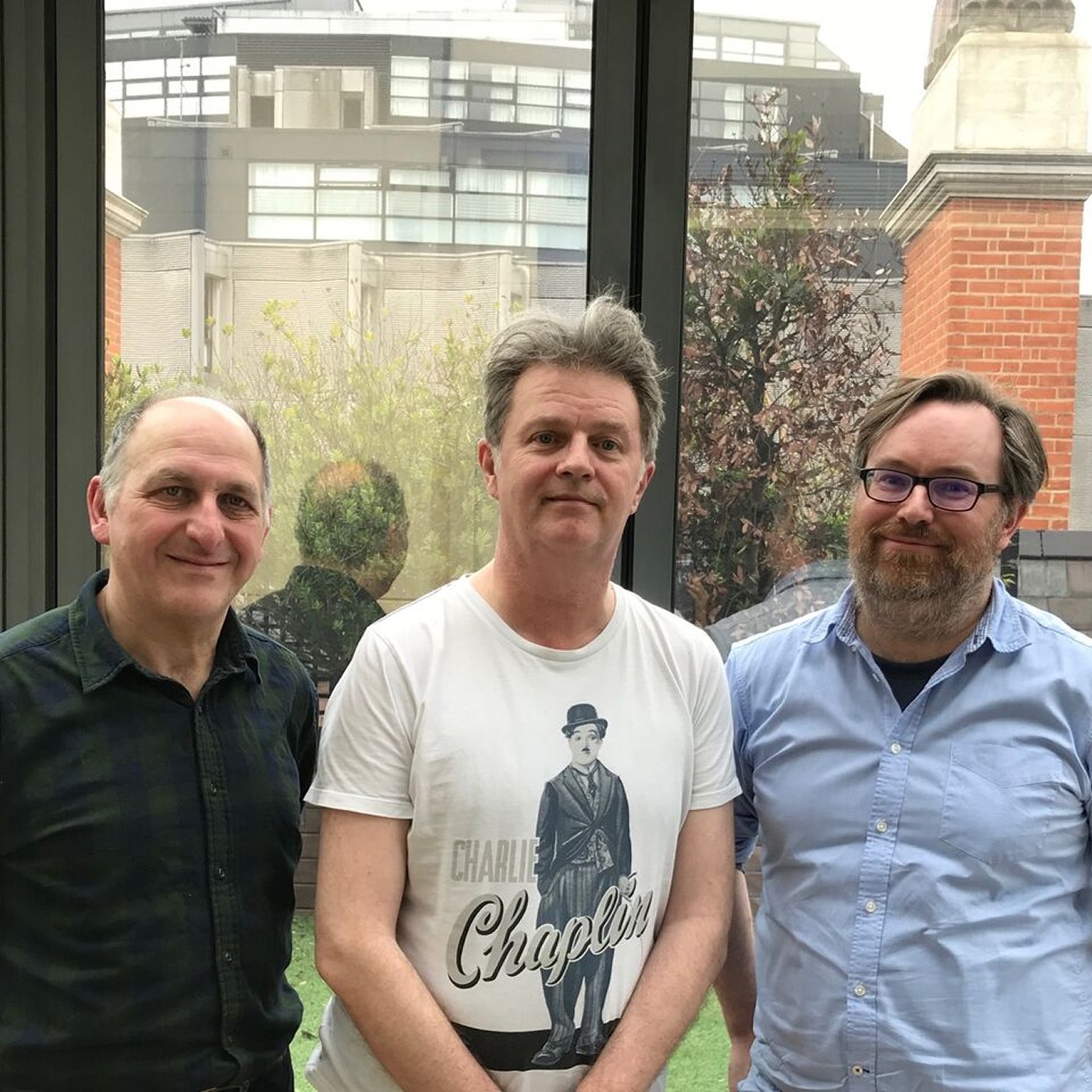
Welcome to sitcom geeks, I'm Dave Cohen. And I'm James Carey. And we're delighted today to have us our special guest, one of the great names of comedy of the last 30 years, really. I was like, kind of more, almost.
Yes, yes. Long time. Big star of TV, radio and stage. Please welcome Paul Merton.
Thank you very much. Thank you. I can hear the sound of people clapping. Paul Merton is about a radio and TV, so I mean, is there a preference for you?
Just a minute. It's undoubtedly my favourite show. I think because when I was watching Desperate Hours when it was going out originally at the Steptown, I was also listening to just a minute. And so, to be on the show that I listened to as a teenager, and when I lived in the bed, sits in Stretham, you may even have come to one of them, I can't remember.
Small rooms. Yeah. And I would have, I didn't have a TV at one particular time, so I would take just a minute off the radio on a little C60 cassette, you know, half out each side. And when I was going to sleep at night, I'd put them on and listen to them.
And I heard one on Radio 4 Extra about a year ago, which is one that I used to record. And I knew it word for word. It was like, I must say, it was a play that I'd been in for 15 years or something. I was the thing where people Jones said, I don't think that's a rate like you, or whatever it would be.
So to show that I really enjoyed, then to become part of it, a nickel is still going strong at the 95 this year. He's one year younger than the BBC. The year that Howard Lloyd was hanging off the clock in safety last of the year that he was born. He won the award the other day at some radio awards where I gave him the award.
His first radio job was in 1941, at the age of 18. So he's physically, you know, he needs a stick now, but mentally and he's still completely alert. He still wants to know what the next gig is. He's still sort of like eager for the next one.
So I would say in terms of, just a minute I would say, yeah, absolutely, in terms of the medium as well. I think it was TV, you know, the TV show I did a long time ago, there's a lot of people involved. There's a great thrill to find yourself out on location. Somebody's built a polystyrene whale and there's a spout of water coming out of the top of it.
There's a cowboy suspended in the spout of water and he's actually on a piece of wire and something like that. It's great to see. But the immediacy of radio, I recently just did a thing, it's going out on April the 8th, that's Suki, my wife, right, Suki Webster. And it was a play that we've done in Edinburgh.
And now we're doing it as a radio thing. You've got the script in your hand. So, you know, that anxiety about shall I remember the words and all that sort of stuff, or if it's a laugh you don't expect. You can just take it all there.
So, that's a great joy as well. I think probably radio would be my favourite. Although, I mean, I still do the Comedy Store players with the intro chums. I mean, that again is good fun because if you have an idea, you just a comic idea, you just do it.
You don't have to take it to somebody to see if they think it's a funny. This is the thing, I want to come back to the radio thing in a moment. But, you must have done what? 2000 in pro shows and all of them.
Well, Comedy Store players is 1985, just a minute since 1989. I looked up to that the other day, 395 of them just a minute ago. And then have a good news for you, so 1990, and I've been doing everything for about 30 years, TV, radio and stage, which is extraordinary really. I can't think of anything that matches any comparison to that really.
No, I don't think so. No, it's funny, isn't it? I mean, just a minute was going strong. It was already going for 20 years by the time I joined it.
But I think I was able to, with Nickless' help as well, I was able to change it a little bit. And Nickless' awards points for amusing remarks. So, it encourages you to be funny, if you like. Well, it did alter.
And I mean, in a way that the radio shows alter that obviously the influence of the alternative comedy. So, long running shows like, I'm sorry, I'm the clue, and News Quiz. And just a minute, strong enough as they were, why don't they work so that when somebody like yourself comes into just a minute, that kind of alters the fit or... I mean, the show itself is the style really for just a minute, because the format is so simple but so strong.
It's really, I mean, kids get it straight away. You can't hesitate with people deviate, which of course are free, they're using comedy all the time. Dissertation is called Time, in Porsen. Deviation is going on a flight of fantasy, whatever you call it.
And repetition is emphasis. So, I mean, in normal speed or comedy, you might employ all three of those. But yes, the format is so strong, and yet capable of infinite variety. Simple but capable of infinite variety.
So, the show then that's going out very soon. Can you tell us a bit more about that? Yes, it's played with... We didn't know that about two or three years ago, it's a half-hour play, which is now adapted for radio.
Essentially, it's about a stalker, somebody who's a huge fan of a stand-up comedian who's not as successful as he would like to be. And she sort of essentially breaks into his hotel room one night and confronts him for not answering her fan letters and comedy. And realises in the end that he's a completely egotistical person. She sort of starts to go off him a bit because he's always been a big fan of him.
But he's wearing pajamas with photographs of himself and a cosmology dies and stuff, you know, and he's very, very egotistical. And it went really well. We did it at the drill hall, and the audience really lacked it up. It was great fun.
It feels like a... It was a really handcuffed situation. Yeah, it could be, I suppose, in a way. Because I find it interesting that, I mean, Hancock, it feels like in this country, at least it almost invented the sitcom genre.
You know, I know there's the Glams preceding it. But at the same time, it doesn't bear any relation to sitcoms that came after it. No. It's about more of an idea in a situation.
There's no real continuity in the media. Well, yeah, I've been playing the radio. Yeah, in a TV show. I mean, one week he's an airline pilot, and next week he's an employed variety artist.
So, it was... And Ray and Ellen would be... Sometimes people would try and claim that they invented sitcom in this country. But, as you say, the Glams were before that.
But also, they were big fans of the Lucy Show in America. And that's that predates sitcom. That predates their work. And you've had stuff with Burns and Ellen and Jack Benny and all that kind of stuff.
So, it's sort of an American invention, really. But it's odd in a way that they just... I mean, I suppose you've got the inside number nine legal gentleman doing their six different things each week. That's the first thing like that for quite a long time.
It's the first thing you'll really like to do. I'm surprised that that hasn't been tried more often. It's probably down to expense, hardly. If you've got the same set every week for six weeks, you're cutting down on the expense.
If you've got to invent something new every week, or build something new, and also a lot of writers, it's a difficult thing. I mean, as you say, the number nine legal gentleman guys do it. I suppose it's back here as well, to some extent. But in terms of mainstream classic comedy, you can't quite imagine an 8.30 show.
Well, it's also, I suppose, you think about comic actors these days. Who are the comic actors? I mean, it's comedians tend to be doing comedy, isn't it? Who are the generation?
I mean, Bernard Crippins is still around. But if you think about all the actors, you're done with the Missouri... You think of Dad's army cast, for example? Where would you begin to cast something like Dad's army?
They did it, didn't they? They were using actors that are particularly known in comedy. Although Michael Gambon, who I didn't see. But also, why on Earth, if you are a successful actor and know for it, why would you agree now to do a sitcom of the BBC?
And the critics are literally lying in wait to dance on your grain for daring to do a sitcom. I suppose, and sitcoms, you know, like Lee Mac, for example, they tend to be written by the people who are in them. So you've got that sort of thing where comedians write. Quick thing about Michael Gambon, he did have a good news for you once.
And they're on the show, they show you some of the questions beforehand so that people who are new on the show don't say it on here. Is this our question? What do you meant to be doing this and all this stuff? They don't give you much information, but they tell you OK, this will be it.
So we had Campbell Vordman hosting it. And this is a story about great acting. Campbell Vordman was hosting it, and so they played a conundrum. So they showed us nine letters of the conundrum with the word all mixed up.
So I said to Michael Gambon in the sort of like, not rehearsal, it's not grand enough for that, but the brief rum for us. And she only pretend on the night that we don't know what a conundrum is, and just say what the word is as it appears. So we get two hours later, up comes the word to Babawab, whatever it is. And he presses his buzz, he goes, Babawab.
And the audience sort of laughs, and he looks at me. And as he looks at me, I'm convinced he's forgotten our conversation. Because his eyes are telling me, what are they laughing at? That's what it says.
And I had to take a moment that he was acting, in his eyes, completely sold me. He was actually thought that it was Babawab. That's great. And that's what you get with an actor, isn't it?
An actor that can do that. It's a superb actor that can do that in the eye. I went to the scene with Clive Owen, where he was angry with my character. I got it, it was totally real.
It really was no mucking about. It really was. And I think it's the eyes. The eyes are telling you to tell the story.
I recently watched a comedian's in cars getting coffee, and it's John Oliver talking to Jerry. And they're both talking about acting in Druckers. John's been in a couple of bits about community and other things. And both he and Jerry know that they're not actors.
And they were both basically bonding over the fact that sometimes they're with people who are really acting. And they're meant to be doing a scene in front of the audience just thinking, wow, they're really good. And it's me. Well, this is why this is going back to Tony Hangle.
That was something that when they, in the radio shows and the TV shows, they started a cast proper actors instead of comics. Well, Kenneth Williams was a proper actor before him. But instead of character, so if the guy was a postman, he was a real postman. The guy was a solicitor.
He was a solicitor. And Tony liked that realism. He liked that. And it was easier for him to bounce off somebody that, if they were a vicar, they were a vicar.
Yeah. Well, actually, when you have, I remember the episode that they remade, for BBC 4, Sid was the landlord, I think it wasn't him. So he went to sit and that kind of stuff, the under mind. I never saw it.
I was away. That's Kevin McNally. Yeah, yeah. It's really nice, actually.
I'm a great job. His impersonation is almost sort of, it's almost, I mean, I want to say another word other than magic, it's possession. I think it's partly because he's got the same shaped head. You know?
Because I saw him in Edinburgh doing a one-off thing. There was one point when he was just coming away from the script and doing the visual thing over here. And I thought I was watching the real thing. You know, extraordinary.
Yeah, that's why we incarnation. I hope you're enjoying this interview with Paul Merton. We'll get back to it in a moment. And actually, there is a second part to this interview, where we talk a lot about Goulton and Simpson and how Paul got to know them.
And that's a really interesting discussion with some about some real comedy greats. And if you want to listen to that straight away, you can do it by being a Patreon subscriber. So you can support the show in that way. And you'll also find our interview with Jack Dockety.
And so you won't have to wait to hear those interviews, to be able to hear them straight away. And also an interview with Twitter sensation Moose Allen, who is also a supporter of this show. We're very grateful to him and all of you who supports us. So if you want to listen to those, plus other secret Patreon-only podcasts, and you also get a copy of my book, writing that sitcom.
And also we do our first 10 pages for Patreon members as well. So lots of reasons to support us. So do go over to our Patreon page. If you Google Patreon, sitcom gigs, you'll find us getting contact with us via email, sitcomgigs.gmail.com.
Follow us on Facebook and on Twitter. And we'll also be at the craft of comedy event in London. No, so I hope you to see you there. Maybe see you at that.
In the meantime, back to my interview with Paul Merton. We're just talking a little bit about how sitcom is changing. And I think what interests I always loved, although I didn't know at the time when I was watching Step Toe as a kid, they were very much the kind of son of the kind of the one act they were like one act plays. And in the way I like you're saying with Hancock that every week he's a different person or a different job.
But that sense of something that does self-contained story, but also there's not even though it's an audience show, that isn't that kind of absolute necessity for laughs going away through. And I just was wondering if there would be any other issues. Because you believe in the characters. I remember now, I was going to say something like that.
I got sidetracked. I prefaced it with a story that you may not have heard. I've never heard it. The first series they did, the 63 series, Step Toe and some huge hit, voted TV show of the year and best performances and all this sort of thing.
At the end of that series, Wilford Bramble gets the offer to go to Broadway in America in a show called Kelly, a new musical called Kelly. Now, if this takes off, it could be away for a year, 18 months, two years. So he has a conversation with Ray and he says, well, this is the break of a lifetime. I can't really say no to this.
And they say, well, OK, I mean, obviously, we don't want to stop you going to Broadway. So he goes off to America for rehearsals. So Ray and Alan think about themselves and think, OK, that's what we do. We'll keep the title step turned, some.
The old man dies. The sun goes to the funeral. How will go to the funeral? Comes back to the house.
There's a knock at the door. There's an 18-year-old boy at the door who says, my mum says, if I was ever in his area, I should come and see you. And it turns out he's the son of Ari H Corbett. Right.
Lovely. Brilliant. They've gone as far as thinking who they wanted to play the sun. There's been 1964 David Hemmons, who then, that age was, I don't know who David Hemmons is, but yeah.
He was quite a very young looking, up and coming actor. That was their first thought who they would want to get. Wilford Bramble goes to America, opens up on Broadway. The show closes that night.
It was a disaster. The headline in Variety was, is anybody here seeing Kelly? He's back before the series starts, before they start writing it. So if that show had been a hit, Wilford Bramble would be a very difficult trivia question.
Who played the Farrb in step-tow time? No, no, no. The first series who played the Farrb. So, you know, there we are.
I've never seen that story from Ray and I know they're into use. They told me that one. But that would work, though. That's a very organic alternative.
It didn't throw them. OK, we'll make the sun the dad. Yeah, and then it would be awful that the sun would feel himself turning into his dad. You need to come into the family business.
But I don't know anything about it. You'll soon pick it up. I'd hate to really understand. I mean, as we talked about now, you can see the comic possibilities.
How old and the sun going out with the same woman or something? Or, you know, you've got an 18-year-old in there, you sort of maybe into the Beatles and stuff. The old man saying, well, you know, there's nothing wrong with Benny Goodman or whatever it would be. I suppose you get a bit of that in these still-oven allowors, where now David Jason is his art-cried and has sort of turned into him and his sort of free spirit has been crushed.
And now there's a young chap in that, I suppose, that's the only guy. Yes, yes. Well, Roy Park continues to amaze. I mean, I don't know how many scripts he's written.
I've always, I always, I always, much of mine, people can do it on their own. Because most people, as you know, in terms of writing, I usually work as a couple or at least part of a team. But one person writing that's in the reality. I assumed he was sort of in his 40s or 50s in 1970.
But apparently he was writing all those lines. He was sort of in his 20s, when he started. I think he was about 70 or no. He's always, yeah, easily.
He's like, I think he's about 70s. Yeah, yeah. And yeah, he's just knocking them out. I mean, they did at least 200 last at some hours.
I think he then, I heard a story from Paul Mayhew Archer, where he was, he said, well, I've got, he sort of, you know, he phoned the BBC and said, do you want another show? Because I'm doing, last at some while in the mornings, I'm doing keeping up, I'm doing, I've been allowed in the afternoon. And he's talking for my evenings. What about a show about this woman, you know, I said, bouquet?
Mm-hmm. I'm an holiday. You're next policeman, I don't know. I think, yeah, I think I'll play a story, something like that.
It's a great thing about policemen, you know, to access to. Got them to take three hours to write that episode. God, I must have been a slow day for them. Yes, it's right.
What was the typewriter that worked in the world? Alan Orwood, he was always down there, did the typewriter. And they always agreed that nothing went down on the piece of paper until they were both happy with it. Ray went out the room and came back from him, and Alan was just tidying something up and put him.
What was that? No, no, nothing. I'm just underlined in something. But now they always insisted that, you know, nothing ever got, I mean, you know, some type, I've heard of writers who write separately.
Yeah. I think Ben Elton and Richard Kirk is there for the Blackadder shows. Good reason, probably. No, I mean, I haven't read them.
Apart from the idea of something we usually plot the episodes together, and then I would be able to write one draft, and then he'll have them look, and then he'll write a draft a bit different. Have you written a written book about that? So, do you have a room with a writer? I know you occasionally.
I don't know, we have a lot of people who have a lot of people who have. Yes, we did that for a lot. We've written a lot with John Nurbay, haven't we? Yes, yeah.
We did the sketch show. That was a lot of work. We would take us about eight, nine months to write a series, but we were making it deliberately difficult for ourselves by trying not to, we kind of broke our rules towards the end, but we were trying never to do a repeat. So, there were no running characters, apart from the kiosk thing, which was just a way I had an idea of putting stand-up, didn't look like stand-up, and you can have people coming in and going.
A bit like Ithmar. You know, you've got a central figure, and somebody comes in and does a joke and disappears again. Yeah, I mean, I don't know. It's sort of like, I end, you know, the three things I do, none of them involve any preparation, not being sober, turning up in time.
Which is what happened in town? Oh, it's never the hell of a challenge. I mean, look at the time now. It's absolutely not the time now.
That's right. So, I mean, I would, the great thing about writing something that then gets picked up, and you know, like a TV script show, TV sketch show, is that you, an idea you had, you think is funny. And then you speak to the prop guy, and then he says, or she says, okay, how about this and that? Oh, yeah, that's a good idea.
And then you develop it, and then you film it, and then you're showing in front of an audience. Now, it might have been sort of six or seven months since you had the idea, and then the audience laughed. That's great. That's really, that's the one thing that's impro, which I suppose essentially is what I do, and all the other things doesn't give you.
You don't have that anticipation of something being shown to somebody. Okay. So that's a very funny prop. Wait, do people see that?
Yes, it works. Exactly as we thought it would work. In impro, of course, it just, which makes it, you know, if you can do it, it's a lazy person's way of doing it, because you can just, off the top of your head. Yeah, because I know you're a big, big fan of the silent, uh, Megan.
Yes. I'm doing a thing at City of Variety's Leeds, and I've been making, uh, showing some Keaton Chaplin in law and hard, because I don't know, I was not a fan of Chaplin, and you, you forced me to sit down and watch, and the unknown Chaplin series. Yeah, yeah. You got to take it for Chaplin.
But, you know, in the end, I was very happy, I'm very happy. But it's just, if you, if you, a lot of early Chaplin stuff, the Keystone stuff, particularly the first time you did, it's not very good. Uh, but it wasn't, you know, these films were made in space of three days at a time when audiences, you know, cinema was really sort of rocketed from its invention in 1895 through sort of 1910s. You know, immigrants in America couldn't speak in, couldn't speak English, could go to see a film, whether it be a Western or a comedy and something, and the Chaplin Keystone film, like all the keys, I've been making two or three days, because the audience went two or three times a week and expected to see a new keystone film every time.
They weren't meant to last the week, you know, so it's consequently, there's not a lot of thought goes in them. There's no sort of, it's, and if they, particularly the Chaplin films, I'll just say this briefly, in case anybody is a Chaplin fan, there's some terrible versions of the Keystone films, because they're not in copyright, nobody owns the copyright, they are just dreadful. They are, they're only, did they look bad, but they've got the wrong, they've got a musical soundtrack on there, which bears no relation to the action. So you can watch one of those and just think you're, it's just dreadful.
But the BFI have brought out Chaplin Keystone films in a very good setting, but I would essentially go for the Gold Rush, that's available on DVD. Okay. That's the one, that's the one. That's the one.
Just thinking a little bit about the contrast there, that so much of what you do is just off the cuff, off the moment. And yeah, you know, so much of what you admire is such an incredibly crafted, like, Chaplin moments that's, you know, cuz they used to shoot. Yeah, so, or Buster Keaton as well, you know, but we were talking earlier about the sketch show, Dippa Channel 4, a long time ago. But there was a lot of visual stuff in there, a lot of the sketches were visual, because there's something about, when you're watching a silent film, when I show these films with Neil Brand on the piano and you show it to an audience of 400, 500 people, you don't, if you watch a Mark's Brothers film, occasionally miss what Groucho's saying, because you've laughed at the last nine.
In a silent film, there's nothing to get in the way. The action is continuous. There's nothing to stop you just laughing continuously through the thing. And like some of the early Lauren Hardy's silent films are just, it's a lot to just build and build and build.
There's one called Big Business, where essentially they're selling Christmas trees in California. Jimmy Finlinson, who's the sort of, he's a sort of, he's a sort of bald scot, you know, who's always sort of originated the phrase, Do, you know, which way they're using Simpsons, which home he uses Simpsons. There's a thing where they're escalating fight between the two and then the Christmas tree gets caught in the door, they start attacking his car, then they break the windows, and he breaks the windscreen off the car, then he smashes the car on to an ax. And the two of them get, you know, builds and builds and builds in his 20 minute sequence.
And in the end, the policeman comes over and says, via a title car, who's responsible for all this? And Lauren Hardy pointed Jimmy Finlinson and he starts crying. And then we cut to the policeman who's crying. And then we cut to Lauren Hardy, a crime.
And we cut to some passersby, standard witnesses who are crying. And he's like, every cut, there's a huge laugh on it. You're like, one, two, three, four, five, there's a huge laugh. And it's, when they made it in 1928, they would take it to a cinema of people and say, okay, this is something you're not expecting, but we just wanted to see this.
People would sit around with notebooks and say, okay, that cut needs to come in there. We don't need that one. That one's good. How would Lloyd sort of kind of invent it as a way of doing it?
And it still works. It still works today. It is so brilliantly done. The film, The How Would Lloyd From Safety Last When He's Hanging Off the Clock, because that's climbing up the building.
The last half hour of that film is as potent as any half hour cinema has ever been made. It's still, people still gasp. People don't notice in The How Would Lloyd film that the background changes, because they've gone to another location. So to be higher up, there's a building which appears half of it.
Nobody ever notices that. But when he's balancing on this window ledge and there's a mouse run, he's trousers. People scream. They scream out.
In a way which they get so engaged with it, a bit like radio, the sign up film doesn't give you all the information. You have to bridge that gap yourself. It makes you lean better. And if you look away, it's gone.
So it pays, it rewards 100% attention. It's like the birds, the scariest moment in the film. The birds. You know there's going to be flocks of birds attacking people.
There's a moment about halfway in the film where someone's putting a picture up on the wall. And she's just knocking the nail at the end. It's a jumps. And then you see it in the cinema.
Everyone in the room just. Well he knew this. I did a documentary with Suki a long time ago about Hitchcock. And he knew that, so take an example, Psycho is a good example.
That the shower scene in Psycho, 25 minutes in. You don't see anything else, anything like as bad as the rest of the film, you don't need to. Because you say you're at such a pitch that you're just, you know, particularly if you've never seen the film before. And he's breaking all the narrative rules.
But she's the star of this. She's the star of this film. And now she's gone. There's a bit where the investigative detective is at the house.
He's walking up the stairs. And Hitchcock goes to this top shot up here right at the ceiling. Really on angle looking down on the stairs. And it's disconcerting.
And then the figure, the mother figure, comes out from the side here and just stamps him. He's all in a wide shot. But you're already discombobulated because what we're doing up there. Why are we up there?
And it just comes in because he's trying to disguise who the mother is as well. So that shot from North by North West when he's coming out of UN building or something, isn't it? That's an brilliant shot. So high up.
And you see it's like an ant running across. It's unsettling. It is unsettling. It is unsettling.
It is unsettling because it's sort of, quote another Hitchcock from Vertigo. You're unnecessarily high. It's wrong. Why are we that high up?
Yeah. Oh, thanks, go to Paul Merton for his time and his kind hospitality to us. And there will be more from him on the next episode. And of course, if you can't wait, then do join us on Patreon and you'll be able to listen to the rest straight away.
So thanks very much for listening. And we'll speak to you next time. Bye-bye.