So if you've been listening to earlier episodes of this podcast, you already know that the idea came from a class about Mexican art and history that Fannie Blauer and Susan Vogel teach to groups of older American adults. Fannie, who grew up in Mexico, says her students tend to get uncomfortable when the subject of the Mexican-American war comes up. She says in Mexico, they have a different name for it. It's called the American Invasion.
Fannie has brought a fifth grade history textbook into her studio. It's produced by the Mexican government that explains, if you understand, Spanish what happened from the Mexican perspective. I think at the beginning of your education in elementary school, you are growing to dislike Americans in many ways. We carry this heritage of, they took half of our territory.
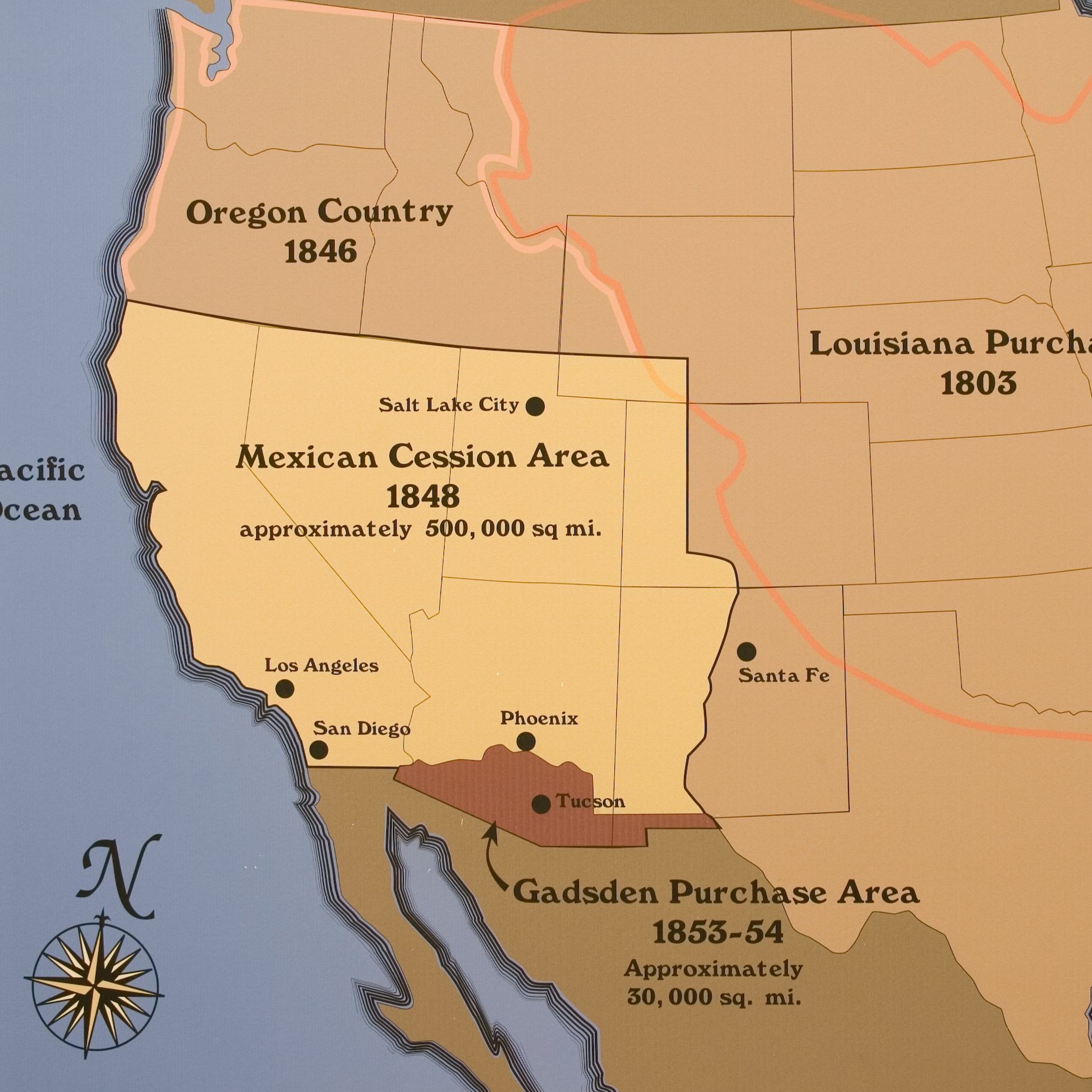
Okay, here's just a reminder of why this conflict was important, even though it happened 170 years ago, and why the agreement that followed the Treaty of Guadalupe Hidalgo, that was created under President James Polk, changed everything between America and Mexico. This is from a history channel documentary. For a price of $15 million, half the original offer made two years earlier, whole cuisine would get long desired. A Texas-Mexico border at the Rio Grande and Mexico's northern territories.
Today, that land includes the states of California, Nevada, Arizona, New Mexico, Utah, and parts of Colorado and Wyoming, more than 500,000 square miles, nearly half of Mexico's former territory. One of the images that young Mexican students see in their history textbooks when they learn about this war is an 1851 painting by Carl Neville. It's of the Zocalo in Mexico City. Here's Susan Vogel.
So it just looks like a theater hall. It looks like downtown, the middle of Mexico City, and it's got troops marching in. And when we show this to students, we say, what do you see here? Anything out of place here?
Anything unusual? It takes them a while. But then they see there's a US flag flying over the National Palace. So I say, what would it be like if you go to Washington, D.C., and you see the Canadian flag flying over the White House?
And often they say, well, that would be rude. To add insult to injury, in September 1847, when American troops hoisted their flag on Mexico's capital, it was a couple days before Mexico's national celebration of independence from Spain. Fannie, who's now a US citizen, has studied the conflict. And she says her understanding now is more nuanced.
I think Mexico played a huge role in losing this part of the territory. The way the corrupted system was built with President Santana and before that, in the relationships that they had with Mexico, the anticipation of how Texas was considered, they always considered themselves as an independent territory. All these factors played a huge role. The fact that President Polk, his idea of moving towards the West and taking advantage of this, and Mexico is the neighbor who's going to have to suffer the consequences.
Everything comes together. It's not only the invasion. This is from a 1938 Mexican film, The Cemetery of Eagles, showing the fall of Mexico City and the American soldiers admiring the bravery of the young Mexicans they've just killed. I'm Ross Chambless.
This is Nueva Svozis, part eight. And in this episode, we're talking about art and the Mexican-American War, or the American invasion, depending on which version of the story you've heard. Today in Mexico, that particular American invasion, there were actually several, is remembered with a national holiday. September 13th, they even have a national monument to mark a decisive battle.
As part of the battle that was going on in Mexico City, when the American troops arrived, there was a big battle going on the kill of Chapultepec. As the story goes, as the American soldiers closed in on the city, there were half a dozen teenage Mexican boys who fought to the bitter end. And one of them wrapped himself in the Mexican flag to save it from being captured and threw himself off the edge of a tower to his death. This story of the Nino-Séribus has become kind of a legendary.
I found a lot of material that is extremely controversial in terms of how this concept of these heroes, these boys, have been politicized throughout the history of Mexico. The monument for Nino-Séribus, or child heroes, celebrates Mexican bravery and sacrifice in a war that they lost. They even hold annual reenactment ceremonies that you can see on YouTube. Here are the Nino-Séribus.
No. This is a piece of the story of Mexico. And the people of the Nino-Séribus were the first to present the Nino-Séribus. And the people of the Nino-Séribus are the first to present the Nino-Séribus.
The Nino-Séribus represents the idea that Mexico's identity is based on fighting off invaders. And we don't think about that at all here. If I think about the cultural identity that I grew up with, it was celebrated in an American holiday every July 24th. That's Pioneer Day in Utah, the day of Mormon pioneers settled in Salt Lake City.
And every year in the days of 47 parade, a group of men in period costumes and muskets marched down State Street as the Mormon Battalion. That was a group of Mormon soldiers who went off to join the war against Mexico. Even after many years, these volunteer patriots realized that their service to God, country, and family helped to secure a vast new territory for their country through their march. The march of the Mormon Battalion.
I am on some sins across the hill and all the more and all these such heavy thoughts my heart to build, supporting with my sally. But there's this other battalion from that Mexican-American conflict that I never heard about. Coming from all over the US of A, like God's Revenge, we soon get full battalion strength. Your commasurant pounds of meat to the public train yet.
Attract right! You're in the San Patricios now! Select your commanding officer Lieutenant John Riley himself. Meet Francis Fitzgerald.
Fresh off the boat from country court. Straight into the blue and now with us. Go on to the Mormon to you, lad. One man's hero is this 1999 film about the St.
Patrick's Battalion, or the San Patricios, a group of Irish Catholic immigrants who deserted the American army and fought with the Mexicans instead. When the Irish saw that they were being discriminated because of their religion and their accent and everything that they represented from the informale and they decided what is happening here is the same thing that is happening home. So they moved to the Mexican side and they fought. The Mexicans and the Irish shared the Catholic faith and apparently the Mexicans treated them better.
But in the end, the Irish turncoats were captured and hung to death and all but erased it seems from American memory. But they're still celebrated in Mexico and with an obscure modern folk ballad. I don't think that it's Americans have tried to forget that our country invaded Mexico and took their land and that's why we don't remember it or talk about it. It may just be something that culturally we're not proud to remember.
Even in that history channel documentary, there's a tinge of guilt. This was the war that Abraham Lincoln called Unconstitutional. And this is a Scrant label, one of the most unjust wars ever waged. But the president who waged it in James Cole believed the US at ample cost.
I'm sure my experience with this so I grew up in California. Here's Luis Lopez. In school, we learned the Mexican American War. I think we spent like two days on it.
I come home and say, hey dad, today I got to learn about the Mexican American War. He goes, what? Mexican American War. So yeah, to me it's like a mutual combat, right?
Between two adversaries, over some kind of dispute. I said, no. Mexico was basically already weak, beat up, trying to recover. And they just came in and took it.
Right? And so that got completely different narrative at home. At the time I was quite sure where I fell. Do I agree more with invasion with that terminology?
Do I agree more with Mexican American War? But yeah, at age 13, real quick I realized that what schools in the United States were teaching at least in that state wasn't necessarily the whole truth. And so yeah, as a Chicano, that definitely contributed to some feelings later on about now I'm in this space. I have no control over what happened.
But there's a sense of nativeness to this land. Being a Chicano as well, history lets me know that we were here prior to these disputes and so that definitely made another connection for me. This is Susan Vogel. So I grew up with this idea, just that we all, our relatives, our ancestors came west for the great opportunities and to build our country and grow up singing the song about the US from sea to shining sea.
And just very proud of this heritage of the United States. We definitely learned that during this expansion there were some terrible things done regarding Native Americans. But other than that, it was more just proud of this pioneer heritage and the values of expanding this country and building it and the California Gold Rush and all the things that built the country we have now. Let's get back to the art.
If you could name only one image that most profoundly shaped American cultural identity during the late 1800s, what would it be? It might be this one. It's pretty commonly found in American history textbooks. It's called American Progress.
It was painted in 1872 by John Gast. It looks huge. When I first looked at that, this I thought, it must be like a mural. It's so powerful.
In fact, it's small. It's only 12 inches by 16 inches. But it's been reproduced many times. It was commissioned by a publisher of a fashionable Western travel guide and reproduced extensively in magazines and as a poster.
It's often called the Manifest Destiny image. It's a rectangular painting of an imagined landscape of the American West. There's movement in this painting from right to left, mainly because the main subject of the painting here is this blonde, white-skinned, scantily clad angelic image floating through the air, towards from the light on the right to the darkness on the left. This angelic figure lady is holding a book in her right hand.
And on the left hand, she's trailing behind her wires. So this would be telegraph wires. Or it could be Google fiber. I don't know.
It represents the expansion of technology, I think. Below this floating woman, railroad tracks are being laid. Horse-drawn stage coaches are driving forward and white European people are in the forefront, advancing westward towards the left side, which is the dark and cloudy and foreboding western frontier. And on the edge, we see Indians and buffalo and other wild animals being driven out.
I think this also is a very symbolic of the lens in which history is written, for me personally. Text throughout schools, throughout different curriculums, kind of portrays history in the same way. We see it from elementary all the way up to high school, where settlers are kind of seen as heroes and during the work of God. And the downplay of the atrocities happened to native peoples.
And so with this image of this woman looking angelic, heavenly, I mean, she doesn't look menacing or aggressive. I mean, she's just gracefully kind of gliding over these people down here, kind of protecting them. And it almost seems like naturally the Native Americans and these animals are kind of on their own just kind of going away, getting out of the way. And that's not really how things went down.
Whenever I stand under the rotunda of the Utah State Capitol in Lookup, I see images that tell stories not unlike John Gast's American progress. These large public murals tell the state's official narrative about this place. Most of the mural panels depict an industrious group of pioneers. Their skin is white as mine, intrepidly building a new home out of the wilderness.
In one panel, a group of men are planting an American flag atop Enzine Peak. But what interests me most is a single panel showing the backs of four brown-skinned Mexican-looking men wearing some rarerrows with a donkey. Next to them stands two Spanish missionaries. And next to them, a solitary Native American man standing almost pushed out of the frame.
Each of these men are lumped into the same panel, even though they inhabited this land at completely different times. They're all looking out across the horizon towards Utah Lake. I wonder what they're thinking. I wonder what stories they would tell about this place.
I wonder if they saw those white pioneers as illegal immigrants coming into Mexico. Most of history is the story written by the people who write it. And if you don't look for other sources of history, whether they're oral histories or you look at the indigenous communities and their side of it, you're not going to get a broader perspective. This is Danny Quintana.
I'm Danny Quintana. I'm a writer and environmental activist. I practice law so I can afford my nefarious activities. Danny claims his roots all the way back to Spanish settlers in 1598 who colonized New Mexico.
Well, when I was growing up, I rejected that entire view of history because my early childhood was in New Mexico, so Spanish was my first language in 16th century Castilian Spanish. And I knew my history before I came to Utah. And I always looked at history as West looking East. What are these people doing invading our lands?
So when I see these pictures, I would see the history that was being taught. And I questioned every single aspect of it, my studied history on my own. And I didn't believe any of it. And I just never bought into the whole mythology of Manifest Destiny.
In some ways, my own perception of Manifest Destiny is shaped by a more contemporary critique. There's a 1999 film called Ravenous. It's kind of an obscure black comedy horror film. And it's gruesome.
It's about cannibalism. It takes place during the Mexican-American War at an isolated American army outpost in the Sierra Mountains of California. And near the end, a few of the men are overtaken by an infectious, insatiable craving to kill and eat other people to survive. Manifest Destiny.
Westward. Expansion. In a come April. And I'll start again.
Thousands of gold hungry Americans will travel over those mountains on the way to new lives. Passing right. We won't kill. In this community.
It's unlikely. This story is an allegory of Manifest Destiny, a critique of America's unquenchable desire to expand and grab as much land as possible in the 19th century. There's no floating angel of righteous entitlement here. Just unbridled consumption, cannibalism, a crisis of morality with which the American soldiers must reconcile.
For me, this film, John Gas, American Progress, and even the murals painted above us in the Utah Capitol, retunded, skirt around some very awkward and uncomfortable questions that still linger. Who is here first? Has the taking of Mexico's land ever truly been settled? And if not, what now?
Here's Vinnie Blower. I mean, who was here first? I mean, we were going to go back. When we see that perspective as a global human perspective, it just becomes a very political, politicized language in terms of how we want to make ourselves.
And for me, really the concept of Manifest Destiny I never ever heard about this during my childhood. It was until I came to the US that I learned. I learned in a way that Santana was a very stupid Mexican precedent that allowed that to happen. That's how I learned it.
Luis Lopez. I think it definitely affects students, which is people having to live with this history where every day, when you hear about it, when you see paintings, you see images, it's only getting this one narrative that I would say deep down, you know, is not the whole truth. And it's portraying sometimes your people identify with my indigenous ancestry, it portrays us in a certain way that definitely doesn't contribute to yourself as dean, yourself image, you kind of internalize these things. So, definitely when we ask ourselves what effect do they have on students, also just people in general.
Susan Vogel grew up in Utah just like me, but as a teenager, she spent a lot of time in Mexico. I went to start going to Mexico when I was 17 and I started getting a different point of view. I mean, we're at least learning more about different points of view and it was pretty startling. Because I went from a class in El Paso, a University of Texas, El Paso where the teacher said in my class the eagle flies and the flag waves and if you don't like it take another class, then I landed in La Unam, you know, National University of Mexico City, where I was learning about things I never heard of in Mexico, so Cialismo, Maracismo, Camonizmo, suddenly my mind exploded and I thought, oh my gosh, I can learn about all these things throughout the world and it was a huge, huge and exciting thing to learn about different countries and cultures.
But what this hit me personally when I was married to a Mexican, had a baby who's half Mexican and we would bring her grandma from Mexico City and I would say, you know, welcome to Utah, welcome to Utah and she would say, which you stole from us. So I thought, what? I mean, I knew intellectually, you know, the history but I didn't realize it was so alive. I recently read an article about NAFTA and all the things going on politically now and you can't negotiate a trade agreement unless you understand the role of history.
And so from the Mexican point of view, negotiating something or renegotiating NAFTA, the perspective is the Mexican-American War, 1846, a Trump-to-order dispute that ended up with US soldiers occupying the capital of Mexico and forcing the government to sign over half the country's territory, the Mexican Revolution in 1910 when the US ambassador helped overthrow the Mexican president, the US invasion of Mexico in 1914, all of these historic events are very relevant to the current situation. And it quoted the US ambassador to Mexico saying Mexicans live their history every day. I think that's something that we don't do and that we overlook when we're dealing with other countries. The images we discussed in this episode live at the website and home for this podcast, ArtisMexUT.org.
You can also find their links to some of the films that we mentioned and discussed. Thanks to Luis Lopez, Fanny Blauer, Susan Vogel, and Danny Quintana for sharing their enlightened perspectives of Mexican culture and art. Music you heard in this episode comes from Elliot Goldenfell and Antonio Pinto, Gustavo Santo Lao, Damon Alvarne, Michael Nyman, David Rovix wrote the song about the St. Patrick's Battalion and this cover of This Land Is Your Land is like Chicano Batman.
If you want to comment or share your own impressions about any of the works of art or topics that we discussed in this episode, please let us know. You can visit our website or the Artis De Mexico and Utah Facebook site to make a comment there. This podcast is made possible by a grant from Utah Humanities thanks to KCPW in downtown Salt Lake City for the studio space. I'm Ross Calas.