
EPISODE · Jan 8, 2026 · 52 MIN
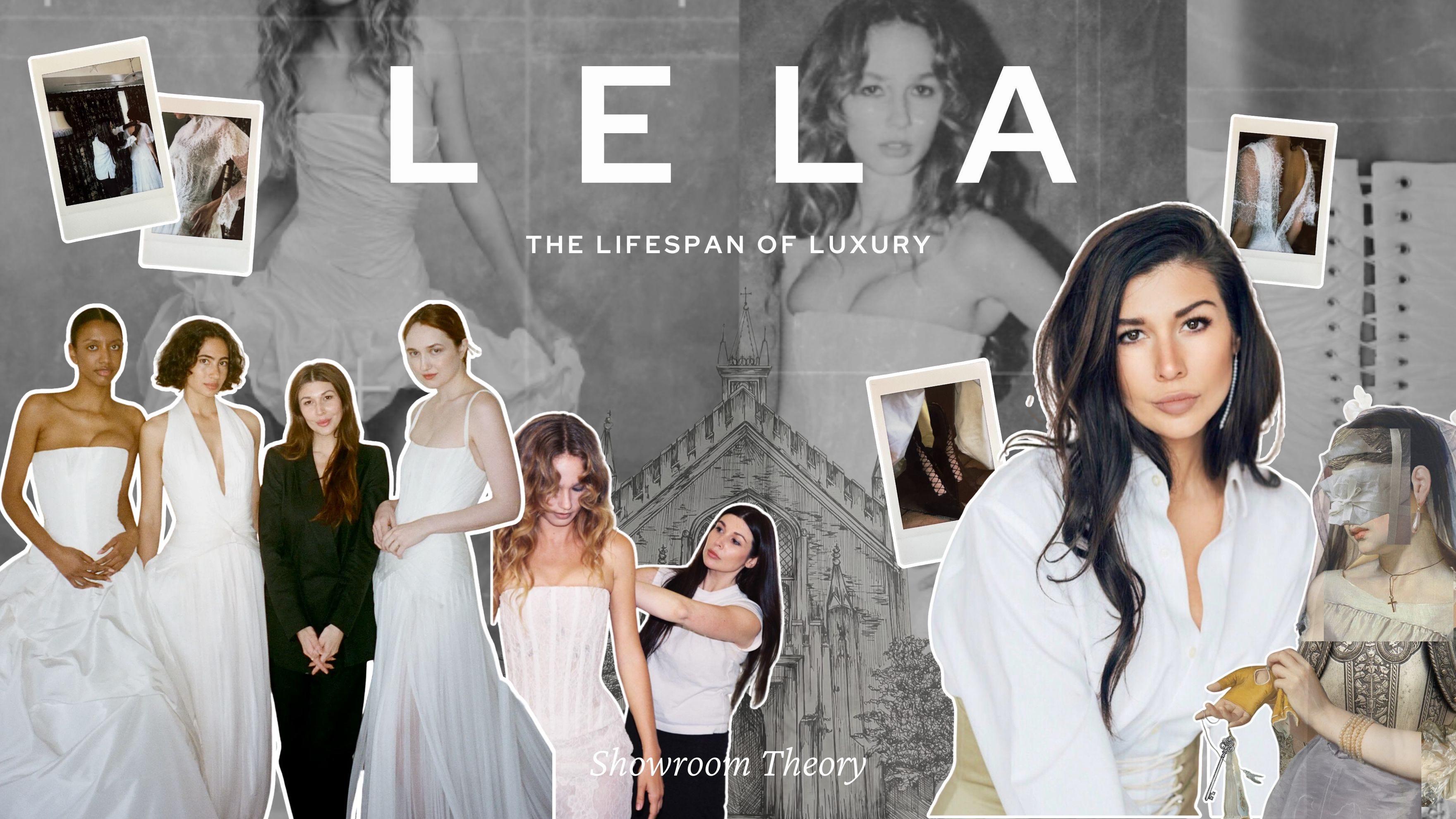
Episode 8: The Lifespan of Luxury (Lela Orr of Ferrah)
from Showroom Theory · host Showroom Theory
Editor’s Note:This conversation with Lela Orr unfolds at a moment when luxury, fashion, and bridal are quietly renegotiating their values. What emerges isn’t simply a profile of a designer, but a broader inquiry into what luxury is becoming: slower, more intimate, more durable. This accompanying essay explores those shifts - the rise of slow design as cultural resistance, the return of ceremony in consumption, and the role bridal continues to play in shaping identity - through the lens of a changing industry.Luxury is in the middle of an identity crisis. For most of the last century, the market, including bridal, has been structured around acquisition and display. Objects as proof. Ownership as status. Newness was the engine, and disposability was the cost.But revolution arrives slowly. Lela Orr, a Louisiana native and the founding designer of Ferrah, is building a bridal atelier around a reframing of value that quietly challenges the industry’s operating system. With a deep reverence for nostalgia, her home state as the primary horseman of inspiration, and a commitment to circular fashion, she prioritizes not materials, not virality, not visibility, but what survives us.She explains it without hesitation:“We only work with 20 brides right now… because I feel a big sense of responsibility with these dresses. They have to be made beautifully, but also made to last.”It is a striking statement in an industry built on speed. And it cuts directly to the heart of a broader shift unfolding inside luxury, one that is easy to sense but harder to articulate. Of course, Orr names it cleanly:“The most profound shift in luxury comes not from what things are even made of, but what happens throughout their lifespan.”In other words, luxury is no longer just about what we buy. It’s about what we keep, care for, and pass down. What Lela describes, and what I am increasingly seeing across the most thoughtful corners of bridal, is something fundamentally subversive:Luxury as stewardship.Luxury as continuity.Luxury as memory work.Slow Design as RebellionFashion has trained its insiders to equate growth with acceleration: more releases, shorter cycles, larger numbers. Bridal may not follow the same seasonal cadence as ready-to-wear, but the pressure remains. Be more efficient. Expand faster. Appear everywhere.For decades, the production model has rewarded scale and punished restraint. But Orr’s studio runs in the opposite direction.Every Ferrah gown is made in-house, with alterations included and fittings unhurried. No piece leaves the New Orleans atelier without already belonging to the body it was designed for.When I told Orr during our conversation that designing this way had begun to feel like “a form of rebellion,” she laughed.“I love being a rebel.”But what Lela’s really rebelling against isn’t the industry itself; it’s the cultural assumption that faster and bigger are inherently better. That growth must come at the expense of care. That meaning can survive mass production.Over the last two bridal seasons, I’ve listened as whispers of Ferrah’s work have circulated through the buying community, stirring the industry the way Louisiana wind lifts Spanish moss. I have had more than one conversation about what a coup it would be to secure Farrah as an exclusive made-to-order partner. The urgency is driven by two forces: genuine excitement around a designer fluent in both intention and aesthetic intelligence, and the mounting pressure retailers feel to invest in brands moving against the prevailing grain.Ferrah’s refusal to organize around speed is not nostalgic. It’s structural.And it works.In a culture built on viral hauls and ten-second trend cycles, steadiness has become foreign. We no longer recognize slow, considered framing. That doesn’t trouble Orr. She caps production at twenty brides not because demand is low - it’s not - but because the work demands it. Every decision is governed by longevity rather than throughput.That’s a radical choice in a system that measures success by scale and it’s quietly defiant in an industry addicted to velocity. It suggests that luxury’s future, and the future of bridal, may depend less on spectacle and more on stewardship.The Ceremony of Making Things LastIn bridal, this philosophy finds its most natural home.For decades, fashion has conditioned us to think of garments as temporary. Replaceable. Seasonal. Disposable. Bridal remains one of the few categories where permanence is not only possible, it’s expected.“That linear take-make-waste model that defined fashion for so long is yielding to something more elegant… which is like circular fashion. I’m making something that’s going to become a family heirloom,” says Orr.An heirloom not as aesthetic, but as a future-oriented object.One that assumes memory and anticipates inheritance.That’s not retail, it’s ceremony.Joy as a Design ValueAnother shift unfolding alongside this structural change is the elevation of emotional experience as a legitimate design outcome. For decades, fashion evaluated success through visual metrics: silhouette, sell-through, status. How a garment felt on the body was secondary. To its credit, in bridal, that hierarchy is inherently inverted. Even in bridal, where emotional stakes are higher, joy is still rarely treated as a primary design value. Yet joy is precisely what many brides are seeking: physical ease, emotional safety, self-recognition. These aren’t abstract ideals. They’re measurable outcomes that determine whether a gown truly transforms its wearer.Not transformation through spectacle, but alignment through experience.That does not negate beauty, craftsmanship, sex appeal, luxury, silhouette, or structure. But joy, the lived internal experience of the wearer, has quietly slipped from the center of design.“Joy in dressing and joy for such a special day… that’s why I do what I do. It begins when you come to the atelier and lasts until you wear it on your wedding day. When people put things on and say they feel happy, or comfortable, or glowing… I’m like, yes. That’s the moment.”In Ferrah’s work, joy isn’t simply decorative, it’s functional. Against all ‘snatched to the gods’ odds, even the idea of support operates on two levels. Lela unabashedly prioritizes the comfort of her brides. She’s often shocked to hear that clients are surprised at Ferrah’s balance between literal structural support (corsets) and ease of movement.But to me, it’s clear that ‘support’ functions as a double entendre inside this atelier.it’s It’s engineered through breathability, yes, but there is also emotional support: trust, collaboration, and the rare experience of leaving an atelier both physically and psychologically held. Brides depart with a snatched waist and an expanded sense of self.Bridal as Identity TransformationBridal is often dismissed as frothy, decorative, commercial. Anyone who has stood in a fitting room with a woman crossing that threshold knows better.What distinguishes bridal from most of fashion is not only longevity, but its proximity to identity transformation.Bridal garments are worn at a threshold moment. They participate in the reorganization of self. They become part of how the wearer understands who she is before and after the ceremony.As I found myself saying during my conversation with Orr:“The garment, the dress, the designer becomes almost a witness to that transformation.”This is why bridal cannot be reduced to product. It’s infrastructure for becoming.The dress does not create the change. But it holds it.It becomes the physical record of becoming. Ephemera for metamorphosis.What Survives UsWhat Lela is building with Farrah, and what many emerging designers are quietly constructing alongside her, is not simply a brand. It is a revolutionary contract between maker and wearer.One that prioritizes care over churn.Memory over momentum.Presence over production.Luxury is not evolving toward spectacle, it’s evolving toward permanence.Toward objects that learn our names (and our children’s names). Toward garments that absorb our most tender moments. Toward a future in which what matters most is not what we consume, but what we choose to carry forward.The most meaningful luxury isn’t defined by what we accumulate. It’s defined by what lingers. And for some, what lingers just happens to have a corset.Thank you so much for reading! Subscribe for free to receive new articles and support my work. It means the world! This is a public episode. If you would like to discuss this with other subscribers or get access to bonus episodes, visit showroomtheory.substack.com
Embed this episode
Ready to play
Episode 8: The Lifespan of Luxury (Lela Orr of Ferrah)
No transcript for this episode yet
Similar Episodes
No similar episodes found.