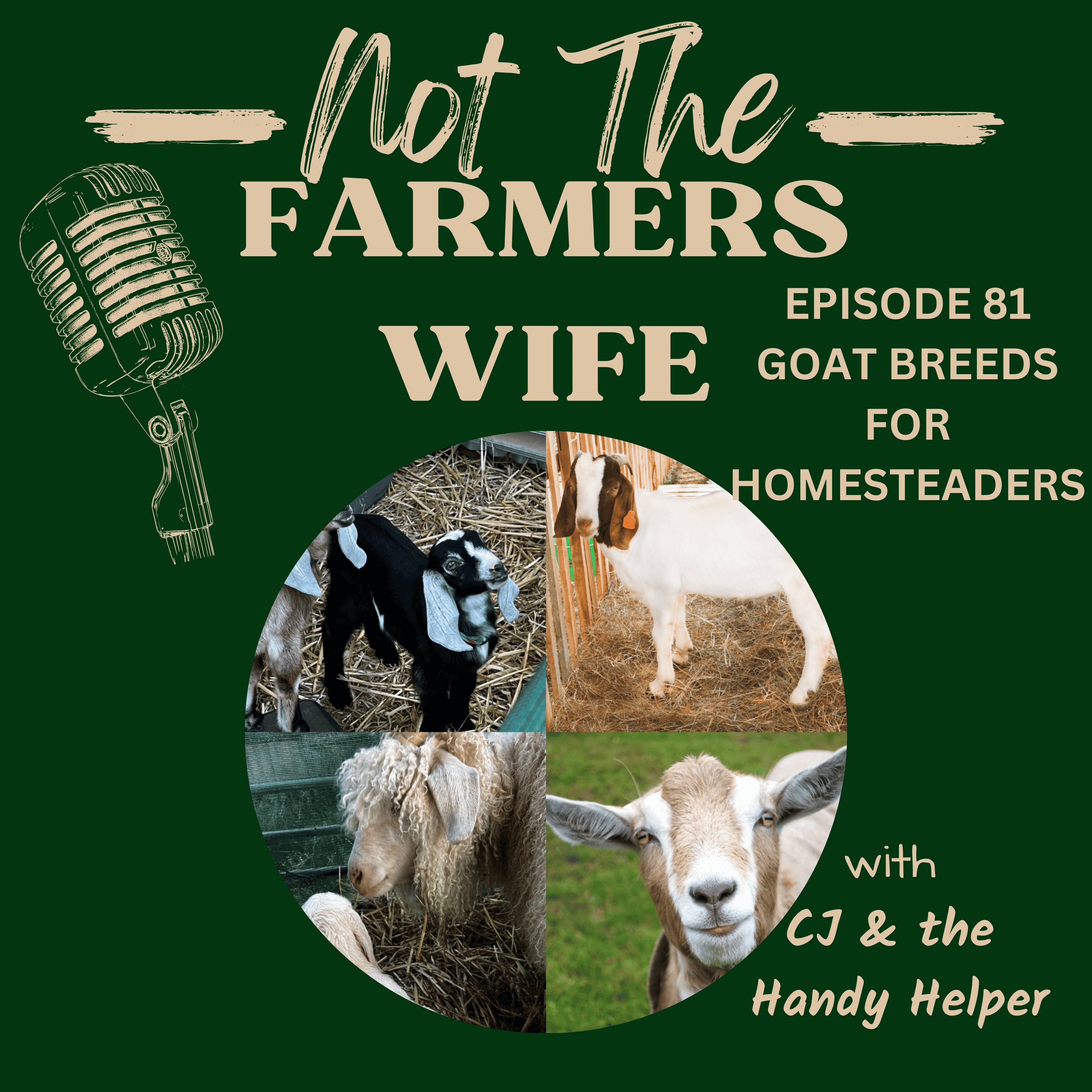
Episode 81 - Goat Breeds for Homesteaders episode artwork

EPISODE · Sep 15, 2024 · 53 MIN

Episode 81 - Goat Breeds for Homesteaders

from Ditch The Store · host CJ Steedman

Goat Breeds for Homesteaders  Introduction - Why Goats?     - Goats are versatile animals that can provide meat, milk, and fibre.   - They are relatively low-maintenance and adaptable, making them a popular choice for homesteaders.   - Overview of the three main categories of goat breeds: meat, milk, and fibre.   Meat Goat Breeds    - Purpose: Raised primarily for their meat, these breeds are typically hardy and efficient converters of feed into body mass.   Boer (bow-uh or bor)    - Pros:      - Fast-growing, large, and heavy-muscled.      - High-quality meat production.      - Easy to manage and generally docile.      - Good feed-to-meat conversion rate.    - Cons:      - Can be prone to health issues if not well-managed (e.g., parasites).      - More expensive initial purchase cost.      - Requires good fencing due to their strength and curiosity.   Kiko (kee-ko)    - Pros:      - Extremely hardy and low-maintenance.      - Resistant to parasites and diseases.      - Good foragers, can thrive on rough terrain.    - Cons:      - Slower growth compared to Boer goats.      - Meat yield may be lower in comparison to larger breeds.      - Can be more independent, which may be challenging for beginners.   Rangeland    - Pros:      - Highly adaptable and resilient to harsh environments.      - Low maintenance with excellent foraging ability.      - Can thrive in extensive, low-input systems, ideal for beginner homesteaders.    - Cons:      - Generally smaller than Boer or Kiko, so less meat yield.      - Can be wilder in temperament and harder to manage in confined spaces.      - May require more time to acclimate to different climates.   Milk Goat Breeds    - Purpose: Primarily kept for their high milk production, with some breeds also having dual-purpose qualities.   British Alpine    - Pros:      - Excellent milk production.      - Hardy and adaptable to different climates.      - Good for mixed-flock operations.    - Cons:      - Lower butterfat content compared to other dairy breeds.      - Can be more independent and aloof.      - More attention may be required to their nutrition for optimal milk production.   Saanen    - Pros:      - One of the highest milk producers.      - Calm and gentle demeanor.      - Good choice for family farms due to their obedience.    - Cons:      - Milk has a lower butterfat content.      - Sensitive to heat, so may require additional cooling in hot climates.      - Large size can be intimidating for beginners.   Fibre Goat Breeds    - Purpose: These goats are primarily raised for their fibre, which can be used to produce high-quality wool or cashmere.   Angora    - Pros:      - Produces high-quality mohair fibre.      - Mohair is valuable and in demand.      - Can be dual-purpose for both fibre and meat.    - Cons:      - High maintenance: Require regular shearing and more grooming than other breeds.      - Susceptible to parasites, so health management is key.      - Not as hardy as other breeds, more prone to illness in harsh climates.   Cashmere    - Pros:      - Produces luxury cashmere fibre.      - Hardy and adaptable to different environments.      - Typically less maintenance than Angoras.    - Cons:      - Fiber yield is lower per goat compared to Angoras.      - Cashmere goats can be more independent and less docile.      - Need specialised knowledge to harvest and process cashmere properly.    Dual-Purpose Goat Breeds    - Purpose: Some breeds can provide both meat and milk, offering versatility for homesteaders.   Anglo-Nubian    - Pros:      - High butterfat content in milk (great for cheese and cream).      - Dual-purpose: Can also provide meat.      - Friendly and social personality.    - Cons:      - Loud and vocal, which may be a concern for neighbours.      - Prone to health issues in wet or cold climates.      - Require good fencing, as they can be escape artists.   Toggenburg    - Pros:      - Good milk production with decent butterfat content.      - Adaptable and hardy in various climates.    - Cons:      - Milk production is lower than top milk breeds.      - Can be more aloof than other dairy breeds.      - Not as large as Boer or Kiko for meat production.   Nigerian Dwarf    - Pros:      - Excellent milk for its size, with high butterfat content.      - Small, manageable size for beginners.      - Friendly, easygoing personality.    - Cons:      - Lower milk yield due to small size.      - Not suitable for large meat production.      - Can be escape artists if fencing isn’t secure.    Factors to Consider When Choosing a Goat Breed    - Homestead Goals: Do you want milk, meat, fibre, or a combination of these?    - Climate: Some breeds are more suited to hot or cold climates.    - Space Available: Larger breeds need more room to roam.    - Experience Level: Some breeds are better for beginners, while others require more hands-on care.    - Budget: Consider initial costs, as well as long-term care and maintenance.    Conclusion - Balancing Needs with Practicality: Encourage new homesteaders to evaluate their needs and goals before choosing a goat breed. - Starting Small: For first-timers, starting with a dual-purpose or easy-to-manage breed may be the best choice. - Continued Learning: Keeping goats is a rewarding experience that requires ongoing care, learning, and patience.

Goat Breeds for Homesteaders  Introduction - Why Goats?     - Goats are versatile animals that can provide meat, milk, and fibre.   - They are relatively low-maintenance and adaptable, making them a popular choice for homesteaders.   - Overview of the three main categories of goat breeds: meat, milk, and fibre.   Meat Goat Breeds    - Purpose: Raised primarily for their meat, these breeds are typically hardy and efficient converters of feed into body mass.   Boer (bow-uh or bor)    - Pros:      - Fast-growing, large, and heavy-muscled.      - High-quality meat production.      - Easy to manage and generally docile.      - Good feed-to-meat conversion rate.    - Cons:      - Can be prone to health issues if not well-managed (e.g., parasites).      - More expensive initial purchase cost.      - Requires good fencing due to their strength and curiosity.   Kiko (kee-ko)    - Pros:      - Extremely hardy and low-maintenance.      - Resistant to parasites and diseases.      - Good foragers, can thrive on rough terrain.    - Cons:      - Slower growth compared to Boer goats.      - Meat yield may be lower in comparison to larger breeds.      - Can be more independent, which may be challenging for beginners.   Rangeland    - Pros:      - Highly adaptable and resilient to harsh environments.      - Low maintenance with excellent foraging ability.      - Can thrive in extensive, low-input systems, ideal for beginner homesteaders.    - Cons:      - Generally smaller than Boer or Kiko, so less meat yield.      - Can be wilder in temperament and harder to manage in confined spaces.      - May require more time to acclimate to different climates.   Milk Goat Breeds    - Purpose: Primarily kept for their high milk production, with some breeds also having dual-purpose qualities.   British Alpine    - Pros:      - Excellent milk production.      - Hardy and adaptable to different climates.      - Good for mixed-flock operations.    - Cons:      - Lower butterfat content compared to other dairy breeds.      - Can be more independent and aloof.      - More attention may be required to their nutrition for optimal milk production.   Saanen    - Pros:      - One of the highest milk producers.      - Calm and gentle demeanor.      - Good choice for family farms due to their obedience.    - Cons:      - Milk has a lower butterfat content.      - Sensitive to heat, so may require additional cooling in hot climates.      - Large size can be intimidating for beginners.   Fibre Goat Breeds    - Purpose: These goats are primarily raised for their fibre, which can be used to produce high-quality wool or cashmere.   Angora    - Pros:      - Produces high-quality mohair fibre.      - Mohair is valuable and in demand.      - Can be dual-purpose for both fibre and meat.    - Cons:      - High maintenance: Require regular shearing and more grooming than other breeds.      - Susceptible to parasites, so health management is key.      - Not as hardy as other breeds, more prone to illness in harsh climates.   Cashmere    - Pros:      - Produces luxury cashmere fibre.      - Hardy and adaptable to different environments.      - Typically less maintenance than Angoras.    - Cons:      - Fiber yield is lower per goat compared to Angoras.      - Cashmere goats can be more independent and less docile.      - Need specialised knowledge to harvest and process cashmere properly.    Dual-Purpose Goat Breeds    - Purpose: Some breeds can provide both meat and milk, offering versatility for homesteaders.   Anglo-Nubian    - Pros:      - High butterfat content in milk (great for cheese and cream).      - Dual-purpose: Can also provide meat.      - Friendly and social personality.    - Cons:      - Loud and vocal, which may be a concern for neighbours.      - Prone to health issues in wet or cold climates.      - Require good fencing, as they can be escape artists.   Toggenburg    - Pros:      - Good milk production with decent butterfat content.      - Adaptable and hardy in various climates.    - Cons:      - Milk production is lower than top milk breeds.      - Can be more aloof than other dairy breeds.      - Not as large as Boer or Kiko for meat production.   Nigerian Dwarf    - Pros:      - Excellent milk for its size, with high butterfat content.      - Small, manageable size for beginners.      - Friendly, easygoing personality.    - Cons:      - Lower milk yield due to small size.      - Not suitable for large meat production.      - Can be escape artists if fencing isn’t secure.    Factors to Consider When Choosing a Goat Breed    - Homestead Goals: Do you want milk, meat, fibre, or a combination of these?    - Climate: Some breeds are more suited to hot or cold climates.    - Space Available: Larger breeds need more room to roam.    - Experience Level: Some breeds are better for beginners, while others require more hands-on care.    - Budget: Consider initial costs, as well as long-term care and maintenance.    Conclusion - Balancing Needs with Practicality: Encourage new homesteaders to evaluate their needs and goals before choosing a goat breed. - Starting Small: For first-timers, starting with a dual-purpose or easy-to-manage breed may be the best choice. - Continued Learning: Keeping goats is a rewarding experience that requires ongoing care, learning, and patience.

NOW PLAYING

Episode 81 - Goat Breeds for Homesteaders

0:00 53:48

No transcript for this episode yet

We transcribe on demand. Request one and we'll notify you when it's ready — usually under 10 minutes.

Big Old Life: Heather Blackbird interviews people on planet earth. Heather Blackbird loves asking questions. This podcast is a learning experience. Join me, Heather Blackbird, as I talk to people about their lives. Frequency of new episodes is a little all over the place and I'm learning as I go. Big Old Life is a small way of talking about the vastness of life, one person at a time. If you are reading this or found this podcast it's probably because someone you know gave you a link to it. :) Explicit Tales Of A Superstar DJ The Insomniac Spun seemingly out of nowhere from her complacent life in the corporate world, turned seemingly overnight from 16-Hour shift work and into the life of a literally starving artist and working musician, The Protagonist navigates her supposed rise to fame and superstardom on a journey through spiritual awakening, coming-of-age, and intimate self-realization--guided by an omnipresent force and equipped with the power of love, magic, and music. {Enter The Multiverse.} [The Festival Project] The Festival Project, Inc.™ is a multidimensional multimedia platform which encompasses exploratory and artistic social personifications and expressions on cosmic theory, spirituality, growth, health & wellness, philosophy and theoretic dynamics in entertainment such as music, design, film, television, radio, dance and festival culture, art, fashion, literature, and science. The Festival Project™ and its subsidiary Non-Profit, The Collective Complex © aims to challenge modern artistic and philosop Explicit Bitcoin Is Dead Trey Carson Welcome to Bitcoin is Dead, the ultimate Bitcoin variety show where host Trey takes you on a journey through the ever-evolving world of Bitcoin. Each episode brings new personalities, fascinating locations, and insightful conversations with politicians, educators, and innovators shaping the future of Bitcoin. Whether you're a seasoned Bitcoiner or just starting your journey, tune in for thought-provoking discussions, unique perspectives, and a deep dive into the ideas and people driving the Bitcoin revolution. Explicit The Sacred +Profane Podcast nephtaragrace The Sacred + Profane Podcast is a provocative conversation dedicated to cementing a better future for all. We specialize in unpacking the nuances of what is considered sacred and profane, particularly focusing on sex, death, and all that pertains to the circle of life. Our aim in focusing on such ”taboo” subject matter is to demystify what is unconscious, bring to light what has been known for centuries as ”the occult,” and empower the rapid transformation that is occurring on the Planet. Explicit

Frequently Asked Questions

How long is this episode of Ditch The Store?

This episode is 53 minutes long.

When was this Ditch The Store episode published?

This episode was published on September 15, 2024.

What is this episode about?

Goat Breeds for Homesteaders  Introduction - Why Goats?     - Goats are versatile animals that can provide meat, milk, and fibre.   - They are relatively low-maintenance and adaptable, making them a popular choice for homesteaders.   - Overview of...

Can I download this Ditch The Store episode?

Yes, you can download this episode by clicking the download button on the episode player, or subscribe to the podcast in your preferred podcast app for automatic downloads.
URL copied to clipboard!