
EPISODE · Jan 16, 2026 · 45 MIN
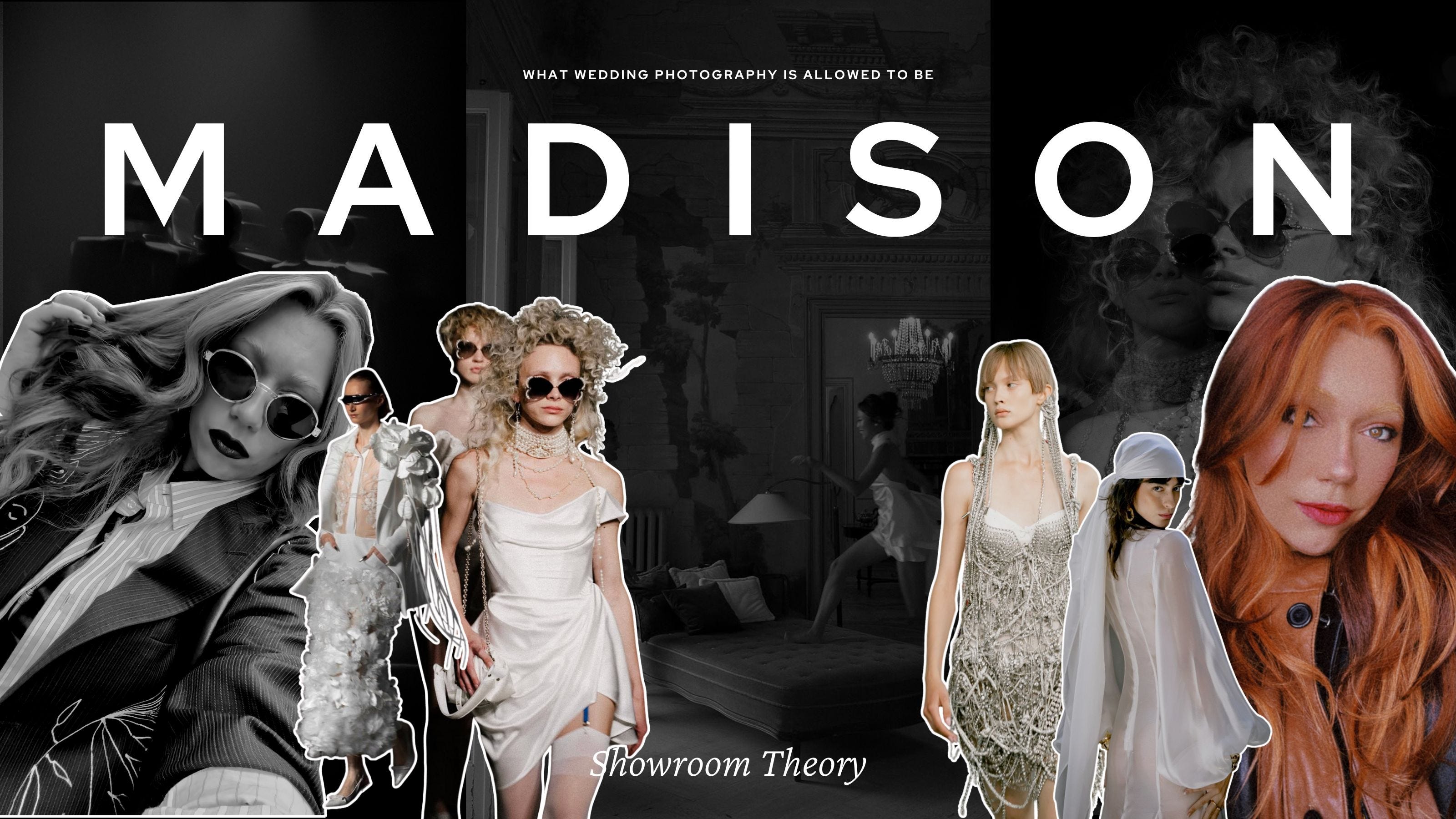
Episode 9: What Wedding Photography Is Allowed to Be with Madison Aycoth
from Showroom Theory · host Showroom Theory
The Lie We Tell About Wedding PhotographyThe wedding industry has been misleading us about photography. Not because it minimizes the medium, quite the opposite, but because it narrows it. Oversimplifies it. Prescribes it. In weddings, photography is treated as sacred, indispensable, and non-negotiable. And yet, within that reverence, there’s an astonishing amount of policing. The right kinds of photos. The right style. The correct visual grammar required for a wedding to be legible to publishers, platforms, and the broader bridal gaze. A checklist of must-snap shots masquerading as taste.It’s not that couples don’t care about photography… they care deeply. Wedding photography sits squarely alongside the dress in terms of emotional hierarchy. Photographs are the artifact meant to outlive the day itself. The proof that something meaningful occurred. And because they carry so much weight, just as we always do, we’ve quietly turned photography into a performance of correctness. What began as preservation has become prescription.Timelessness, in this context, is rarely about time. It’s about compliance.Feral by DesignWhat photographer Madison Aycoth does, both in weddings and in her work capturing traditional (albeit avant-garde) fashion, is refuse compliance.Self-proclaimed “equal parts catharsis and catastrophe,” Madison shifts between fashion and weddings with a fluency that makes some people uneasy. Not because she lacks seriousness in either world, but because she refuses to hierarchize them. She’s spent years photographing backstage at fashion shows, inside compressed, high-adrenaline environments where emotion runs just beneath the surface and time collapses into urgency. These are spaces defined by movement, instinct, and proximity - where the final image isn’t about polish so much as presence. And in fashion, you learn quickly that perfection is rarely the point. Feeling is.She brings this training into weddings without softening it. Not as provocation, and not as aesthetic rebellion, but as a different way of seeing. Madison approaches weddings not as a sequence to be managed or a checklist to be completed, but as temporary worlds - emotionally charged, physically demanding, often unruly in the way meaningful rituals tend to be. Her instinct isn’t to tidy that reality into something more palatable, but to stay with it long enough for something honest to surface. Madison’s work resists the industry’s default grammar not because she’s rejecting weddings, but because she’s taking them seriously on their own terms. That seriousness, about emotion, about presence, about what images are capable of holding, is what makes her work feel disruptive in a space so unnervingly obsessed with visual correctness.Proof Versus InterpretationWedding photography has learned to confuse proof with care. The rules flatten experience into evidence, insisting that emotion be legible, orderly, and complete. But weddings themselves are rarely any of those things. They are feral. Physical. Unruly. Full of sweaty dancing, ugly crying, and the unguarded seconds when composure drops and something true slips through.Photography, in other spheres, has long been allowed to sit with that discomfort. Fashion understands blur, shadow, and tension not as flaws but as language. It allows images to unsettle before they reassure, to withhold explanation, to make the viewer pause rather than immediately admire. Beauty, in that world, doesn’t announce itself politely.“Fashion is inherently very experimental… weddings are inherently incredibly safe and at the risk of also staying mildly performative.” - Madison AycothWhen that mindset enters weddings, even quietly, the images begin to ask something different of us. To feel first. To sit with what’s unresolved. To experience the photograph not as confirmation of the event, but as its own encounter.When couples set out to find a photographer among the endless swell of “Best Of” articles, they’re often searching for someone who can best immortalize a day they’ve poured everything into: money, energy, time, negotiation, tension… often more than they can budget on all fronts. They want to know none of it was wasted. That it all counted. In this way, photography becomes a form of insurance.But an editorial, emotion-led approach to photography doesn’t always uphold that desire. It doesn’t promise completeness. It doesn’t guarantee that everything will look “right.” Instead, it offers something riskier yet far more rewarding: a mirror. An interpretation. Art where documentation once stood. Light becomes architecture. Shadows carry meaning. Off-kilter posing reveals something truer than symmetry ever could.Of course, this is where the anxiety enters. Because interpretation cannot be controlled in the same way as proof can.Letting the Day HappenMadison spoke to me a few weeks ago about encouraging the couples that come to her (most of them already familiar with her style and therefore more inclined to experiment) to take risks. To abandon the self-imposed timeline. To let the day unfold rather than forcing it into the familiar order. To accept photographic evidence not as a checklist of manufactured moments, but as its own art form - one that responds to what actually happens, not what was planned to happen.She’s uninterested in industry approval. In clout. In cliques. In fact, Madison takes pleasure in shaking things up:… One of my favorite things to do is like kind of ruffle feathers a little bit in the bridal industry… But you think it’s cool. You don’t know why you think it’s cool yet, but you do think it’s cool… It’s the same for my work in wedding photography. It’s like, “Oh, you think it’s cool, but you don’t understand why you think it’s cool.” And for me, that was what I wanted because I still was able to get you to think about it. - Madison AycothWhat matters to her is the work. Being a conduit for it. Consequently, her world-building is quiet but total: the way she finds shadow by being fully present, the way music guides the emotional register she wants both models and couples to inhabit. A playlist becomes a moodboard for feeling, not aesthetics. Sound shaping sight. Rhythm guiding memory.The Fashion/Wedding Divide Is a Convenient FictionThe harsh contrast the industry typically draws between the fashion world and the wedding world is largely a facade. Both industries traffic in the same materials: desire, identity, ritual, aspiration. Both rely on image-making to construct meaning. The insistence on separating them serves less to protect tradition than to mitigate risk.Fashion photography is allowed abstraction because it’s not burdened with legacy. Weddings are denied it precisely because they are.On runways and in cramped backstage dressing rooms, emotions are allowed to be messy. Human. Chaotic. The chaos itself is an essential part of the full experience, and capturing it becomes a way to share both the glamour and behind-the-scenes choreography that’s otherwise unseen to the voyueristic eye. But in weddings, this same swirl of activity (preceding an eerily similar walk down the aisle) is forbidden. To crystallize it ina photo is to betray the illusion of perfection, serenity, and beauty of the most orchestrated perfect day in a couple’s lives. Photography itself doesn’t change based on subject matter. It remains interpretive, selective, and subjective… or it can, if we allow it.What changes is the permission we grant it.What We’re Actually Afraid OfI think what we’re actually afraid of is being seen as ‘other.’ Of constructing a ritual that doesn’t quite fit the box a decade of hyper-visible weddings has built for us. We’re afraid art will capture something unflattering in all its messy, chaotic humanness. Afraid that we’ll be ugly criers - and that this will be what’s remembered, preserved in evidence, rather than carefully staged invitation suites or the perfunctory bouquet shot.We’re afraid of losing narrative control.But it’s worth asking what we truly want to immortalize on film. What we want to hold in our hands fifty years from now. Because long after the bridal industrial complex has crumbled, these rituals will still have happened. They are our histories. Our legacies. To reduce them to curated photo dumps optimized for approval is not preservation. It’s a kind of lie.Who Benefits From the FearNot to tiptoe too closely to anarchy, but the industry benefits from this fear because it keeps us consuming. Comparing. Scaling up. Bigger, better, more viral weddings require more money, more resources, more investment. This is a sixty-six-billion-dollar industry in the U.S. alone. It thrives on legibility. On repetition. On images that perform well in public.The punk, the homemade, the pared back threaten that economy. They resist optimization. They don’t always translate cleanly to platforms designed for sameness.Fear keeps the loop intact.Photography as InterruptionPhotography could interrupt this loop - not by abandoning documentation, but by refusing adherence. By making room for experimentation, tension, darkness, truth. By borrowing not fashion’s aesthetics, but its permission structure. Its willingness to let images be felt before they are understood.You only need glance at Madison’s work (spanning “a collection of uninterrupted wedding moments” to “all things bridal, runway, and editorial”) to observe this tension in action. If weddings are one of the last places we still allow ourselves to feel sincerely, then it’s our responsibility to inhabit that sincerity fully. To let it be shaped by the moment rather than managed by expectation. We have so few remaining spaces for this kind of embodied presence now - call it breath-work, call it surrender, call it being human without polish - that policing it feels like a cultural failure.This isn’t a call to stop photographing weddings. Quite the opposite. It’s a call to document them with abandon. To allow photography to function not just as evidence, but as witness.Meaning-making through ritual that results in shallow images is a waste of time and resources. Meaning-making that results in historical proof - messy, imperfect, emotionally intact - that’s fashion. That’s punk. That’s forever.Thanks for reading & listening to the podcast! Subscribe for free to receive new posts and support my work. This is a public episode. If you would like to discuss this with other subscribers or get access to bonus episodes, visit showroomtheory.substack.com
Embed this episode
Ready to play
Episode 9: What Wedding Photography Is Allowed to Be with Madison Aycoth
No transcript for this episode yet
Similar Episodes
No similar episodes found.