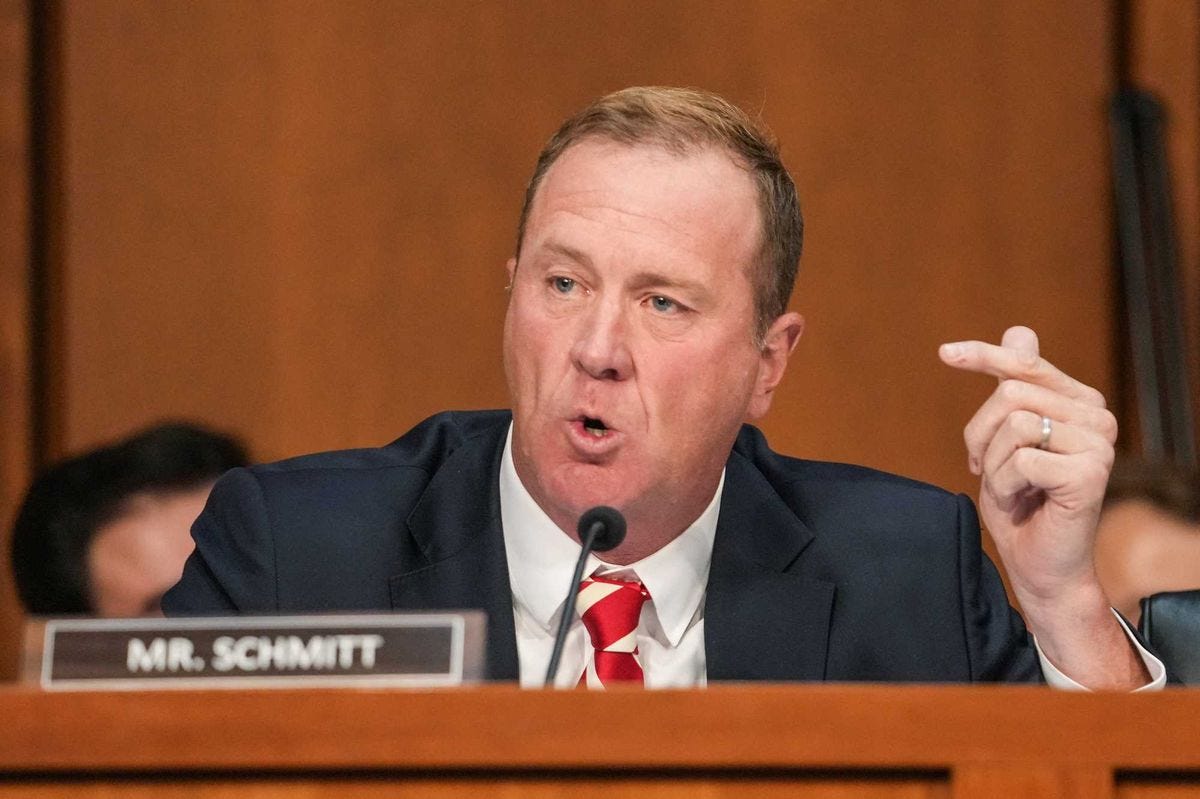
Eric Schmitt suffers new embarrassment as aide blames 'software error' for donor mess
from Systemic Error Podcast Hosted by Paulo Santos
What happened RawStory reports that Federal Election Commission staff sent three letters to U.S. Sen. Eric Schmitt’s campaign committee seeking corrections or explanations for apparent campaign-finance reporting problems. Thirteen out-of-state donors appeared nearly 5,700 times in Schmitt’s reports, producing a net $85,672 in contributions; reported totals for each donor ranged from just over the $3,500 per-election limit to more than $10,500. Campaign treasurer Janna Rutland attributed mismatched donor information to a “software error” and said amended reports included necessary refunds, redesignations or reattributions. The FEC letters do not establish that Schmitt, his campaign or any donor violated federal law, and the reporting does not determine whether the underlying transactions were intentional, accidental or unwanted. One Texas woman’s name appeared 1,011 times in Schmitt’s filings and more than 126,000 times across federal records after she began donating through WinRed in December 2023. Multiple filings can arise from a single contribution moving among platforms and committees, but former FEC chairman Bradley Smith said numbers that large warrant scrutiny. The campaign owns the filings Schmitt’s campaign holds the relevant institutional responsibility. WinRed may process transactions, donors may authorize recurring payments, and software may generate bad data, but the campaign committee files the reports, accepts the money and must correct excessive contributions. Rutland’s explanation identifies a mechanism, not an absence of responsibility. “Software error” does not tell the public which system failed, why the campaign missed the mismatches, how long the problem persisted or what controls now prevent a recurrence. The campaign reportedly did not answer a request for comment, leaving its compliance letters to do all the explaining. Automation serves the recipient Automated fundraising is not merely administrative plumbing. It lets campaigns extract enormous transaction volume from a relatively small pool of people while reducing processing costs. The political organizations receive those benefits; donors and regulators absorb much of the resulting confusion. The scale described here makes passive innocence an inadequate standard. Schmitt’s committee reportedly received repeated FEC inquiries involving overlapping donors. Another Missouri Republican, Rep. Eric Burlison, said his campaign blocked the same Texas donor after daily—and sometimes twice-daily—payments began to resemble spam. That response shows campaigns can intervene when anomalous activity becomes obvious. The donor is the weaker party The convenient framing treats recurring contributions as a test of whether individuals read the form carefully enough. Burlison defended recurring donations by calling contributors “intelligent agents,” provided the forms are clear. But clarity is precisely what has been disputed: online donation systems have faced scrutiny over design choices that can obscure recurring-payment terms. The reporting does not establish that Schmitt’s donors were deceived. It does establish a lopsided arrangement. Campaigns and fundraising platforms design and operate the machinery, possess the transaction data and benefit from repeated payments. Individual donors must detect unwanted charges, seek cancellation and hope campaigns maintain accurate records. Blaming inattentive users would shift accountability away from the institutions best positioned to prevent the problem. Regulation trails the machine Missouri tightened its rules after reporting showed that a 92-year-old Nebraska veteran had unwittingly become a recurring donor to a county campaign. State and local candidates must now obtain clear consent, issue a receipt for every donation and stop recurring payments when asked or after an election. The article says comparable federal restrictions do not exist. That gap is a political choice expressed through inaction. The FEC can request explanations and corrections after suspicious patterns appear, but post hoc bookkeeping does little to protect a donor who never knowingly intended a long series of charges. A system built around automated extraction cannot be adequately policed by waiting for extraordinary totals to trigger a letter. A profitable failure of accountability This story reveals a familiar structure: political organizations embrace automation for its efficiency, then invoke technical complexity when the resulting records become indefensible. The evidence here does not prove fraud or establish a campaign-finance violation. It does show that thousands of entries, repeated regulatory questions and implausibly prolific donor records can accumulate before meaningful scrutiny arrives. Calling that a donor mess understates the hierarchy. The donor supplies the money. The platform controls the interface. The campaign receives the benefit and bears the reporting duty. The regulator arrives later, asking for corrections. When responsibility dissolves into “software,” every institution keeps its advantage while no human actor appears answerable for the foreseeable consequences. Thanks to Raw Story Source: Eric Schmitt suffers new embarrassment as aide blames ‘software error’ for donor mess This is a public episode. If you would like to discuss this with other subscribers or get access to bonus episodes, visit paulstsmith.substack.com
Embed this episode
No transcript yet.