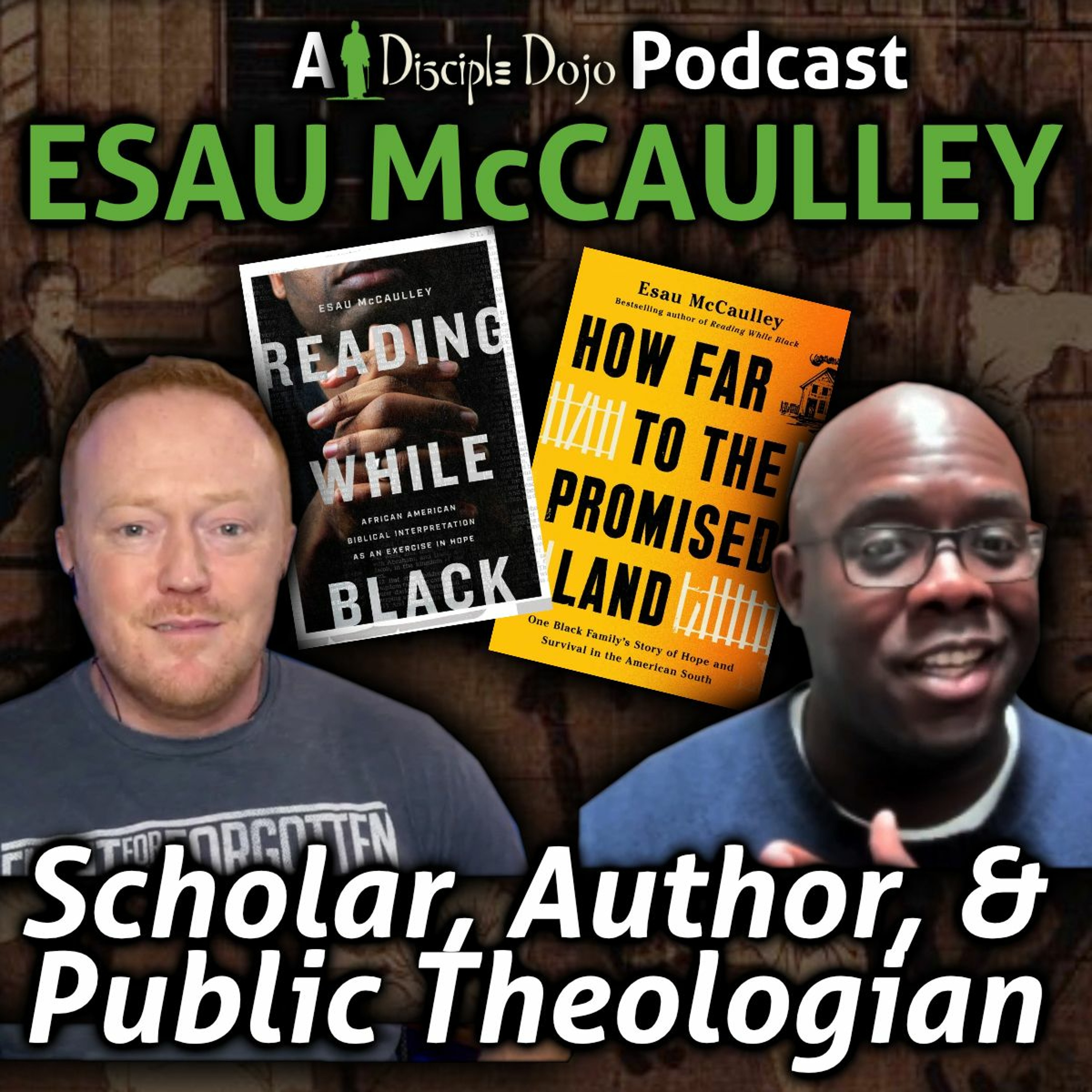
Welcome to Disciple Dojo. You are in for a treat today. I got to sit down with a friend of mine from my old seminary days. You may have heard of him, Dr. Esau McCulley. Esau and I were at Gordon-Conwell together back in the day. And since then, he has gone on to do amazing things. Got his PhD under N.T. Wright, which in and of itself is just...
And he's also written a couple of amazing books, two of which I have here with me. The first, Reading While Black. This is one of the best books that I've ever read. I cannot speak highly enough about Reading While Black. If you have not read this book, you need to read it. And then his new book, which we talk about in this episode, How Far to the Promised Land, One Black Family's Story of Hope and Survival in the American South. And this is a memoir.
Esau talks about his childhood and growing up and some trauma that happened in his family and how God used all of that to shape and to transform him into the person who he is today. The husband, the father, the writer, the scholar. I ordered this book on Kindle and I read it in under 24 hours. It is incredibly compelling. It's available on Audible as well. So I reached out to Esau and asked if he'd be willing to come on and chat for a little bit here in the dojo. And he graciously agreed to. And so before we jump into that interview, if you haven't already, do us a favor and click that little subscribe button and the notification icon right beside it. Those two things that don't cost anything.
are two of the most important things you can do to help us continue to grow this channel. And as always, Disciple Dojo is a 501c3 nonprofit. Everything we do is donor funded. So if you believe in what we're doing, if you enjoy the content, if you want to help us keep the lights on, then I'd invite you to consider becoming a monthly Disciple Dojo donor. That really, really helps us in a tangible way. And it can be whatever dollar amount you feel led or are able to give. Okay, let's talk to my friend, Dr. Esau McCauley.
Esau, it really is great to have you here. It was 20 years between when we were in a room together and then we were in a room together again. And so now it's been almost one year that we're talking again, but it's because you've been doing some amazing work. And so I'm thrilled to have you here and I want to talk about what's going on. But I also just want to know how you're doing. Like, what are you up to? What are you working on right now? Oh, thank you. Thank you. Thank you. Am I like, what is it called when you enter the dojo? What are you first called?
Well, first, just a white belt. But if you come in with experience from other academies... No, I'm a white belt to the dojo. But you are a theological black belt. Par excellence. So what am I working on now? One of the things that when you release a book, you go through two separate feelings. One is, why do we even do this? Why do we put ourselves through the stress and the anxiety of writing something and giving it to the world? You think, I'm never doing this again. I'm never writing another word. And at the same time...
you want to go on to your next project because there's a big gap between when you finish something, when the world hears about it. And so by the time the world hears about it, you're kind of in them ready for your second, your next thing. Right. And so I'm in the early stages of working on a project. I don't want to give the title out yet. I'm just going to hold on to it. I can say it's looking at the Bible and slavery. Okay. Will it be more academic audience or more popular audience or both? That's a great question.
That's a great question. Or just for a Bible nerd audience. There is a technical version in my mind and a popular version in my mind. And they're also in the midst of fighting for one another. What do you think I should do? Should I do the technical version or the popular version? I can't imagine doing either because writing a book is such a daunting task, but you seem to do it well. I like when people have something for popular audiences, but then they have like, if you want to know more, here's my dissertation or whatever. Yeah, that's helpful. We'll see what the Lord does. I have no idea whether or not it's going to be technical. Well, you're, so you, for those who, I mean.
Dojo viewers who live in under a rock, they may not know who you are. They've been watching this channel. They've heard me talk about you. And even when I've had other friends, like in our kind of scholar world on here and they, but if they don't know you, so you studied under somebody who's pretty well known when your PhD, a fellow named Tom Wright. Well, you're skipping stuff. We went to Gordon-Conwell together. I studied with you. I'm building up to that, obviously. That was a climax. I did my PhD at the University of St. Andrews. I studied under the direction of N.T. Wright, and I wrote a dissertation on Galatians. After that, I wrote a couple of other things.
This station published, it's called Sharing the Sons of Inheritance. I wrote Reading While Black, African-American Biblical Interpretation as an Exercise in Hope. Then I wrote a small book, a children's book, Josie Johnston and the Holy Spirit. Then I wrote a Lent book that was also kind of brief. And because I can't stick in one genre, I wrote Half Part of the Promised Land. So yeah, N.T. Wright was at the beginning, but there's been a few things since then. And there's been things before that when we were hanging out and going to Conwell together. Yeah, well, I was getting, when I was reading, there's so many things I want to talk about and I want to honor your time. So I'm trying not to like scattershot this. But so the reason I mentioned N.T. Wright, first of all, is because I think he,
as good as anyone, maybe Christopher Wright as well, I put them in the same category, is able to write to both audiences in the same works. And, and can, you know, even their popular level stuff has scholarly depth that I'm just like dropped, you know, jaw dropping. And so knowing your lineage pedigree academic wise, I feel like you are, and this is not just blowing smoke. I feel like your works that I've, and I've read two of your books now reading while black and how far the promise man. And I feel like even though both of those are popular level, the depth that they are, that they have.
is something that anybody like any actually more scholars should be able to do and communicate that way because you're not it's not fluff uh you're getting things that are deep and you're presenting them in a way that is that is very profound and also engaging that's rare man that's that's not a lot of people can do that you do it well oh well thank you it's funny because you know when i've been me and my family reading john john's gospel and i was just finishing a round of it uh last night and there's this passage at the end where jesus tells um peter that he's gonna die he's gonna be martyred And Peter goes, what about that guy? He looks over at John. What about that guy? And Jesus, in effect, says that's none of your business. You follow me. And so the reason that relates to what you were just talking about is that sometimes we can look enviously at other writers. And so sometimes, man, I wish I sounded as technical and nerdy as other people, you know, and I wrote these 800.
page books with like a thousand footnotes. But that's actually not my skill set. And I have to be comfortable writing the kinds of books that God gave me and say, that's just my lane, right? And if God has a different lane for somebody else, like let them run down that lane. And I would be a very bad version of someone else. And I think somebody else would be a very bad version of me. And so if people find what I do useful, then like praise God for it. Well, so this is a perfect segue because in the book, one of the passages I pulled out and folks, just if you don't know, so Esau's book is How Far to the Promised Land. His previous book is Reading While Black. I recommend both of...
There we go. I recommend both of these. This one is one that's out now that he's doing, you know, I want people to read and I want to highlight, but you need to read this one and maybe one day I'll be able to get him back here to talk about that. Cause for 2021, this was in the like top three books that I read that year. I'm glad I made it to the list. Yeah. Yeah. No, it was. And everybody on my social media knows, cause I posted, I was like, y'all need to read this. Um, I was talking to one of my friends. He was like, this was like reading life, like breathing life into me. And, um, yeah, it was just, yeah.
You're very well regarded here at the dojo, but you're reading how far to the promised land. I knew you before there was a dojo, so I'm like pre-dojo. All right, let's talk about this. I got to share at least one Esau from seminary story. Oh, yeah, that's what I'm here for. I'm not letting you, I know you have a plan. You're hijacking, you're hijacking. I'm hijacking your show. Go ahead, give me some seminary love. I don't know what you're about to say. No, no, no, it's nothing with love. I have a couple of distinct memories. So Esau came to, you came to Gordon-Conwell. You were, the first time we met, you were coming up for a weekend just to visit and see if you were interested. You were there for the recruitment weekend, yeah. Yeah, and so it was.
a weekend at gordon-conwell nothing happens everybody leaves or goes off or does i mean it's like a ghost town in the dorms and you were staying on the the floor the the thippin hall floor or maybe the floor by me but i remember that weekend we were hanging out because i was like oh this you know hey nice to meet you you're also from the south oh alabama i'm from georgia you know we had that going on and so i remember us just hanging out and chatting and me being like like man i hope this guy comes here like i think you have a great time and i think you know we could benefit but then you did come and we got to hang out a little bit the next year your first year my second year and one of my favorite memories was going to i think it was danvers one of the little towns around Hamilton and going and seeing the movie barbershop together in the theater. Oh, that to this day was one of my favorite memories because I remember both of us were like laughing and loving it. And, but it was in a part of the country that's very white. And there was a lot of uncomfortable laugh because barbershop is, you know, there's some stuff that some people are ready for the barbershop, but I just remember laughing so hard and you laughing. And then I was talking about like,
There's not a lot of people that are really laughing at some stuff because they don't know if they can or not. Like people that lower their voice when they say the word black, like when they use the word black, they lower their voice. And so those are the kind of conversations I remember us having and just the incidents. It was cool. But then I transferred down to Charlotte the next year and you finished on and you sailed into academia. And so I've just been watching you and some of the other folks like Nije and others kind of.
becoming the people whose books seminary students now are starting to read and grapple with. That's very kind of you, especially, I know Nijay is a really quality scholar, as is Carmen Armes, who you mentioned, so they're both really good people. I want to be like them one day. That's not fake humility. They're really talented and they deserve all the acclaim that they get. Absolutely. Well, I put you in that category unquestionably. And this is what you said in the book that touches on what you just talked about, your calling and not wanting to compare yourself beautifully. It was on page 148 and 150. So in there, you talk about your first sermon.
And you said, I'm going to read quote. You said much to my surprise, I was not good at writing black sermons. Yeah. Talked about that. But then you went on to say, and I love this quote. You said, I came to understand that I had a calling of a different sort to try and put into words and on paper, the varied experiences of God in the souls of black folks. Yeah. That's beautiful, man. That's the reason I love that is because you have, you, it's very rare when somebody will, will be, everybody wants to be everything. Like I wrote a book. I want to be the best writer. I preach a sermon. I'm going to be the best preacher. I, you know, everything I do, they want to be the best. And it takes.
A very, you know, self-awareness to be like, this is what I'm called to do. And this is what I know I'm good at. Yeah. So interestingly enough, it's so funny when people ask you stuff, there's like, here's, here's a secret insight and don't laugh at me. Cause I always like to share like my bad ideas, but the original title for reading while black was the new Testament and the souls of black folks. That was the original title. But anybody who knows is W.E.B. Du Bois wrote the souls of black folks. And you can't, you can't come for W.E.B. Du Bois unless you, you can't evoke that, that book unless you know you got a classic. And I said, I don't want any of that smoke. So, but the idea of talking about the souls of black folks has always been a part of my own kind of.
literary life. And so when I got to that section of the book, when I said the varied experiences of the souls of black folks, I was actually thinking of reading while black. Nobody would get there unless you knew that was the original title. Oh, I didn't know that. Yeah, nobody knows. It's like a fun thing for me as a reader, as a writer. We as writers have all kinds of fun that no one ever gets to know about. We're playing literary games to keep ourselves interested. So it's really interesting when someone pulls out a sentence where I can kind of talk about that. Yeah, I love it. When I talk about black preaching, I don't think I'm a horrible preacher. I think I'm a decent communicator. But I come from the southern black preaching tradition where you don't play.
And if you can't bring it, then you sit down somewhere. And I grew up in an all black context and all black church. I didn't, I didn't come from kind of evangelicalism and kind of meander into black spaces. And so my communication style, whether I speak now is whether I spoke when I was in my neighborhood, but it was just different. And even though I liked to talk about God, I just wasn't from, God didn't call me to kind of communicate in the black center of kind of Southern black preaching at the time. Right. But beyond just like the, the vocal inflections that I had in mind, it was really.
more that when I was writing sermons, there were so many ideas and literary flourishes that I wanted to do that it wasn't really fitting into a sermon. A sermon needs to be, I think, a clear proclamation, a beginning, a middle, and an end, and you're kind of communicating a point or two. But a lot of the times, some of the things I wanted to communicate, I realized were book-length ideas. And just because of my context, they didn't really have a category for writer. And so it took me a long time with meandering and struggling before I found kind of the center of my vocation. Because one of the really hard things to do is...
how do you serve God in a unique way when everybody's used to serving God in a particular way? Like, you know, missionary, pastor, you know, those are the kinds of things we think about. And what do you do when you have a unique calling? And how do you discern that? And that's what I was getting at at that point in the book.
Well, it's, it resonates strongly with me for a couple of reasons. One of which is I I'm very clear, like I joke around at SBL or when I'm talking to scholars, I'm like, I'm joking around, like I'm an imposter syndrome or, you know, cause I don't just lowly MDiv is what I say. But, but I'm also, it's tongue in cheek because I'm very aware that where God calls me and the ministry of Disciple Dojo to do is to be the bridge between academia and everyday people that just love the Bible, but aren't going to go read commentaries. And, and, and so it's, it's a niche space, you know, and it's a very, and I'm okay with it. And it seems like that you're.
aware of that and you're not just okay with it you're like no this is i like woe to me if i don't do this stuff it's really it's really interesting that you say that you have imposter syndrome i have i have imposter syndrome too because i don't consider myself a traditional academic and i see people who and god bless them like they have you know 15 commentaries they have you know like oxford university press monographs they have like these kind of technical, leading the conversation at SBL kinds of careers. And sometimes I feel like, man, I wish I had their career. I wish I had those kinds of things. Because you don't get love as a biblical studies PhD writing children's books, right? Or writing memoirs. And he didn't write a memoir. He just did more and more Bible books. And so...
I just or even like even like one of my other jobs is I'm an opinion writer for The New York Times. And most of those articles aren't directly religious. Right. And so I just do a lot of different things that isn't like a standard New Testament. Like professors, I don't know where they're going to kick me out of the New Testament scholar club. And so when you ask me about it is it is really hard, like I said, to be comfortable in your own skin, because there's always someone who's telling you that you can't do something that you should do. And that that.
The chapter that the book comes from is called Call and Response. I think that's what it's called. And it's really me struggling with my own vocation. And hopefully other people who are trying to figure out what it is God is calling them to do might feel comfortable breaking out of the stereotypical mode of what people think you should be. Because I don't know a lot. There weren't a lot of biblical scholars who were writing the kinds of things that I feel like called to write. And so it's been really kind of...
tricky for me to navigate these spaces well it's it's what i'm finding out running disciple dojo and doing interviews with biblical scholars and those of you that are in the guild is there's a craving that people have like popular level viewers have for good solid rigorous academic scholarship but in a way that they can understand and in a way that pushes past all of the the jargon all of the stereotypes of academia and just gets super real and i do i put you in that group i put you in that group of people who are able to do that and man you gotta Just be encouraged. I think you're hitting a wider, not just wider, but a deeper need than if you did write 50 commentaries. No, commentaries are coming, but thank you for that. It makes me feel good. Well, I'm looking forward to it. I'm just in case Zonderman comes looking for me. I'm working on it, Zonderman. It's coming. All right. Zonderman, let him off the hook. He's working on it. Back off, Zonderman. Call it on your goons. Yeah. I don't want to pull it up at SBL. Like, where's my commentator? They're going to hire a guy who's just sitting there with a baseball bat in the corner and looking at you like, come on, Macaulay. In the book, you talked about, there's a couple of things.
Again, I want to touch on because I mean, I could just sit here, read the book and every sentence, there's something that would be fun to discuss, but there was the poignant stuff. And since we don't have a lot of time, I want to really drill in when you, you talked about a part of where you were wrestling with your identity and your calling and how you said, you said a phrase, you said, even my rebellion felt scripted. And you talked about in two separate pages, parts in the book, one early around page 78, I think. And then the other on page 186, you talked about experiences you had that I think are not uncommon, especially among black Americans, especially in the South. where you said, I'll read the quotes and then tell me if I'm interpreting right. You said they needed, this is about your experience at Swanee and in academia. You said they needed black voices to challenge their enemies on the right. I'm talking about progressive in circles. They needed their critiques dipped in chocolate. I needed less Bertrand Russell and more Frederick Douglass. And this was about sort of like the left-wing progressive white academia. But then later in the book, when you're talking about a family gathering with your in-laws.
And you talked about the feeling you said the only black person in a room sometimes stops being a person, becoming instead black people consolidated, a representative who must challenge black tropes at every turn. And you're asking, I wonder how this person would feel if they knew that's going through my head. I feel like those are the two. If you had to say this is how for back of a better word, right leaning white evangelicalism versus left leaning white evangelicalism. It seems like those are the two.
polls that you're talking about. Am I reading that right? Yeah. The second one was not with my family. It was just at a random holiday gathering. Oh, okay. It was a holiday. It was gathering. Holiday gathering. Okay. Okay. And so the first one, I'll talk about them in turn. The first one, when I was in college, when I was talking about their scripted rebellion, and this is not, one of the things that's really hard is to not shrink everybody down through your experiences. And so I'm not saying that everyone who goes through spiritual doubt has charted the path that I'm describing.
What I'm saying is there's this phenomenon that leads you to believe that you kind of have one faith in your child or a young person. You go to college, you read some books, and then you kind of like abandon the faith. And then you kind of basically kind of secular humanism as the way forward to as a way forward in society. So you kind of say, OK, I used to be a Christian. I still want to do good in the world. Here are all these progressive political ideas is going to bring about utopia. Now, there's certain kind of political ideas that I think are important. So I'm not saying that these things are kind of pushed to the side. What I do want to say is.
I became exactly what the academy wanted me to be at a certain point in college, kind of like an African-American who spoke a lot about racism and whose job it was within the system of the academy to call both liberals and conservatives racist. So my rebellion was playing a particular role, even within the liberal sections. It's your job to keep us on track racially and to critique kind of the right even more. And when I said I needed less Bertrand Russell and more Frederick Douglass, Frederick Douglass was a Christian who had a particular African-American. critique of structural racism combined with the deep faith in God. And the black church has a long history of pushing back against racism from the context of deeply held spiritual and Christian convictions.
And so what I was speaking about is this consistent desire to actually be seen and be yourself. And what I mean by that is just because I say racism is bad or whatever I might want to say, it doesn't mean that it follows that I share the same worldview with everyone who says racism is bad. The idea that racism is bad or structured racism exists is what I'll call something that is accessible via common grace. People who can read and analyze the world with a variety of convictions can come to that conclusion. But I can come from that conclusion from the space of my Christian convictions. And fighting for that space is...
one of the kind of defining characteristics of my life is fighting for the space to be my black Christian soul and not be pushed into one of the boxes. Now, when I talked about it in the other place in the book was this idea that when you move through certain white spaces, you become black people consolidated. In other words, people, and this happens a lot when I talk about issues of racism and justice, people will go out and they will kind of read some books. Maybe you can tell what kind of media they consume by the questions they ask. They'll go and consume media that talks about all of these things that black people believe.
In the moment I began to talk about race, they go, what about this? What about this? What about this? I was like, where did you get all of these ideas from? Oh, I heard it on talk radio. And this is what I told the black people who believe in racism believe. And so now I have to then defeat all of those arguments. I didn't assert all of those things. It was not my job to explain to you all the things that you're upset about vis-a-vis critical race theory. That ain't me. That's your construct of a black person. And so trying to have the freedom to be an individual person of faith.
in a context where you can see some of these stereotypes is an interesting one. Can I say one more nerdy thing? Yeah, we love nerdy things here. So one of the things that I really, I think this may sound like crazy. I think that biblical studies, if people really pay attention to biblical studies, a lot of the arguments around race and racism would go away, at least the form of the arguments. And let me give you a perfect example. Let me give you an example. Here's like one key one. You're going to love this. We're in a seminary, me and you, right? We're hanging around in Gordon and Conway. They teach us how to write exegesis papers, right? And they say, whenever you do an exegesis paper, one of the things you have to do is word studies. You remember word studies? Word studies? Oh, yeah.
Because you then, the purpose of word study is, so I'm going to be nervous for a second, to prevent something like illegitimate totality transfer, which means that when someone uses the word faith, it doesn't mean every possible meaning of faith. It means the meaning of faith intended by the writer in context. And so what you do is when you see a word, you study it to gain the range of meaning and then find out how it's used by individual authors. And so you will find out that Christians in the New Testament will use words with slightly different nuances of meaning. So you can't just assume that when James says one thing and one gets faith and Paul, they mean the exact same thing, right? So I just learned.
as a Bible scholar, to understand the author's meaning of a word and sentence in context, right? That's biblical studies 101. So then Esau, I'm calling meanders out into the world, right? and you say something like justice or racism or systematic injustice, right? Well, that word means what I say it means based on context, right? In other words, there's a range of meaning and my meaning is defined by my usage. What you're not allowed to do is actually go find someone else to use the word, right? Bring their definition in and plump it into my sentence. And the amount of times that you see people go and say, oh, here's the word. It comes from political race theory. Here's the Franklin School. Here's the whole range of meaning. Like, no, in biblical studies, one-on-one, you learn language doesn't work that way.
And to understand an author, you actually have to understand the author. And so for me, it has actually been my work as a Bible scholar that has shown me that a lot of the ways that people talk about race and injustice in language, in popular culture, is linguistically unsophisticated. And so I've just struggled to consistently say, I mean what I say in context. And obviously I'm not like a perfect writer and I say things that are incorrect. But what I don't allow is people to import meanings from elsewhere into my own writing and thought. Because I know in whom I believe and I know in whom is my confidence. And I know what I think about the scriptures. But that's how our society has devolved in public discourse. Everything is right-left dichotomy. So if you agree with this.
you must be on that side. And if you agree with this, you must be on that side. And what I like about your writing in particular, and there are a few, like I said, there are a few voices out there that do this. I think you do this very well is, and I just wrote this the other day when I was finished reading how far to the promised land. What I like about Esau Macaulay, the public intellectual, and that's what you are, is that you are responsive without being reactionary. In other words, you don't not respond and you don't not talk about issues that are important and maybe even issues that are divisive. But you don't do it as so many talking heads in public discourse do in a reactionary way. It's a responsive way. And I thought that I thought Reading While Black is a book link example of that, of responsibly taking on just so many of the ideas that have been floating around our culture these past couple of years and saying, actually, let's.
Look at this thoughtfully with historical nuance. One of the glorious things about being a writer is that you don't see the first draft. So I think that people, people, I think that people have, like, you know me, like, you know me well enough to know, like, hey, I'm actually kind of an emotional guy. I feel things and I get excited. But what I've learned is sometimes getting that tweet off immediately.
isn't the most helpful for building up the body of Christ. And so there's things that I text that I don't tweet. And there's things that I say to God in prayer that doesn't become public. And sometimes there's drafts of articles. I have to write that whole angry draft that nobody sees and write the draft that I think is useful for the people of God. And I think that...
I was talking to someone the other day about this, a friend of mine named Justin Gibbany, who runs the Ant Campaign. I was like, Justin, man, people think of me as this really measured dude, but I'm not, and I just want to go off sometimes. He's like, well, maybe this is God using people's perception of you to make you a more holy person. And what I mean by that is I do think that one of the things that I have seen, and maybe I'm just wrong about this, is like paths to success and notoriety. And it feels like if you take an extreme position on one side or the other, that you can get a lot of people to hate you. And if enough people hate you, then you can build a community by resisting that hatred. These are the mean people. You should like me because the mean people don't like me. Or if you're on the liberal side, look at the fundies. They don't like me. And so it's not just sitting in the middle. That's what I'm talking about. Like the middle. It's not the loci of righteousness. What I'm saying is that sometimes avoiding polemics is...
It's not always the way to garner attention, quick and easy attention. But I feel like there are people who exist in the world who recognize that sometimes things are more complicated than they might see at first appearance. And I try to speak to that audience, even if it's not as big as the polarizing size on one side or the other. Well, thoughtful takes last much longer than hot takes. And that's what I think you do well is give a thoughtful take. I mean, like you said, you're not going to be like every issue I want to be right in the middle. No, some issues are going to be like this side has it right. And some issues this side has it right. But they're individual.
Issues looked at as issues, not collectively as this is the script that I'm supposed to take. I tell my students, they're not old enough to remember this. But back in the day... You used to go to McDonald's, Burger King, and you had to like get the order that they said. It's like burger, fried, drink. That's it. You can't get a milkshake, apple pie, large, this, medium, that. It was like, no, it's ketchup and that's what you're going to get, right? Or you kind of go to the cafeteria. These are the three things you can get from the cafeteria. This is on your lunch plate, right? And I think that sometimes we think about that when it comes to like politics. Oh, somebody else prepares the plate and I got to eat everything on the plate. Well, no, no, only want this piece on the plate. The other stuff doesn't come from the plate. And so what I always say to my students, they have that freedom to create their own menus and not to take on, because like either, you know, these people have,
fully articulated the kingdom of God, or they've fallen short in some way. And that's the same thing as me, too. I say the same thing. Like, you definitely shouldn't take everything that I say. Like, I'm either a theological genius, and I finally figured out the Bible, and everybody's going to say, after 2,000 years of your history, you still got it right, or my exegesis is wrong somewhere, or my connecting a passage is wrong somewhere. And what we're trying to do as Christians is together discern the mind of Christ. And so I'm not engaging in the class to convince you of all my ideological opinions. My job is to take us on a mutual journey to understand. And of course, I think I'm right.
But I have to be open to the possibility of being wrong. Like you might make me a Methodist before this is all over. Listen, I don't even know. You don't got that far to travel. That's true. That's true. But man, Methodism is in no shape to make anybody anything until we get out of the house in order right now. But speaking of, you are ordained in the Anglican communion. Is that correct?
What is your, because you're doing work with outside of your denomination right now too. I'm a theologian in residence at Progressive Baptist Church in Chicago, but I am an Anglican clergy person. Does that, and I assume that's through like, I don't know, collaboration between the two. My bishop gave me permission to go hang out with the Baptist. Because that was what was, most people would not expect, you know, like young black, former football playing scholar, athlete, grew up and writes about the black church, has all these experiences, is an Anglican clergy person. And I remember back in seminary when you were going into Anglicanism, I was like,
All right. That's interesting. I always found that interesting. There's a couple of things. It really depends on your perception of global Christianity. And I would say that, for example, in Africa, obviously Catholicism is strong. Pentecostalism is strong. And a lot of the African churches are.
African-American churches are Pentecostal. But the majority of global Anglicanism is black and brown people. So it's not odd globally. It's a little bit odd in the United States for a variety of reasons. The American South in particular. Yeah. And which, you know, that would be another podcast one day to explore. But I would say there is nothing inherently not black about liking liturgy and sacrifice. One of the things that was really interesting when I went back, I was back in my hometown a few weeks ago, like last month in September, to look, to go back to the church that I attended. And I forgot.
all of the elements of the service that were kind of deeply liturgical, even though I didn't know it. So we'd have kind of like an opening hymn that was always traditional. We had this thing called responsive reading where the pastor would say something and the congregation would respond back to it. And there was like certain, like we always sang certain songs at certain times. And so I do think that there is kind of a liturgical piety that exists in certain elements of the black Christian tradition that is sometimes understated. And so I didn't see an essential conflict between
like Black culture and liturgy. Liturgy is the skeleton, right? The enculturation, the flesh that you put on it comes from different places. And if you go to the Caribbean, you see Anglicans with steel drums, but also have incense. And so I think that it's sometimes our limited imagination in the United States to kind of not really see the possibility of marrying a deeply liturgical sensibility with a love for Black culture. So I don't see an essential conflict between the two. It's the stereotypes that we face in our cultures are, well, if you're into liturgy, you can't into anything contemporary and vice versa.
Maybe I am stubborn enough to feel like part of part of our jobs as scholars and as people of faith and as clergy, that's all of those things describe me, is that we have to follow the evidence where our convictions take us, even if it doesn't land us in some place that is super comfortable. And so I believe that like the liturgical life with the. with the sacraments and the church year and the creed and confessions are good for our soul. It's not the only way of being a Christian. I'm in a Baptist church that doesn't do any of those things. But the gospel is rightly preached in the Black church that I attend and the people are being formed as disciples. And so I guess I'm a bit of an ecumenical Christian in that sense that I have my convictions, but I believe that the Holy Spirit is evident and it works in a lot of variety of spaces. And each one of them has their own beauty. Amen. I think it's awesome. Folks, follow and read Esau's stuff.
for things like this, for challenging stereotypes, but not in a reactionary or in a click-grabbing way, but in a deep and a profound way. And you've been like this at least since I've known you for 20-something years now. Before we end, because we don't have a lot of time. I got like 15 more minutes. Okay, all right. I'm trying to be very... We're making it work. We'll keep going. I can talk to you that much. It's been 20 years. I know, I know. I definitely got to have you back on because there's a lot more that I want to talk to you about. But one, have you seen the documentary on ESPN, The Cave of Adullam?
No. So Lawrence Fishburne. I don't watch TV anymore, man. I don't see anything. OK, well, so Lawrence Fishburne produced it. And my friend Jason Wilson runs it. It's called The Cave of Adullam, where David trained his mighty men. But it's a center in inner city Detroit where Jason uses martial arts to mentor primarily young black boys in urban Detroit and to help them process trauma in healthy ways. He's wrote a couple of books, Cry Like a Man. Oh, yeah. He's got big, white, bushy beard, bald head. He's done YouTube videos. OK, I'd love to connect you guys sometime. He's awesome.
He deals with that, the issue of trauma and how trauma unresolved manifests in all these ways. And the documentary follows like five of the boys throughout school and how he's working with this amazing documentary. You can see it online. But when you're writing about your experiences growing up, there were a few points as page 16, page 24, page 40. You talked about trauma. And these are beautiful lines the way you said it, because there's incredibly profound. You said, talking about yourself and as growing up, you said, I, like so many other children, bring my trauma with me to class. And then.
The point on page 24, you said black children grow up fast because our flesh stirs up complex emotions in those much older than us. That's a whole thing we can unpack for hours during the same years when we're memorizing vocabulary words and multiplication tables. We're also readying ourselves to read and respond to grown up feelings. And then page 40 to avoid processing our traumas. We made jokes about the violence, knowing in our hearts that there was nothing particularly funny about it. One thing about black men and our suffering, we've been trained to lie to each other. The other rule of black male friendship always accept the lie. And so what you what you're talking about in these sections and folks read the book for him to see the stories that these are.
thoughts are being packed around but the idea of men in particular boys growing up not being able to process individual trauma and then collectively uh collective generational trauma they're this uh unspoken rule within black culture and you talk about in some elements of hip-hop culture and some other things they're just they're ways it's all coping with generational trauma i think that um it's really interesting um i feel like god has been very merciful to me For my last two full-length books, How About To The Promised Land and Reading My Black, they ended up being, I think, important books for the moment when they were released. And I feel like when Reading My Black came out, we were really asking this question as a society of...
is it okay to keep out these things from a place of deep Christian conviction? And I didn't realize at the time, this is just providence. And as a part of the promised land, I was working on it. I didn't realize how much issues of trauma were going to be in the public square when the book was released. And what I mean by that is, you know, a lot of, if the questions were exegetical four years ago, they're existential now. And we're asking the question is, can God be good in the midst of a hard story? And what, in other words, like, not like what does the Bible say, but like, how do these things actually take flesh in the lives of people?
And so even though this book isn't biblical in the sense of a bunch of Bible verses, I quote very little scripture in the entire book, it is wrestling with this question of where is God in the midst of all of these difficult things that are happening to me? And me being honest about some of those traumas hopefully gives other people the comfort to be honest about their stuff too. One of the things that I'll also say, and I love the Academy, and I don't want to yell at my brothers and sisters in the Academy. But sometimes our trauma and our life stories are hiding behind our exegesis. We're pretending like we're interpreting the Bible. We're actually working out all of our stuff in class. And so like our disdain for certain things come from places that precede our opening up the Greek and the Hebrew. And so for me to open up and say, you know what, this is the context out of which, you know, the conviction of reading while black comes. Here it is. Here's the difficult things. And I think that kind of honesty may be helpful to people. But the truth is, I just like.
I'm not really good at like, maybe I'll just always be stuck where I am as far as like making it forward in life. I'm just not good at politics. I'm not good at pretending. And so I'm just like, man, if you believe this stuff, just say you believe it. Or if you don't, just say you don't. Or this is the context out of which you come to lead you through these convictions, tell the truth, right? And so I'm hoping that acknowledging that pain, and I'll say one more thing about that. One of the hardest things to kind of navigate as an African-American Christian who's living in these kinds of sometimes majority white spaces is that we come to God.
over and through the traumas that are inflicted upon us in part because of our race. In other words, our question of theodicy isn't abstract. Like how do I make sense of the goodness of God when there's evil in the world? It's how do I make sense of the goodness of God when there are people who claim to believe in the same God who are being evil to me? And so I can't separate my Christian testimony from the fact that Jesus helps me overcome like anti-black racism and those kinds of things. And so when I talk about Jesus helping me overcome those things and people deny the reality of those things, we actually are limiting my testimony.
And I have to be able to talk about all the things that happens to me because that's part of what it means to say God is good. Imagine someone who had cancer and God helped him through cancer. And that was part of their testimony. Don't talk about cancer. That's too depressing. That's too depressive. No, no, no. Cancer is forever a part of my testimony. Right. And so for me, the things that I experienced as a child and the fact that I'm a Christian as an adult can't be removed from my story or it's not my story. It's like I'm not Jesus. Right. So this is an analogy because I only know Bible stories. Right. When Jesus shows us his wounds. Right. It's saying the person who was wounded is the person who was resurrected.
It's not a different Jesus, right? Yes. And so when we say, here are the things we went through, but God carried us through, we have to show the scars. We have to. Or we're not telling the corners of our story. Yeah. Did you have, did you take Revelation with Sean McDonough? I didn't have a bad Christian. I took everything else with him but Revelation. Okay, okay, good. I had him on it recently. We were talking about that class, but one of the most profound points he made in that class that stuck with me forever was that throughout eternity, he's the slaughtered lamb. Like the bearing the marks of his slaughter.
That's part of exactly what you're saying. And that's what makes the salvation so glorious is that it's through the horrendous suffering, not around it or downplaying it or saying that it wasn't really that bad. And people ask me, people ask me, like, why would you write a memoir after writing a biblical studies book? And it's precisely this question. This is the question, right? Into what kind of context is a young black man in the South find God? Right. And so what I mean by that is, yes, there's racism.
That's in the South. Yes, that's family trauma. That's part of my background. Yes, there's poverty. That's part of my background. And it's into that context that God enters. I'm thinking so much about, like, Surprised by Joy, C.S. Lewis' conversion story. But you know what? I got a lot from that conversion story, but I was not meandering around Oxford with some of the greatest intellectual luminaries convincing me to become a Christian, right? No, I was a black kid in Alabama dealing with cops pulling me over.
And in the same way that Lewis is asking about where God is in Oxford, I'm asking where God is in Huntsville, Alabama. And for kids who have to find God in that context, they need those kinds of stories. I'm sorry, go ahead, go ahead. In other words, I think that... spiritual biographies, if they're going to be true, have to articulate what it means to come to faith in a particular space. And for me, it meant talking about family and racism and poverty and injustice and God and, you know, liberal universities and conservative evangelicals, all of that stuff was a part of my own background. Yes, they have to hear those stories and they have to see those stories embodied. And that's why I wanted to have you on the show more than just us to hang out because I love your work in general, but because it's, I think it's important.
my friend Jason, who I mentioned at the cave after I read how far the promise land, which viewers, I read his book literally in 24 hours. It was very compelling. And I just, I read it almost straight through, but I texted Jason. I said, Hey man, this is, you need to read this book. This is like his book, cry like a man, which was his memoir about, but in urban Detroit, because I want people to see like, people, the ability of God to reach people in their situations, wherever they are, like your situation is yours and it's real. And it's, and it's, and there are, I think I know that there are other people out there that are like, well, you know, I can't relate to, like you said, I can't relate to CS Lewis or I can't relate to pick any other evangelical or even like.
Christian luminary, whatever. But they can relate to, in your case, a young kid growing up in Alabama, playing football, experiencing all this stuff with his family. Folks, it's the story of Esau's family, like in a micro level. But it resonates with people all across the spectrum and people outside of just, you know, rural poverty. Alabama in the late seventies, early eighties. And so that's what I want readers to read the book because they're getting a glimpse into something that's bigger than just your family because of the way you're looking at your family struggle through a bigger lens. And you called the book. I want to make sure that people ask, why is it called how far the promised land? And you said that when you look at the history of black people in America, that God miraculously has provided it. But you said, you said by miracle, I do not mean a simple rescue and escape from danger. Instead, like the ancient Israelites finding their way in the desert, we have received just enough manna in the wilderness to make it another day.
That's what I love about the book is that there's nothing in it. It does come full circle in the sense that you have a beautiful resolution at the end when you're talking about you and your father and that relationship is just incredibly touching. But there's nothing trite about this. It's not a Hallmark movie. It's like this is the reality. This is the messy muddled reality. But through it all from beginning to end, you're showing and giving voice to God being faithful for you, for your family and for community in general. You know, it's funny because I wish like I was talking about this the other day. It's like my.
spiritual experience has always been there's an easy way or a hard way. God always uses to take, seems to take me through the hard way. Nothing ever comes easy. I'm blessed in a variety of ways, but that's just my reality. But one of the things that's really interesting is that even though the title is How Far to the Promised Land, the passage that is underlying that entire idea is not an Exodus passage. Everyone will sit under their own bond in victory. There'll be no one to make them afraid, says the Lord Almighty. And for them, there was this idea that one day God was going to come back and rescue Israel. And when he rescued Israel, there'll be no more suffering.
No, they wouldn't have to be afraid of some invading army coming in to kind of blow things up. And they were all sitting under their own violent victory. So the idea of the promised land was this place where people could be safe and secure with the people that they love. And when I talk about help out to the promised land, what I'm talking about is getting to that place where there's no one to make them afraid and everyone has their own place. And for generations in my family, we've been striving to come to that place, that place where there was no one to make us afraid and there was no one to harm us.
That journey, that constant thriving is beautiful in its own right, even if we don't make it there. We don't make it to that place of safety. You know, when I initially, I know I got to go, when I initially wrote the book, I had a different ending in mind. I planned on ending it. We will have to see how it actually ends. But I planned on ending it by saying there is no promised land. We're looking for a city whose builder and maker is God. But I realized that there is a kind of home away from home that is possible for the people of God. And that even though we can't have it in the fullness here, that part of my work is to make space for.
more African-American people, more stepped on people, more broadly, to have a little space to call their own, their own vine and fig tree, even if only for a moment. There's this part, so I'm going full Bible, but there's this part in David's life. I think it's David or Solomon. So they're all in their own vine and fig tree. They're all settled in the land. Now things go bad, but there are these moments where like, oh, it's good for a second. And then it kind of dissipates. And so that good for a second is fleeting because we're looking for a city. But I think that it's possible for us to have those real moments of joy and community. And I want more people to experience it. Yeah. On earth as it is in heaven. I mean, that's what we're able to pray for.
Man, again, I could ask you five hours more worth of questions, but you got to run, get your kids. I got to go be a decent dad. Thank you. Go be a decent dad. Thank you. What's after white belt? What comes after white belt? Well, in jujitsu, it's blue. So you would be a disciple. Your second appearance, you'll be a blue belt the next time you come back. I got to leave with the white belt I came with. If I come back, I get the blue belt. You earn it the next time. How many times do I come to get the black belt? How many belts are there? Well, jujitsu is only five, so it's not a lot. So each belt means more.
When I come back, I want you to have a blue belt on the screen and show it to me. Embroider your name on it. I'll give it to you at SBL this year. Man, it really is. I so appreciate you. The best way for anybody to connect with you or to follow you, what's the best way for people to engage with your work? Obviously, other than going and ordering how far to the promised land and being welcome. I have like Esau Macaulay is on all, it's the same one on all the socials. Shockingly, there's not a bunch of Esau Macaulay, so I didn't have to like Esau Macaulay 42 or whatever. Yes, you're fortunate because I don't have that issue with James and Michael Smith.
Well, I'll put the info up there. I'll put places where people can order the book and follow you on your website and everything else. I really do. In all sincerity, I want you to know, like I have enjoyed seeing your ministry over the years and seeing like, I know that guy, we were together in seminary and God's doing really cool stuff with him. And I.
Just want Disciple Dojo to magnify it however we can. So thank you so much for coming on. Thank you for the kind words. I really appreciate them. And I want my blue belt when I come back. Just show it to me so I can know that I'm earning something. All right. Well, you got to come back and get it. When I come back, I'm going to England, as you know, for six months for my sabbatical. When I come back, I'll have some more content for you. Then I'll get my blue belt there. All right. I love that plan. All right, brother. Take care. I hope you guys enjoyed that interview. It was so great to sit down and catch up with Esau for a little bit. Again, if you haven't read his book, How Far to the Promised Land, I'm going to pull a link where you can order it in the description below.
Pick up Reading While Black as well if you haven't read that. Both of these books are fantastic and both are 100% endorsed by Disciple Dojo. That's all for now. Take care. We'll see you back here next time at Disciple Dojo. And as always, keep training.