Everything Will Be Here Waiting
from Speakeasy Theology Hosted by Chris EW Green
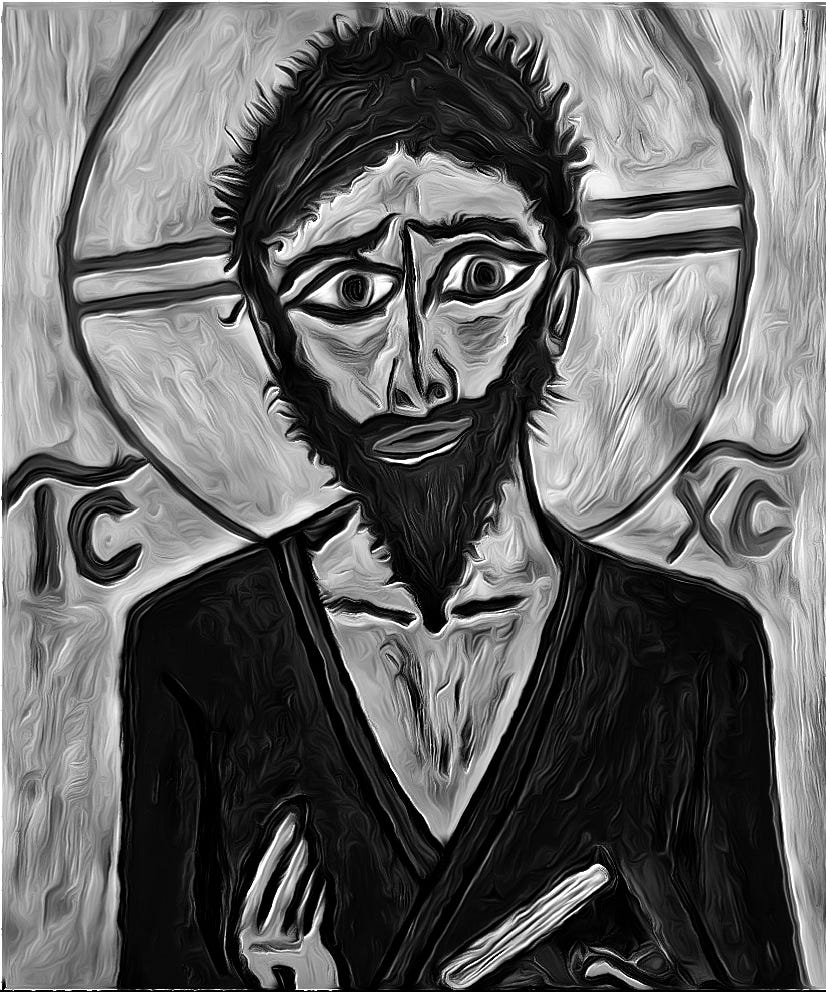
NOTE: Trying something new this week, including text as well as audio for the reflections and a piece of original artwork. Let’s begin with the first lesson — Acts 5:27-32: When the temple police had brought the apostles, they had them stand before the council. The high priest questioned them, saying, “We gave you strict orders not to teach in this name, yet here you have filled Jerusalem with your teaching and you are determined to bring this man's blood on us.” But Peter and the apostles answered, “We must obey God rather than any human authority. The God of our ancestors raised up Jesus, whom you had killed by hanging him on a tree. God exalted him at his right hand as Leader and Savior that he might give repentance to Israel and forgiveness of sins. And we are witnesses to these things, and so is the Holy Spirit whom God has given to those who obey him.” We should not assume that everything done in this scene is to be praised as necessary or right. In spite of what’s sometimes suggested, not everything described in Acts is prescribed by the Spirit. The apostles, including Peter, routinely get it wrong. Luke knows Israel’s Scriptures well. He knows the stories of the patriarchs, including Abraham, and the stories of the kings, including David. He knows the stories of the prophets, including Moses, and the stories of the priests, including Aaron. And he knows that these stories are far more often than not stories of vanity, corruption, faithlessness, ineptitude, apathy, overreach. Notice: Luke does not say, as he had done earlier (in Acts 2 and in Acts 4), that Peter and the apostles are “filled with the Spirit” in their speaking. He says only that they answered their accusers. Perhaps, then, the high priest is at least half-right? Of course, the temple authorities did work with other powers to get Jesus killed. But the apostles’ words seem blunt, not incisive. What they say only enrages the council. It does not “cut to the heart” as Peter’s Pentecost sermon did. Tellingly, the apostles do not say a word about Herod or Pilate. Even more to the point, they do not say a word about their own responsibility for what happened to Jesus. Bearing those silences in mind, it is worth pointing out, then, that they claim the Holy Spirit has been given by God to those who “obey him.” In the Gospel, however, as you may remember, Jesus says the Father gives the Holy Spirit to those who “ask him” (Lk 11:13). It is also worth pointing out that they say God desires to give repentance and the forgiveness of sins to Israel . But in his last words before his ascension, Jesus told them they would be his witnesses not only in Jerusalem and Judea but to the ends of the earth (Acts 1:8). In today’s Gospel, John 20, Jesus breathes on the disciples, as he had breathed on Adam in the beginning, sharing the Spirit of life with them—even though they have been anything but obedient and even though they ask for nothing. This is how John tells that story: When it was evening on that day, the first day of the week, and the doors of the house where the disciples had met were locked for fear of the Jews, Jesus came and stood among them and said, “Peace be with you.” After he said this, he showed them his hands and his side. Then the disciples rejoiced when they saw the Lord. Jesus said to them again, “Peace be with you. As the Father has sent me, so I send you.” When he had said this, he breathed on them and said to them, “Receive the Holy Spirit. If you forgive the sins of any, they are forgiven them; if you retain the sins of any, they are retained.” “The doors of the house were locked…” The disciples, including Peter and John and the other apostles, are burrowed away in hiding “for fear of the Jews.” Their fear is all the more remarkable given what they know: they know the tomb is empty; they know the cloth that had been on Jesus’ face was left behind, neatly folded; they know Mary Magdalene has seen the Lord; they know the word of promise he shared with her for them. And yet they remain in hiding. We’re told they fear “the Jews”—those prominent extremists and hardliners in Jerusalem and Judea who had successfully plotted and schemed to kill Jesus. That is almost certainly what they told themselves. But in truth they are not so much afraid as in dread. Not of the Jews but of the Lord. The Gospels are clear: the disciples, including the apostles, simply do not have the words for what they feel has happened. But their bodies know, because their hearts know, that whatever has happened has brought everything they have known into doubt. “Doubting Thomas,” in this regard, is anything but alone. So, on the evening of the first day of the new creation, the doors are locked, the Gospel says, and Jesus comes and stands among his terrified disciples. He does not stand at the door and knock. He simply appears among them. We sometimes tell the story of the resurrection as if Jesus startled awake early on Sunday morning, suddenly realizing he had been dead and now is alive again. Listen to Maire Howe’s marvelous lines: Two of the fingers on his right hand had been broken So when he poured back into that hand it surprised him—it hurt him at first. And his whole body was too small. Imagine the sky trying to fit into a tunnel carved into a hill. He came into it two ways: From the outside, as we step into a pair of pants. And from the center—suddenly all at once. Then he felt himself awake in the dark alone. The Gospels tell a different story. They say nothing about Jesus’ inner thoughts and feelings. They tell us that the stone is rolled away only after Jesus is risen. They tell us the stone is rolled away for show, so the guards and the disciples can know for a fact that something impossible has happened—something impossible indeed. They tell us that Jesus left the tomb where he had been buried the same way he arrives in this room where the disciples have barricaded themselves. Then, he disappeared. Now, he appears. Well, that’s not quite right. We can’t speak of the “then” of the resurrection—as if it happened at a particular moment in time, a moment that could be timed. The resurrection happened not in time but to it. The risen Christ, they’re told, is no longer in the tomb: “Why do you seek the living among the dead? He is not here.” But what they soon discover is that he is in the tomb because the tomb is in him. As Robert Jenson says in his Large Catechism, “there is no spatial separation to overcome between the embodied Jesus ‘in heaven’ and the loaf and cup on the altar” of Communion. Why not? Because “the question of Christ’s bodily presence at the Supper is… not a question of getting from one place to another but of availability to us in the places where he chooses to be found and directs us to seek him. All places are one in their accessibility to him.” And so are all times. As I’ve just said, the events of Christ’s life—his birth, his baptism, his death, his resurrection—happen not only in time but to it. The Christ who appears in the locked room to those frightened disciples is the same Christ who appears in the sealed fountain of the virgin’s womb. It his resurrection, his disappearing from the sealed tomb, that fuses the events of his life into the transfiguring presence at work at the deepest depths of history. Rahner gets this exactly right, I think: The purpose of [Jesus’] life is perfectly accomplished in his resurrection… The whole Christ with his whole destiny and with everything he experienced and suffered on earth with his human nature, has now entered into the glory of the Father. The glorification of his body is not something accidental—a second thought, but it is given to him because he has attained the great end and purpose of his history. That is so true that everything that he was in course of his history has entered into the glory of the Father. Jesus has not lost a thing… He possesses his life c… This is a public episode. If you'd like to discuss this with other subscribers or get access to bonus episodes, visit cewgreen.substack.com/subscribe
Embed this episode
No transcript yet.