I'm Debra Cayman. I'm an investigative reporter for The New York Times. One morning a few months ago I got an email and this person said to me, Hey, I have some documents I think you want to see. So I got on a plane that afternoon and I met them in person and I photographed the documents and we were able to tell a story that moved our reporting forward and are really significant way. When you subscribe to The New York Times, you're getting a whole team of reporters who are willing to jump and go verify information and bring back documents and shine light on things that other people would like to keep in it.
If you're a subscriber, thank you for being a part of that. From The New York Times, this is the Sunday Daily. I'm Natalie Kitroa. We're coming to you a day early because tomorrow our colleagues at the interview are going to drop an episode with Scott Pelly from 60 Minutes. It was just fired from CBS this week after a blow up with a program's new executive producer.
So that's tomorrow. On today's show, we're going to talk about what's set to be the most watched sports event on the planet, the 2026 World Cup. There's been no shortage of controversy surrounding this tournament, from exorbitant ticket prices to legal threats over those prices, to the geopolitical tensions hanging over it all. But when the games begin this coming week, the focus will inevitably turn to the competition, which is bigger than ever this year. Billions of people will be watching from all over the globe, screaming at their televisions, parading in the streets, painting their faces and beating drums in stadiums.
So to get us all ready for this World Cup, our global soccer correspondent, Tark Pangia, tells us everything we need to know about the teams, the games, and the dramas that are about to captivate the world. It's Saturday, June 6th. Tark, welcome to the Sunday Daily from Across the Pond. It's wonderful to have you here. It's wonderful to be with you.
So you have been covering soccer for a very long time. How many World Cups have you been to remind me? I've been to six and the next one will be my seventh. That's so many. It sounds like a lot. You age with these tournaments as well.
I'm a very old man now. Were you a baby at your first one? Yeah, almost. I went as a teenager with my brother. We got a fantastic summer in France in 1998.
Who were you rooting for? I'm from England, so we were rooting for England. But it was just being at the World Cup and around this international, our martyr of fans was just fantastic. Okay, so you are something of a fan. I, to situate myself, am the daughter of a fan.
My dad is Greek, and I think it would be an understatement to say that soccer is the single most important thing in his entire life. And for our purposes here today, we are coming to Utah because you're not just someone who's been to a lot of these things. You are an expert on this tournament. And from my understanding, the one we're about to see is very different. It's bigger than ever. And for those of us who don't think about this every single day, I want to break this down.
Let's start with what is new here? What makes this World Cup special? This is the biggest tournament in terms of host nations, the number of host nations. Three, that's never happened before. You have Mexico, Canada, and the United States of America, which will have the bulk of the games and all across the US.
So you're going from the West Coast with Los Angeles, San Francisco, Seattle, listed as host cities there, then coming across, you've got Houston, Dallas, Atlanta, and Kansas City. And then Miami, Boston, Philadelphia. And then we have the final, which will be in New York, will actually in New Jersey. So that's a lot of places. So many different cities. It's insane. Yeah.
Okay. And there's also more teams, right? It's not just more cities, more places, more countries, but more actual participants. Yeah, this is the other great innovation of this tournament. This is the first time we're going to have 48 teams at FIFA World Cup.
It has been 32 since that first World Cup that I went to in 98 in France. And now we've added more teams, 48 teams. It's arguably the easiest World Cup to qualify for as well, because you have more teams. However, unfortunately for them, we're not going to see Italy. Yeah, they somehow found a way to not qualify for the easiest one to qualify for, which also includes Greece, which is my dad's team.
So RIP to us, 48 teams is a lot, as you're saying, how many actual games need to be played between these teams in order to start eliminating them? Like, how long is this going to take? We're going to have 72 group stage games. So that's the start of the tournament. The teams are divided into blocks of four, 12 of these.
And it's going to take a huge amount of time to eliminate 12 teams. Four games a day for 24 straight days. Is that too much? I guess we're going to find out. Yeah, or if you are extremely pumped about this, like I understand billions of people are, is that just the right amount?
Well, if you're an employer, I guess it's what you want. You're going to have a few people either being bleary-eyed in the morning or not showing up to work because it's football. And why are they doing this? Why do they make it so much bigger? Well, one of the reasons is pure football politics. FIFA is a membership organization of 211 nations. Every four years, they gather to elect or re-elect the president.
And when he's able to give out more gifts, it's much easier to be re-elected. So here we are, Janien Fantino, the FIFA president. He's decided to expand it to 48 teams. So this serves him. Yeah, of course, there's a glass half full way of looking at this as well. Adding more teams gives more countries, more chances to play in the best tournament in the world.
And now we are giving the opportunity to fans and populations all across the world who may have never sampled this to get that World Cup magic in their country. Right. And the idea is that that magic is being shared because there are all these new smaller countries that are now getting a chance this year. Yeah, smaller in the soccer sense in the footballing world, these aren't powerhouse nations. Some geographically small, some maybe not so geographically small, but really haven't made a mark on the game significantly.
So we must start with the smallest. Please. Coraceau. The only thing I knew about Coraceau that it was a blue cocktail drink. A blue wave is heading to the World Cup. But it is a country in the Caribbean population of 160,000.
For the first time in their history. Which would be roughly two full Azteca stadiums in Mexico City. Now they've qualified for the World Cup that if you're living on a Caribbean island that's called Coraceau must be magical. And who's playing on that team where the total population is 160,000? Well, the squad is made up of players born in the Netherlands with ancestral connections to Coraceau.
Could be parents, could be grandparents and they are going to be donning the Coraceau shirt, which I'm sure is going to be quite cool. It's also other countries there. Jordan, for example, they've qualified for the World Cup. We've got Iraq at the World Cup. Not first time, I mentioned Iraq. In my lifetime, I can't admit Iraq at a World Cup.
The same goes for the Democratic Republic of Congo. The last time they qualified for a World Cup, that country had a different name. It was called Zaire. We've got Haiti, big Haitian population in the United States. Yeah, and some of these countries are dealing with really hard times right now.
I mean, the Democratic Republic of Congo is dealing with Ebola, Haiti has been having all of this violence now for years. I mean, you got to imagine for them just seeing their players, these 11 men representing them on the field. That has to be so exciting. It must be fantastic because this is you being represented on the biggest stage. And, you know, some of the matchups, some of these guys could be up against Leonardo Messino.
If you're a kid in any of these places, it gives you a chance to dream about these things. Someone like you could one day do this. It's fabulous. Okay, are there dark horses in this World Cup? Anybody that's an underdog, potential Cinderella stories, a team that could defy expectations that we should be watching for here?
So an underdog has never won a World Cup. So that gives us a dilemma here when we're trying to pick dark horses. But this World Cup, as we said, is different. 48 teams, three countries. Could we have a surprise?
You've appropriately tempered expectations, I will say, Tark. So let me start with underdog number one, United States of America. And the USA can dream of reaching the quarterfinals. This is not a good football team by any international measure. They're fine.
They know. The country officially plays last at France 98. But if you were to talk to odds makers, they would not be telling you that the United States is going to win the World Cup. Two defeats in this international window for the United States. However, home support, they are playing in their own country.
If they get on a run, if they're star man, Christian Pulisic manages to put a bit of form together. And the rest of the team back him up with that support. Is there a chance that they can go deep? Yes, there's a chance. Are they going to win the World Cup? Absolutely not.
It's worth saying that this is really the one sport where the United States is reliably an underdog. Americans are used to dominating international sporting events, winning all the gold medals, for example. And now we're talking about them as basically an impossibility to win this thing. Yeah, I mean, the US have never really made a big impact on global soccer. They've done well at previous World Cups. They've got through the group stages.
Before this World Cup, the USA had only ever won two games in the World Cup finals. Well, they'll remember this day all right. They've given a good account of themselves, but there's been no expectation of anyone that they should have gone any further. But they're only over two teams in a football pitch at once on a soccer field at once. And one of them's going to win.
Who knows? The luck of the bounce, the referee's decision goes your way. You're through to the next round on. So let's see how that goes. OK, so anything can happen. I'm going to pin my hopes on that for the US team.
Who else? What other dark horses? I think one that is interesting is Ecuador. From South America, use of the climate. This is going to be played in searingly hot weather in stadiums when they are not climate controlled.
So Ecuador is one to watch and I will give you a European selection as well, Norway. And Norway are showing just why they're going to win this group. Norway haven't been at the World Cup since 1998, but have one of the true superstars in the forward Erling Harland, who seems to score for fun. Well, Harland! Some finish that from Erling Harland.
And you need goals to win soccer games. So if big Erling scores lots of goals, Norway could be there towards the end of the tournament. Harland's waiting in the middle again. He's reached the middle again. He's scored again.
Two goals in less than a minute. In terms of dark horses, and normally they'd be among the favourites because of the name. When I think World Cup, I think Brazil. The fans are spinning onto the pick here, but Brazil in sub-tuous form. Those Canary Yellow shirts, those images of Pele lifting the trophy.
But we're not talking about Brazil at this World Cup. People haven't been talking about them. And that's why I'm going to put them in the Dark Horse category. They're not in the conversation. However, Brazil could be there at the end of the tournament.
OK, let's talk about the big dogs, the heavies. Who are the favourites? The heavy favourites for this tournament are all from Europe. We have Spain. Three blows in Switzerland and Spain.
The current European champion. The old kings of European football regain the crown. They've got a superstar in LaMien-Yamal. What a goal that was! LaMien-Yamal!
You're lucky to get the... Soccer has been dominated by Messi, the Argentinian great, and Ronaldo, the Portuguese superstar. It's just been so hard for anyone else to cut through this. Until now, quickly, three players can pervert, but he's beaten them all. LaMien-Yamal!
Oh, wow! LaMien-Yamal, this teenager who is uber confident, uber skillful, playing for one of the biggest teams in the world in Barcelona and playing like it's not hard work. LaMien-Yamal, it's not hard work! He is doing things on the soccer field that make people who don't even like the sport watch this guy, because what is this magic in this guy's feet? So, LaMien could emerge as the superstar of this World Cup, as someone who already is a superstar of the football world.
Okay, so you have Spain led by this young star in Lemignon Mall. Who else? I think every World Cup now will always have a strong French team. There is nowhere on planet Earth that produces more top professional talent than France and in particular, the Greater Paris region. It is protruding out these players.
What is it? What's going on over there? There is a mix of the diaspora, the French colonial influence from back in the day and the people that have moved to France, made their homes in Paris, these families, whether they are from West Africa, where they are from North Africa, the Caribbean, they have produced since I was a kid, more and more top footballers. And here we are at another World Cup. Interim back, I won't touch by killing them back, I won't go by killing them back, I won't go by killing them back.
We've got killing them back, I'm back, I'm back, I'm back, I'm back, I'm back, I'm back he scored three goals in the World Cup final in Qatar in 2022, but they lost to that game. Argentina, champions of the world. It's crazy to score a hat trick in a World Cup final and still not win, just to note. But he can't be too sad, because four years before that, just out of his teams, he won the World Cup. It is France, Alay Leper.
And then since then though, there's more players have come through, this attacking line up, if killing Mbappe caught the flu and couldn't play for a few weeks or misses the World Cup, would France lose that much? Any other team would, but then you have Dezire Duet from Paris Saint-Germain, who's just won the Champions League with his team. Duet got shot away, the spot in the presence of four red shirts. You have Usman Dembele, who played in the same game in the same attack. Dembele, six-rider away!
The list goes on and on. We could have a podcast just going through great French football players. Right, it's like the Harlem Globetrotters several times over. It is, it is. And there's other teams that are in contention.
This is the day we've all been waiting for, the final of the eighth World Cup competition between England, the host nation and West Asia. You have England not having won the World Cup since 1966. And he comes to the end of the season. It's in France! Slip through Kane, is this the hat trick moment?
Harry Kane! They've got a great squad, led by Harry Kane, a great centre forward. Remarkable, relentless! If he starts scoring goals, England have a chance. And equally, Portugal, they've got a very well-balanced squad, they've got great players.
All these teams on their day could beat each other. That I think is super interesting. One team I think will not be there at the end. Los Aiento Amigos is Argentina. Okay, I want to talk about Argentina and specifically the great Lionel Messi.
But first, let's take a quick break. We'll be right back. Law transforms agreement into reality. A word becomes an agreement. An agreement becomes a contract.
A contract becomes law. Today, Harvey, the AI platform for legal work, is writing the next chapter. More than 200,000 lawyers are building with Harvey, accelerating review, sharpening negotiations, and more. This is how the future of agreements is being crafted now. Harvey, learn more at harvey.ai.
Harvey does not provide legal advice. Users should always independently review and verify any output from Harvey. I'm Gilbert Cruz. This week on the Book Review Podcast, we have a special Halloween treat. Or trick, or treat.
Two horror writers recommend some titles that are sure to keep you up at night. I am a big fan of sentient houses in general. I think this is one of the scariest books I've ever read. Listen to the Book Review, wherever you get your podcasts. The door shouldn't be open.
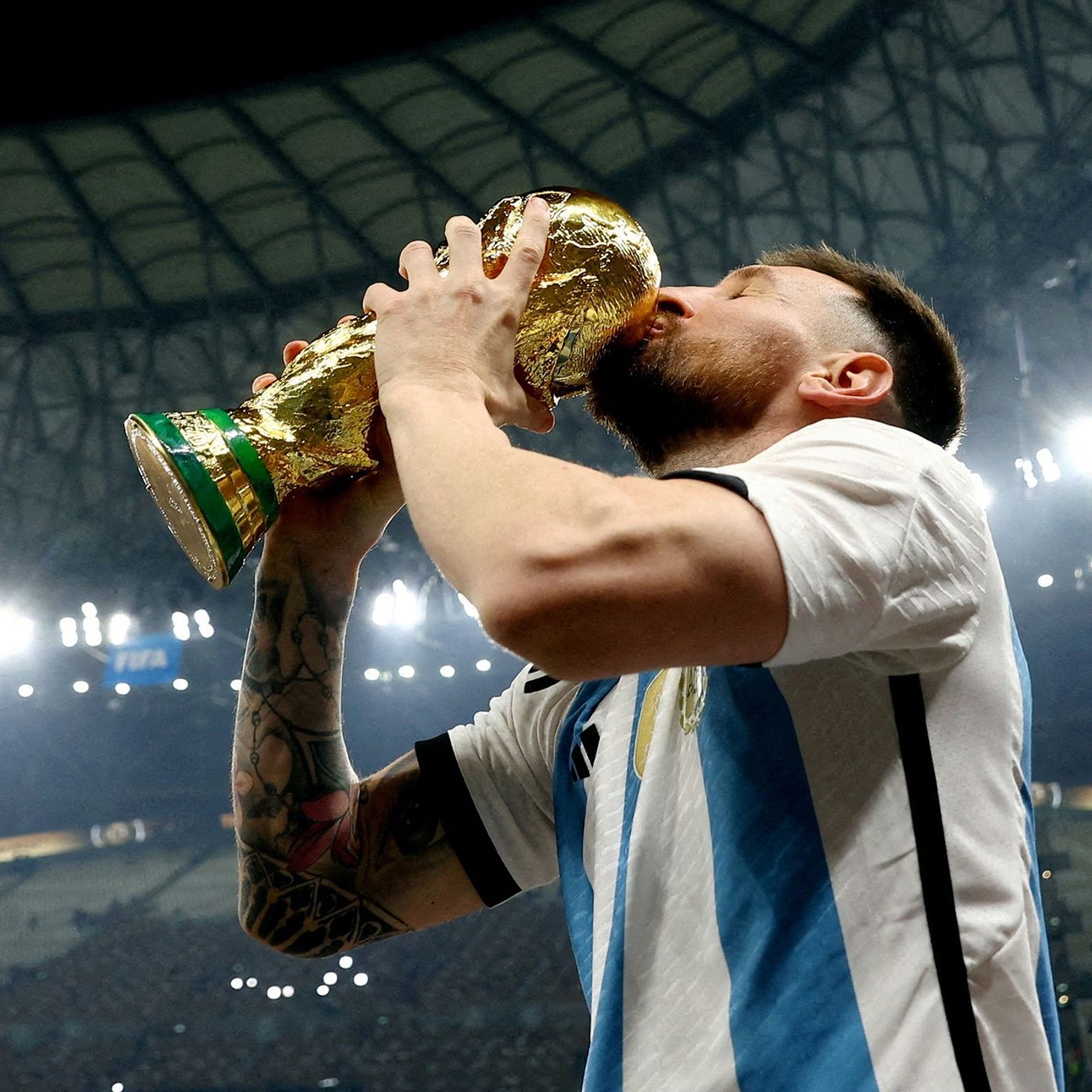
Who left it open? Let's talk about Argentina. These are the reigning champs from the last World Cup in 2022. Messi said that was his last World Cup. Now he's saying this is actually his last World Cup.
Is this really his last? Should we trust him? You kind of got to hope it's his last because you want to remember these guys at their very best, at their very peak, not creaking old men, just trying to break records for playing in World Cups. I think it was inevitable he was going to play in the World Cup because he's still adored by Argentina. He still wants to play.
And I think if Messi says he wants to play, he gets to play and he's still very good at football. Let's see how it rolls. But this is a very, I think, old team and aging team. There's too many players who played in the previous World Cup. So we're going to be with Argentina.
I think this might be one tournament too many for a lot of those guys. And I think Argentina could lose and be eliminated against the first good team they come up against. Even so, even if your prediction comes true and it might not. But even if it does, there is something beautiful and poignant about watching what does seem to be the last stand for the player that many consider to be the greatest of all time in this sport. Messi, just talk about that, that end of an era moment that we're about to see.
Quite frankly, we're never going to see anything like this again. This diminutive magician sort of with floppy hair arrived as a teenager at Barcelona and wowed the world for two decades. He doesn't look like an athlete yet. He's on the field doing these things that we can't imagine and producing magic week after week. He reminds a lot of people, me included, of one of those players as if he's been controlled in a video game.
The ball is at his mercy. I don't think we will see the like of this again. Certainly not in terms of its longevity. Well, that is going to be very special to watch. My understanding is he's not the only old head in this thing.
Right, Tariq, there's others for whom this may be the last one. This is the last hurrah for a group of players who seem to have gone on and on and on. This is a group of players who, unlike the past, seem to have kept themselves so fit in peak condition that they're playing into their 40s or close to their 40s. And the first one you have to think about is Cristiano Ronaldo. Oh, genius.
Absolute genius. Over the wall. Down. Under the crossbar. Yes, he's playing in Saudi Arabia now.
As you mentioned before, in Europe, my work gets done. I won everything. I played the ball. But again, like Messi, he dominated the sport for 20 years. And then, look at him.
Luca Modrich. Modrich. Now he won Leishwand. Sensational goal from Luca Modrich. Great Croatian tactician in the midfield, the great captain of the Croatian teams.
And surely now, Croatia's golden generation are on their way to the last 16. This could be the last games he plays. I wonder if he might even retire after the World Cup, a true hero to the Croatian people. But it is this kind of attachment between player and nation, fan and nation. It's kind of a bit of alchemy that requires all of these things to come together.
Right. The thing is about having these men pushing 40 in this tournament and still doing it, is that these countries have had so long to build this intense relationship to them. You know, so it's not just like any other player. This is like your native son, truly. Absolutely.
I mean, Portugal and Ronaldo, for example, he is the most important figure in that country, whether it's business, politics, culture. Cristiano Ronaldo is extremely important to Portugal's sense of itself, I would say. And also with Messi and Ronaldo in particular. These aren't kind of soccer superstars. These are arguably the most famous people on the planet.
I think Ronaldo has more Instagram followers than any other human being. And then I think it's Messi is number three and they're sandwiched by Taylor Swift or something like that. So the only person who can come close. Yeah. And that tells you something about those guys.
It tells you something about this sport and where it's placed in the global conversation in our modern culture. And then it tells you something, I guess, also as we're entering it, about the world cups. You've got the most famous people playing the biggest sport or the most biggest cultural expression of humanity at the moment. And then playing at this stage, which is the stage that the entire world tunes in for. So in other words, this is big.
Okay. Let's take one more quick break. And then we're going to talk about something else that is big, this world cup, which is ticket prices. We'll be right back. Law transforms agreement into reality.
A word becomes an agreement. An agreement becomes a contract. A contract becomes law. Today, Harvey, the AI platform for legal work is writing the next chapter. More than 200,000 lawyers are building with Harvey, accelerating review, sharpening negotiations, and more.
This is how the future of agreements is being crafted now. Harvey, learn more at harvey.ai. Harvey does not provide legal advice. Users should always independently review and verify any output from Harvey. So, Tariq, now that we have, I think, the on-field drama is covered, more or less.
I want to talk about the main off-field drama that has consumed the conversation about the world cup, which is how crazy expensive it has been to get a ticket. Just walk me through these prices. My understanding is they have been just absolutely extraordinary. These prices are, I, wateringly expensive for average football fans, average World Cup fans, people who go to tournaments. So, we are talking three times to 10 times more than they cost in Qatar, which was already the most expensive World Cup.
And I'll give you an example. The World Cup final, the most expensive ticket for the category one, which is the top category outside of VIP. For Qatar, it was about $1,000. For this World Cup, the ticket costs $10,000. That is ludicrous.
That's unbelievable. And fans around the world have been tearing their hair out over these prices. How can we be expected to follow our teams at these prices? So the prices that I'm talking about are in the hundreds of dollars to the thousands of dollars. And why are they so expensive this time around?
They're expensive because the World Cup is where it is, particularly in the United States of America. There is a sense that FIFA can generate greater returns because there is a wealthier population, quite frankly, in the US that can spend hundreds of dollars, if not thousands of dollars, per game on World Cup tickets. There's also, for the first time in the history of this tournament, something called dynamic pricing. Those of us who have booked flights or hotels might be used to this, how on Monday the flight was $200 and suddenly you've waited two days and that's now $500. So annoying.
FIFA have thought this will be bright. Why don't we do this? Why don't we decide to have World Cup tickets for these 104 games dynamically priced? So the idea was, depending on the demand, the prices would fluctuate lower if there isn't that great demand for those games or spike if there is a lot of people wanting to do this. So far, what we've seen is not much coming down because the prices started very expensive and prices then shooting up $800 for a group stage game, $1,000 for a group stage game, then you get into the knockouts.
And then fans are also confused as to where they're going to be sitting because FIFA keep changing the categories. The seats are designated into pricing categories depending on where they are in the stadium. And fans have now complained that, hang on, I paid for this category. Why am I now in the nosebleeds and what is this new category that's emerged? So there's a lot of confusion, so much confusion in fact that the Attorney Generals of New Jersey and New York have talked about starting legal proceedings against FIFA over this.
And what are the fans saying? These are people who are used to sacrificing a lot for World Cups. Do they see this as, well, it's an annoyance that we must bear or are they revolting? What's the vibe? The fans are furious and disappointed and it doesn't matter where you go.
They feel exploited. They feel their passions have been exploited and they feel kind of abused. And to that point, I decided to go to Buenos Aires, the capital of Argentina, but try and put a human face at this because in my experience, in the last three, four World Cups I've been to, one of the most eye-catching backdrops of these tournaments have been the sheer number of Argentines who find a way to get to the World Cup and to make it a World Cup with flags, with songs, with atmosphere. The fans are protagonists from the stands in the way the players are on the field.
And I thought, this must be impossible for these people who are so obsessed with the World Cup to face ticket prices like this. What are they going to do? And what do you find? What are they doing? So, I went to an Asado or a barbecue of Argentine fans preparing to go to the World Cup at a park in Buenos Aires.
What's the name of the World Cup? What's the name of the World Cup? Four, in this case, three and a half years. To organise and say. To get a sense of the extremes, there's a guy I met called Matias Celasdino.
He is so obsessed with Argentina. He went to every single one of their qualifying games. So they played games across South America. He went to 18 matches, nine in Argentina, and nine overseas as far away as Venezuela, all across the region to be there for Argentina and to hammer his drum, to beat his drum. He's one of the drummers.
OK. To support of this team. But this is the first World Cup he said that he's taking his wife and son to. It's a good feeling. It's a good feeling.
My wife, to go with me, to the World Cup is going to resign. And she could not get time off work. So guess what she did? She's quit her job. What?
She quit her job for the World Cup? It's the obsession. It's the passion. Because we have to do it. It's a disentiment that we have.
It's something you kind of have to do. Something is pushing you in that direction and there's nothing that can stop you going. How common is that? Are all of the people that you're talking to in Argentina telling you they're willing to go that far to get to the games? It's common enough.
However, there are people who are feeling this is just a step too far. This is one World Cup. They may have to miss because of the prices. However, there's people who are so obsessed with the World Cup, so obsessed with Argentina, the World Cup. They're willing to travel to just be part of the atmosphere, to get near to the World Cup.
As someone said to me, I want to be with my people at the World Cup. Is this kind of need to be there that verges on the religious in a way that we have to make this pilgrimage to be at this thing because Argentina at the World Cup is the stage for our nation and we must represent themselves there. All of this reminds me of this thing that the Latin American writer Eduardo Galliano who wrote a lot about soccer said about soccer fandom. He said, the true fan never says, my team plays today. They say we play today.
And then he talks about what happens when the fans leave the stadium. And I remember this quote. He says, the fan returns to his solitude, to the eye who had been we. And I know this because my dad is a huge soccer fan and he used to cite this, but he cited it in reverse when he told it to me as a kid. He said, when the fan enters the stadium, the eye becomes we.
That is fantastic. And that is the experience. But there is something truly magical of being part of a World Cup, part of your team's journey in the World Cup. The best part is as it gets really close, the night before that first game, the fans have already made their journeys into wherever they're going to be, the excitement. Their team hasn't lost yet.
Everything is still possible. But they're out in this new country. They're wearing their colours. They're seeing fans from all over the world wearing their colours. And I remember the night before the opening game of the 2018 World Cup in Russia, there's a street in Moscow called Nikola Skya Street.
And that place was truly incredible before the tournament opened. Because it's a long street you see these fans, Egyptians, Brazilians, Argentines, Saudis, Mexicans and on and on, communing, singing, swapping stories, almost like a Noah's Ark of global humanity, right, of people in this one place. And this is before a ball has been kicked. Honestly, for me, these moments are very hard to replicate at any other time.
It makes me feel really lucky to live in the New York area when all of this will be happening right outside our doorstep. And it sounds like Americans in general should just feel excited to experience this, this precise kind of community that is going to spill out onto our streets. And guess what? It's free. No dynamic pricing.
Open your front door, step off the porch and go and meet everyone. This is a gathering of humanity unlike anything else. Well, Tarek, thank you so much and have a wonderful World Cup. Thank you. Great to be with you.
Today's episode was produced by Tina Antilini with help from Alex Barron and Luke Vanderpluque. It was edited by Wendy Doar, production assistance from Dahlia Hadad. It contains music by Diane Wong, Rowan Nemestow, Dan Powell, Corey Shreble and Mary Lozano. And was engineered by Rowan Nemestow. Special thanks to Henry Bushnell.
That's it for the Sunday Daily. I'm Natalie Kitroweth. See you on Monday.