
EPISODE · Jan 10, 2026 · 41 MIN
Everything you wanted to know about Paqtnkek but were afraid to ask
from Let's Talk Antigonish Podcast · host Let's Talk Antigonish
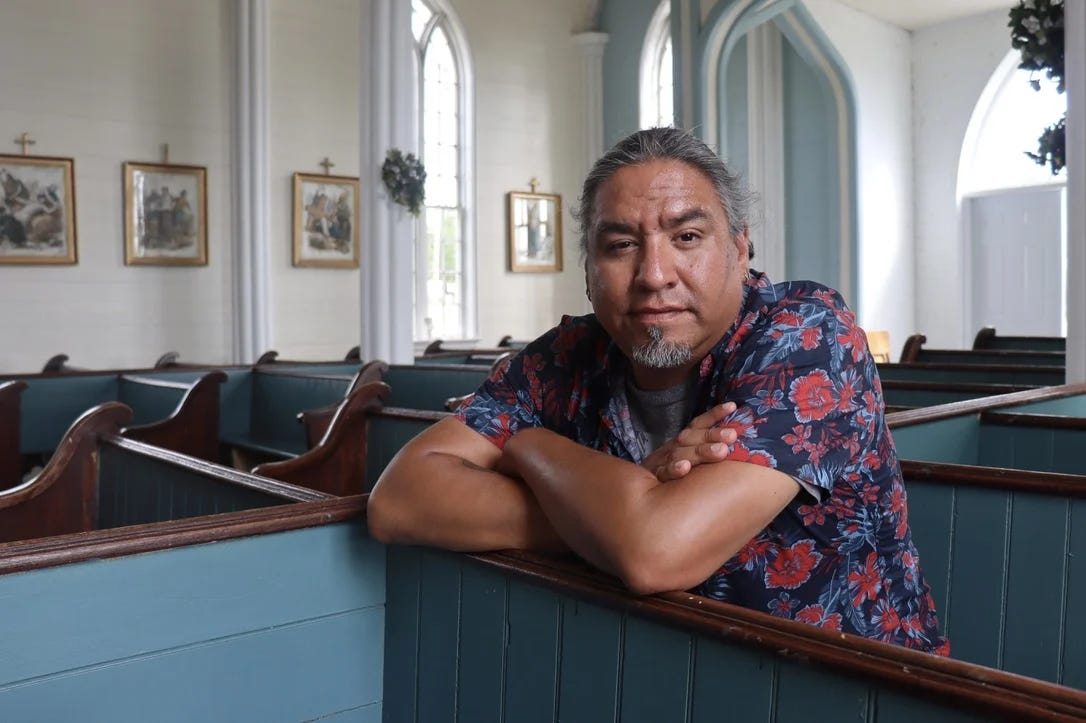
We sat down with Mi’kmaw community historian Trevor Gould to pepper him with questions about Paqtnkek, the history of the Mi’kmaq in this area, and the origins of the name “Antigonish”Every time someone says “Antigonish,” they’re speaking a Mi’kmaw word—though most don’t realize it. The town’s name comes from Nalikitquniejk, meaning “the place where the branches are broken off,” a descriptor of this land that predates European settlement by thousands of years. And as Trevor Gould, Mi’kmaw community historian and former Paqtnkek band council member, explained to “Let’s Talk Antigonish” hosts Justin and Anuj, understanding this history isn’t just an academic exercise—it’s essential to understanding how we, as a community, share this place.Gould, 42, was born and raised in Paqtnkek. He studied history at Dalhousie University and worked at the Mi’kmawey Debert Cultural Centre for about 12 years, where he developed a deep expertise in Mi’kmaw oral histories, place names, and cultural preservation. He’s also known across Canada as an emcee/singer/dancer at powwows, a filmmaker, and someone who’s worked tirelessly to make Mi’kmaw history visible in a region where it’s too often overlooked.To understand Antigonish’s Mi’kmaw history, Gould began with geography. The region sits within Eskikewa’kik, one of seven districts that comprise Mi’kma’ki (the Mi’kmaw homeland). The name means “skin dresser’s territory,” reflecting the area’s (former) abundance of caribou, black bear, and porcupines, and the skill of local Mi’kmaw people in creating quilled clothing.“This was like the Paris of Mi’kma’ki,” Gould joked. “You want to go get good clothes, man? You go down to Eskikewa’kik.”Antigonish sits at the head of a crucial river system that sustained Mi’kmaw communities for millennia. When Loyalist Captain Timothy Hierlihy arrived in the 1760s seeking soldiers who had deserted, he found hundreds of Mi’kmaw people living on both sides of the harbor—at Town Point and Williams Point. The harbor was particularly valuable for its eel population, a resource that remains significant today.What followed was a pattern repeated across North America: conflict, displacement, and forced relocation. Initially, the Loyalists wanted to call their settlement Dorchester. There were no roads connecting it to other settlements, which were all on Nova Scotia’s South Shore. Over time, the Mi’kmaw population was pushed out—into the mountains, down the river, away from their traditional territories.The journey from Nalikitquniejk to present-day Paqtnkek involved multiple displacements over centuries. In the late 1700s, Mi’kmaw families moved to Pomquet (itself derived from the Mi’kmaw word Poqmkek, meaning something like “fishing hole” or “hole in the ice”). There they lived for over a century, eventually forming three distinct communities along the river.“When we moved to Pomquet, we were already a combination of many different communities,” Gould explained. These included Niktuek (meaning “the forked area”) upriver near Heatherton, Paqtnkek proper at the harbor front, and Welnek where the mission church was built in the late 1800s.Throughout the 1800s, these communities occupied their traditional territories even as European settlement expanded. But in 1911, the railroad came through, literally cutting through Mi’kmaw reserve land and beginning a new displacement. Between 1911 and 1917, families were forced to relocate to Afton, where a new reserve had been established on rocky uphill land nowhere near the harbor or river.“They needed us out of there,” Gould said of the railroad’s impact. “So they started moving us from there to Afton.”The Afton location became the consolidated home for families from all three previous communities. When the community officially changed its name around 2001, they chose Paqtnkek—the traditional name most associated with their identity, even though they now lived far from the harbor that name describes.“It’s nowhere by the bay.” Gould explained. “But that’s why we have that name, because this is where we originated.”The conversation touched on the complexities of identity for both Indigenous peoples and newcomers. Co-host Anuj, who immigrated to Canada 15 years ago, asked how he should understand his place as a new Canadian on Mi’kmaw land. Gould’s response emphasized that Mi’kmaw people have been “the doorway to Canada” since time immemorial, constantly adapting and accepting different cultures.“If you come with an open mind and understand that this is a Mi’kmaw place that you’re living in, of course you’re going to be accepted,” Gould said. Gould acknowledged experiencing his strongest encounters with racism in Antigonish, despite traveling to the American South. Growing up, he felt a visible separation between Paqtnkek and the town—a separation that was both historical and present. For years, he didn’t feel connected to Antigonish despite it bearing a Mi’kmaw name and sitting on Mi’kmaw territory.The powwow discussion revealed opportunities for bridge-building. Paqtnkek initially brought their powwow to St. FX to create a large contest powwow with better facilities and to introduce the town to Mi’kmaw culture in a “safe place.” After two successful years building that relationship, they moved the powwow back to the community—but many town residents didn’t follow.“Everyone that’s listening to this, you are welcome to Paqtnkek Powwow whenever we have it,” Gould emphasized, addressing the awkwardness many non-Indigenous people feel about attending events in the community itself.Gould sees the town changing substantially, particularly in the past 15 years with increased immigration and diversity. He credits St. FX and the Coady Institute for both an increase in diversity and increased tolerance. This diversification seems to have created more space for Indigenous visibility and acceptance.One tangible symbol of recognition came just a year or two ago: the installation of the “Antigonish Nalikitquniejk” sign. “That alone is the one Mi’kmaw presence and the one Mi’kmaw thing that you can see when you’re walking in Antigonish,” Gould noted. Beyond that sign, Mi’kmaw presence remains largely invisible in the town’s public spaces and narratives.Future developments at Paqtnkek include a birthing center being built on their former powwow grounds—the reason last year’s powwow served as a “last hurrah” before the arbor is removed. The community is also home to Bayside, a health center, and numerous other initiatives Gould hopes to discuss in future conversations.The interview concluded with Gould’s powerful message directly to listeners: “For thousands of years, my ancestors have been part of this land, buried or been put back and given back. When you think of when you put your ancestors in the ground, they become the ground. They become the soil. The trees and the grass and everything that grows from that soil contain a part of them.”This isn’t merely spiritual, Gould clarified—it’s chemical, atomic, literal. His ancestors’ physical matter has become part of every tree, every blade of grass in Nalikitquniejk. The concept of land ownership becomes impossible when you understand this deep, millennia-long integration with place.Anuj and Justin just barely scratched the surface of topics they wanted to explore: two-eyed seeing, the history of fishing (especially eels and salmon), and countless other threads of Mi’kmaw history in this region. Gould enthusiastically agreed to return for regular conversations, joking that since he’s not currently on band council, “I got no job, so you guys can hire me.”Key Insights from Trevor Gould:* Oral History as Valid Historical Record: Mi’kmaw oral traditions preserved knowledge of treaties and territorial rights for centuries when written records denied their existence. This transmission method deserves equal weight with European-style documentation.* Antigonish Is a Mi’kmaw Word: Every time someone says “Antigonish,” they’re speaking Mi’kmaw, whether they know it or not. The name comes from Nalikitquniejk, meaning “the place where the branches are broken off.”* Eskikewa’kik—The Skin Dressers’ Territory: Antigonish and Guysborough County comprise one of seven Mi’kmaw districts, known for exceptional hunting and clothing craftsmanship. Paqtnkek is currently the only Mi’kmaw community within this district.* Multiple Forced Displacements: From the 1760s through the early 1900s, Mi’kmaw communities were repeatedly pushed from their territories—first from the Antigonish harbor area to Pomquet/Heatherton, then to Afton when the railroad came through in 1911.* The Eel Connection: Leaving the Antigonish harbor meant abandoning one of the region’s greatest eel resources. During the 1940s centralization policies that tried to relocate Mi’kmaw people entirely, those who stayed did so largely because of eels and salmon.* Names Carry History: Pomquet, Tracadie—these aren’t French names but Mi’kmaw words adapted by Acadian settlers who lived cooperatively with Mi’kmaw communities. The Acadians “appreciated our way of life so much that they kept Pomquet, which was Poqmkek, which is really just a French way of saying it.”* Ancestors in the Land: For thousands of years, Mi’kmaw people have been buried in this soil, becoming part of the trees, grass, and earth. “My ancestors are part of that. Every grass, every tree, everything that you see in this area. My ancestors are part of that.”* Welcoming Newcomers—With Conditions: Mi’kmaw people have always been open to sharing the land with others. “As long as you understand that where you’re at is a Mi’kmaw place and that these resources were here to be shared in a very respectable way... then of course you’re going to be accepted.”* Visibility Matters: Gould noted feeling increasingly comfortable in Antigonish in recent years, being invited to speak at the museum, St. FX, and other venues. “I feel visible, man. When I come to this place now, I feel that there is more acceptance.” Get full access to Let's Talk Antigonish at letstalkantigonish.substack.com/subscribe
Embed this episode
Ready to play
Everything you wanted to know about Paqtnkek but were afraid to ask
No transcript for this episode yet
Similar Episodes
No similar episodes found.
Similar Podcasts
No similar podcasts found.