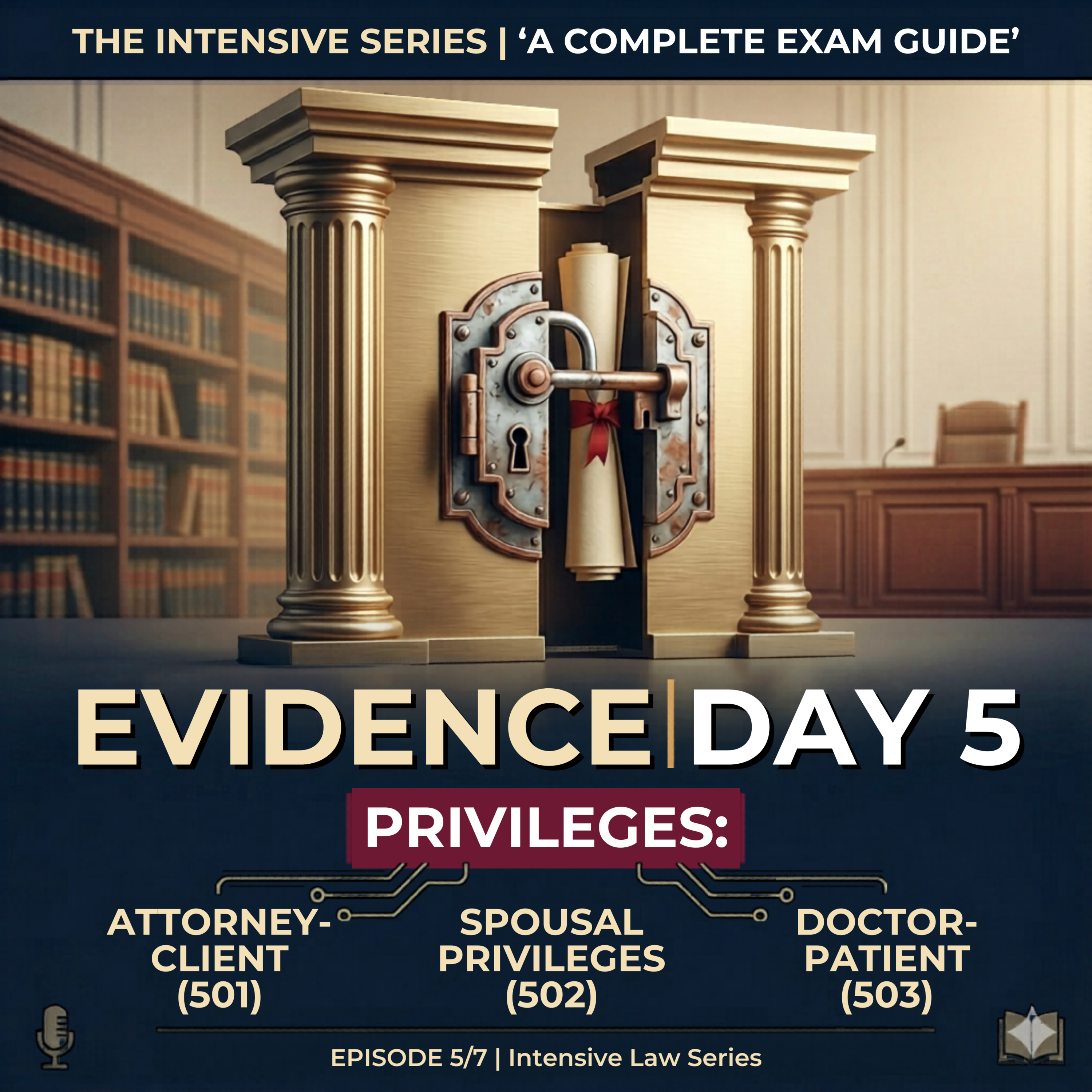
Evidence Day Five: The Hearsay Exceptions episode artwork

EPISODE · Apr 10, 2026 · 1H 7M

Evidence Day Five: The Hearsay Exceptions

from Law School · host The Law School of America

In this deep dive into evidence law, we explore how courts differentiate between trustworthy and unreliable out-of-court statements through rules, doctrines, and constitutional safeguards. If you're preparing for a law exam or practicing law, understanding these intricacies is essential for navigating or challenging hearsay evidence effectively.Hearsay is the Achilles’ heel of the trial lawyer — but what if your most critical evidence is just a ghost? This episode unlocks the secret pathways of evidence law, revealing how courts breathe life into out-of-court statements that seem beyond reach. If you’ve ever wondered how some ghostly hearsay makes it into court and others don't, you’ll discover the meticulous rules and psychological tricks behind the exceptions that save vital evidence. From the eerie tomb of Rule 804 to the trusted ghosts of Rule 803, we dissect the precise legal architecture that transforms unreliable whispers into admissible proof.We break down the most tested hearsay categories with surgical clarity: tomb exceptions requiring absolute unavailability—think dying declarations and statements against interest—unlocked only when the declarant is truly gone or sealed away. You’ll understand the PRISM diagnostic to navigate privilege, refusal, incapacity, subpoena failure, and memory gaps, avoiding common traps on exam day. Then, we shift gears into ghost exceptions, where availability doesn’t matter—spontaneous, routine statements like excited utterances and medical reports can come in even when the declarant is right in front of you.But the real game-changer is the confrontation clause — the constitutional firewall that can block otherwise reliable hearsay if it’s testimonial and the witness isn’t cross-examined. We explore the primary purpose test that separates live testimony from information designed for future prosecution, highlighting why even the most reliable-sounding audio or written evidence can be barred in the courtroom. With historic cases like Crawford v. Washington and Shepard, you’ll see how the Sixth Amendment reigns supreme over evidence rules when it comes to protecting your client’s rights.For trial strategists and law students alike, we deliver a step-by-step protocol—an unbreakable five-part algorithm—to diagnose, analyze, and challenge hearsay in any scenario. Whether navigating complex paper trails, confessions, or police reports, you’ll develop the mental discipline to spot the traps and leverage the law’s lifelines. Our final frontier? The future of evidence: how to authenticate objects and digital evidence in a world of AI forgery and digital manipulation.If mastering the rules that turn ghosts into credible witnesses and understanding the constitutional limits that safeguard fairness sound vital, this is your definitive guide. Prepare to see evidence law with fresh eyes—more precise, more strategic, and absolutely essential for winning in high-stakes litigation.Main insights include:The fundamental distinction between Rule 804 (Tomb exceptions) requiring unavailable declarants and Rule 803 (Ghost exceptions) which do not care about availability.The five-pronged PRISM diagnostic (Privilege, Refusal, Incapacity, Subpoena, Memory) to establish genuine unavailability under Rule 804.The specific requirements for core hearsay exceptions such as dying declarations, former testimony, statements against interest, and business records.The crucial difference between exemptions, which are not hearsay by rule, and exceptions, which admit hearsay due to reliability.The significance of the primary purpose test under Crawford v. Washington that distinguishes testimonial from non-testimonial statements, impacting their admissibility in criminal cases.The critical five-step hearsay diagnostic protocol to navigate complex evidence questions on exams and in court.The constitutional prominence of the Confrontation Clause, which overrides even valid hearsay exceptions when testimonial statements a

In this deep dive into evidence law, we explore how courts differentiate between trustworthy and unreliable out-of-court statements through rules, doctrines, and constitutional safeguards. If you're preparing for a law exam or practicing law, understanding these intricacies is essential for navigating or challenging hearsay evidence effectively.Hearsay is the Achilles’ heel of the trial lawyer — but what if your most critical evidence is just a ghost? This episode unlocks the secret pathways of evidence law, revealing how courts breathe life into out-of-court statements that seem beyond reach. If you’ve ever wondered how some ghostly hearsay makes it into court and others don't, you’ll discover the meticulous rules and psychological tricks behind the exceptions that save vital evidence. From the eerie tomb of Rule 804 to the trusted ghosts of Rule 803, we dissect the precise legal architecture that transforms unreliable whispers into admissible proof.We break down the most tested hearsay categories with surgical clarity: tomb exceptions requiring absolute unavailability—think dying declarations and statements against interest—unlocked only when the declarant is truly gone or sealed away. You’ll understand the PRISM diagnostic to navigate privilege, refusal, incapacity, subpoena failure, and memory gaps, avoiding common traps on exam day. Then, we shift gears into ghost exceptions, where availability doesn’t matter—spontaneous, routine statements like excited utterances and medical reports can come in even when the declarant is right in front of you.But the real game-changer is the confrontation clause — the constitutional firewall that can block otherwise reliable hearsay if it’s testimonial and the witness isn’t cross-examined. We explore the primary purpose test that separates live testimony from information designed for future prosecution, highlighting why even the most reliable-sounding audio or written evidence can be barred in the courtroom. With historic cases like Crawford v. Washington and Shepard, you’ll see how the Sixth Amendment reigns supreme over evidence rules when it comes to protecting your client’s rights.For trial strategists and law students alike, we deliver a step-by-step protocol—an unbreakable five-part algorithm—to diagnose, analyze, and challenge hearsay in any scenario. Whether navigating complex paper trails, confessions, or police reports, you’ll develop the mental discipline to spot the traps and leverage the law’s lifelines. Our final frontier? The future of evidence: how to authenticate objects and digital evidence in a world of AI forgery and digital manipulation.If mastering the rules that turn ghosts into credible witnesses and understanding the constitutional limits that safeguard fairness sound vital, this is your definitive guide. Prepare to see evidence law with fresh eyes—more precise, more strategic, and absolutely essential for winning in high-stakes litigation.Main insights include:The fundamental distinction between Rule 804 (Tomb exceptions) requiring unavailable declarants and Rule 803 (Ghost exceptions) which do not care about availability.The five-pronged PRISM diagnostic (Privilege, Refusal, Incapacity, Subpoena, Memory) to establish genuine unavailability under Rule 804.The specific requirements for core hearsay exceptions such as dying declarations, former testimony, statements against interest, and business records.The crucial difference between exemptions, which are not hearsay by rule, and exceptions, which admit hearsay due to reliability.The significance of the primary purpose test under Crawford v. Washington that distinguishes testimonial from non-testimonial statements, impacting their admissibility in criminal cases.The critical five-step hearsay diagnostic protocol to navigate complex evidence questions on exams and in court.The constitutional prominence of the Confrontation Clause, which overrides even valid hearsay exceptions when testimonial statements a

NOW PLAYING

Evidence Day Five: The Hearsay Exceptions

0:00 1:07:12

No transcript for this episode yet

We transcribe on demand. Request one and we'll notify you when it's ready — usually under 10 minutes.

The Small Business Startup School – Business Notes | Financial Literacy | Retail Psychology – For Professionals & Entrepreneurs The Small Business Startup School Inc. Starting or buying a small business? While personal circumstances may vary, business patterns remain timeless. On The Small Business Startup School, we explore strategies, insights, and practical solutions to help entrepreneurs confidently navigate their journey.Hosted by Ola Williams—a retail entrepreneur, fintech founder, and financial coach with over two decades of experience—this podcast marries financial awareness and retail psychology with optimism to deliver actionable takeaways.Join us to learn, grow, and connect as we uncover the keys to business success.Let’s continue to learn together and be encouraged to keep on connecting! The 48 Laws of Power by Robert Greene (Full Audiobook) Robert Greene Amoral, cunning, ruthless, and instructive, this multi-million-copy New York Times bestseller is the definitive manual for anyone interested in gaining, observing, or defending against ultimate control – from the author of The Laws of Human Nature.In the book that People magazine proclaimed “beguiling” and “fascinating,” Robert Greene and Joost Elffers have distilled three thousand years of the history of power into 48 essential laws by drawing from the philosophies of Machiavelli, Sun Tzu, and Carl Von Clausewitz and also from the lives of figures ranging from Henry Kissinger to P.T. Barnum.Some laws teach the need for prudence (“Law 1: Never Outshine the Master”), others teach the value of confidence (“Law 28: Enter Action with Boldness”), and many recommend absolute self-preservation (“Law 15: Crush Your Enemy Totally”). Every law, though, has one thing in common: an interest in t Guardians Of Innocence Guardians Of Innocence Guardians of Innocence is a powerful and informative podcast designed to equip parents, teachers, and communities with the knowledge and tools needed to protect children from the growing threat of trafficking. Each episode dives deep into the tactics traffickers use to target vulnerable children—both online and in real life—and provides actionable advice on how to recognize the warning signs.Through expert interviews with cyber safety professionals, law enforcement, and survivors, we uncover the latest grooming methods, share real-world stories, and empower listeners to become vigilant guardians of innocence in their own families and communities.Guardians of Innocence is more than just a podcast; it’s a call to action to safeguard our children, raise awareness, and foster a united front against trafficking.Listen. Learn. Protect. The Laura Ingraham Show Laura Ingraham The most-watched woman in the history of cable news brings her no-holds-barred political and cultural commentary to podcasting with The Laura Ingraham Show. A bestselling author, breast cancer survivor, and mother of three internationally adopted children, Laura was the most listened-to woman in talk radio before launching her own podcast. A trailblazer across media platforms, she brings a unique perspective to this twice-weekly show, drawing on her experience as a white-collar criminal defense litigator and a Supreme Court law clerk.New episodes drop twice a week—delivering the clarity, courage, and common sense America needs.

Frequently Asked Questions

How long is this episode of Law School?

This episode is 1 hour and 7 minutes long.

When was this Law School episode published?

This episode was published on April 10, 2026.

What is this episode about?

In this deep dive into evidence law, we explore how courts differentiate between trustworthy and unreliable out-of-court statements through rules, doctrines, and constitutional safeguards. If you're preparing for a law exam or practicing law,...

Can I download this Law School episode?

Yes, you can download this episode by clicking the download button on the episode player, or subscribe to the podcast in your preferred podcast app for automatic downloads.
URL copied to clipboard!