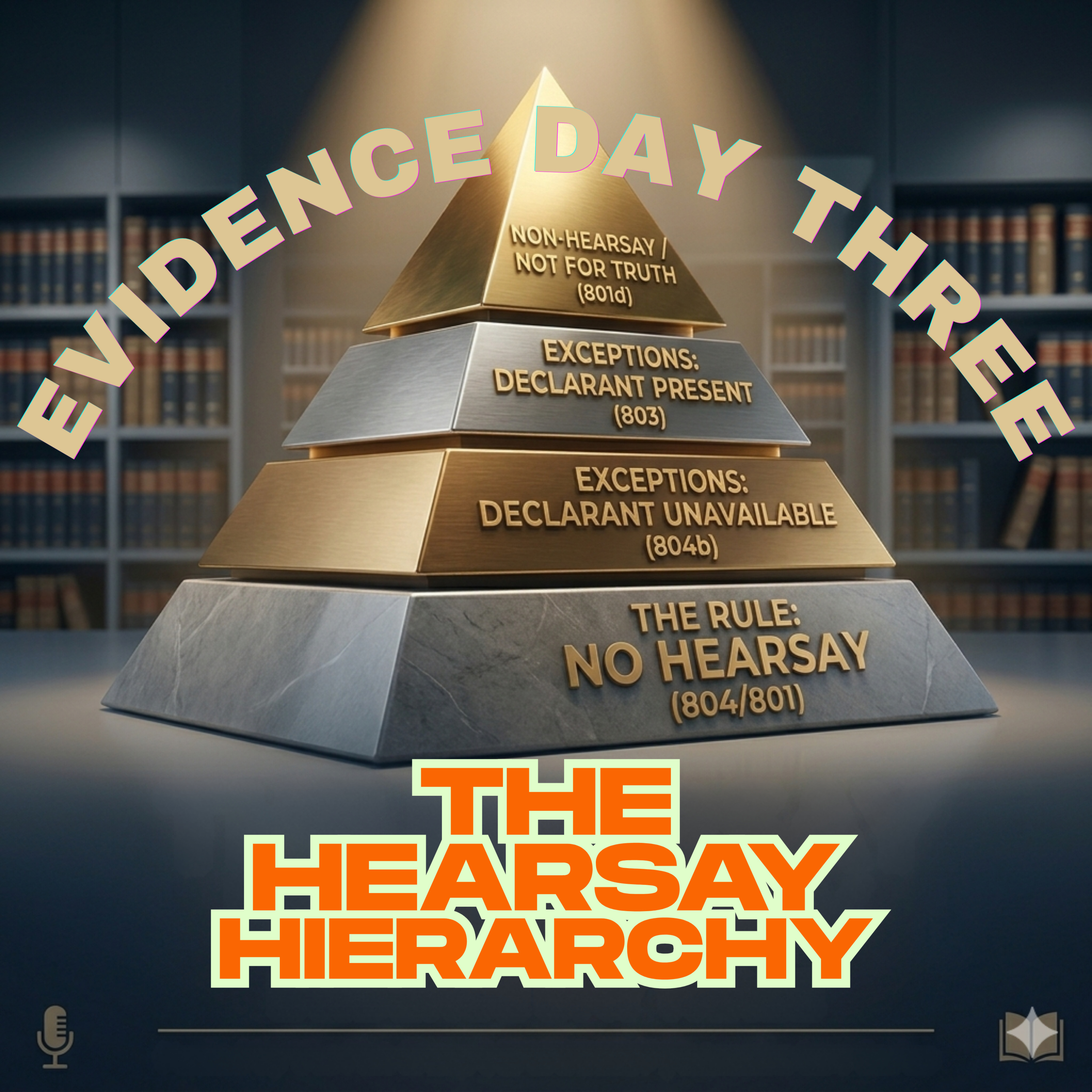
Evidence Day Three: The Witness Clinic episode artwork

EPISODE · Apr 8, 2026 · 1H 6M

Evidence Day Three: The Witness Clinic

from Law School · host The Law School of America

In this episode, we delve into the foundational pillars of witness testimony, unraveling the complexities of competency, memory, and the art of impeachment. Designed to equip law students and future lawyers, this session clarifies how the evidence rules operate as a precise, mechanical system to test and ensure reliability under pressure.Main Topics:Criterion for Witness Competency: The modern presumption that everyone with a pulse can testify and how judges scrutinize functional capacities.Memory Refreshing and Recorded Recollections: The distinctions between Rule 612's present recollection refreshed and Rule 803's past recollection recorded.Impeachment Strategies: The comprehensive toolkit — Bias, Inconsistent Statements, Contradictions, Capacity, and Character (BICCC) — and the circular rules governing character evidence, prior bad acts, and prior convictions.Legal Traps and Tips: Navigating hearsay exceptions, the purpose of voir dire on witness competence, and the strategic use of extrinsic evidence.Key Insights:Everyone is presumed competent; the judge applies a simple four-part functional test.Recalling information is different from using documents to revive memories; admissibility hinges on procedural nuances.Impeachment is not about the facts but about impugning a witness’s reliability, with rules designed to balance fairness and efficiency.The rules prevent the jury from being overwhelmed by past bad behavior while ensuring only relevant, probative evidence is admitted.The legal system is a mechanical labyrinth, with precise gates that determine what evidence is permitted and when, emphasizing the importance of understanding the underlying principles.Most witnesses in court are presumed competent — until they’re not. But how do the rules of evidence meticulously sift truth from bias, memory failures, or outright lies? If you're preparing for the bar or diving into litigation strategy, understanding this delicate process can make or break your case.In this episode, we demystify the complex architecture that underpins witness testimony: from the threshold of competency under Federal Rule 601 to sophisticated memory refresh techniques like present recollection refreshed versus past recollection recorded. You'll discover how judges act as gatekeepers, using strict functional tests to decide who can even take the stand, regardless of their moral character or credibility.We dive deep into the battlefield of impeachment, revealing the powerful toolkit that turns unreliable witnesses into targets. Learn how bias, inconsistent statements, capacity issues, or character for untruthfulness are systematically exposed—often relying on extrinsic evidence—thanks to rules like 608 and 609. You'll also grasp the crucial distinctions between hearsay exceptions and inadmissible evidence, understanding EXACTLY which documents can be read aloud, which can be introduced as exhibits, and why some pieces stay out of the jury room to preserve fairness.Most dramatically, we expose classic traps: what happens when a witness’s memory fails, or when a criminal conviction is “read into” evidence? You'll learn how the rules protect against prejudice even when the stakes are high—when an old felony or a prior bad act could be a game changer, or a simple charge without a final conviction might be inadmissible altogether.This episode transforms the chaos of courtroom evidence into a precise science—whether you’re scrutinizing a bolt of bias or defending a nervous witness. Perfect for law students, bar exam takers, or any attorney sharpening their trial craft. Get the tools, frame the strategies, and see how every rule is designed to cut through the fog and reveal the truth.As technology advances, the legal landscape faces even bigger questions—what if witnesses outsource memory to AI? But until then, mastering these foundational rules is your surest path to victory—because in the courtroom, the story you tell depends on the evidence y

In this episode, we delve into the foundational pillars of witness testimony, unraveling the complexities of competency, memory, and the art of impeachment. Designed to equip law students and future lawyers, this session clarifies how the evidence rules operate as a precise, mechanical system to test and ensure reliability under pressure.Main Topics:Criterion for Witness Competency: The modern presumption that everyone with a pulse can testify and how judges scrutinize functional capacities.Memory Refreshing and Recorded Recollections: The distinctions between Rule 612's present recollection refreshed and Rule 803's past recollection recorded.Impeachment Strategies: The comprehensive toolkit — Bias, Inconsistent Statements, Contradictions, Capacity, and Character (BICCC) — and the circular rules governing character evidence, prior bad acts, and prior convictions.Legal Traps and Tips: Navigating hearsay exceptions, the purpose of voir dire on witness competence, and the strategic use of extrinsic evidence.Key Insights:Everyone is presumed competent; the judge applies a simple four-part functional test.Recalling information is different from using documents to revive memories; admissibility hinges on procedural nuances.Impeachment is not about the facts but about impugning a witness’s reliability, with rules designed to balance fairness and efficiency.The rules prevent the jury from being overwhelmed by past bad behavior while ensuring only relevant, probative evidence is admitted.The legal system is a mechanical labyrinth, with precise gates that determine what evidence is permitted and when, emphasizing the importance of understanding the underlying principles.Most witnesses in court are presumed competent — until they’re not. But how do the rules of evidence meticulously sift truth from bias, memory failures, or outright lies? If you're preparing for the bar or diving into litigation strategy, understanding this delicate process can make or break your case.In this episode, we demystify the complex architecture that underpins witness testimony: from the threshold of competency under Federal Rule 601 to sophisticated memory refresh techniques like present recollection refreshed versus past recollection recorded. You'll discover how judges act as gatekeepers, using strict functional tests to decide who can even take the stand, regardless of their moral character or credibility.We dive deep into the battlefield of impeachment, revealing the powerful toolkit that turns unreliable witnesses into targets. Learn how bias, inconsistent statements, capacity issues, or character for untruthfulness are systematically exposed—often relying on extrinsic evidence—thanks to rules like 608 and 609. You'll also grasp the crucial distinctions between hearsay exceptions and inadmissible evidence, understanding EXACTLY which documents can be read aloud, which can be introduced as exhibits, and why some pieces stay out of the jury room to preserve fairness.Most dramatically, we expose classic traps: what happens when a witness’s memory fails, or when a criminal conviction is “read into” evidence? You'll learn how the rules protect against prejudice even when the stakes are high—when an old felony or a prior bad act could be a game changer, or a simple charge without a final conviction might be inadmissible altogether.This episode transforms the chaos of courtroom evidence into a precise science—whether you’re scrutinizing a bolt of bias or defending a nervous witness. Perfect for law students, bar exam takers, or any attorney sharpening their trial craft. Get the tools, frame the strategies, and see how every rule is designed to cut through the fog and reveal the truth.As technology advances, the legal landscape faces even bigger questions—what if witnesses outsource memory to AI? But until then, mastering these foundational rules is your surest path to victory—because in the courtroom, the story you tell depends on the evidence y

NOW PLAYING

Evidence Day Three: The Witness Clinic

0:00 1:06:48

No transcript for this episode yet

We transcribe on demand. Request one and we'll notify you when it's ready — usually under 10 minutes.

The Small Business Startup School – Business Notes | Financial Literacy | Retail Psychology – For Professionals & Entrepreneurs The Small Business Startup School Inc. Starting or buying a small business? While personal circumstances may vary, business patterns remain timeless. On The Small Business Startup School, we explore strategies, insights, and practical solutions to help entrepreneurs confidently navigate their journey.Hosted by Ola Williams—a retail entrepreneur, fintech founder, and financial coach with over two decades of experience—this podcast marries financial awareness and retail psychology with optimism to deliver actionable takeaways.Join us to learn, grow, and connect as we uncover the keys to business success.Let’s continue to learn together and be encouraged to keep on connecting! The 48 Laws of Power by Robert Greene (Full Audiobook) Robert Greene Amoral, cunning, ruthless, and instructive, this multi-million-copy New York Times bestseller is the definitive manual for anyone interested in gaining, observing, or defending against ultimate control – from the author of The Laws of Human Nature.In the book that People magazine proclaimed “beguiling” and “fascinating,” Robert Greene and Joost Elffers have distilled three thousand years of the history of power into 48 essential laws by drawing from the philosophies of Machiavelli, Sun Tzu, and Carl Von Clausewitz and also from the lives of figures ranging from Henry Kissinger to P.T. Barnum.Some laws teach the need for prudence (“Law 1: Never Outshine the Master”), others teach the value of confidence (“Law 28: Enter Action with Boldness”), and many recommend absolute self-preservation (“Law 15: Crush Your Enemy Totally”). Every law, though, has one thing in common: an interest in t Guardians Of Innocence Guardians Of Innocence Guardians of Innocence is a powerful and informative podcast designed to equip parents, teachers, and communities with the knowledge and tools needed to protect children from the growing threat of trafficking. Each episode dives deep into the tactics traffickers use to target vulnerable children—both online and in real life—and provides actionable advice on how to recognize the warning signs.Through expert interviews with cyber safety professionals, law enforcement, and survivors, we uncover the latest grooming methods, share real-world stories, and empower listeners to become vigilant guardians of innocence in their own families and communities.Guardians of Innocence is more than just a podcast; it’s a call to action to safeguard our children, raise awareness, and foster a united front against trafficking.Listen. Learn. Protect. The Laura Ingraham Show Laura Ingraham The most-watched woman in the history of cable news brings her no-holds-barred political and cultural commentary to podcasting with The Laura Ingraham Show. A bestselling author, breast cancer survivor, and mother of three internationally adopted children, Laura was the most listened-to woman in talk radio before launching her own podcast. A trailblazer across media platforms, she brings a unique perspective to this twice-weekly show, drawing on her experience as a white-collar criminal defense litigator and a Supreme Court law clerk.New episodes drop twice a week—delivering the clarity, courage, and common sense America needs.

Frequently Asked Questions

How long is this episode of Law School?

This episode is 1 hour and 6 minutes long.

When was this Law School episode published?

This episode was published on April 8, 2026.

What is this episode about?

In this episode, we delve into the foundational pillars of witness testimony, unraveling the complexities of competency, memory, and the art of impeachment. Designed to equip law students and future lawyers, this session clarifies how the evidence...

Can I download this Law School episode?

Yes, you can download this episode by clicking the download button on the episode player, or subscribe to the podcast in your preferred podcast app for automatic downloads.
URL copied to clipboard!