
EPISODE · Jul 10, 2026 · 1H
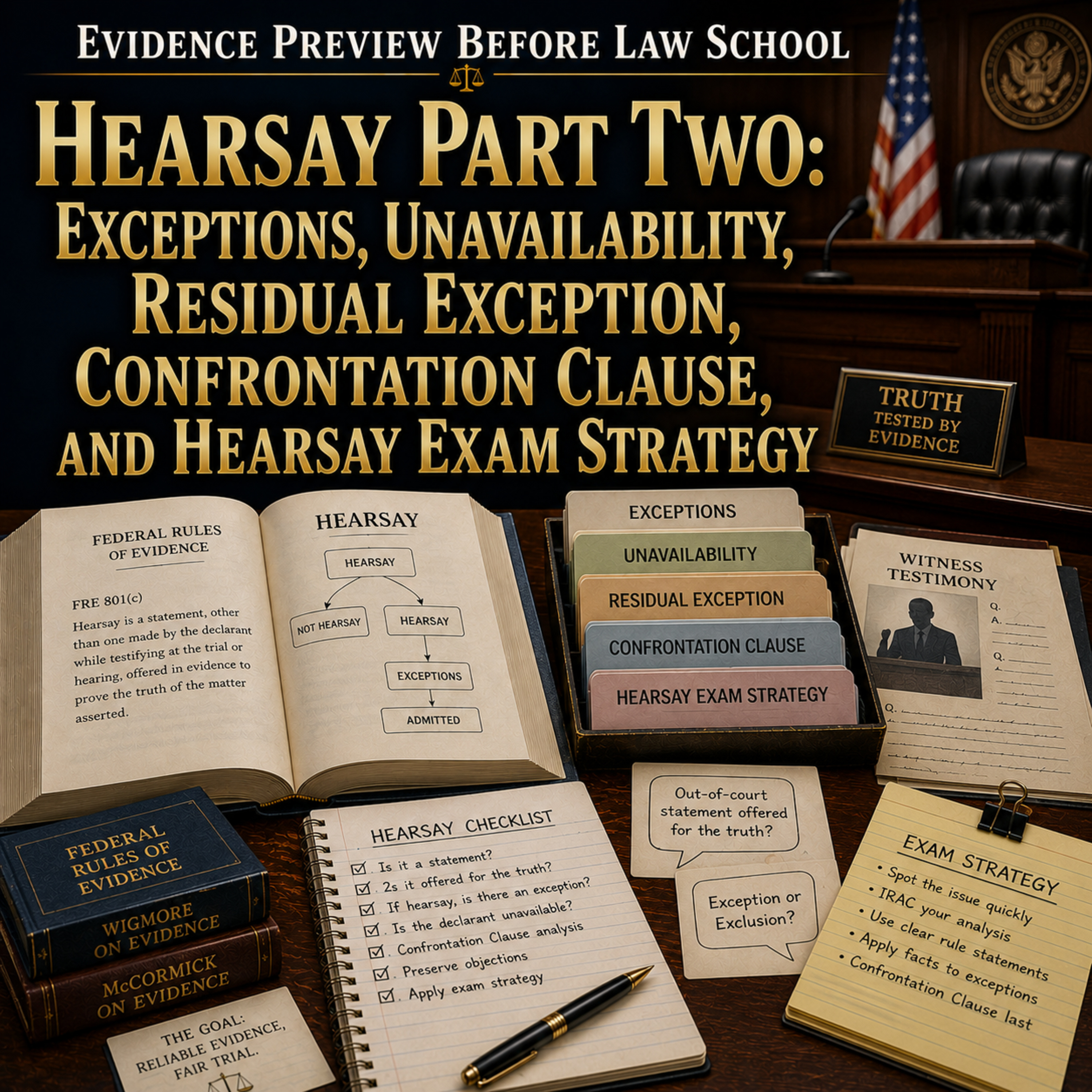
Evidence Preview: Hearsay Part Two: Exceptions, Unavailability, Residual Exception, Confrontation Clause, and Hearsay Exam Strategy
from Law School · host The Law School of America
▶ Click Here to Master Evidence Foundations ▬▬▬▬▬▬▬▬▬▬ EPISODE SUMMARY Hearsay exceptions are organized around reliability, necessity, adversarial testing, and policy. Some exceptions apply regardless of declarant availability. Others require unavailability. Some statements are not hearsay at all. And in criminal cases, confrontation may override ordinary hearsay analysis.Rule 803 exceptions apply regardless of availability. Present sense impressions rely on contemporaneity. Excited utterances rely on stress from a startling event. Then-existing state of mind covers motive, intent, plan, emotion, pain, and bodily condition, but generally not memory or belief offered to prove the remembered fact. Medical-treatment statements rely on the declarant’s incentive to obtain accurate care. Recorded recollection applies when a witness once knew, made or adopted an accurate record when memory was fresh, and now cannot recall fully. Business and public records rely on routine, duty, regularity, and trustworthiness.Rule 804 exceptions require unavailability. Former testimony requires prior opportunity and similar motive to develop the testimony. Dying declarations apply in homicide prosecutions and civil cases when the declarant believed death was imminent and spoke about the cause or circumstances. Statements against interest require that the statement was genuinely contrary to the declarant’s interest when made. Forfeiture by wrongdoing prevents a party from benefiting by intentionally causing a witness’s unavailability.The residual exception is narrow and should be used only when the statement has strong guarantees of trustworthiness, is more probative than reasonably available alternatives, and admission serves justice.The Confrontation Clause applies in criminal prosecutions when testimonial hearsay is offered against the accused. Such statements generally require unavailability and prior opportunity for cross-examination. Statements during ongoing emergencies are more likely nontestimonial; formal statements proving past events for prosecution are more likely testimonial.The central lesson is strategy. On an exam, identify the hearsay purpose, test exclusions first, then exceptions, then confrontation. Hearsay is not a list to memorize blindly. It is a system for deciding when out-of-court assertions may fairly be used as proof.
Embed this episode
Ready to play
Evidence Preview: Hearsay Part Two: Exceptions, Unavailability, Residual Exception, Confrontation Clause, and Hearsay Exam Strategy
No transcript for this episode yet
Similar Episodes
No similar episodes found.
Similar Podcasts
No similar podcasts found.