
EPISODE · Jul 7, 2026 · 1H 3M
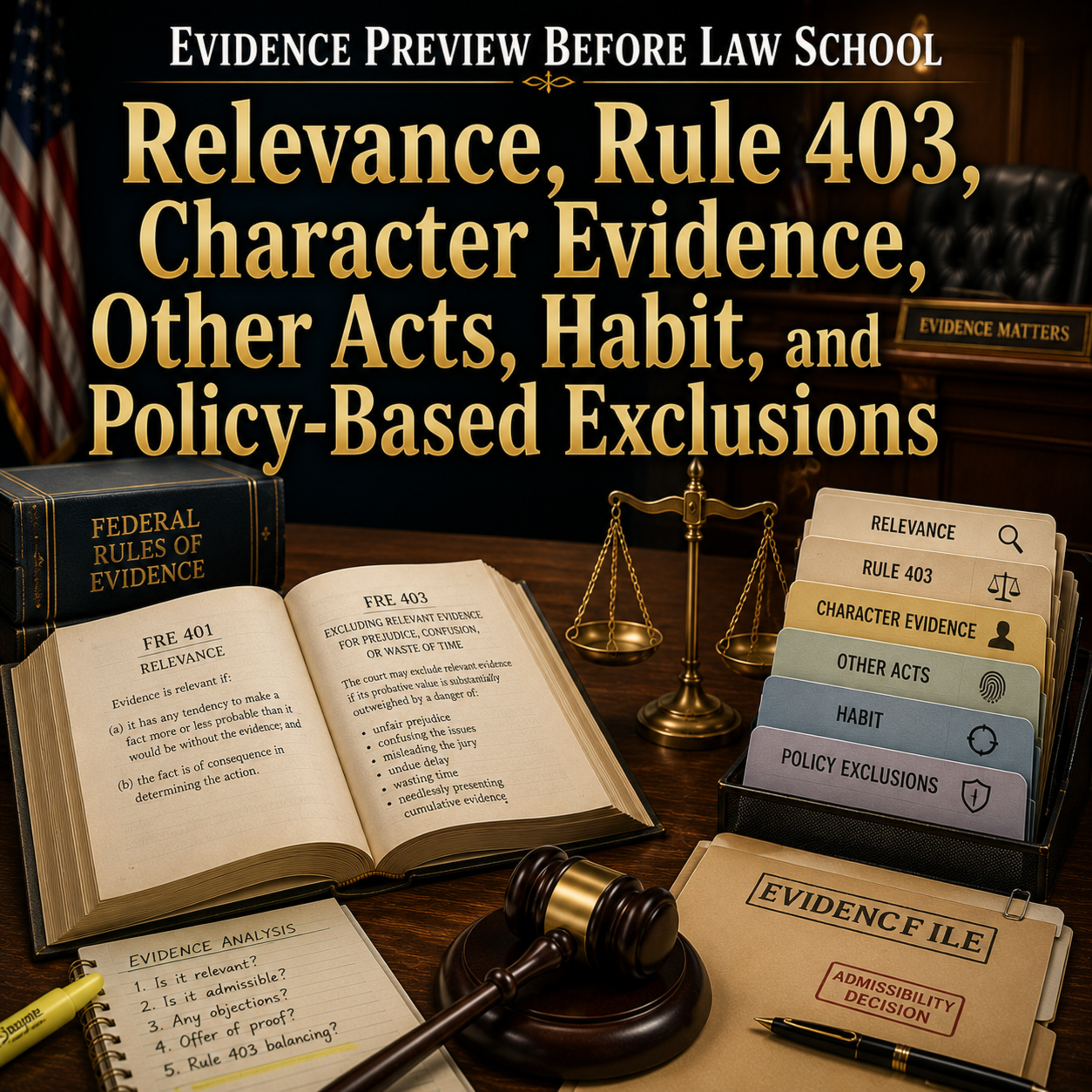
Evidence Preview: Relevance, Rule 403, Character Evidence, Other Acts, Habit, and Policy-Based Exclusions
from Law School · host The Law School of America
» 📘VIEW THE COMPANION STUDY GUIDE📘[💡FREE💡] «▬▬▬▬▬▬▬▬▬▬EPISODE SUMMARYRelevance is the starting point of admissibility. The analysis begins by identifying the item of evidence, the proposition it is offered to prove, whether that proposition matters under the substantive law, whether the evidence makes the proposition more or less probable, and whether another rule excludes or limits it.Rule 403 permits exclusion of relevant evidence when probative value is substantially outweighed by unfair prejudice, confusion, misleading the jury, delay, waste of time, or cumulative proof. The rule favors admissibility, and unfair prejudice means improper emotional or irrational decision-making, not merely harm to a party’s case.Character evidence is generally inadmissible to prove conduct in conformity with character. In criminal cases, defendants may offer pertinent traits of their own character, and may sometimes offer pertinent traits of an alleged victim. The prosecution may rebut when the defendant opens the door. In civil cases, character evidence is generally inadmissible to prove conduct unless character is an essential element of a claim or defense.When character evidence is admissible to prove conduct under criminal exceptions, reputation and opinion are usually the proper methods on direct examination. Specific instances are generally reserved for cross-examining the character witness. When character is an essential element, specific instances may be used.Other crimes, wrongs, or acts are inadmissible for propensity but may be admissible for nonpropensity purposes such as motive, intent, absence of mistake, identity, knowledge, opportunity, preparation, or plan. Rule 403 still applies.Habit evidence is admissible to prove conduct in conformity with habit because habit describes a regular response to a specific repeated situation, not a general personality trait.Policy-based exclusions limit evidence of subsequent remedial measures, settlement negotiations, medical-payment offers, plea discussions, liability insurance, and sexual behavior or predisposition. These rules often exclude evidence for one purpose while allowing it for another.The central lesson is that relevance opens the door, but other rules decide whether the evidence may walk through. Strong Evidence analysis always asks: Relevant for what purpose, and excluded by what rule?
Embed this episode
Ready to play
Evidence Preview: Relevance, Rule 403, Character Evidence, Other Acts, Habit, and Policy-Based Exclusions
No transcript for this episode yet
Similar Episodes
No similar episodes found.
Similar Podcasts
No similar podcasts found.