
EPISODE · Aug 4, 2026 · 46 MIN
Farm Recovery: Neighbors Clear the Way After The Storm
from Red Dirt Agronomy Podcast · host Dave Deken, Brian Arnall Ph.D., Josh Lofton Ph.D., Karen Eifert Jones
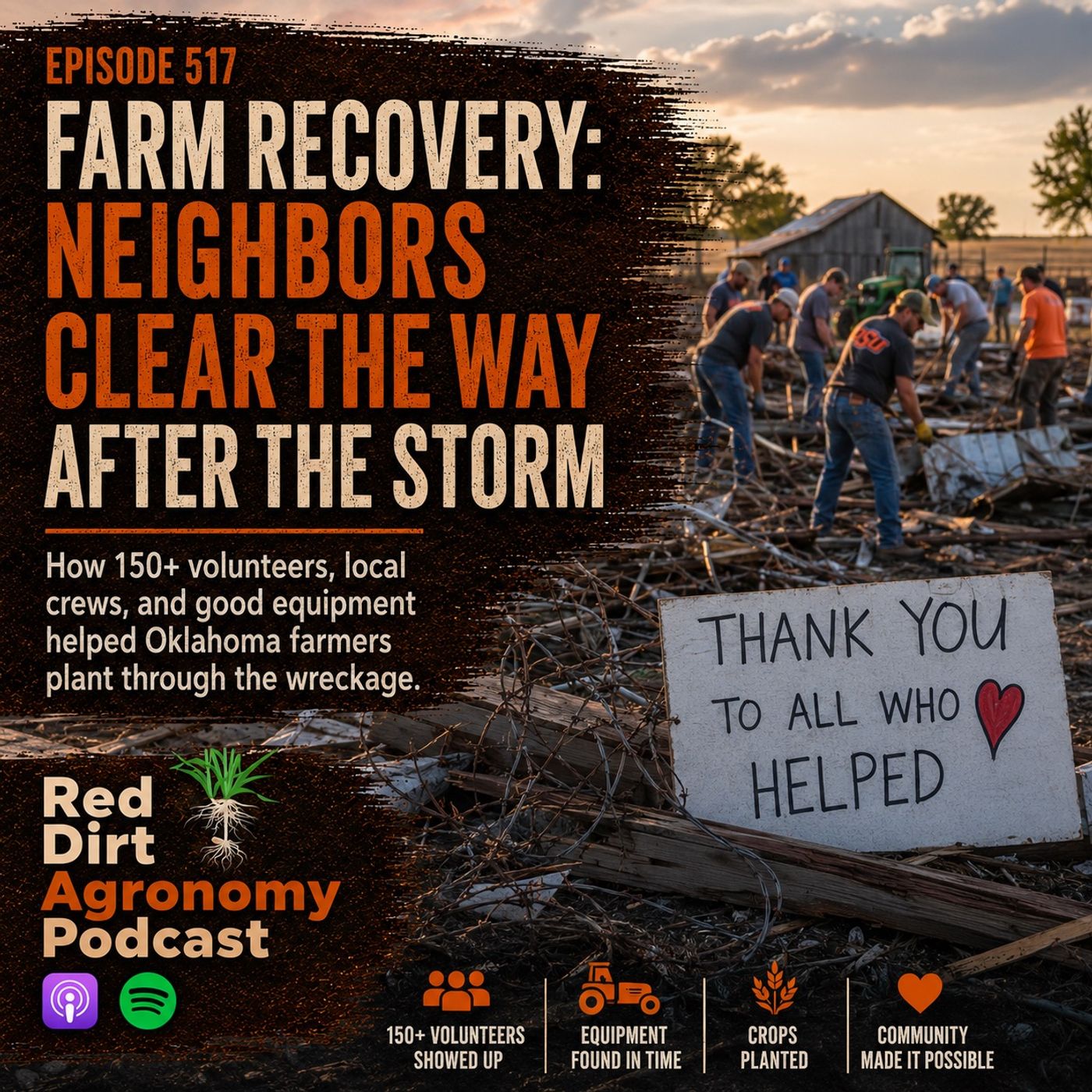
A tornado can leave a farm standing and still prevent the next crop from going into the ground. North-central Oklahoma farmer Karen Eifert Jones shares what happened after the April 23 tornado passed over her family’s headquarters near Enid and tracked across five of their farms. Barbed wire, lumber, shingles and household belongings covered fields and pastures that needed to be planted within days. Karen explains how more than 150 volunteers, neighbors and emergency crews helped locate equipment, wind-damaged fence and walk fields shoulder to shoulder before the next rain. She also shares practical lessons about disaster donations, community shelters, farm mental health, USDA fence assistance, crop decisions and the local relationships that make agricultural recovery possible. Key takeaways: Tornado debris can create serious hazards for planters, combines, livestock and vehicle tires long after the storm. Local emergency coordinators can help farmers locate highly specialized equipment such as hydraulic wire winders. Flexible cash donations allow trusted local groups to purchase the tools and supplies survivors actually need. Community recovery must address mental health, livestock losses, warning communication, and access to safe shelter. Long-term crop rotations still require flexible decisions based on moisture, weeds, labor, cattle, and planting windows. Detailed timestamped rundown 00:00–02:47 — Episode introduction Dave introduces Karen Eifert Jones and the episode’s central story: recovering farmland after a tornado scattered fences, construction material and household debris across multiple farms.02:47–03:55 — What is growing on the farm Karen reviews millet planting, completed canola harvest, nearly completed wheat harvest, full-season corn, soybeans, grain sorghum, double-crop soybeans and the cattle operation.03:55–05:04 — Making annual crop decisions The discussion turns to balancing a five-year operating plan with short-term field conditions, rainfall and individual farm constraints.05:04–06:52 — Why millet fits one difficult farm Karen explains how access limitations make hay the only practical option on one rented farm and why millet has become its most profitable use.06:52–07:11 — Hay sales build new relationships A wheat field overtaken by rye was harvested as hay, creating a relationship with a drought-stricken customer who later subleased pasture.07:11–08:49 — Canola’s place in the rotation Canola may only break even in some years, but Karen values it as a rotation tool that can improve the following wheat crop.08:49–09:33 — Wheat and canola yield losses Both crops produced roughly one-quarter of expected yields because the moisture needed during production did not arrive.09:33–10:57 — Why the farm still double-crops Double-cropping helps keep the soil covered, manage weeds and provide an opportunity for revenue rather than leaving ground idle.10:57–12:06 — Soybeans, sorghum and weed pressure Moisture, broadleaf weeds, grasses and Johnson grass influence which crop goes into each field.12:06–12:56 — Why double-crop corn does not fit The family has considered double-crop corn but regards the timing and production potential as too marginal.12:16–12:56 — Connecting crops and cattle Corn and sorghum residue can be grazed, so water access, fencing and planned cattle locations also influence crop choice.13:03–15:10 — Buying equipment versus hiring custom work Karen describes how labor availability, machinery costs, custom rates and cooperation with neighboring operations shape equipment decisions.15:10–16:34 — Preparing for generational transition Her son is working as an hourly employee before purchasing shares in the operation, while the family expands primarily through rented land.16:44–19:23 — Remembering the April storm Dave recounts watching tornadoes near Braman and Enid before realizing one was approaching Karen’s farm and Vance Air Force Base.19:23–20:28 — Karen watches from Stillwater Karen was attending an Oklahoma State University event and sheltered in the student union after discovering her friend’s hotel lacked an adequate tornado plan.20:28–21:43 — The tornado crosses the operation A neighbor sent video showing the funnel over Karen’s house. The path crossed the headquarters and continued along five farms.21:43–22:56 — Debris blocks spring planting Four fallow farms were filled with wire and wreckage just as full-season planting needed to begin.22:56–24:29 — The search for wire winders After two unsuccessful days, Karen asked the local emergency command center for help locating a hydraulic wire winder. Within minutes, one was found—and a neighbor located another.24:29–25:06 — One request produces two crews Karen’s church planned to send volunteers, while emergency coordinators arranged an additional crew.25:06–26:29 — Walking fields shoulder to shoulder Volunteers searched the ground systematically. One 20-acre field contained so much material that workers could barely take a step without encountering debris.25:30–26:29 — Returning personal belongings Crews recovered photographs, checks, certificates and named clothing that could be cleaned and returned to tornado survivors.26:29–27:29 — More than 150 people volunteer Volunteers came from Enid, Tulsa, Wichita, Oklahoma City, Woodward and surrounding communities, representing many ages and occupations.27:29–28:13 — The Oklahoma Standard in action The hosts reflect on the rural instinct to ask what work needs to be done and then show up to do it.28:13–28:59 — Clearing the final field before rain A second crew completed debris removal around 3 p.m. The planter was already waiting, and the field was planted by 5 p.m.29:14–30:06 — A growing crop becomes a thank-you Karen’s son arranged for a roadside banner thanking donors and volunteers. Grain sorghum growing behind it demonstrates what their work made possible.30:08–32:45 — Community shelters and warning access Karen argues for more public shelter options, particularly for lower-income residents, immigrants, apartment residents and people who may not receive or understand warnings.32:45–34:41 — Livestock losses and mental health The group discusses the emotional consequences of losing animals, homes and personal security, including anxiety that can return during later storms.34:41–35:34 — Surviving more than one disaster Karen recounts the story of an elderly couple who lost a home in the 1973 Enid flood and then lost its replacement in the 2026 tornado.35:34–37:51 — What disaster survivors really need Water, snacks, gloves and flashlights were useful, but excess or poorly matched donations created storage and distribution challenges.37:51–38:31 — Cash purchases specialized equipment Local coordinators used donated funds to buy tow-behind magnetic sweepers for collecting nails and other metal from fields and properties.38:31–40:10 — Keep donations close to the community Karen recommends working through trusted local organizations, churches, Extension offices or other groups that understand immediate needs.40:10–40:39 — Leftover supplies become emergency trailers Unused water, first-aid materials, gloves and tools were stored in trailers that can be deployed during the next tornado, fire or emergency.41:14–41:58 — USDA assistance for damaged fencing Karen used her previous USDA experience to help neighbors find the appropriate forms and ask about cost-share support.41:58–43:02 — Previewing an Enid canola meeting The conversation shifts to an Aug. 4 producer meeting focused on canola production, harvest methods, varieties and market opportunities.43:02–44:16 — Comparing canola harvest strategies Wind damaged windrowed canola, while rain complicated desiccation, illustrating that no harvest approach eliminates every weather risk.44:16–45:40 — Canola’s renewable-fuel market Karen explains that much of the region’s canola enters a specialized market connected to renewable jet fuel, carbon ratings and energy policy.45:40–46:14 — Final reflections The hosts thank Karen for sharing both the tornado recovery story and her perspective on the future of canola.46:14–46:56 — Closing and listener invitation Dave directs listeners to Red Dirt Agronomy for guest information, resources and future episodes. RedDirtAgronomy.com
Embed this episode
What this episode covers
A tornado may pass in minutes, but the work it leaves behind can threaten an entire planting season. In this episode of the Red Dirt Agronomy Podcast, north-central Oklahoma farmer Karen Eifert Jones recounts the April 23 tornado that passed directly over her family’s farm headquarters near Enid and followed a path across five of their farms. Although their home was spared a direct strike, miles of damaged fence, barbed wire, shingles, lumber and household belongings were scattered across fields and pastures that needed to be planted immediately. Karen explains how more than 150 volunteers, local emergency personnel, churches, neighbors and complete strangers helped clear the land. Two urgently needed hydraulic wire winders were located after days of searching, crews walked fields shoulder to shoulder, and one heavily damaged field was cleared by 3 p.m. and planted by 5 p.m.—just before the next rain. The conversation also explores what farmers actually need after a disaster. Karen discusses why flexible cash donations can be more useful than unsolicited supplies, how local organizations can identify needs faster, why accessible community shelters matter and how tornado losses affect mental health long after the debris is removed. The episode closes with lessons about USDA fence-replacement assistance, crop rotation, canola production and the strength of rural communities that show up when the work cannot wait.
Ready to play
Farm Recovery: Neighbors Clear the Way After The Storm
No transcript for this episode yet
Similar Episodes
Dec 17, 2025 ·30m
Dec 11, 2025 ·26m