
EPISODE · Jan 15, 2025 · 3 MIN
FASCINATING FACTS ON CONVERGENT THINKING AND DIVERGENT THINKING
from BEYOND THE OBVIOUS · host Purushothaman C
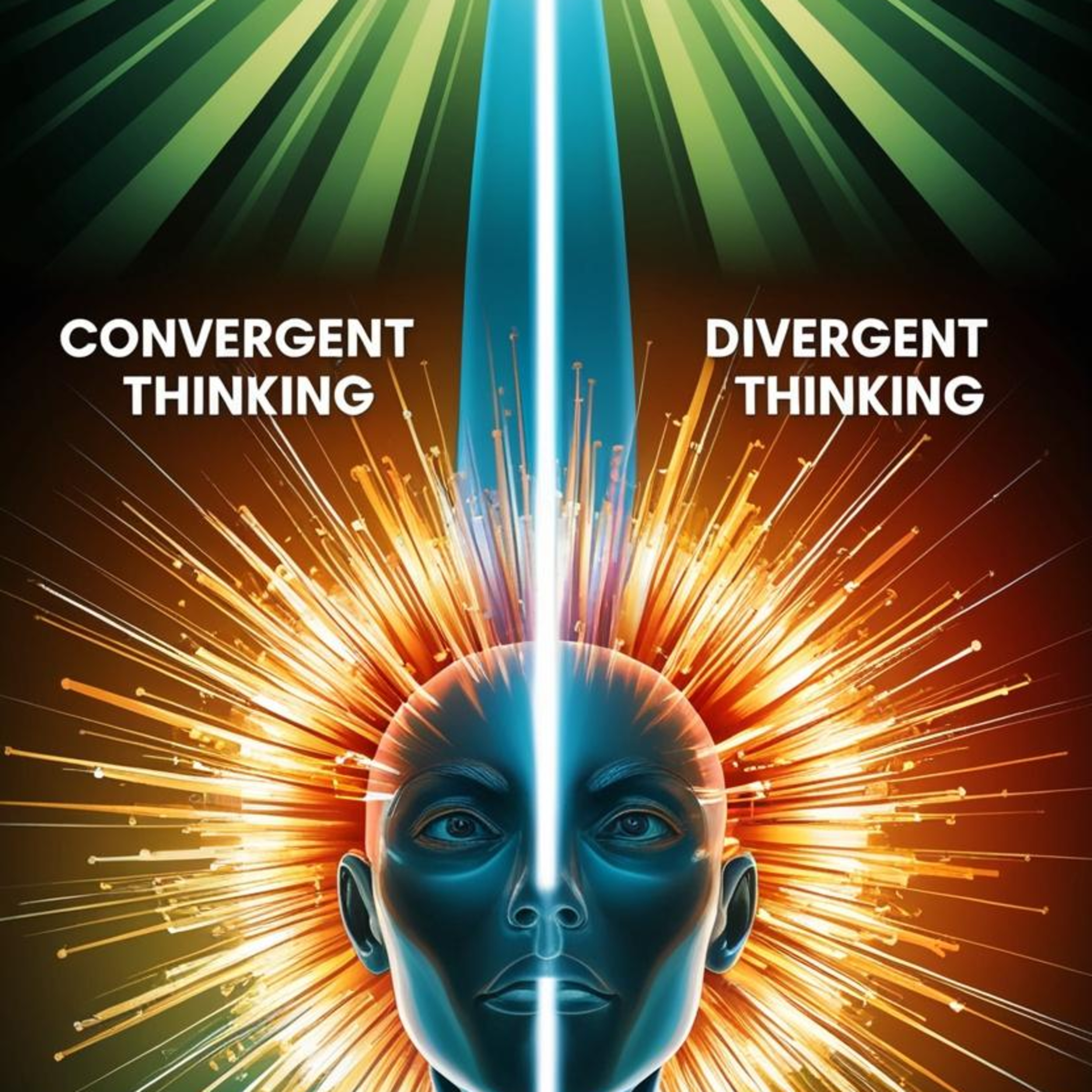
FASCINATING FACTS ON CONVERGENT THINKING AND DIVERGENT THINKING Convergent thinking and divergent thinking are two distinct cognitive approaches that play critical roles in problem-solving and creativity. While they serve complementary purposes, their processes, outcomes, and applications differ significantly. Convergent thinking focuses on narrowing down multiple options to arrive at a single, correct solution. It is systematic, logical, and analytical often used in situations requiring definitive answers, such as solving mathematical problems, answering multiple-choice questions or addressing issues with clear outcomes. Key characteristics include: Linear Process: It involves sequential steps, progressing from identifying the problem to finding the solution. Fact-based: Relies on established knowledge, rules and logical reasoning. Goal-oriented: Aims for accuracy and efficiency, ensuring the solution aligns with predefined criteria. Examples: Solving a crossword puzzle, performing scientific calculations or following a recipe. Convergent thinking is ideal for structured environments like academics, business operations or technical problem-solving, where precision is paramount. Divergent thinking, in contrast, emphasizes generating multiple ideas or solutions from a single starting point. It is spontaneous, creative, and open-ended fostering innovation and originality. Key characteristics include: Non-linear Process: Encourages free-flowing thought without strict adherence to logic or order. Creative Exploration: Focuses on brainstorming, imagination and experimentation. Flexibility: Allows for unconventional and novel approaches to problems. Examples: Developing alternative uses for a common object, composing a story, or designing a marketing campaign. This type of thinking thrives in unstructured scenarios, such as artistic creation, strategic planning, and research, where diverse perspectives enhance outcomes. Comparison: Nature of Thought: Convergent thinking is deductive, seeking the "best" answer, while divergent thinking is inductive, exploring "many" possibilities. Focus: Convergent thinking prioritizes depth, analyzing one solution thoroughly, whereas divergent thinking values breadth, exploring varied options. Outcome: The former yields concrete, definitive results; the latter encourages innovative, open-ended outcomes. Application: Convergent thinking is vital in solving technical problems, while divergent thinking is key to creative pursuits. Conclusion: Both thinking styles are essential in problem-solving. While convergent thinking ensures clarity and precision, divergent thinking fuels creativity and innovation. The interplay between the two fosters comprehensive decision-making, empowering individuals and teams to tackle challenges effectively.
Embed this episode
NOW PLAYING
FASCINATING FACTS ON CONVERGENT THINKING AND DIVERGENT THINKING
No transcript for this episode yet
Similar Episodes
No similar episodes found.
Similar Podcasts
No similar podcasts found.