
EPISODE · Feb 23, 2024 · 4 MIN
Fast Data Processing with Apache Arrow
from Higher Signal: Get Smarter. Faster. · host Higher Signal
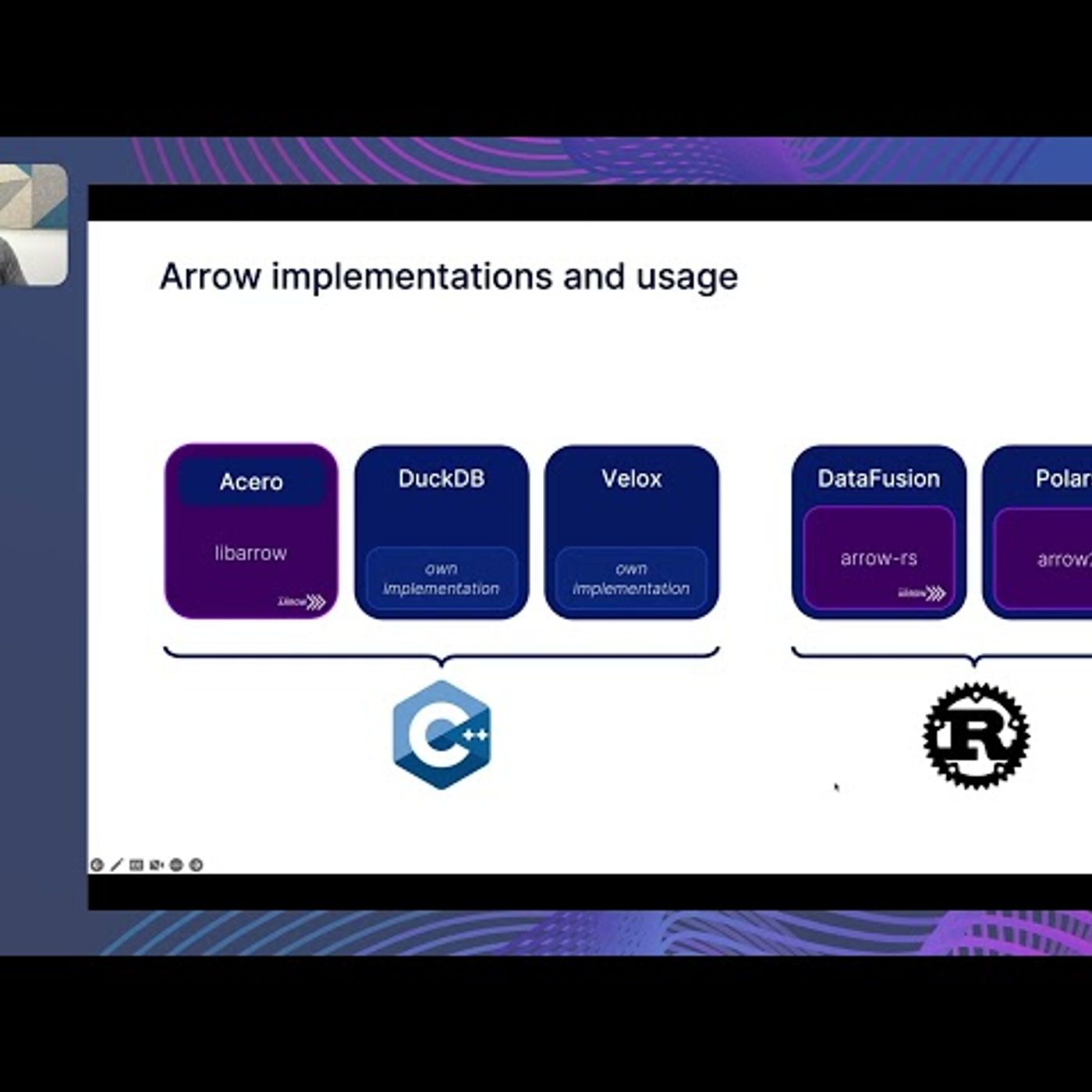
Summary of key themes and main points: 1. Apache Arrow is an in-memory columnar data format that facilitates efficient, standardized storage and exchange of large data sets among various big data analytics systems. It has language-agnostic and cross-platform compatibility. 2. Columnar storage, a hallmark of Apache Arrow, offers benefits like faster data access, improved compression, and more efficient data analysis thanks to its organization of data by columns instead of rows. 3. Apache Arrow boasts a strong ecosystem and integration with big data tools like Apache Spark, Apache Flink, and Hive, which simplifies its adoption within data analytics workflows. 4. Two Rust-based query engines, Data Fusion and Polars, leverage the Apache Arrow format to provide high performance for data processing and analysis with interfaces akin to traditional SQL. 5. Data Fusion is a modular, extensible query engine with connectors to multiple data sources and supports a variety of SQL queries and functions. 6. Polars, while retaining competitive performance and ease of use, is slightly less developed than Data Fusion but is catching up rapidly, showing promise especially for smaller data sets. 7. Limitations identified are the lack of cloud storage integrations and distributed, enterprise-ready features which are currently better addressed by Apache Spark, particularly for big data sets over 50GB. Key questions the transcript answers: - What is Apache Arrow and what are its advantages? Apache Arrow is an in-memory columnar data format designed for efficient data storage and exchange in big data analytics. Its advantages include zero-copy capabilities, cross-platform and language-agnostic interoperability, and high performance due to its structured format and optimization for memory efficiency. - What are the differences between Data Fusion and Polars? Data Fusion is a modular query engine with a strong SQL engine and broad functionality, known for integrating with various data sources. Polars is optimized for performance and easy to use with a focus on fast execution and lower memory footprint albeit with less SQL features compared to Data Fusion. - Under what conditions should one use Data Fusion, Polars, or Apache Spark? For large-scale data handling over 50GB, Apache Spark is recommended due to its distributed processing capability. For datasets under 50GB, Data Fusion is ideal for comprehensive SQL feature sets, while Polars offers superior performance, particularly with Python bindings. Here are a few memorable quotes: "We can see that heavy development is happening on this repository." "Polar's community is working on it [...] Polars beat everything in terms of performance." "In fact, that's why Rust has been built to have the CNC plus speed with memory safety." "But both polars and data fusion are promising." "If you have a large amount of data above 50 gigabyte, go to Spark." Core Takeaway: The core problem described in the transcript is the need for efficient, standardized data processing and analytics across various systems and programming languages, particularly for big data applications. Not solving this issue can result in inefficient data processing, leading to increased costs, slower insights, and a fragmented approach to data analytics which can hamper decision-making and overall performance. To address this problem: 1. Adopt Apache Arrow for its in-memory columnar data storage which offers faster data access, enhanced compression, and language-agnostic, cross-platform interoperability. 2. For small to medium-sized data sets (under 50GB), leverage Rust-based query engines like Data Fusion for a robust SQL feature set or Polars for top-tier performance, especially in Python environments. 3. For large data sets (over 50GB), continue to use Apache Spark as it provides the necessary distributed, enterprise-ready features for extensive big data processing and analytics. Tags here: Apache Arrow, columnar data format, Apache Spark, big data analytics, Data Fusion, Polars, Rust
Embed this episode
Ready to play
Fast Data Processing with Apache Arrow
No transcript for this episode yet
Similar Episodes
No similar episodes found.