Fast X-ray Bursts and Their Optical Surprises: The Case of EP241021a episode artwork

EPISODE · Mar 27, 2025 · 27 MIN

Fast X-ray Bursts and Their Optical Surprises: The Case of EP241021a

from Multi-messenger astrophysics · host Astro-COLIBRI

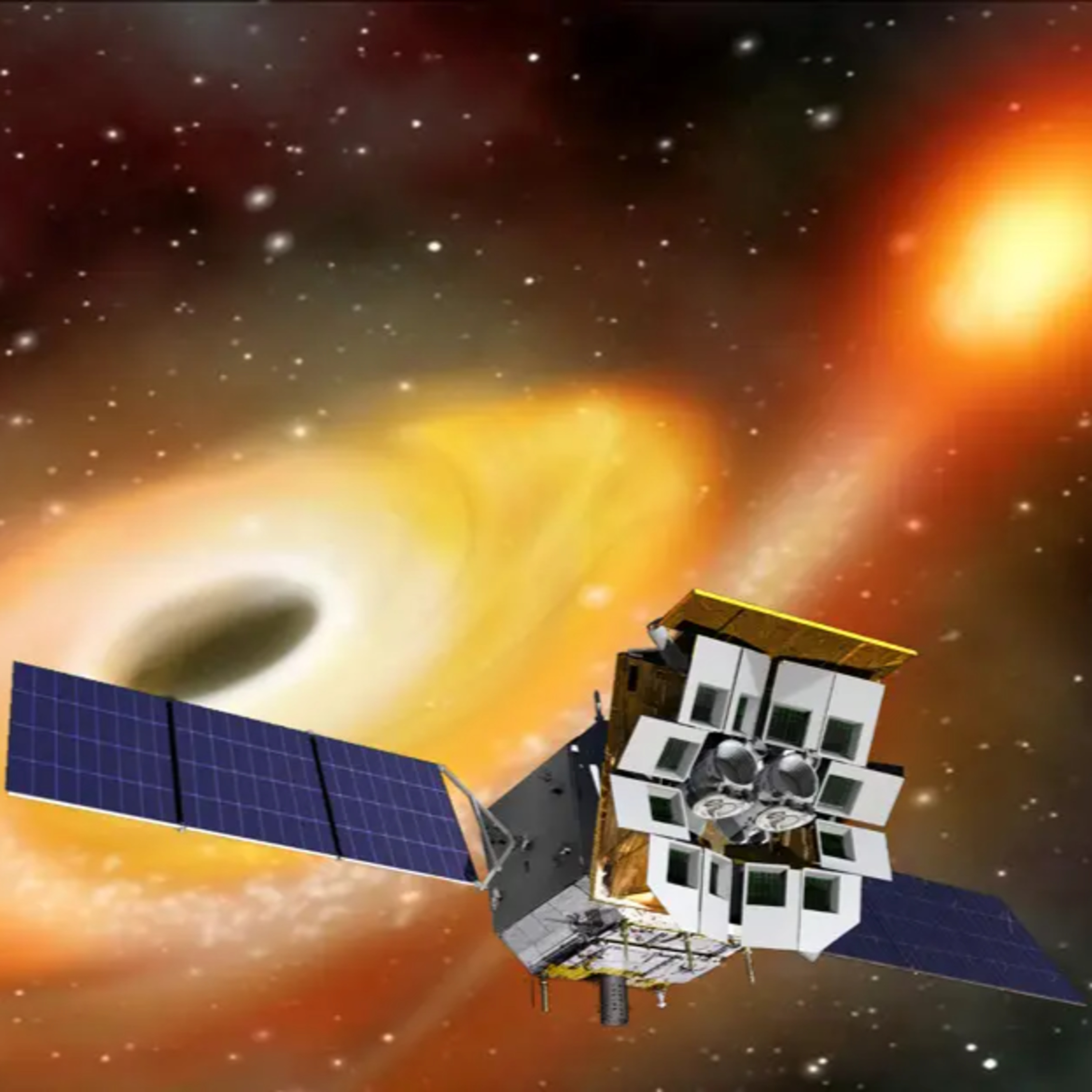
* EP241021a was discovered as a soft X-ray trigger but was not detected at gamma-ray frequencies.* The prompt soft X-ray emission spectrum is consistent with **non-thermal radiation**, suggesting a **mildly relativistic outflow with a bulk Lorentz factor Γ≳ 4**.* The optical and near-infrared light curve shows a **two-component behavior**: an initial fading component (∼ t⁻¹) followed by a **rapid rise (steeper than ∼ t⁴)**, peaking at an absolute magnitude of **Mr ≈−22 mag**, before quickly returning to the initial decay. This peak magnitude is **the most luminous optical emission associated with an FXT**, surpassing EP240414a.* Standard supernova models cannot explain either the **absolute magnitude or the rapid timescale (< 2 days rest frame)** of the rebrightening.* The X-ray, optical, and near-infrared spectral energy distributions indicate a **red color (r− J ≈ 1 mag)** and suggest a **non-thermal origin (∼ ν⁻¹)** for the broadband emission.* Considering a gamma-ray burst (GRB) as a possible scenario, the authors favor a **refreshed shock as the cause of the rebrightening**. This is consistent with the inferred mildly relativistic outflow.* The results suggest a **likely link between EP-discovered FXTs and low-luminosity gamma-ray bursts**.The source also compares EP241021a to another peculiar EP transient, **EP240414a**, which showed a roughly similar multi-wavelength behavior. Both events share features like the lack of gamma-ray emission, multiple optical emission components, a relatively flat X-ray light curve, and luminous, late-peaking radio emission. However, EP241021a has a **more luminous peak in its second optical component** and **longer timescales** for its light curve variations. Unlike EP240414a, which showed spectroscopic evidence of a supernova, **no clear supernova features were identified in the HET spectra of EP241021a**.The authors explore various interpretations for the rebrightening, including off-axis structured jets and refreshed shocks. They disfavor a simple forward shock from an off-axis structured jet due to the steep rise observed but suggest that a **reverse shock from off-axis material in a shallow structured jet** or a **refreshed shock** are more plausible explanations. The consistency of the temporal and spectral indices with standard afterglow closure relations in a wind environment (expected for a massive star progenitor) supports the refreshed shock scenario.The paper concludes that both EP241021a and EP240414a are likely produced by the **death of a massive star**. The non-thermal prompt emission necessitates at least a mildly relativistic outflow. The rapid optical rebrightening is challenging for supernova models and may be due to refreshed shocks or a reverse shock from off-axis material, both favoring a mildly relativistic outflow and non-thermal synchrotron radiation. The authors emphasize the need for future observations of similar events to better understand their nature.Acknowledements: Podcast prepared with Google/NotebookLM. Illustration credits: Chinese Academy of Sciences (CAS).

* EP241021a was discovered as a soft X-ray trigger but was not detected at gamma-ray frequencies.* The prompt soft X-ray emission spectrum is consistent with **non-thermal radiation**, suggesting a **mildly relativistic outflow with a bulk Lorentz factor Γ≳ 4**.* The optical and near-infrared light curve shows a **two-component behavior**: an initial fading component (∼ t⁻¹) followed by a **rapid rise (steeper than ∼ t⁴)**, peaking at an absolute magnitude of **Mr ≈−22 mag**, before quickly returning to the initial decay. This peak magnitude is **the most luminous optical emission associated with an FXT**, surpassing EP240414a.* Standard supernova models cannot explain either the **absolute magnitude or the rapid timescale (< 2 days rest frame)** of the rebrightening.* The X-ray, optical, and near-infrared spectral energy distributions indicate a **red color (r− J ≈ 1 mag)** and suggest a **non-thermal origin (∼ ν⁻¹)** for the broadband emission.* Considering a gamma-ray burst (GRB) as a possible scenario, the authors favor a **refreshed shock as the cause of the rebrightening**. This is consistent with the inferred mildly relativistic outflow.* The results suggest a **likely link between EP-discovered FXTs and low-luminosity gamma-ray bursts**.The source also compares EP241021a to another peculiar EP transient, **EP240414a**, which showed a roughly similar multi-wavelength behavior. Both events share features like the lack of gamma-ray emission, multiple optical emission components, a relatively flat X-ray light curve, and luminous, late-peaking radio emission. However, EP241021a has a **more luminous peak in its second optical component** and **longer timescales** for its light curve variations. Unlike EP240414a, which showed spectroscopic evidence of a supernova, **no clear supernova features were identified in the HET spectra of EP241021a**.The authors explore various interpretations for the rebrightening, including off-axis structured jets and refreshed shocks. They disfavor a simple forward shock from an off-axis structured jet due to the steep rise observed but suggest that a **reverse shock from off-axis material in a shallow structured jet** or a **refreshed shock** are more plausible explanations. The consistency of the temporal and spectral indices with standard afterglow closure relations in a wind environment (expected for a massive star progenitor) supports the refreshed shock scenario.The paper concludes that both EP241021a and EP240414a are likely produced by the **death of a massive star**. The non-thermal prompt emission necessitates at least a mildly relativistic outflow. The rapid optical rebrightening is challenging for supernova models and may be due to refreshed shocks or a reverse shock from off-axis material, both favoring a mildly relativistic outflow and non-thermal synchrotron radiation. The authors emphasize the need for future observations of similar events to better understand their nature.Acknowledements: Podcast prepared with Google/NotebookLM. Illustration credits: Chinese Academy of Sciences (CAS).

NOW PLAYING

Fast X-ray Bursts and Their Optical Surprises: The Case of EP241021a

0:00 27:35

No transcript for this episode yet

We transcribe on demand. Request one and we'll notify you when it's ready — usually under 10 minutes.

The 48 Laws of Power by Robert Greene (Full Audiobook) Robert Greene Amoral, cunning, ruthless, and instructive, this multi-million-copy New York Times bestseller is the definitive manual for anyone interested in gaining, observing, or defending against ultimate control – from the author of The Laws of Human Nature.In the book that People magazine proclaimed “beguiling” and “fascinating,” Robert Greene and Joost Elffers have distilled three thousand years of the history of power into 48 essential laws by drawing from the philosophies of Machiavelli, Sun Tzu, and Carl Von Clausewitz and also from the lives of figures ranging from Henry Kissinger to P.T. Barnum.Some laws teach the need for prudence (“Law 1: Never Outshine the Master”), others teach the value of confidence (“Law 28: Enter Action with Boldness”), and many recommend absolute self-preservation (“Law 15: Crush Your Enemy Totally”). Every law, though, has one thing in common: an interest in t API Intersection Stoplight Building a successful API requires more than just coding. It starts with collaborative design, focuses on creating a great developer experience, and ends with getting your company on board, maintaining consistency, and maximizing your API’s profitability.In the API Intersection, you’ll learn from experienced API practitioners who transformed their organizations, and get tangible advice to build quality APIs with collaborative API-first design.Jason Harmon brings over a decade of industry-recognized REST API experience to discuss topics around API design, governance, identity/auth versioning, and more.They’ll answer listener questions, and discuss best practices on API design (definition, modeling, grammar), Governance (multi-team design, reviewing new API’s), Platform Transformation (culture, internal education, versioning) and more.They’ll also chat with experienced API practitioners from a wide array of industries to draw out practical takeaways and insights you can use.H MTG PodQuest Echoblade Studios Podcast reporting events relating to Magic: The Gathering Puzzle Quest, and specifically covering ”The Gods of Theros” multi-coalition for the online game Magic: The Gathering--Puzzle Quest. Can be enjoyed by any players of MTGPQ or anybody with ears. Maybe.TRIGGER WARNING: A LOT of nerdy stuff. Possibly an occasional vulgarity, though we keep that to a minimum. Passive Investing Podcast The Real Estate Women The Passive Investing Podcast is a round table discussion where we teach you how to create a stream of passive income through Multi Family investing. Crystal, Candy, Colleen & Tamara dive into the classroom, board room and living room on Multi Family real estate investing, with Guests Matt Pichney, Rod Khleif, and Julie Holly pulling up a chair to share stories and insight on their areas of expertise. Whether you’re trying to jump into real estate to free yourself from the grind of the 9-5, to build a stream of passive income or to create generational wealth, join us at the table!

Frequently Asked Questions

How long is this episode of Multi-messenger astrophysics?

This episode is 27 minutes long.

When was this Multi-messenger astrophysics episode published?

This episode was published on March 27, 2025.

What is this episode about?

* EP241021a was discovered as a soft X-ray trigger but was not detected at gamma-ray frequencies.* The prompt soft X-ray emission spectrum is consistent with **non-thermal radiation**, suggesting a **mildly relativistic outflow with a bulk Lorentz...

Can I download this Multi-messenger astrophysics episode?

Yes, you can download this episode by clicking the download button on the episode player, or subscribe to the podcast in your preferred podcast app for automatic downloads.
URL copied to clipboard!