🚀 Faster, Please! — The Podcast #15
from Faster, Please! — The Podcast Hosted by James Pethokoukis
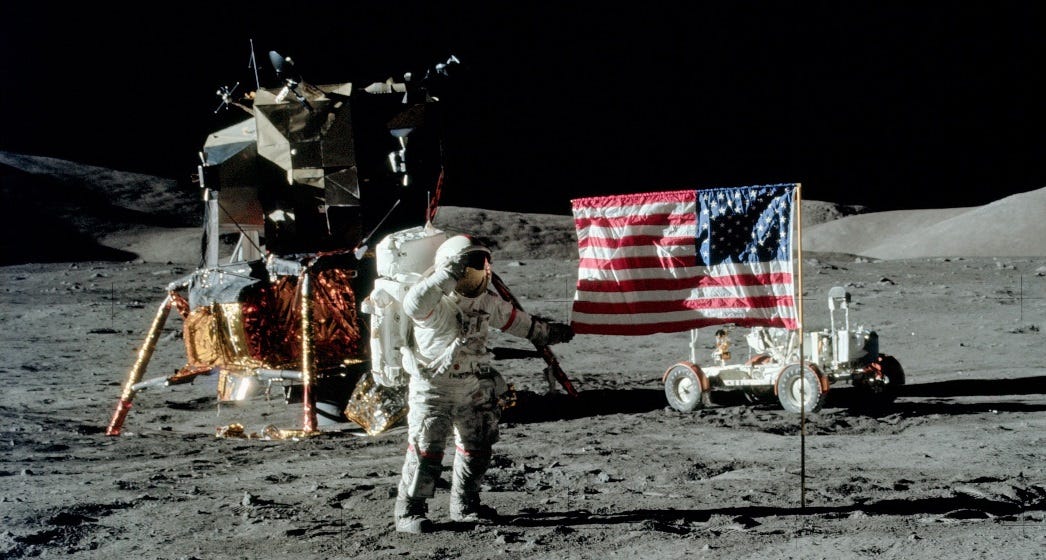
This month, December 2022, marks the 50-year anniversary of when man last stood on the Moon. NASA's Apollo missions were an awe-inspiring triumph of human achievement, but do people really care about space anymore? To discuss the wonder of space exploration, the virtues involved, and why robotic missions just aren't enough, I'm joined by Charles T. Rubin. Charles is a contributing editor at The New Atlantis, where he has published several excellent essays on space exploration, his latest being "Middle Seat to the Moon" in the fall 2022 issue. He's also a professor emeritus of political science at Duquesne University and the author of several books, including 2014's Eclipse of Man: Human Extinction and the Meaning of Progress. In This Episode * Will space become mundane? (1:29) * The case for astronauts (10:10) * Billionaires in space (14:29) * Sci-fi and the future of space (19:41) Below is an edited transcript of our conversation. Will space become mundane? James Pethokoukis: In your New Atlantis essay, you write that “to make something routine is precisely to suck the wonder out of it, to make it uninteresting.” In regards to space exploration, is it important that people have a sense of wonder to it? Is it important to maintain public support for government efforts? And is it important in a higher spiritual sense, that we have a sense of wonder about the vastness of the universe outside our own little pale blue dot of it? Charles Rubin: I think both of those are true, actually. It applies not just to government space program efforts, but also now to private space program efforts. The private ones obviously will operate in a market environment. Someday, I think it is hoped that such trips will not just be for immensely wealthy people, but will be for normally wealthy people. And they're going to have to have a reason to want to go into space. I think, as is true in many, many circumstances of tourism, it will be because there's something very cool and wondrous to be seen out there. That is certainly part of any justification — an important part, it seems to me, for both private space efforts and, of course, public space efforts. There are going to be many different reasons why people will support or be against a government-funded space program. But here also, I think that wonder plays an important role in attracting some kinds of people to those efforts who would otherwise not be attracted. The science of it, the technology of it — those are crucial things, but they're not going to appeal to everybody. But exploration and going where no human being has gone before: These are things that are going to have a broader appeal, I think. I wonder, even if we get to the point where it's maybe not common that people take a quick trip into almost space or even at the point where they can have a vacation in orbit, even if you know people who have done that, I think there will still be a sense of wonder. I've done some traveling, probably a lot less traveling than some other people. But I'm pretty sure that when I go to Italy and see the Colosseum, or if I went to Australia and saw Mount Uluru, even though I am not the first person to do that and I know people have done that, I would still probably think those are pretty awesome. I certainly hope that's true. It may be useful if I say something more about my concerns about routinization: I think that there are problems that will be faced as space travel gets more common and is available to more people. That will be a wonderful thing in terms of the success of the technology, but we will potentially find ourselves in a situation where it's going to be like flying in an airplane to Australia or flying in an airplane to Italy: I don't know how many people look out the window under those circumstances. And yet here you are flying at an immense height with extraordinary vistas to be seen around you, and we simply take it for granted. I began to think about some of this in the way I do when I was going occasionally into New York City from New Jersey. I don't think this is a train ride that is known — well, I can know for sure — it's not known for its natural beauty, and I could look around me and see that people were doing almost anything other than looking out the window. But it's kind of an extraordinary ride. You're passing through suburban America, you're passing through decaying industrial areas. There's just a lot to be seen there. But of course, it's just a train ride so who really is going to be looking too carefully at what's going on around them? I'd like to see that in our space efforts we maintain that level of interest at all levels of the journey. And again, I think that's going to be an important part of both commercial and governmental success. Is that possible? Is that an unavoidable downside? Some things are going to become common and there's always going to be a certain amount of people like yourself — I'm probably more like you in this; I always think it's cool the first time I see a New York skyline or taking a train and just seeing how one little town might be different; I enjoy that — and some people don’t, they will get lost in their phones or naps, and that's just the way we are. Different people have different preferences. Yes, and that's fine. In fact, that's wonderful. But I don't think it's impossible to open a door that might otherwise be left shut. In other words, I think these are outlooks that can be cultivated. They're outlooks that can be encouraged. I think I was fortunate growing up: My folks took us on wonderful driving vacations, and when we started out was an era of auto suspensions where car sickness was still a major concern. We were actively discouraged from reading in the car, so we learned to pay attention to the landscape. And my mother was a great one for pointing things out, and she was never afraid to hide her own enthusiasm. And I didn't do such a good job with my kids, who became readers in the car. I kind of wish that were otherwise, but I probably could have done better. Again, I think there are attitudes that can be cultivated, there are expectations that can be created, that will perhaps allow more people rather than fewer to appreciate the wonders of space flight. That reminded me of a book by the Nobel laureate Edmund Phelps called Mass Flourishing. And toward the end of the book, he talks a little bit about schools. And he's worried that we're not creating entrepreneurial — in the broadest sense of the word — risk-taking, adventurous children. Are we creating with our current education system, do you think, the kind of people who can have a real sense of awe, a sense of wonder at what they see out of a window on a spacecraft or a space hotel? That sounds like a last chapter I very much need to read. I agree. I think there are multiple tendencies in contemporary American culture that readily point us in directions that are not healthy. My hope would be something like this: that a serious, active, adventurous, risk-taking space program could serve something of the same function going forward in our time as that extraordinary, less than a decade served in the 1960s when the United States was on its way to the Moon. That really was inspiring. I look back on it and I think it's amazing. It took so short a time from the Kennedy speech to having people on the Moon. And people responded to that, it seems to me. The case for astronauts Frequent listeners will know that I love the TV show For All Mankind. And for those who have not watched it, it's an alt-history show where the space race never ends. The US and the USSR just keep racing, and it has all kinds of interesting side effects. And I remember, I think it was the end of season three, it flash-forwards — spoilers — to the early ‘90s. And what you see is this Martian vista, then you see an astronaut's boot take a step on that Martian vista. But some people don't get a thrill out of that. They think, “Fine. Build your space facto… This is a public episode. If you'd like to discuss this with other subscribers or get access to bonus episodes, visit fasterplease.substack.com/subscribe
Embed this episode
No transcript yet.