🚀 Faster, Please! — The Podcast #33
from Faster, Please! — The Podcast Hosted by James Pethokoukis
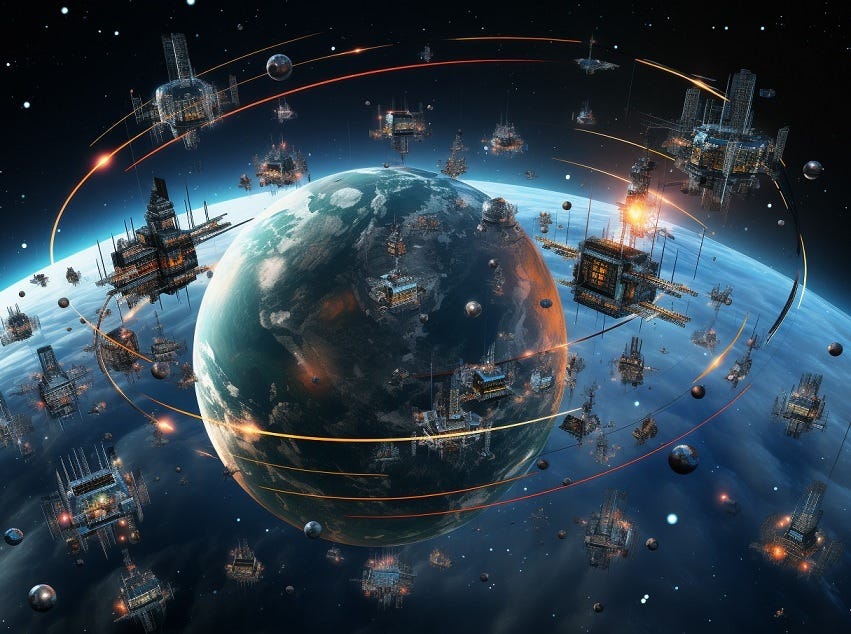
Over the past 15 years, the cost to launch a rocket into orbit has declined dramatically thanks to SpaceX. Today, we're witnessing the launch of a new Space Age — one built around billionaires like Elon Musk, but also a flowering of smaller private ventures. To discuss the state of play in the emerging orbital economy, I've brought Ashlee Vance on this episode of Faster, Please! — The Podcast. Vance is the author of the new book, When the Heavens Went on Sale: The Misfits and Geniuses Racing to Put Space Within Reach. He previous wrote, Elon Musk: Tesla, SpaceX, and the Quest for a Fantastic Future in 2015. Faster, Please! is a reader-supported publication. To receive new posts and support my work, consider becoming a free or paid subscriber. In This Episode * How SpaceX launched a new Space Age (1:13) * The companies building a “computing shell” around the planet (8:37) * The proliferation of satellites (15:07) * The downsides of the emerging space economy (24:07) Below is an edited transcript of our conversation How SpaceX launched a new Space Age James Pethokoukis: The book begins with a story of the first successful orbital launch of a SpaceX Falcon 1. There were three failed attempts, the whole thing is looking pretty dicey about the future of the company in this effort, and on the fourth attempt, September, 2008, they're able to get to orbit and release a payload. Before September, 2008, what does the space economy/space industry look like? Where are we starting? Ashlee Vance: The starting point: sort of sadly, it looked a lot the same for many, many decades. We had this nation-backed space program, [which was] dominant. There were just a handful of nations, really, that were the major players in all this. Some wealthy people at various stages had come along and tried to commercialize space and make their own rockets, and had varying degrees of success, but no staying power. It ended up that it always takes longer and costs more than you think. And NASA was always sitting there really as your main competitor and undermining your business. With the Falcon 1, it really was this watershed-type moment where finally somebody had succeeded. Yes, SpaceX had people from traditional aerospace, but Elon [Musk] certainly was not from the aerospace world. He had a lot of 20-somethings on his team who had never done this before. It just signaled this new era, or the possibility of a new era, because you had people just who hadn't been part of the old guard doing this thing. The goal here was to get a rocket into space and get it there way cheaper than what NASA was doing. What was the key breakthrough that allowed that decline in costs? And why didn't NASA just do this? NASA, and in particular the Department of Defense, had desired this type of thing for a long time: a low-cost rocket that could get to space quickly and often. It seems like this should be doable, but they had really struggled to make it happen. The DOD had funded various efforts. There's a couple things going on. SpaceX had this huge advantage, I think, of this clean slate to this. They came at this without the usual baggage. And in this case, the baggage means a lot of military government contractors who are pricing things quite expensively. They're doing things the way they've always done them, which means you probably don't want to see any sort of failure so you're building it in a ton of redundancy and spending all this extra money to make sure you look good when this thing goes. SpaceX comes in with this clean slate. The original pitch deck for SpaceX described it as like the Southwest for space. Cost was like at the top of [Elon Musk’s] mind and he wanted to make this cheap. They did have some breakthroughs. The physics around a rocket are the physics, and we've known this for decades. There's not much room for huge breakthroughs in engineering that nobody has thought of yet. But they did come in with this modern, Silicon Valley–style approach to software, particularly to electronics—although this kind of comes in later in SpaceX's history—where SpaceX was going to build a lot of the electronics themselves, often turning to consumer-grade electronics instead of what people call space-grade, which means it's built by a military contractor, it probably costs a thousand times what it should cost, but it's guaranteed to work in space. They had this clean slate. They did things as cheap as possible. The team was small. It wasn't this bloated contractor. That was their primary advantage at the beginning, I would argue. Over time, as they've gotten much bigger and much more money is coming in, there's a whole host of technological advantages. But on the Falcon 1, it really was that clean slate, this low-cost approach. Obviously if you're beginning your book, which is not a history of SpaceX, but you're beginning with SpaceX, then that must have marked an important inflection point where you could sort of imagine two paths. One path: the 2010s look a lot like the 2000s, which look a lot like the ‘90s. Versus this very different path. Why is SpaceX important in creating this new path, and what do things look like now? Yeah. I'm so glad you called that out and you phrased it the way you did with these two paths, because a lot of people—my editors were giving me grief for, “Why are you spending so much time talking about SpaceX in the prologue of this book that's not going to be about SpaceX?” But as you pointed out… By the way, having dealt with book editors, I can imagine that conversation quite easily. I wanted people to know how fragile this was, and where it did it come from? You mentioned it: Three of the previous rockets had failed, SpaceX was running out of money, they were running out of credibility, people had been on this island, Kwajalein, for six years, basically losing their minds. If this rocket does not go, I think we do end up in that scenario that you were just talking about, where the 2010s look pretty much like they always had. It was important to me just to give people this history, how hard this is. I see this as this inciting incident. It's funny, because you kind of go from governments and then there were like honest-to-God billionaires. When Elon started SpaceX, he was rich, but he wasn't rich like he is now. We're talking about like a hundred million dollars he put into SpaceX. So the bar had come down quite a bit. But in that moment when this rocket flies and then in the years that follow, when SpaceX really starts to hit its stride, this unlocks all of this. There was so much enthusiasm for space and young kids who wanted to get into this industry, and it had been slow and boring and the excitement had sort of come out of it. You had the generation of people who had grown up watching Apollo. Those people were getting older, and there wasn't something new to look at for a lot of people who were much younger. And here it is. Here's this company that's making commercial space real. And this guy, Elon, is quite eccentric and interesting, and some people sort of want to be like him. I write about it in the book: It was sort of like the four-minute mile to me. It's like, once somebody does it, then all of a sudden you see lots of people now are breaking the four-minute mile. This thing that seemed impossible, it turns out is possible. You have this unlocking in your head of what people can do. And so I just think across the world, it unlocked this passion, this latent engineering smarts and energy, and made this seem real. So you end up with startups all over the world chasing rockets and satellites. The companies building a “computing shell” around the planet In the book, you write, “The future that all these space buffs have already started building is one in which many rockets blast off every day. These rockets will be carrying thousands of satellites that will be placed not all that far above our heads. The satellites will change the way communications work on Earth by, for one, making the intern… This is a public episode. If you'd like to discuss this with other subscribers or get access to bonus episodes, visit fasterplease.substack.com/subscribe
Embed this episode
No transcript yet.