🚀 Faster, Please! — The Podcast #7
from Faster, Please! — The Podcast Hosted by James Pethokoukis
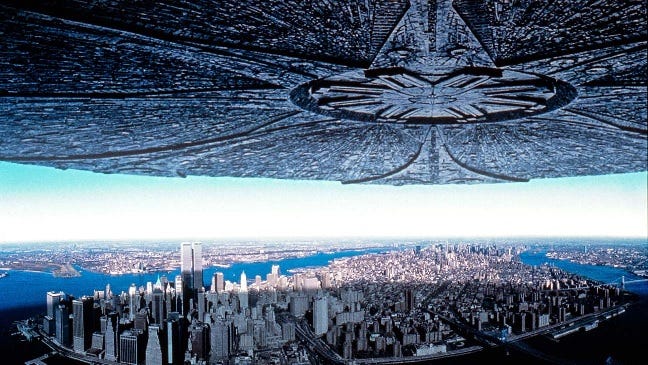
In this episode of Faster, Please! — The Podcast, I'm continuing last week's discussion with Robin Hanson, professor of economics at George Mason University and author of the Overcoming Bias blog. His books include The Age of Em: Work, Love and Life when Robots Rule the Earth and The Elephant in the Brain: Hidden Motives in Everyday Life. (Be sure to check out last week’s episode for the first part of my conversation with Robin. We discussed futurism, innovation, and economic growth over the very long run, among other topics. Definitely worth the listen!) In part two, Robin and I talk about the possibility of extraterrestrial life. Earlier this year, the US House of Representatives held a hearing on what Washington now calls "unexplained aerial phenomena." While the hearing didn't unveil high-def, close-up footage of little green men or flying saucers, it did signal that Washington is taking UAPs more seriously. But what if we really are being visited by extraterrestrials? What would contact with an advanced alien civilization mean for humanity? It's exactly the kind of out-there question Robin considers seriously and then applies rigorous, economic thinking. In This Episode: * The case for extraterrestrial life (1:34) * A model to explain UFOs (6:49) * Could aliens be domesticating us right now? (13:23) * Would advanced alien civilization renew our interest in progress? (17:01) * Is America on the verge of a pro-progress renaissance? (18:49) Below is an edited transcript of our conversation. The case for extraterrestrial life James Pethokoukis: In the past few years there have been a lot of interesting developments on the UFO — now UAP — front. The government seems to be taking these sightings far more seriously. Navy pilots are testifying. What is your take on all this? Robin Hanson: There are two very different discussions and topics here. One topic is, “There are these weird sightings. What's with that? And could those be aliens?” Another more standard, conservative topic is just, “Here's this vast empty universe. Are there aliens out there? If so, where?” So that second topic is where I've recently done some work and where I feel most authoritative, although I'm happy to also talk about the other subject as well. But I think we should talk first about the more conservative subject. The more conservative subject, I think, is — and I probably have this maybe 50 percent correct — once civilizations progress far enough, they expand. When they expand, they change things. If there were a lot of these civilizations out there, we should be able to, at this point, detect the changes they've made. Either we've come so early that there aren't a lot of these kinds of civilizations out there … let me stop there and then you can begin to correct me. The key question is: it looks like we soon could go out expanding and we don't see limits to how far we could go. We could fill the universe. Yet, we look out and it's an empty universe. So there seems to be a conflict there. Where are the giant Dyson spheres? One explanation is, we are so rare that in the entire observable universe, we're the only ones. And therefore, that's why there's nobody else out there. That's not a crazy position, except for the fact that we're early. The median star will last five trillion years. We're here on our star after only five billion years, a factor of 1000. Our standard best theory of when advanced life like us should appear, if the universe would stay empty and wait for it, would be near the end of a long-lived planet. That's when it would be most likely to appear. There's this power of the number of hard steps, which we could go into, but basically, the chance of appearing should go as the power of this time. If there are, say, six hard steps, which is a middle estimate, then the chance of appearing 1000 times later would go as 1000 to the power of six. Which would be 10 to the 18th. We are just crazy early with respect to that analysis. There is a key assumption of the analysis, which is the universe would sit and wait empty until we showed up. The simplest way to resolve this is to deny that assumption is to say, “The universe is not sitting and waiting empty. In fact, it's filling up right now. And in a billion years or two, it'll be all full. And we had to show up before that deadline.” And then you might say, “If the universe is filling up right now, if right now the universe is half full of aliens, why don't we see any?” We should be detecting signals, seeing things. We have this brand new telescope out there sitting a million miles away. If we were sitting at a random place in the universe, that would be true. But we are the subject of a selection effect. Here's the key story: We have to be at a place where the aliens haven't gotten to yet. Because otherwise, they would be here instead of us. That's the key problem. If aliens expand at almost the speed of light, then you won’t see them until they’re almost here. And that means if you look backwards in our light cone — from our point, all the way backwards — almost all that light cone is excluded. Aliens couldn’t be there because, again, if they had arisen there, they would be here now instead of us. The only places aliens could appear that we could see now would have to be just at the edge of that cone. Therefore, the key explanation is aliens are out there, but everywhere the aliens are not, we can't see them because the aliens are moving so fast we don't see them until they're almost there. So the day on the clock is the thing telling you aliens are out there right now. That might seem counterintuitive. “How's the clock supposed to tell me about aliens? Shouldn't I see pictures of weird guys with antennae?” Something, right? I'm saying, “No, it's the clock. The clock is telling you that they're out there.” Because the clock is saying you're crazy early, and the best explanation for why you're crazy early is that they're out there right now. But if we take a simple model of, they’re arising in random places and random times, and we fit it to three key datums we know, we can actually get estimates for this basic model of aliens out there. It has the following key parameter estimates: They're expanding at, say, half the speed of light or faster; they appear roughly once per million galaxies, so pretty rare; and if we expanded out soon and meet them, we'd meet them in a billion years or so. The observable universe has a trillion galaxies in it. So once per million galaxies means there are a lot of them that will appear in our observable universe. But it's not like a few stars over. This is really rare. Once per million galaxies. We're not going to meet them soon. Again, in a billion years. So there's a long time to wait here. A model to explain UFOs Based on this answer, I don't think your answer to my first question is “We are making contact with alien intelligence.” This simple model predicts strongly that there's just no way that UFOs are aliens. If this were the only possible model, that would be my answer. But I have to pause and ask, “Can I change the model to make it more plausible?” I tried to do this exercise; I tried to say, “How could I most plausibly make a set of assumptions that would have as their implication UFOs are aliens and they’re really here?” Is this a different model or are you just changing something key in that model? I’m going to change some things in this model, I'll have to change several things. I'm going to make some assumptions so that I get the implication that some UFOs are aliens and they're doing the weird things we see. And the key question is going to be, “How many assumptions do you have to make, and how unlikely are they?” This is the argument about the prior on this theory. Think of a murder trial. In a murder trial, somebody says A killed B. You know that the prior probability of that is like one in a million: One in 1000 people are killed in a murder a… This is a public episode. If you'd like to discuss this with other subscribers or get access to bonus episodes, visit fasterplease.substack.com/subscribe
Embed this episode
No transcript yet.