
EPISODE · Sep 27, 2026 · 1H 2M
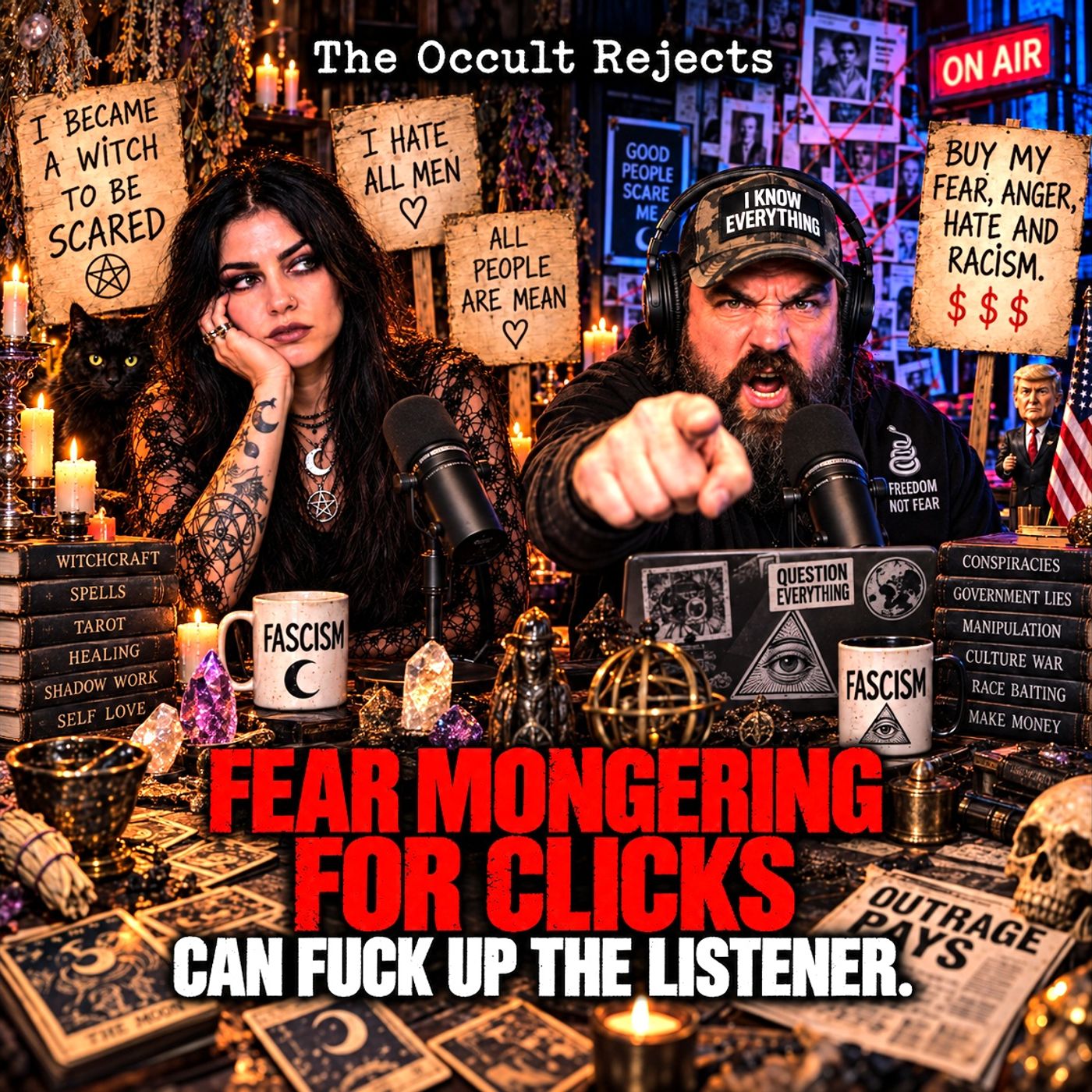
Fear Mongering for Clicks Can Fuck Up the Listener
from The Occult Rejects · host The Occult Rejects
Links For The Occult Rejectshttps://linktr.ee/theoccultrejectsOccult Research Institutehttps://www.occultresearchinstitute.org/Substackhttps://substack.com/@theoccultrejects?r=7auau0&utm_campaign=profile&utm_medium=profile-pageCash Apphttps://cash.app/$theoccultrejectsVenmo@TheOccultRejectsPatreonhttps://www.patreon.com/TheOccultRejectsBIBLIOGRAPHYFear, Negativity, Attention, and StressBaumeister, Roy F., Ellen Bratslavsky, Catrin Finkenauer, and Kathleen D. Vohs. “Bad Is Stronger Than Good.” Review of General Psychology 5, no. 4 (2001): 323–370. https://doi.org/10.1037/1089-2680.5.4.323.Bar-Haim, Yair, Dominique Lamy, Lee Pergamin, Marian J. Bakermans-Kranenburg, and Marinus H. van IJzendoorn. “Threat-Related Attentional Bias in Anxious and Nonanxious Individuals: A Meta-Analytic Study.” Psychological Bulletin 133, no. 1 (2007): 1–24. https://doi.org/10.1037/0033-2909.133.1.1.Tannenbaum, Melanie B., Justin Hepler, Rick S. Zimmerman, Lindsey Saul, Samantha Jacobs, Kristina Wilson, and Dolores Albarracín. “Appealing to Fear: A Meta-Analysis of Fear Appeal Effectiveness and Theories.” Psychological Bulletin 141, no. 6 (2015): 1178–1204. https://doi.org/10.1037/a0039729.Juster, Robert-Paul, Bruce S. McEwen, and Sonia J. Lupien. “Allostatic Load Biomarkers of Chronic Stress and Impact on Health and Cognition.” Neuroscience & Biobehavioral Reviews 35, no. 1 (2010): 2–16. https://doi.org/10.1016/j.neubiorev.2009.10.002.Negative News, Trauma Coverage, and Stress ReactivityMarin, Marie-France, Julie-Katia Morin-Major, Tania E. Schramek, Annick Beaupré, Andrea Perna, Robert-Paul Juster, and Sonia J. Lupien. “There Is No News Like Bad News: Women Are More Remembering and Stress Reactive after Reading Real Negative News than Men.” PLoS ONE 7, no. 10 (2012): e47189. https://doi.org/10.1371/journal.pone.0047189.Holman, E. Alison, Dana Rose Garfin, and Roxane Cohen Silver. “Media’s Role in Broadcasting Acute Stress Following the Boston Marathon Bombings.” Proceedings of the National Academy of Sciences 111, no. 1 (2014): 93–98. https://doi.org/10.1073/pnas.1316265110.Thompson, Rebecca R., Nickolas M. Jones, E. Alison Holman, and Roxane Cohen Silver. “Media Exposure to Mass Violence Events Can Fuel a Cycle of Distress.” Science Advances 5, no. 4 (2019): eaav3502. https://doi.org/10.1126/sciadv.aav3502.Fear, Negativity, and the Attention EconomyRobertson, Claire E., Nicolas Pröllochs, Kaoru Schwarzenegger, Philip Pärnamets, Jay J. Van Bavel, and Stefan Feuerriegel. “Negativity Drives Online News Consumption.” Nature Human Behaviour 7 (2023): 812–822. https://doi.org/10.1038/s41562-023-01538-4.Shabahang, Reza, Hyeyeon Hwang, Emma F. Thomas, Mara S. Aruguete, Lynn E. McCutcheon, Gábor Orosz, Abbas Ali Hossein Khanzadeh, Benyamin Mokhtari Chirani, and Ágnes Zsila. “Doomscrolling Evokes Existential Anxiety and Fosters Pessimism about Human Nature? Evidence from Iran and the United States.” Computers in Human Behavior Reports 15 (2024): 100438. https://doi.org/10.1016/j.chbr.2024.100438.Conspiracy Exposure and Paranoid ThoughtMolenda, Zuzanna, Marta Marchlewska, Adam Karakula, Wojciech Podsiadłowski, Marta Rogoza, Paulina Bagrowska, and Dagmara Szczepańska. “Thought Contagion? Conspiracy Beliefs Boost Paranoid Thoughts.” Applied Psychology: Health and Well-Being 16, no. 4 (2024): 2065–2082. https://doi.org/10.1111/aphw.12577.Repetition and the Illusory Truth EffectYe, Steeven, David Attali, Maria Ghazi, Arnaud Cachia, Mathieu Cassotti, Grégoire Borst, et al. “Systematic Review and Meta-Analysis of the Evidence for an Illusory Truth Effect and Its Determinants.” Nature Communications 17 (2026): 3270. https://doi.org/10.1038/s41467-026-70041-x.Intolerance of Uncertainty, Worry, and AnxietyAkbari, Mehdi, Sonay Sheikhi, Mahsa Sadat Navab Safiadin, Minoo Rahmani, Roya Forootan, and Gordon J. G. Asmundson. “A Hierarchical Uncertainty Framework of Anxiety: Preregistered Meta-Analytic Structural Model of Intolerance of Uncertainty and Worry across Anxiety Disorders.” Clinical Psychology Review 128 (2026): 102773. https://doi.org/10.1016/j.cpr.2026.102773.Intergroup Threat, Prejudice, and Negative GeneralizationRiek, Blake M., Eric W. Mania, and Samuel L. Gaertner. “Intergroup Threat and Outgroup Attitudes: A Meta-Analytic Review.” Personality and Social Psychology Review 10, no. 4 (2006): 336–353. https://doi.org/10.1207/s15327957pspr1004_4.Paolini, Stefania, and Kylie McIntyre. “Bad Is Stronger Than Good for Stigmatized, but Not Admired Outgroups: Meta-Analytical Tests of Intergroup Valence Asymmetry in Individual-to-Group Generalization Experiments.” Personality and Social Psychology Review 23, no. 1 (2019): 3–47. https://doi.org/10.1177/1088868317753504.Paolini, Stefania, Meghann Gibbs, Brett Sales, Danielle Anderson, and Kylie McIntyre. “Negativity Bias in Intergroup Contact: Meta-Analytical Evidence That Bad Is Stronger Than Good, Especially When People Have the Opportunity and Motivation to Opt Out of Contact.” Psychological Bulletin 150, no. 8 (2024): 921–964. https://doi.org/10.1037/bul0000439.Satanic Panic, McMartin, Suggestion, and False AllegationsGarven, Sena, James M. Wood, Roy S. Malpass, and John S. Shaw III. “More Than Suggestion: The Effect of Interviewing Techniques from the McMartin Preschool Case.” Journal of Applied Psychology 83, no. 3 (1998): 347–359. https://doi.org/10.1037/0021-9010.83.3.347.Garven, Sena, James M. Wood, and Roy S. Malpass. “Allegations of Wrongdoing: The Effects of Reinforcement on Children’s Mundane and Fantastic Claims.” Journal of Applied Psychology 85, no. 1 (2000): 38–49. https://doi.org/10.1037/0021-9010.85.1.38.Goodman, Gail S., Jodi A. Quas, Bette L. Bottoms, Jianjian Qin, Phillip R. Shaver, Holly Orcutt, and Cheryl Shapiro. “Children’s Religious Knowledge: Implications for Understanding Satanic Ritual Abuse Allegations.” Child Abuse & Neglect 21, no. 11 (1997): 1111–1130. https://doi.org/10.1016/S0145-2134(97)00070-7.Trust, Loneliness, Social Exclusion, and Conspiracy BeliefsGodžáková, Dana, and Jakub Šrol. “Mind in Doubt and Isolated Soul: Examining Longitudinal Relationships Between Conspiracy Beliefs Related to COVID-19, Interpersonal Trust, Loneliness and Social Exclusion.” Journal of Community & Applied Social Psychology 36, no. 3 (2026): e70267. https://doi.org/10.1002/casp.70267.Also want to remind people about the website, if you're into reading we have tons of information by multiple contributors, and we got t-shirts up on the site if you're interested. Fun fact, the art is all based on the eyeball.
Embed this episode
What this episode covers
Links For The Occult Rejects https://linktr.ee/theoccultrejects Occult Research Institute https://www.occultresearchinstitute.org/ Substack https://substack.com/@theoccultrejects?r=7auau0&utm_campaign=profile&utm_medium=profile-page Cash App https://cash.app/$theoccultrejects Venmo @TheOccultRejects Patreon https://www.patreon.com/TheOccultRejects BIBLIOGRAPHY Fear, Negativity, Attention, and Stress Baumeister, Roy F., Ellen Bratslavsky, Catrin Finkenauer, and Kathleen D. Vohs. “Bad Is Stronger Than Good.” Review of General Psychology 5, no. 4 (2001): 323–370. https://doi.org/10.1037/1089-2680.5.4.323. Bar-Haim, Yair, Dominique Lamy, Lee Pergamin, Marian J. Bakermans-Kranenburg, and Marinus H. van IJzendoorn. “Threat-Related Attentional Bias in Anxious and Nonanxious Individuals: A Meta-Analytic Study.” Psychological Bulletin 133, no. 1 (2007): 1–24. https://doi.org/10.1037/0033-2909.133.1.1. Tannenbaum, Melanie B., Justin Hepler, Rick S. Zimmerman, Lindsey Saul, Samantha Jacobs, Kristina Wilson, and Dolores Albarracín. “Appealing to Fear: A Meta-Analysis of Fear Appeal Effectiveness and Theories.” Psychological Bulletin 141, no. 6 (2015): 1178–1204. https://doi.org/10.1037/a0039729. Juster, Robert-Paul, Bruce S. McEwen, and Sonia J. Lupien. “Allostatic Load Biomarkers of Chronic Stress and Impact on Health and Cognition.” Neuroscience & Biobehavioral Reviews 35, no. 1 (2010): 2–16. https://doi.org/10.1016/j.neubiorev.2009.10.002. Negative News, Trauma Coverage, and Stress Reactivity Marin, Marie-France, Julie-Katia Morin-Major, Tania E. Schramek, Annick Beaupré, Andrea Perna, Robert-Paul Juster, and Sonia J. Lupien. “There Is No News Like Bad News: Women Are More Remembering and Stress Reactive after Reading Real Negative News than Men.” PLoS ONE 7, no. 10 (2012): e47189. https://doi.org/10.1371/journal.pone.0047189. Holman, E. Alison, Dana Rose Garfin, and Roxane Cohen Silver. “Media’s Role in Broadcasting Acute Stress Following the Boston Marathon Bombings.” Proceedings of the National Academy of Sciences 111, no. 1 (2014): 93–98. https://doi.org/10.1073/pnas.1316265110. Thompson, Rebecca R., Nickolas M. Jones, E. Alison Holman, and Roxane Cohen Silver. “Media Exposure to Mass Violence Events Can Fuel a Cycle of Distress.” Science Advances 5, no. 4 (2019): eaav3502. https://doi.org/10.1126/sciadv.aav3502. Fear, Negativity, and the Attention Economy Robertson, Claire E., Nicolas Pröllochs, Kaoru Schwarzenegger, Philip Pärnamets, Jay J. Van Bavel, and Stefan Feuerriegel. “Negativity Drives Online News Consumption.” Nature Human Behaviour 7 (2023): 812–822. https://doi.org/10.1038/s41562-023-01538-4. Shabahang, Reza, Hyeyeon Hwang, Emma F. Thomas, Mara S. Aruguete, Lynn E. McCutcheon, Gábor Orosz, Abbas Ali Hossein Khanzadeh, Benyamin Mokhtari Chirani, and Ágnes Zsila. “Doomscrolling Evokes Existential Anxiety and Fosters Pessimism about Human Nature? Evidence from Iran and the United States.” Computers in Human Behavior Reports 15 (2024): 100438. https://doi.org/10.1016/j.chbr.2024.100438. Conspiracy Exposure and Paranoid Thought Molenda, Zuzanna, Marta Marchlewska, Adam Karakula, Wojciech Podsiadłowski, Marta Rogoza, Paulina Bagrowska, and Dagmara Szczepańska. “Thought Contagion? Conspiracy Beliefs Boost Paranoid Thoughts.” Applied Psychology: Health and Well-Being 16, no. 4 (2024): 2065–2082. https://doi.org/10.1111/aphw.12577. Repetition and the Illusory Truth Effect Ye, Steeven, David Attali, Maria Ghazi, Arnaud Cachia, Mathieu Cassotti, Grégoire Borst, et al. “Systematic Review and Meta-Analysis of the Evidence for an Illusory Truth Effect and Its Determinants.” Nature Communications 17 (2026): 3270. https://doi.org/10.1038/s41467-026-70041-x. Intolerance of Uncertainty, Worry, and Anxiety Akbari, Mehdi, Sonay Sheikhi, Mahsa Sadat Navab Safiadin, Minoo...
Ready to play
Fear Mongering for Clicks Can Fuck Up the Listener
No transcript for this episode yet
Similar Episodes
No similar episodes found.
Similar Podcasts
No similar podcasts found.