This is Believe. One network, every topic, everywhere. From the Homestead Studios in Santa Clarita, California, this is a Headache Soul production. Welcome to Just the Tipsters, America's favorite true crime podcast. I'm your host, Melissa Morgan. With me today is my handsome and talented co-host, Joshua Subway Bevin. Subway? Looks like you got a foot long. See, I did a head fake. I did a head fake. I was like, I'm going to start off the year being... It just looks that way. ...being nice to us.
Look, next week it's going to be back to being mean to you, but I was trying to up your Tinder profile thing. Yeah. Hey, how you doing? Subway. They call me Subway. They call me Subway. Because it looks like I got a photo. Okay. And I don't like Jared. I thought you were going to call me like Fat Jared. No. I was going, I was head faking. Or maybe other, yeah. Other. Other Jared attributes. No. I was trying to make it seem like. Yeah. Yeah. Things are good for you. Exactly. Exactly.
I like what I got. I know how to use it. That's all that matters. That's what we're at. Hey, if you like it, that's the best part, I guess. I don't know. I don't have a lot of, you know, like research data.
Paint men and their penises. I need more funding from the government to continue my research. I'm writing a grant right now. Yeah, right. Exactly. I was hoping you could help me. I thought you're a good grant writer. You're good with words and shit. Well, happy new year. I think this might be the second one of the new year, my beautiful pictures. We're already deep into 25. Deep. So deep. I hope we can see our way out. We're like coal miners and they sent a bird down and it died and then we're still trying to claw away.
We already cooked it. Yeah, we cooked it and ate it. It tastes just like chicken. I wanted to say thank you to Tipster Jerry for his sweet email. He, I guess, heard on one of the episodes that I'd finished school and he sent an email to congratulate me and he said the kindest thing. He said he knew Mark was beaming. And I, you know, yeah, that means a lot to me right there. Thank you, Jerry. I hope so because all I ever wanted to do is make Mark proud. So now I got a certification. Now I got to get a fucking job and I am, you know, prepare for impact, Kentucky. I will be in you soon in a couple of days. And I'm having a lunch with one of my favorite detectives.
Speaking of detectives, one of my favorite detectives helped us out tremendously with this episode. So we'll get into that in a minute. But before that, this is an abrupt left turn. But there is an amazing podcast called The Telepathy Tapes. The Telepathy Tapes? Yeah. I am not thrilled with the title. However, it, I think, will attract the people that it's looking for. It is a woman. I don't know that she is a scientist. I honestly do not know her interest in this topic. But she has lots of family members on and neuroscientists and speech pathologists, et cetera.
And it is about how people on the autism spectrum communicate. And it is fascinating. And if you have anyone in your family who, you know, may have been diagnosed autistic and there's, you know, nonverbal and, you know, I don't want to call it semi-verbal, but some verbal and then, you know, high functioning. I mean, I have come to the conclusion everyone I know and myself is somewhere on the spectrum. For sure. I have weird things that I didn't understand what they were. Like I have terrible misphonia, like, you know, some people like chewing or loud noises or bright lights, things, you know, throw me off. And I don't, I'm like, why do you have to be this way? In my head, I'm thinking that all the time. I mean, I don't know that I'd be diagnosed autistic, but I also wouldn't.
turn that diagnosis down. I mean, I just think everyone has, I would call it like your own personality, your own quirks. I just think everyone's on the spectrum somewhere. Absolutely. But you know, that's right. That's right. That's, you know, the level is what the level is. But so far, I think I might be on episode four.
She has met a female doctor who Johns Hopkins educated, but she is on the board of Harvard Medical School. And she, I think her name is Dr. Jane Powell. And she has done lots of tests. And this host, her name is Kai, I believe, KY. She, you know, it's scientific and technical, but not over anyone's head. And the fascinating part is hearing these families all across the country and what they go through, how difficult it is when they, you know, I vaguely remember children are born usually within the first year or two.
If they start to regress and go within, you know what's happening. Sure. And you don't know where it's going to land. And most of them are nonverbal. Some of them that are being talked about in the episodes, you know, are verbal. But a lot of them, and it's very controversial in the autism world, they call them spellers. People that use an iPad to spell things out. Okay. They have letter boards, you know, things. It's kind of like developing, in my mind, it's like ASL. It's like American Sign Language, you know. But the conclusion, and it's still, I guess, kind of up in the air, is that.
I mean, I just know that we only use a small percentage of our brain. I've always believed, you know, call it your gut instinct. Like you get to a crossroads, you're like, I'm going to go left, not right. Oh, for sure. You know, you think about someone in the phone rings, you know, I feel like those, I feel like there's lots of, and I know you're very, very intuitive and have a lot of clarity. You got, you live your life by that. I've seen you make decisions.
And, you know, express yourself. That's not going to be good for me or, you know. Right. And that's I mean, and the more I feel like the more that you tap into it, the more that anybody taps into it, the stronger we get. I am with you. And I have in different times of my in my life felt I have cut myself off, you know, and not listen to myself. And there are times when I feel like I have listened to myself. And yet it I was like, I don't feel like I'm connected correctly because I feel like I'm making wrong decisions. I feel that way way more often than I than I want to. But I know that, you know.
Somewhere deep down in there, whether we access it or not, there is an untapped world that can really help and guide us. And it is fascinating, this podcast. I urge you to listen to it even if you don't have any family members or anyone in your life that is labeled autistic. It's a really interesting and the real life stories of the parents and the people going through this. Some of them are very young. Some of them are teenagers. Some of them are early 20s. And it's not like smooth. It's like your kid is diagnosed and that's it. These parents search far and wide to find specific schools to help them. And some of the schools.
are not as open and receptive. It's just like almost like putting them in an institution. And what is so interesting is every single one of the ones I've listened to so far that have been, you know, kind of talked to and exposed their inner world, they all say, I'm in here. Oh, I know they all want it and fascinating. And we're talking a young girl, a teenage girl and a boy in his twenties and a teenage boy all say, I feel like this is important. I feel like what you're doing, testing me. And I feel like this is important that people know this, all of them separately of each other, you know, different parts of the country, different levels of, you know, of diagnosis. But yeah, I, I know I I've gone on too long, but I can't help it. I'm urging you to listen to, it's fascinating. It is. I, I can't get enough of it. And I'm, I feel like.
a lot of times i'm like huh like a new piece of information because i'm like that makes all the sense in the world and it starts with parents thinking they're reading my mind oh something as simple as and then they start to test them and they are It typically they have one school. It's amazing. They have one person who they connect with more, more frequently, like one parent. Sometimes it's most of the time the mother because they're more of the nurturing caregiver. But one young girl, her dad is her connector. And yeah, it's I think you're going to enjoy it. I would just give it a shot. I think it's pretty interesting. So this episode is courtesy of Tipster Anne.
And was a coworker and friend. And offhandedly, one day we were talking about unsolved homicide. She goes, yeah, it's like my friend Jerry. His case has been unsolved all these years. I'm like, what? Oh, what? So she tells me about it. And I'm like, well, now this is very interesting. And the more details I learned, the more I thought, why would this have happened? So a lot of cases we cover, you can maybe see a flag coming a mile away. Like it is a family member. It is a spouse. It is a partner. It is a friend. It is a financial issue. It is blah, blah.
feels ridiculously random. And yet there were so many people involved that I believe, like most detectives believe, everybody talks. Got it. There's that whole two people can keep a secret if one's dead. You know? Sure. And even that person that's alive may not be able to keep the secret. There were at least four people involved in this. Okay. None of them knew the victim. Okay. Right. Which makes it a little harder. Right. And the many years that have gone by. But I think it's a.
Case worth talking about and keeping keeping in the public's mind because it is senseless in every sense of the word. There were the ripple effects are big and and loud. And, you know, it's it needs to be talked about. So November 20th of 1993. Jerry Annen, who is a karaoke host, was leaving a gig in Lakewood, California.
Jerry had been in many bands and a singer and a guitar player, wrote songs, just like a, you know, an all around amazing musician. Also a really great personable host and karaoke, you know, was just becoming a big deal. Sure. Yeah. That's the timeframe. So he, you know.
knew he wasn't going to be a star as far as a band and a singer. So he went into another field. And after a while, he thought, you know what, I think I can make it work with karaoke. And he bought, you know, some sound systems and some microphones and cassettes or whatever they were back then, CDs, and goes to work and he plays clubs all around Southern California and he is successful. He is also such a kind man that he was not a veteran, but he played many, many...
charity events, raising money for the VFW, the American Legion. He had a special place in his heart for veterans. He donated a lot of money, time, energy, talent, two things to, I mean, and it wasn't just vets, but that was kind of the one closest to his heart. He was just an all around good guy. So tipster Anne and her husband were, you know, she calls him our friend, but they'd also worked together. Anne and her husband owned a recording studio. Got it.
A week before he was murdered, Jerry was at the recording studio. And this is the hard part. Recording a song for his youngest daughter called Baby's First Christmas. Right. So this episode is going to sound like a lot of details about the case because I only know so much about Jerry personally. So and I will explain that I've tried to find I've tried to get.
some people in his life and I have found them, but I have not been able to connect with them. I've not gotten responses. I'll explain that in a moment. But so Anne was like just the nicest guy, you know, such a good, sweet family man. It was a second marriage. He's 47. His wife was 34, Lisa, Lisa Annan. And he had been married before and had two sons and a daughter that were grown. And then he had these two young daughters with Lisa.
They were, you know, an incredibly happy family. And can you imagine one night your husband goes to work doing his job as a karaoke host where he gets people up on stage? Don't be shy. You know, he would start off singing like, you know, my way. He was big, big Frank Sinatra fan, big Elvis fan. And he had a beautiful voice. And then he just doesn't come home. So November 20th, he is packing up at the Hideaway Bar in Lakewood and he is loading. It's a blue.
truck with like a camper cap on top. So he's loading up his blue truck with equipment, speakers, et cetera. And a female bartender at the hideaway is helping him. Now I had heard some things and honestly, the best information I got was from Eileen Cho, who was a writer, a staff writer at LA times. And she did a beautiful writeup about him, a beautiful writeup. You can find that, you know, online and it's considered a robbery.
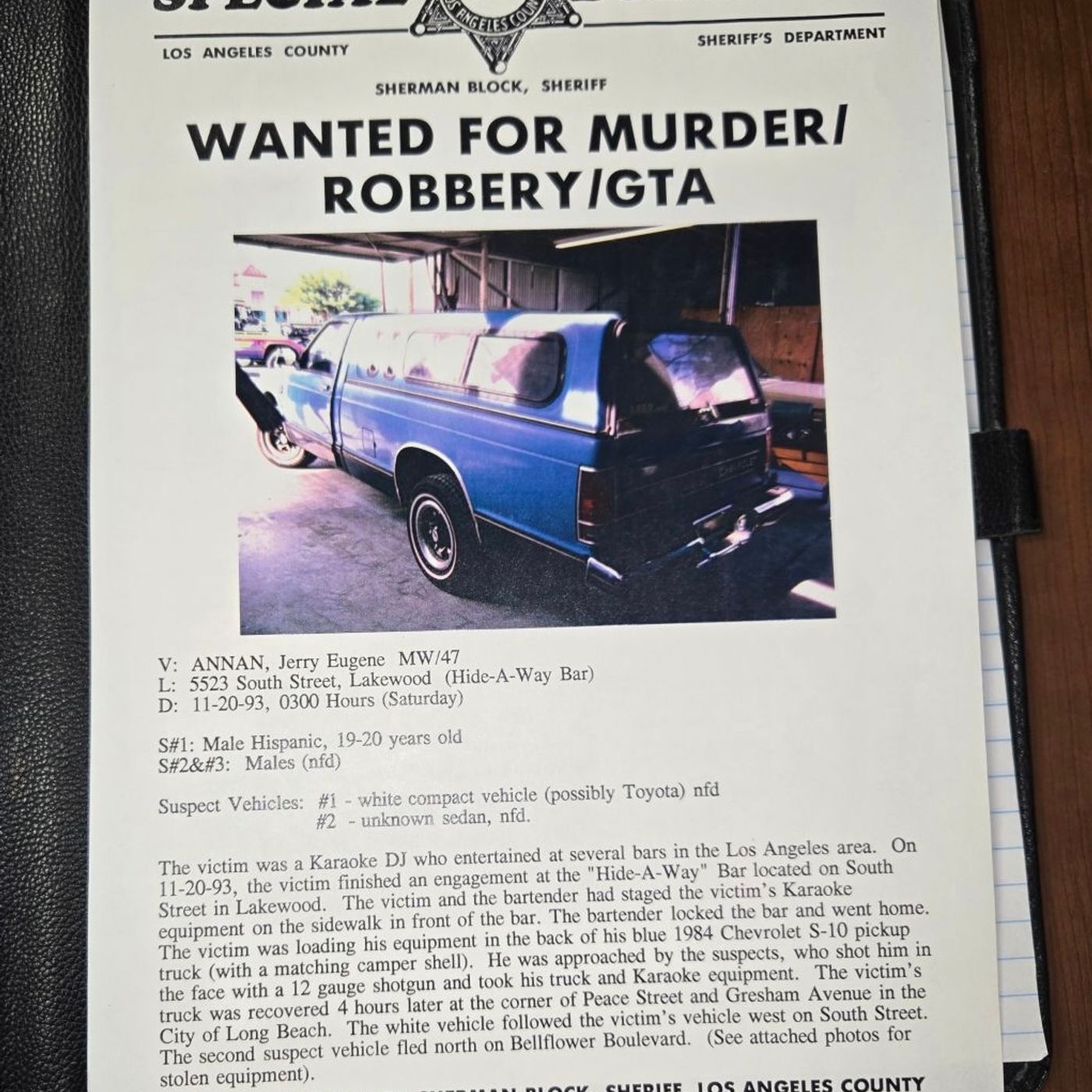
My favorite part is the flyer that the L.A. Sheriff's Department put out, which was homicide, robbery, Grand Theft Auto. They were trying hard to get every angle because they did take the truck. And I'll explain how they took the truck. So this bartender, female bartender is helping Jerry put stuff in the back of his truck. And it was parked in front. I was under the impression it was parked.
behind in an alley where it would be like loading yes okay it is parked on like bellflower avenue just on the street yeah and he's walking out uh-huh door okay it's like a busy street got it now granted it's like 3 30 at night or morning 3 30 in the morning okay um however there are some people there are witnesses one is a baker obviously makes sense he'd be there early coming in to make the donuts and one is a man who um lived both of those are male and the bartender's female one is a man who lived in an apartment across the street. Okay. He had the most advantageous view and the most information. Okay. I have found him, but he lives in another state and I'm trying to get ahold of him. Okay. I will tell you, I have tried to get ahold of Jerry's daughters, who, a thing that happens sometimes when someone...
is either murdered in a terrible way or dies suddenly. People can't take being in the area and they pack up and leave. So Lisa Annan took her two young daughters and moved out of state. Understandable. Unfortunately, the people that are left, his friends, his co-workers, the people that knew how much he gave, are left with, we don't have any answers and we don't know what's going on with the case. And I will tell you, it was never forgotten.
I have a detective friend did. I'd ask him if he wanted to come on to talk about the case. And he said, we'll talk about a different one. So he has recently done a lot of work getting the case back in front of the cold case homicide unit. He is retired. And you can probably figure out who I'm talking about by now, but I'm not going to name him. And what? OK, I was like, oh, no, don't say because I don't think he'd care. But I also know that he went above and beyond and got, you know, information for me that, you know, may not be available to everyone.
So we're just going to say, you know, my beloved retired detective. And he brought it up in front of, you know, the new guard. Sean McCarthy is the LASD homicide detective. I hate to use the word cold case, but cold case unit. I'm going to give you his number at the end. So he has a lot of faith in Sean. And I do, too, if he does, because he doesn't give out compliments easily. So he at first was dubious about the original detectives. And tipster Ann was like, it just felt like they gave up. It's a.
Common misconception when the public, the family don't hear information all the time that the case has gone cold. And obviously, there's only so much you can release. Right. You want to keep some stuff tight to the vest because you're going to build a case for prosecution. Right. So I will tell you that Jerry's mother, Ella Dean Crabtree, actually wrote a letter to the legislature, the California legislature, about her son's case.
Like I don't I said he said that, well, the mother cared enough that she wrote a letter complaining. And I said to the attorney general, he said no to the state legislature. Oh, wow. Yeah. I'm like, all righty. So we know people it wasn't that people didn't care. Right. It was I think that they were so devastated that, you know, I understand why Lisa packed the girls up and moved. Right. I get it. You probably feel like they lived in, you know, a very kind of safe suburb. He worked all over Southern California. You probably think you're in areas that are safe. And then your husband gets, you know. Right.
Shot in the face for what they think was recording equipment, except we're going to get to that in a minute. Why? I guess. I don't know. It seems so. You just talk about senseless. I feel like that is the definition of senseless. So Jerry is loading up the back of his truck. The bartender is helping him. And the baker witnesses some things. And the gentleman across the street witnesses three to four white or light skinned Hispanic men with two different vehicles. A sedan like a Toyota or a Honda and a brown or green pickup truck.
Okay. They come up and apparently the gentleman across the street, the witness across the street hears an argument, some fighting. Okay. And the next thing he knows, one person gets into Jerry's truck. One person is in the sedan and possibly two others are in the truck behind. Okay. They leave the sedan in front, Jerry's truck behind, and the truck at the end turns and goes in the opposite direction. Okay. Interesting. Yeah.
We're talking 1993, so I don't know what sort of CCTV work there is. Probably not. His truck is found a day later in Long Beach. Okay. Now, I ask about the equipment. How expensive is this equipment and is it worth someone's life? Absolutely not, but things were more expensive that way. Sure, because it was worth it to somebody else. Right, in that time. Right. I ask if there were serial numbers. The detective said yes.
They talked to pawn shops in Lakewood, Compton, Long Beach, all areas around there. Nothing ever showed up. Okay. And bizarrely, they left some speakers in the truck. Okay. Easiest thing you would think defense. Because I'm thinking karaoke equipment was probably fairly rare at the time. It would be unique, you know. Because it's karaoke, but it's speakers. Mm-hmm. More generalized. Right. Okay. They took all of the music, the CDs, whatever you had, all of that. But they left these speakers. I asked the detective how hard would it be, you know, defense this. And he said any DJ who works weddings or something could, you know, buy it, you know. Just somebody. Mm-hmm. Like, hey, these fell off a truck, literally. Right. That I killed a guy for. Right. Uh-huh.
I ask about prints. The prints were taken. There were none usable. I ask, could they have used gloves? Could this have been so well orchestrated? And the detective said there was one potential glove smear on the back doors, but that's it. Here's the other thing is I asked if now he had to get a look at this case by calling into the archives because it's, you know, 31 years old now. Right.
And I asked if there was any other evidence that was usable that could maybe be better for testing now. And he said, that I'm going to check on. So knowing that the files were pretty difficult to get a hold of, it would take him a little while to get a hold of. And I had held off on covering this case for a couple of weeks to let him get information to me. And that's why we're covering it now. And we may end up doing an additional episode. I hope we get updates. Wouldn't that be great? But I just want to make sure it's out there because my...
A fervent prayer is that someone out there is aware of who may have done this, who saw something and didn't know it was important. You know, Jerry was so beloved in the community. The LA Times covers his funeral, and he's just a guy like me and you. There were over 200 people at his funeral. There was a large guitar-shaped floral arrangement. I mean, he was so...
He was so beloved and not just because he was kind and did things for veterans. Anyone who knew him. I mean, he was just so beloved. You know, he has five kids total. You know, the two young girls. And I'll tell you, I know I found them because one of them has as her background page on social media. Her is a little girl and her dad bending down on one knee and they're sharing a microphone. Yeah, sweet. Exactly. I mean.
Exactly. This is one of those people that, you know, people, musicians who worked with him said, look, there was just no better guy. He, you know, he worked all of his life for his dream and he's not going to give up. You know, he's a singer songwriter and we're, you know, we do all of the things we can do to make our dreams come true. And, and Jerry wasn't going to give up. And he, you know, a week before he was murdered is recording a song for his daughter in a professional recording studio. Yeah.
You know, as far as him doing all the work he could for the veterans, he was not a veteran, but he was so patriotic and he supported everything they stood for. A member of the Monterey Park American Legion said, you know, after he'd done a 1987 veterans rally with Jerry, he said, I cannot thank him enough for his activism. So the senseless murder is just, I mean. Seriously, let's just think about senseless. Right. It wasn't anger. It wasn't, you know, a woman. It was some shitty karaoke equipment. You take away a life, a dad, a husband, a community member who gives and gives and gives and is happy to do so. You take that away for some fucking karaoke equipment. I don't I know there are people in the community that have to know who did this. I just I just pray that they're somehow within the sound of my voice.
One of his friends said, I don't want my name to be used, but I want you to know. It felt like he was so patriotic. It was like he was coming to help veterans in any way he could. I just want you to know I'm very happy I knew him. I'm very happy I knew him. He was upbeat, positive, funny, and he just knew how to make people feel good, even when they didn't want to. One man said, I mentioned it was my daughter's birthday, and he came to the table and sang happy birthday to her in front of everyone, and she was beaming. I mean, it's...
Yeah, I know. I am not going to keep beating this drum, but I just want you to know the things that happen sometimes and we don't know why and to the people who least deserve them. And I can tell from the research I've done, seeing his family members, they have gone on and have lives of their own and they always remember and talk about Jerry. And I'm, you know, again, we may do an update to this because I would love for there to be more information. Yeah, I hope there's progress. I do too. And I believe that.
Even if there's energy in the air towards something, maybe that helps. That's what we do or try to do. And I will tell you that my beloved detective, when I thought, why are you doing this for me? Why are you going so far out of your way on your time off? And he said, I believe in what you're doing. You're trying to bring closure to families. And that put a lump in my throat. Because again, he's not a guy that tosses out compliments. He's kind of a tough guy. And I love him. And I thank him for everything he's done for us. But honestly, if you know anything.
about what happened November 20th of 1993 to Jerry Annan in front of the Hideaway Club in Lakewood, I'm begging you to call Detective Sean McCarthy at the LA Sheriff's Department at 323-890-5500. And we will have that in our show notes. And if you don't want to call them and you want to call us, please feel free to call us on the tipster hotline at 832-TIPSTER. That's 832-847-7837. You can email us at jttipsters at gmail.com.
You can find us on any of the social media platforms, the Just the Tipsters Facebook page, at JTTipsters on Instagram, at JTTipstersPod on Twitter, and more cowbell. If you would like to support this podcast and get early access and other cool murderous swag, go to patreon.com slash justthetipsters. If you like the show, please take a moment to rate, review, and subscribe. It really does help the show to grow. Thank you for listening.