Welcome to World War I Centennial News, episode number 90. It's about World War I then, what was happening 100 years ago, and it's about World War I now. News and updates about the centennial and the commemoration. So before we get going, I wanted to remind our listeners who really enjoy history that every day on the commission's website, we republish something called the official bulletin on the centennial anniversary of its original published date. What am I talking about? What's the official bulletin? Well, it was the government's official war gazette, the administration's own newspaper published by one of the most amazingly interesting and influential characters of the period and somebody you may not know. His name was George Creel.
He was a journalist, friend, and a staunch supporter of Woodrow Wilson during the election of 1916, who was then, as America declared war, appointed by his friend, the president, to head the newly minted Committee on Public Information, the CPI. Creel's mission was to sell the war and support of the war to the American people. Effectively, George Creel was America's propaganda and war information minister. This included all aspects of media, including print, film, posters, music, paintings, and cartoons, and an amazing daily product, gone largely unnoticed and forgotten in the century since the war. It's called the Official Bulletin. Now, we've developed an audience of really avid readers for the Daily Bulletin who profess that this is one of the daily newspapers that they choose to read. Because, after all, we're more than just a podcast. We're a full multimedia experience about the war that changed the world.
In this week's episode, Looking Back 100 Years, Mike Schuster updates us on the battles in the Balkans, the Middle East, the Southern Front, and more. Dr. Edward Lengel brings us the personal perspectives of two soldiers preparing for what will be one of the biggest battles in American history. We'll be exploring the disconnect between the war preparations back home and the reality in Europe where we're less than 50 days from an armistice. Moving to the present, we'll be exploring Kentucky in World War I with Jana Myers and Jim Pritchard from the Filson Historical Society.
We're going to learn about Utah and World War I from Valerie Jacobson from the Utah World War I Centennial Commission. John Heinsohn traces his grandfather's service as an aerial photographer in the German Air Corps. And The Buzz, where Catherine Akey highlights some of the World War I Centennial posts and stories from social media. It's a full agenda this week for World War I Centennial News, which is brought to you by the U.S. World War I Centennial Commission, the Pritzker Military Museum and Library, and the Starr Foundation. I'm Theo Mayer, the Chief Technologist for the Commission and your host. Welcome to the show. Our theme this week is one of contrast.
The victory at San Mahal is celebrated with jubilation, but the biggest and one of the costliest battles in the nation's history is looming just ahead. In Europe, some probing offers of peace are being extended, but back in the U.S., we're in full swing with a million-man draft and a $6 billion fund drive with which to prosecute the war. With that as a setup, let's jump into our centennial time machine and explore the world 100 years ago in the war that changed the world. We're going to open our history section with Mike Schuster, former NPR correspondent and curator for the Great War Project blog.
So as the U.S. First Army takes the offensive on the Western Front, fighting continues in the Balkans, the British attack in Palestine against the weakening Turkish force. Diplomatic wranglings are happening all over. As we mentioned last week, Austria probes for peace without Germany. Germany suggests to Belgium that they should settle with them right now. And no one actually makes any deals. It's pretty dynamic. Mike, could you unravel some of this for us, please? Sure, Teo. The headlines read, a peace feeler from Austria and Germany. The Allies are not impressed. They are on the offense. Fighting continues in the Balkans and in the Middle East. And this is special to the Great War Project.
In mid-September, a century ago, fighting intensifies across the European fronts of the Great War. At the same time, some are seeking a peace deal. According to historian Martin Gilbert, an offensive begins on the Salonika Front, which is now Greece, and the Allies are in action against the Bulgarian army, an ally of Germany. Fighting spreads quickly against the Serbian army in the Balkans, then in Macedonia and other Balkan territories. In mid-September, 36,000 Serbs, French, and Italians are in action against 12,000 Bulgars and Germans, who are not finished yet.
reports historian Gilbert, so tenacious were the Bulgarian machine gunners that the French used flamethrowers for the first time on the Salonika front to dislodge them, driving the defenders from three mountain peaks. But the Austrians and the Bulgarians show signs of weakening. Two Bulgarian regiments mutinied on September 16th, reports Gilbert. They had no intention of fighting any longer. On September 14th, the Austrians asked the Allied powers in the United States to agree to a confidential and noncommittal exchange of views to see if peace might be possible. This is a significant peace feeler, but it does not include the Germans.
The United States rejected the invitation at once, reports Gilbert. Britain and France soon thereafter. Writes Gilbert, the war would go on, wearing down the life energies of millions. Several days later, the Germans in the Balkans are in retreat, all hope of holding the Balkans shattered. At this moment, reports historian Gilbert, President Wilson rejects the Austrian request for peace talks. So too does the French Prime Minister, Georges Clemenceau, the following day. A separate German peace offer to Belgium on the basis of no claims to be made by Belgium was rejected three days later.
On the Western Front, the Allies continued to advance. In the second half of September, 100 years ago, the British Expeditionary Force took 30,000 prisoners, more than in any previous week of the war. And there was significant action once again in the Middle East. Intelligence seized by the Turkish leadership in Palestine indicates that plans for a Turkish offensive are underway. The British counter with an offensive of their own. A British artillery bombardment begins on September 19th, reports Gilbert then at dawn on the 20th. The British resumed their northward offensive that had ended a year earlier with the capture of Jerusalem.
Within a few hours, the British infantry had broken the Turkish defense lines and British cavalry were advancing rapidly northward. In two days fighting, the British take 7,000 prisoners. The Turks are demoralized and eager to give up the fight, which is precisely what they do. And back in Europe, the Allies, bolstered by a huge American presence, have a plan of their own. But that's the story for next time, and that's some of the stories from the Great War Project a century ago. Mike Schuster is the curator for the Great War Project blog. The link to his post is in the podcast notes.
Joining us now is Dr. Edward Lengel, military historian and segment host for America Emerges, military stories from World War I. As the offensive at San Mahal concludes, and as Ed foreshadowed in his segment last week, a major military battle is looming. The Meuse-Argonne offensive will begin on the 26th of September, and it's going to continue until the 11th hour of the 11th day of the 11th month, when an armistice is enacted on the Western Front. Today, Ed brings us the story of two soldiers who were there at the start of this historic battle. The largest and bloodiest battle in American history, with over 1 million soldiers involved and over 100,000 casualties, including some 26,000 killed in action, began 100 years ago on September 26, 1918.
Two men of the 79th Division's 314th Regiment left eyewitness accounts of the first hours of a battle that changed American history. The Meuse-Argonne opened with the assault of the U.S. First Army, with nine mostly green divisions in the front lines, under the overall command of General John J. Pershing, into some of the most forbidding terrain on the Western Front. But the average American doughboy saw little of the big picture. Second Lieutenant John W. Kress attended an officer's meeting on the evening before the attack. Instructions were very vague as to who was on the left and who was on the right or what our objectives were, he remembered.
We were told to hold foremost in our minds that we were to push forward, forward, and ever forward every moment of the time. While moving into positions that night and preparing for assault, Crest saw tanks for the first time. Suddenly, a black rattling monster loomed up before us, almost filling the road completely. This was the first time we had seen one of those gigantic tanks we had heard so much about. Several of them came clattering along, making enough noise to waken the dead. They were followed by a few of the smaller type called Whippet tanks. From a distance, this combination looked like some animal with its young brood.
Kress then witnessed the massive artillery bombardment on the German front lines. Looking back in the direction from which we had come, one could see the landscape as a mass of belching fire, as if some restless volcano were playing there. As we watched the unfolding of this drama, we instinctively felt that here was history in the making, and that we were actors, however small, taking part in the making of the history, not of a nation or nations, but of the world to be. Private Andrew J. Kachik, a coal miner who had been drafted to serve as a private NH company, found inspiration in his faith as he faced the prospect of battle on September 25th.
We got rid of our blankets and tents. The only things we kept were a raincoat, overcoat, and light pack for our mess kits and shaving kit. That evening for our supper, we had soup, which I still think was made out of leaves pulled off the trees. It was awful. We were mad, but it didn't do us any good. After supper, we got orders for church services. Our chaplain had a few boys bend some small trees to make an arch over the altar, which was a couple of big boxes. He also heard our confessions and gave us holy communion. I will never forget that evening. I knew God was there. The private and his buddies moved forward in pitch dark the next morning.
trying to avoid falling into huge shell holes. The worst part was the ground, which was a big swamp, he remembered. Sometimes I sank up to my knees. As light dawned, Kajic nervously kept jumping into smaller shell holes and peeking out to scan the ground ahead. His buddies mocked him until, as Kajic recalled, an Austrian 88 shell came our way. It missed our hole by about 100 yards. It went whiz-bang and sounded like a million window panes being broken. After that, they couldn't get me to look out again.
The following morning, when it was again dark, Kachik's company happened upon what looks like an enemy machine gun nest. A voice hollered, halt, and something else in German, he remembered. The captain said to me, let's capture this German, and hollered, comrade, and started shooting his handgun .45, and I shot one shot. We ran toward the voice. Well, all hell broke loose. It was a machine gun nest. My captain disappeared. When the machine gun started shooting at us, it made a glaring red light, and the star shells the Germans shot in the air made a lot of light. I dropped to the ground and made myself as flat as I could. I didn't dare to move, not even a muscle.
I waited until the star shell won out. I crawled back to the road and found a big shell hole on it. So I stayed there all by myself. I sure was scared. I didn't know what to do. I knew that I had to get out of there while it was still dark. The machine gun was about 50 steps away from me. I'm not ashamed to say that I prayed fast. Three more Americans tumbled into the same shell hole and they decided to wait for their company to rescue them, Kajic recalled. It was still foggy, but we could see a good distance and the Germans could see us too. They spotted us and started shooting rifle grenades in our hole. Everybody tried to get out first. As things turned out, I was the last one out.
Maybe that saved my life. Two of our scouts that went out first got wounded so badly that they died later. Two of us had to crawl in a ditch by the road for about 300 yards on our stomachs. Kaczek survived this first encounter. On the following morning, he moved forward following a group of French tanks. It was rough because the Germans were shooting their cannons right at the tanks. Some shells missed and came at us. At the same time, other shells were bursting over our heads and on the ground. I could hear the shrapnel hitting the ground all around me and some boys getting hit and some killed, and every time a machine gun opened up, our captain would give an order to lie down.
I could hear the bullets going over my head just like bees buzzing. I never knew that a small lump of dirt as big as my hand looks like a big rock when somebody's shooting at you. The first great test of American arms in the 20th century had just begun. Dr. Edward Lengel is an American military historian and our segment host for America Emerges, military stories from World War I. We put links in the podcast notes to Ed's post and his author's website.
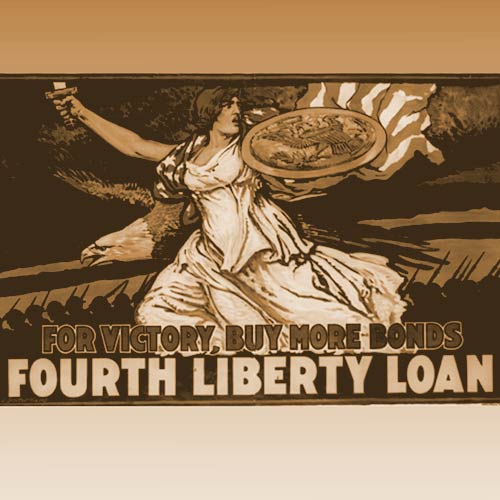
And the story reads, On the evening of Saturday, September 28th, it is estimated that nearly 150,000 Allied speakers will go into action in all parts of the United States, all speaking on the Fourth Liberty Loan, and all basing their speeches upon the information contained in the latest bulletin published by the Four Minute Men by the Committee on Public Information. A great many of these speakers will be ministers of all creeds who have recently become affiliated with this organization of official spokesmen for the government. Between 40 and 50,000 of the total will be commissioned Four Minute Men who have already carried the message through the last three campaigns.
So, let's listen to an actual four-minute man as he pitches the idea.
It is our duty to hurry to that war front with all the hate and energy we can summon, and with every resource that our 250 billion in national wealth can command before that shadow crosses the Atlantic. The latest news from the front is our splendid general putting that line through our share and raise this loan to the German Kaiser. That democracy, though handicapped perhaps at the top, can lead autocracy on any ground it chooses. We want to say to him that we intend to fail on all as we have ever done. Our only passport to be our own blessed flag flying. That was a recording by a man named Richard A. Purdy, a member of the Four Minute Men, during the third Liberty Bond campaign.
Okay, it's time to get into some context about liberty bonds or liberty loans. Liberty bonds are an idea from World War I-era Secretary of the Treasury William Gibbs McAdoo. Now, they're war bonds sold in the United States as a way to finance World War I. You see, in those days, the government didn't just print more money when they needed it. They raised the money. And in this case, by having the citizenry invest directly in the government.
Subscribing to the bonds was sold to the American people as a symbol of patriotic duty. And guess who did the actual selling? Yeah, you heard it earlier. None other than our good friend, Mr. George Creel. Now that aside, this really was the first time that average income Americans had come across the idea of buying securities. In essence, the people were making loans to the U.S. government with a promise of payback and a profit. The average citizen had become an investor, not just the rich guys. And it was their patriotic duty to do that.
Now, for our real history buffs, do you see the connection lines between this and 1929? Okay, but that's a post-armistice story for another day. But here's a kicker for everybody. The act of Congress from 1917 that authorized the liberty bonds is the very same law that we use today as the authority under which we sell all U.S. Treasury bonds. Now, there's a whole lot of other stories I'd love to get into this week, but unfortunately, we're just about out of time. But there's one more headline this week that we just can't skip. Again, from the official bulletin.
Dateline, September 24, 1918. Headline, Prohibition Wins in House 171-34. And the story reads, The House today accepted the Senate Prohibition Amendment to the Food Stimulation Bill by a vote of 171-34, and the nation will become dry on June 30th next, and remain so during the war and until the termination of the demoralization, if the action of Congress is approved by the President. Uh-huh. Regular citizens as investors and prohibition. They both had their genesis 100 years ago. We have links for you in the podcast notes, not only to our research, but to the other episodes where we've talked about the liberty loans. We've jumped back into the present with World War I centennial news now. This part of the podcast focuses on now and how the centennial of World War I and the upcoming centennial of the armistice are being commemorated. This week in commission news, we say goodbye to a friend of the commission and of the centennial.
David Shuey, who called himself a history teller, but who you may have seen and if you were lucky enough, may have met as a completely convincing living General Pershing. David's wonderful portrayals of Pershing were offered to honor the General's memory and the service of all of our veterans who've gone before and since. David was able to literally inhabit the persona of this iconic inspirational leader, not to revel in his glory, but to enlighten audiences, to bring inspiration and the truth of history to people. Thanks to this dedicated history teller, in our mind's eye, we'll always have a vivid vision of Pershing standing with the dignity of a great leader, sometimes astride his horse. And that's all thanks to David Shuey. David, you yourself will be very much missed. In honor of you, here's an actual recording of General Pershing. An American army is fighting for you.
the hardest blows can win against the enemy we are fighting. Spirit of our forefathers, the Army asks your unflating support to the end that the high ideals for which America stands may endure upon the earth. Announced just this week, the Armistice Centennial events planned for Washington, D.C. will include a five-day special opportunity called A First Look, the National World War I Memorial in Washington, D.C. Appropriately, the event will be staged at the site of the future National World War I Memorial. The public is invited to the site over the five days, where we'll set up special exhibitions, renderings, videos, the stunning 10-foot-long miniature maquette, offering a close-up detailed vision of the future 60-foot-long sculpture called A Soldier's Journey.
Special commemorative events will be happening all week, honoring the 100 Cities 100 Memorials awardees, states, many special services, veterans of World War I, jazz concert by the James Reese Tribute 369th experience, and much, much more. We'll be publishing a full schedule and details in the coming weeks. And for those of you who are not in Washington, D.C., we're putting together a live streaming program for you, including from the Sacred Service at the Washington National Cathedral and many of the events at A First Look. The streams will be accessible through the commission website and through the Bells of Peace app. This week in our updates from the states, we're headed first to the Bluegrass State, Kentucky, to learn more about Kentucky in World War I, as we're joined by Jana Meyer, Associate Curator of Collections, and Jim Pritchard, Manuscript Cataloguer from the Filson Historical Society. Welcome to both of you. Thank you. Good to be with you. Well, let's start with a bit of context. Could you introduce us to the Filson Historical Society? What's its genesis? What's the society's goal and mission?
So the Filson is located in Louisville, Kentucky, and we are primarily a research library and archive. We were founded in 1884 by a group of Louisvillians who loved history, and they would get together and present on different historical topics. They also started collecting materials, and so our materials are related to the history of Kentucky and the Ohio Valley region, and we've been collecting since 1884. We're the state's largest private historical society. How did the Filson Historical Society get involved in the commemoration of World War I?
We have networked with other historical organizations in the state, decided to create some exhibits on the centennial of the declaration of war. Mainly, we've sort of focused on the greater Louisville area. And of course, other agencies like the Kentucky Historical Society and the state capitol also have had programs as well as the Department of Military Affairs and the Governor's Centennial Commission. Yeah, we've actually done four different rotating exhibits through the past year and a half at the Wilson. All right, let's get into the story of Kentucky and World War I. What was the state like in 1916? What was its role in the war effort?
Well, Kentucky was a predominantly rural state at that time. Louisville was the largest urban center with cities like Lexington and Covington across the river from Cincinnati, not too far behind in population. Of course, in terms of industry, why coal fields in eastern Kentucky and the Green River country of western Kentucky were well underway, we had one foot in the progressive era, you might say, and another foot in the discord and violence that plagued the state after the Civil War right up to the early years of the 20th century. Our governor was assassinated in the capital in 1900, and it almost led to a kind of mini-civil war in the state. So Kentuckians were rather divided in many ways as to whether to enter the war or not. Yeah, Kentucky had a very diverse population. Actually, we had a large German and Irish immigrant population in Louisville and the northern Kentucky region. And so a lot of those individuals favored neutrality. We also had Henry Watterson, outspoken editor of the Louisville Courier-Journal, one of the nation's leading newspapers. When war was declared, he penned a famous editorial to hell with the Habsburgs and Poland-Soloren. The national press didn't really cover World War I very much, and Watterson was kind of the exception to that.
Watterson became very passionate about the war when Belgium was invaded, and Watterson actually penned two Pulitzer Prize-winning articles. He actually penned the Pulitzer Prize-winning articles in 1917, right when the United States entered the war. Kentucky is also the home of Fort Knox. Is that in your region? Yes, it's not too far south of Louisville. Camp Knox, as it was known during the First World War, was an artillery training facility. Over 125,000 men went through basic training here before they were assigned to regular U.S. Army units and shipped overseas, and were filtered into other units once they reached France.
Pershing actually considered some Kentuckians, some of his best soldiers. Yes, we had our own Sergeant York, who was also from Appalachia. Sergeant Willie Sandlin of Hyden, Kentucky, was awarded a Medal of Honor for wiping out three German machine gun nests during the Meuse-Argonne offensive. And of course, a lot of other Kentuckians received awards. A nurse, Mary Arvin, was decorated by both the French and British governments for remaining at her post at a field hospital, which was under aerial bombardment. Do you know what other commemorative projects are ongoing in the state? Do you know what the commemorative plans are for the armistice? I'm not sure at this point exactly how the state will round out the centennial.
But I'm sure there will be some type of Armistice Day commemorative program. We actually started celebrating Armistice several days earlier because Louisvillians, they heard a fire alarm bell ringing and they thought it was the end of the war. And so we started celebrating Louisville on November 7th. But they knew the end of the war was coming. And so we kept celebrating through the 11th when the Armistice was actually signed. Some of the things that we've recently had in the past, Sergeant Sandlin was reinterred in a veteran's cemetery in his hometown in May, reburied with honors. And of course, at the Kentucky State Fair, there was a huge World War I exhibit.
sort of an interactive trench warfare display that got a lot of attention. Now, what do you think the most interesting project the Filson Historical Society has undertaken relative to World War I? One that I really enjoyed that I was involved in was we did an exhibit on a Kentuckian named Jack Speed. And he was an amateur photographer. And he took his camera with him when he was sent abroad to fight in France. And he took some amazing photographs. And World War I is interesting because it's actually the first war where you do have soldiers taking cameras with them into the field. We also had a really good exhibit prior to that. Actually, I think this was our first exhibit, Call to Arms. And one of the interesting things about that is that we worked very hard to represent the entire community.
I was pleasantly surprised to find a couple of local men who lost their lives with the Harlem Hellfighters. They were Kentuckians, but entered that New York unit as replacements. You know, it seems like everyone who starts to dig into the stories strikes gold. The stories are just wonderful. Well, thank you both for coming on the show. Very welcome. Thanks for having us. Jana Meyer and Jim Pritchard are from the Filson Historical Society in Kentucky. Learn more about the Society and the Centennial of World War I in Kentucky by visiting the links in the podcast notes.
Heading west, we're off to the Beehive State, Utah, to learn more about that state's history during World War I and the commemoration activities there. Here to tell us about it is Valerie Jacobson, the World War I Commission Project Manager at the Utah World War I Centennial Commission. Valerie, welcome to the podcast. Thank you. Valerie, Utah was just barely more than a teenager when America declared war in 1916. It had only been a state for 20 years. What was the state like at the time?
Well, we were mainly agricultural, rural, with mining communities in the state. So with the railroad and the expansion of that, we were able to connect most of the rural areas with the state capitals and the two major cities along the Wasatch Front, Ogden and Provo, with Salt Lake City. Well, how did Utah respond on the war effort, both as a state and from a people standpoint? Well, actually, in 1916, with the Mexican-American border war issue, Utah's National Guard was called up. And they were able to be under General Pershing. And it was kind of like a dress rehearsal for Utah's National Guard to prepare.
to be able to fight in World War I. With the liberty bonds and the war drives, several counties and towns would continually surpass the quota that they had been asked for. It was kind of like a contest between the towns and the different counties to see who could get more money, especially if they were in the mining districts, because you had the wealthy mine owners who would donate a lot of money for the war bonds and drives and things like that. Well, we've had other guests on from Utah, and they described it as a very patriotic state. It is a very patriotic state. In 1917, our total population was between 400,000 and 450,000. And we had about...
21,000 to 25,000 soldiers either volunteered or were drafted for the war. So we had just under 5% of our population serving. That's a really high percentage. Okay, so now into the present. Tell us a little bit about Utah, the World War I Commission and your programs. It seems like education is a big part of your focus. Education is a big part of our focus. The World War I Centennial Commission is under the direction of the Utah Department of Veterans and Military Affairs and the Utah Division of State History. And so between those two, we're trying to focus and bring education and awareness of Utah's involvement in the war throughout the state.
Our state legislature, they were able to get a one-time appropriation of funds, and we've used those funds to do a couple of projects and also award grants throughout the state. We've successfully awarded 14 grants. We try to get them rural so they're not along the major urban areas. One of my favorites is from Emory County, which is restoring and cleaning up World War I veteran markers in the cemeteries in seven different towns in the county. And they've involved the communities and the youth in those specific towns. Now, you also produced a wonderful document showing where all the memorials around the state are. Could you tell us about that?
So this document, it's titled Utah's World War I Monument. It highlights six monuments throughout the state. And then at the back, there is a list of other monuments throughout the state. Our state actually has five of the Spirit of the American Doughboy statues throughout the state. And we wanted to be able to highlight just the different monuments that are in the state to let people know that some of these areas or these monuments, people might just think, oh, that's pretty, and they don't know the history behind it. And so we have six highlighted in the booklet. But with the list at the back, it lets people know that there might be one closer to their town that they could go and see.
Now, one of those is a project I'm very familiar with from the Hundred Cities, Hundred Memorials there. They're one of our awardees in Ogden. And I've spoken to the project manager, Terry Skow, a number of times over the last few years. They were refurbishing one of the Doughboy statues. That one got one of our grants for restoration. And that story, by the way, for our listeners is in episode 63 from this past March. That's a really good project. And they had some wonderful photography from the time as well. They actually applied for one of our grants and we were able to award that. The grant money that they applied for was for the dais for the statue to stand on. It'll be Granite Faith.
And I've received pictures from the Weber County Heritage Foundation in Ogden who applied for the grant from us. The statue is up in the cemetery already, and they'll be having their unveiling on Saturday, November 10th. Wonderful. Now, your commission has organized a lot of screenings and events leading up to the armistice. Can you highlight some of those for us? We have asked different communities in different towns if they know of any events that they have that we could be able to post. And some of the grant recipients, when they have their events or anything like that, we asked them to let us know so that we can post it as well.
Like the Weber State University History Department had a undergraduate student symposium where it was open to the public, but there was one class that was focusing on World War I, and so they gave a report on the involvement of the U.S. in World War I. And we will be having our commemoration to remember the armistice on Thursday, November 8th at our state capitol at 11 o'clock in the morning so as not to interfere with other communities who will be having their celebrations on the Friday or Saturday. Fantastic. Well, Valerie, thank you for coming in and telling us what's going on in the state of Utah with the commemoration of World War I and its history. Thank you.
Valerie Jacobson is from the Utah World War I Centennial Commission. Learn more about Utah and World War I and the centennial events there by visiting the links to the podcast notes. This week, our spotlight on the media shines on a new upcoming documentary about the German Air Service, a project born out of one individual's urge to reconnect with their grandfather. Joining us is John Heinsohn, filmmaker and grandson of Walter Heinsohn, a German aerial photographer in World War I. John is also the producer of Return to Le Cateau, a multi-platform World War I project that also profiles the wartime activities of his grandfather.
John, welcome. Thank you. It's wonderful to be here. John, I want to start by noting to our audience that when I heard about the interview, I was really happy to hear about it because we haven't delved into the German story very much on the podcast. Would you please tell us about your grandfather and what his wartime service was and how the family wound up in the United States? I grew up in Chicago with my grandfather. He was basically like my father, so I was very close to him growing up. And he came to the United States in 1925, lived his whole life here. He very much considered himself an American. He was a very notable photographer in Chicago. The Studio Bunnygraf was an institution in Chicago for 50 years. But he actually learned to be a photographer in the First World War.
And so in the last 18 months of World War I, the draft age was dropped to 16 years old. And so what happened was his older brother, who did not serve in the war, was a photographer. And my grandfather was an apprentice to him when he was drafted. And because he had that practical skill, he was saved from the trenches and sent to France as an aerial observer, photographing and making maps of the trenches. You're clearly inspired by finding a trove of pictures of your grandfather's images. Can you trace that back to us and how that became such a muse for your creative endeavors? I'm Mike Trina, producer and network executive in Los Angeles today.
And what happened was I've had my grandfather's pictures since he died in 1984. And I'd gotten some of the stories from him and whatnot. And what happened was with the anniversary coming up, I decided I was going to try to find where some of the pictures were taken with very low expectations of finding anything. So my son and I, who was 15, actually were in Europe already. And we went to Frankfurt. We were going to drive up through Belgium, down to Paris, trying to find where the pictures were taken. But what happened is we got to France the week of the terror attack in Paris, that horrible time in Paris. And so if you recall during that time, they had basically shut down Belgium looking for the bad guys. And because of that, my son and I had to change our entire itinerary.
It was only by that luck of fate that we found where the pictures were taken. And it has now since become a two-year passion project of mine, where I've been to France 10 times since then, and have not only found where his pictures were taken, but have found out that they are very historically significant and original source material. So you found this trove of pictures, and that drove you to a story, quite obviously. And a lot of Americans sort of find heirlooms like that. How was it researching a military history, particularly since the sources of your information were in Germany? The core group of historical photos I have are probably captured within a 10-day window. I have two or three blocks of photos, one of which regards the Battle of Cambry.
which was November of 1917. My grandfather was stationed nearby at Boisterner Court, which is the famous airfield there where the Greentails were housed. And he was stationed at that airfield during the Battle of Cambry. And there's a very famous event that has very little written about it, where Kaiser Wilhelm had actually gone to Le Coteau in the midst of the Battle of Cambry to talk about the German counterattack that eventually happened on November 30th and won the battle. I have pictures of that meeting that have never been seen before of the Kaiser. And what's interesting was the handful of photos that were published from that day were actually images that were grabbed from movie cameras that were there.
In one of those printed movie images, you can see my grandfather holding his camera. So it actually places him in the location. And I just want to mention to our listeners that, as we've mentioned before, the Battle of Cumbria was really the first major application of tanks. And we did do an episode on tanks last week, and we mentioned that. It really stunned the German forces. But then, of course, they, as you mentioned, even in this interview, came back and halted the offensive. In this great tank battle, after the German counterattack of November 30th, the Germans were fascinated by these tanks. And so they grabbed every photographer they could and sent them into the field so they could photograph the wrecks of these tanks and study them.
And the historians that I met on the ground in France, what they were able to validate for me very quickly was the fact that these photos had never been seen before. They can even date my photos between November 30th and December 4th, because on December 5th, the battle ended when it snowed and none of my pictures have snow. And so through this, I've been able to replicate literally where he spent those 10 days in the midst of this battle of Cambry. And I was invited last November to actually speak as part of the official commemorations in Cambry. And that particular point is what led me now to my documentary film. So we've dug a lot into the context. What should we know about the film?
So the film is actually not about anything that I spoke about. Interestingly enough, in my search for a vision for the documentary, somebody gave me great advice, don't do documentaries about dead people, do it about living people. And so one photograph of my grandfather's taken during the German counterback of Cambry is the source of this because for my grandfather, like a lot of artists of his generation, they were pacifists, right? They were very anti-war, all that kind of stuff. And so I really wanted to find a way.
to not only memorialize my grandfather, but all the men of this generation. I mean, if you spend time in the fields, the one thing you realize is that there really were no winners. It was just horrible. And so I have this one picture of 30 British prisoners that were captured during this German counterattack. My goal is, with this photograph that's never been seen before, is that this photo is going to be revealed the week of November 11th as a symbol of peace and forgiveness 100 years later. The descendant of a German is going to bring these 30 men home with this photograph. My grandfather, at the time he took these photos, was 17 years old. He was a child. And so to imagine my 15-year-old today playing video games about World War I.
here's the opportunity to tell the story of a soldier not shooting with his gun, but shooting with his camera. So in terms of my project, it really is a grassroots project. I'm funding it all myself. And that's why I'm really putting this out there to the community because I think there would be a lot of interest. And so my documentary is going to actually be crowdsourced. Thank you very much, sir. I really appreciate it. John Heinsohn is a filmmaker and the grandson of a photographer who at age 17 became a German aerial photographer in World War I. Learn more at the links in the podcast notes.
This week on World War I War Tech, rather than focusing on life-taking technology, we thought it would be good to turn our focus to a technology that saved countless lives in the past century. Blood transfusion. At the opening of the 20th century, blood transfusions were really risky for both the patient and the donor. They could only be done directly from donor to patient because there was no way to physically store the blood. And then there was a tendency for the blood to clot, clogging the equipment involved in the transfusion.
And even though the scientists had already established the A, B, and O blood groups, well, they didn't really know how they interacted or what would always happen. So the bottom line is that at this time, at the beginning of World War I, a lot of physicians, especially those in Europe, were pretty skeptical about transfusions. A couple of discoveries during World War I changed it. The first was the discovery that a compound called sodium citrate, a chemical combo of salt and acids, could be used to stop the blood from clotting. A professor, Luis Agote, in Buenos Aires, was the first one on the case.
Then a couple of researchers, Peyton Rue and J.R. Turner Jr. from the Rockefeller Institute in New York, found that if you added dextrose, a kind of a sugar to the solution, that you could store the blood for a few weeks. The proper use of salt, acid, and sugar, they change things. Now, when America entered the war in 1917, a lot of physicians familiar with these improvements headed to the battlefront. Among these was a British-born American officer, Oswald Robertson, who's credited with the second discovery necessary for sustained blood transfusion. Really obvious now, but not then. That you can refrigerate the blood and then you can transport it. So he's credited for coming up with the first rudimentary version of the blood bank, involving the repackaging of ammunition boxes into holding containers and then lining them with ice and sawdust to preserve the blood inside.
By the end of the war, Robertson's method had become so successful that he opened a school to teach potential medics the art of blood transfusion. Although it's impossible to tell how many soldiers received blood transfusions on the Western Front, it's certain that many combatants did, as well as the approximately 5 million Americans who continue to receive them every year now. And they all owe their successful operations to the work of these men from World War I. It's another legacy from the war that changed the world in this week's World War I War Tech. Learn more from the links in the podcast notes.
And now for our feature, Speaking World War I, where we explore today's words and phrases that are rooted in the war. Now, we are casting around trying to find some appropriate word for this week with all the soldiers in combat and all the action, and we decided that we would reprise a term from way over a year ago because, well, first of all, most of you weren't listening to us then, and we really like this one. The word is cooties. Yeah, okay, the term cooties does go back to World War I, when soldiers lived in some really horrid conditions that included being covered in lice. Using a lighter to burn lice in their eggs out of the seams of your clothing was a daily pastime for a lot of soldiers when they weren't shooting or ducking bullets and bombs. As a nickname for body lice, cooties first appeared in trench slang around 1915. The term is apparently derived from the coot, a kind of a waterfowl known for being infested with lice and other parasites, and I'm not sure I wanted to know that. But here's a fun second name for cooties. They're also known as arithmetic bugs. Really? Yeah, really. Because here we go.
They added to your troubles. They subtracted from your pleasures. They divided your attention, and they multiplied like crazy. Cooties, you really don't want them. And they're this week's word for speaking World War I. See the podcast notes if you really think you need to know more. In articles and posts, where we highlight the stories you'll find in our weekly newsletter, The Dispatch. Headline. Centennial ceremony set September 23 in France for Meuse-Argonne Offensive. Largest battle in U.S. military history.
Read more about what's planned to honor those who fought and fell during the Meuse-Argonne Offensive, the largest battle ever in the history of the U.S. military, which involved well over a million people, almost 1,000 aircraft, and 400 tanks. Headline, Alice Paul and the Suffrage Movement During World War I. While the terrible, bloody battles raged in Europe in the autumn of 1918, a titanic political battle was also coming to a head back in the United States, the fight for women's suffrage. A leader in that campaign was Alice Paul, who was empowered with her outrageous belief that men and women were equal.
Headline, Michael Wilson opens one man, one war, 100 years art exhibition. Michael Wilson is a visual artist and a military veteran who has created a remarkable new World War I themed art exhibit with a schedule showing at the Cedar Rapids Museum of Art, Cedar Rapids, Iowa from September 15th to December 30th, 2018. Right blog, this week's post, blessed are they that have some longing. This week, Mark Faknitz, a member of the Historical Advisory Board of the Commission, tells the complicated story of how the cemetery at San Miguel came to be and the various narratives the San Miguel Memorial offers for those who came to grieve their war dead. Finally, our selection from our World War I centennial merchandise shop. Our featured item this week is our U.S. Army woolen blanket. Still proudly made in the USA by Woolrich Inc., the oldest continuously operating woolen mill in the United States, the blankets were originally purchased by the U.S. military to supply to our troops.
Now, originally meant to be used by soldiers in their barracks, this limited edition blanket features a heatmarked U.S. emblem in the center and a fabric label commemorating the U.S. centennial of World War I. Links to our merchandise shop and all the articles we've highlighted here are in the weekly dispatch newsletter. Subscribe at www.cc.org slash subscribe. You can also send us a link request with a tweet to at the WW1 podcast or follow the link in the podcast notes.
And that brings us to the buzz. The centennial of World War I this week in social media with Catherine Akey. Here are Catherine's picks for this week. This past week saw commemorations at Sammy Hell, as well as other events like Camp Doboy on Governor's Island in New York. This means that social media was filled with a deluge of images, videos, and stories from all across the world. And this steady flow of amazing images of reenactors, of solemn commemorative events, it can be overwhelming a bit and also hard to keep up with. And it's going to continue as we head into the Muir's Argonne Offensive and the centennial of the armistice. Fear not, we have a few great tips and resources for you.
First and foremost, consider following our accounts. We consistently share and repost images and stories from other amazing World War I social media feeds. Links to our Twitter accounts, our Instagram, and our Facebook are in the podcast notes. Additionally, you can follow the events in Europe by visiting our international commemoration page at www.cc.org slash international, a page that collects and displays posts from all across social media in one spot. You can also visit www.cc.org slash social to see a collection of all our social media posts in one spot, not just those highlighting the events in Europe.
That's it for the buzz this week. We hope you take some time to check out the amazing images and posts from the last week by visiting the links in the podcast notes. And that wraps up episode number 90 of the award-winning World War I Centennial News Podcast. Thank you for listening. We also want to thank our guests, Mike Schuster, the curator for the Great War Project blog, Dr. Edward Lengel, military historian and author, Jana Meyer and Jim Pritchard from the Filson Historical Society in Kentucky, Valerie Jacobson, the World War I Commission project manager at the Utah World War I Centennial Commission, John Heinsohn, citizen historian, researcher, and filmmaker.
Catherine Akey, World War I photography specialist and line producer for the podcast. Many thanks to Mack Nelson and Tim Crow, our interview editing team. JL Michaud, research. And Rachel Hurt, our fall intern. It's a great team. And I'm Theo Mayer, your producer and host. The U.S. World War I Centennial Commission was created by Congress to honor, commemorate, and educate about World War I. Our programs are to inspire a national conversation and awareness about World War I, including this podcast. We're bringing the lessons of 100 years ago to today's educators and their classrooms.
We're helping to restore World War I memorials in communities of all sizes across the country. And of course, we're building America's National World War I Memorial in Washington, D.C. We want to thank the commission's founding sponsor, the Pritzker Military Museum and Library, as well as the Star Foundation for their support. The podcast and a full transcript of the show can be found on our website at www.cc.org.cn. You'll find World War I Centennial News in all the places that you get your podcasts, and even using your smart speaker by saying, play WW1 Centennial News Podcast. The commission's Twitter and Instagram handles are both at WW1CC, and we're on Facebook at WW1 Centennial. Thank you for joining us, and don't forget to share the stories that you're hearing here about the war that changed the world. So long.