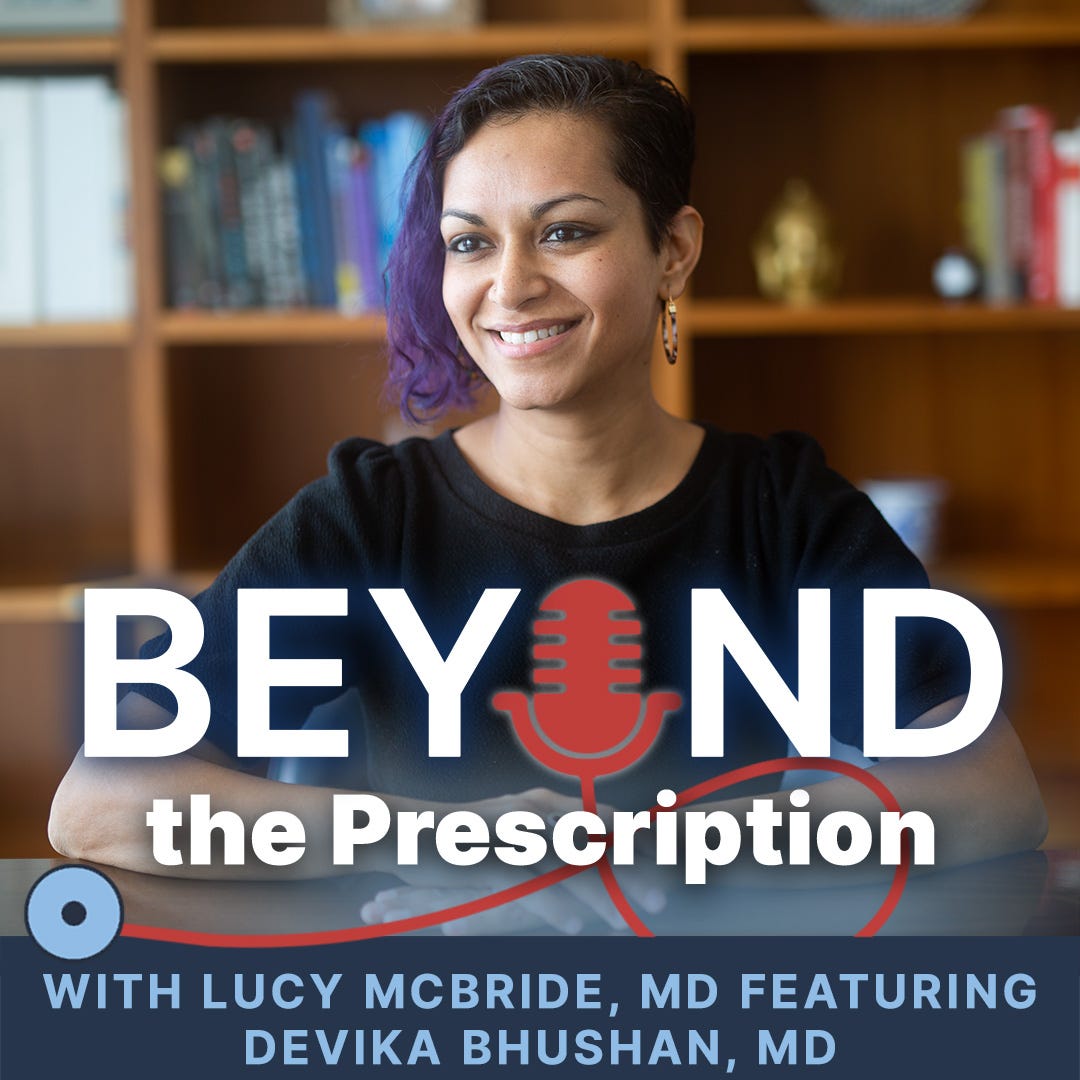
Finding Hope & Light within Darkness
from Beyond the Prescription Hosted by Dr. Lucy McBride
You can also listen to this episode on Spotify! Dr Devika Bhushan is a pediatrician and public health leader who has lived with bipolar disorder for the last 13 years. She has served on Stanford’s faculty and trained at Harvard Medical School and Johns Hopkins. She's a firm believer that life’s trials and tribulations not only improve our self-awareness, they help us flourish. While serving as California’s Acting Surgeon General last year, Dr. Bhushan publicly revealed her diagnosis in an effort to reduce stigma and spread hope for people suffering with mental illness: I believe that our struggles can be the source of our superpowers. They can show us our capacity for vulnerability and strength, and that we can endure and overcome hard things. Through her popular newsletter, Ask Dr Devika B, she is growing a community to help break down the stigma associated with mental illness. As she says, "Stigma festers in the dark and scatters in the light.” On this episode of Beyond the Prescription, Dr. Bhushan shares her advice for mental wellbeing. The two doctors also discuss the complex roots of emotional distress; the shame around mental health diagnoses; and the possibility of post-traumatic growth. Join Dr. McBride every other Monday for a new episode of Beyond the Prescription. You can subscribe on Apple Podcasts, Spotify, or on her Substack at https://lucymcbride.substack.com/podcast. You can sign up for her free weekly newsletter at lucymcbride.substack.com/welcome. Please be sure to like, rate, and review the show! The transcript of the show is here! [00:00:00] Dr. Lucy McBride: Hello, and welcome to my office. I'm Dr. Lucy McBride, and this is Beyond the Prescription, the show where I talk with my guests like I do my patients, pulling the curtain back on what it means to be healthy, redefining health as more than the absence of disease. As a primary care doctor, I've realized that patients are more than their cholesterol and their weight. We are the integrated sum of complex parts. I'm here to help people tell their story and for you to imagine and potentially get healthier from the inside out. You can subscribe to my free weekly newsletter at lucymcbride.substack.com and to the show on Apple Podcasts, Spotify, or wherever you get your podcasts. So let's get into it and go beyond the prescription. [00:01:02] Today I'm joined by the amazing Dr. Devika Bhushan. Devika is a pediatrician and public health leader who has lived with bipolar disorder for the last 13 years. Devika served as California's acting Surgeon General in 2022, where she focused on initiatives around equity, resilience, and innovation. She's a firm believer that our trials and tribulations can help us flourish, and she's learned this through her own experience living with mental illness. Today we will talk about what it's like to face a mental health diagnosis and the individually oriented lessons she's learned along the way. Devika, thank you so much for joining me today. [00:01:42] Dr. Devika Bhushan: It's so great to be here with you, Lucy. Thanks for having me. [00:01:46] LM: So in your op ed for the LA Times last year, you wrote some pretty powerful words. You said, I believe that our struggles can be the source of our superpowers. They can show us our capacity for vulnerability and strength, and that we can endure and overcome hard things. Can you expand on that a little bit? What do you mean by our struggles being our superpowers? [00:02:11] DB: So my toddler, his name is Rumi. And so it's very apt. I'm going to borrow a quote from Rumi. The wound is the place where the light enters us, and this also hearkens on this Japanese tradition whereby when a ceramic bowl breaks rather than throwing it away, they will actually patch it back together with gold. [00:02:37] And so at the end of that break, what you're left with is a stronger bowl, a more unique bowl, and a more beautiful bowl. And I firmly believe that when you have a chance to walk through a really difficult time in your life, whether that's because of mental illness, whether it's physical health, whether it is an early experience of adversity, whatever it might be, I firmly believe that once you have emerged through that, and walked through it and come out the other side, you become much more self aware, number one. You know exactly where you're able to stretch and flex and accommodate and where you're going to break. Right. And so that knowledge when you acquire it is something that will never leave you and will always make you a better whatever you decide to do after that. [00:03:29] So, for instance, like for me, I know that. I can endure a lot. But one thing that my brain, and anybody with bipolar disorder's brain, might not be able to tolerate is actually a lot of circadian rhythm shifts. So, for instance, when I was in residency training, I didn't really internalize this. The fact that I should, from the get go, be really careful about day night switches, about 28 hour calls. [00:03:53] And I learned the hard way that those experiences led me to have mood episodes that required me to be out for three months, two months and really struggle to find an equilibrium again. And so that's number one, right? Like you learn exactly what you're capable of and what you cannot do, where your boundaries need to be as a person. [00:04:13] Number two, I think you learn that there are superpowers that come from enduring really difficult things. So for me, one of those is that I'm a really deep empath and I really understand other people's struggles and vulnerabilities in a way that I don't think I would have if I hadn't had such deep and dark experiences of my own. [00:04:36] And so when, you know, when I was a practicing pediatrician sitting with patients, sitting with families, walking through very challenging things, I could connect with how they were feeling and sometimes give them lessons from my own experiences when those were relevant in a way that really helped me be a better pediatrician. And I similarly found that when team members of mine, when I was the leader of a team, when folks would go through stuff in their own personal lives that was difficult, and impacted their work because we're all human beings first, and whatever's happening for us at home or outside of the work context does show up for us at work, I was able to connect again with what they were going through and help them make the space for whatever that was in a way that maybe a leader who hadn't had their own struggles wouldn't have been able to do. So I think on both of those levels, people don't always, acknowledge or talk about the ways in which struggles lead to superpowers. [00:05:39] But that's a firm sort of belief of mine. And when I'm, for instance, interviewing podcast guests of my own on my podcast called spread the light with Dr. David Gabby, also published in my substack. One of the questions I always ask people is, “So how do you feel like this experience led to your unique strengths or superpowers?” [00:06:00] And people always love reframing their experiences and distilling those strengths down for people. And I'll tell you, when I published my LA Times op ed, which you quoted from, that was the line that people most resonated with. And that was a line where people specifically said to me sometimes, “You know what? I never thought about my chronic PTSD or my... OCD or my borderline personality disorder as giving rise to these superpowers that I have. But you are so right. That's exactly how I experienced this. So I think it's a very empowering frame and it's an important one, [00:06:35] LM: I think you're right. And I think mental health is having this moment, rightly so in the popular vocabulary, right? We've been talking about the mental health toll of the pandemic. We've been talking about the, the grief, the loss, the trauma people have experienced. And I think it's fantastic that we're finally identifying mental health as part of whole health. [00:06:59] I think so… This is a public episode. If you'd like to discuss this with other subscribers or get access to bonus episodes, visit lucymcbride.substack.com/subscribe
Embed this episode
No transcript yet.