
EPISODE · May 27, 2026 · 11 MIN
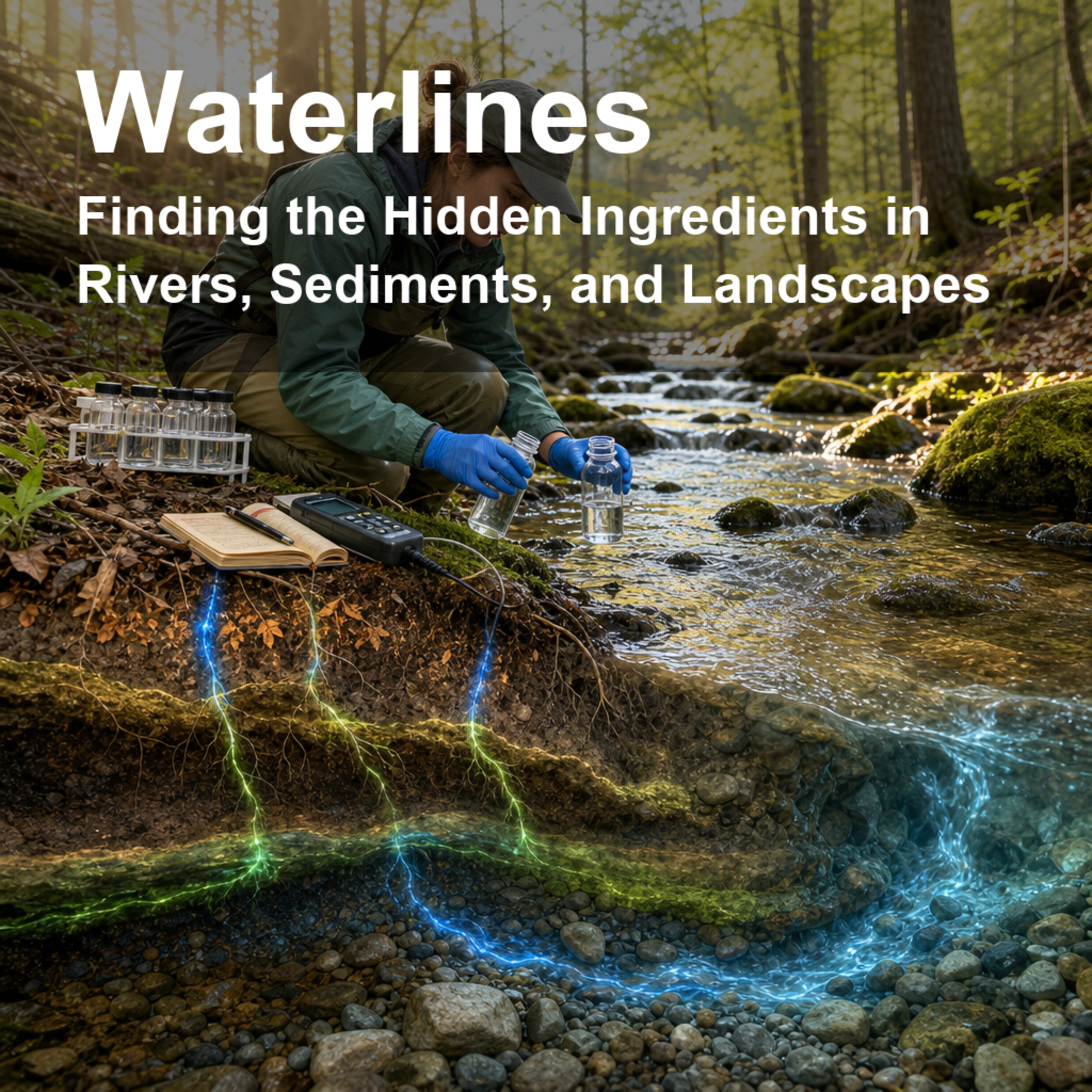
Finding the Hidden Ingredients in Rivers, Sediments, and Landscapes
from Waterlines: How Water Shapes Our World · host jaywen
When you test a stream, scoop deep-sea mud, or scan a landscape from the air, the result is usually a mixture. Rainwater, soil water, groundwater, rock weathering, plankton shells, road surfaces, trees, and bare soil can all blur together in the data. This episode matters because many real environmental decisions begin with the same question: what are the ingredients, and how much of each is in the mix? We explore a new machine-learning approach that helps scientists infer those hidden “end-members” directly from geoscience data, without always needing perfect prior knowledge of the sources. Hosts unpack the idea with everyday analogies: a smoothie recipe, a rubber band around scattered points, and a careful walk downhill that always keeps the percentages adding to 100%. The paper’s method, called simplex projected gradient descent-archetypal analysis, or SPGD-AA, was tested on synthetic mixtures and on three real cases: stream chemistry at Panola Mountain in Georgia, deep-sea sediments from the Nazca Plate, and hyperspectral imagery from Jasper Ridge in California. The episode also keeps the limits in view: the method works best when mixing is mostly linear and conservative, and when the data include samples close enough to the “pure” sources. Citation: Wang, Z., & Wen, T. (2025). Inferring end-members from geoscience data using simplex projected gradient descent-archetypal analysis. Journal of Geophysical Research: Machine Learning and Computation, 2, e2024JH000540. https://doi.org/10.1029/2024JH000540. Disclosure: this Waterlines episode uses AI-generated voices for the hosts.
Embed this episode
NOW PLAYING
Finding the Hidden Ingredients in Rivers, Sediments, and Landscapes
No transcript for this episode yet
Similar Episodes
No similar episodes found.
Similar Podcasts
No similar podcasts found.