Fine tuning log routing (osc25) episode artwork

EPISODE · Jun 26, 2025 · 31 MIN

Fine tuning log routing (osc25)

from Chaos Computer Club - recent events feed (high quality) · host Peter Czanik

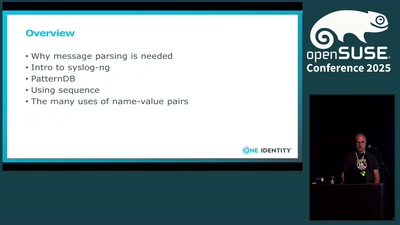
Do you want to detect threats real-time and easily search logs to find relevant information? By default, incoming log messages are treated in log management apps as one long string. This is good enough if you just want to store logs. However, if you also want to act on log messages, you need more structured information. Syslog-ng and other applications also let you parse log messages. While parsing structured logs, like JSON, is easy, unstructured logs need a lot of work. This is where sequence can help you: if you have enough logs to analyze, it can automatically generate parser rules for syslog-ng and LogStash. Name-value pairs (sometimes also called “macros”) are probably one of the most useful parts of syslog-ng. Macros have been a core feature of syslog-ng since the beginning: incoming log messages were parsed by syslog-ng and various fields (priority, facility, date, program, PID and message) were stored into name-value pairs. You could use these to reformat log messages or use these values in file names. Without additional parsing, syslog-ng treats the message part of a log message as one long string. While this might be valid in some use cases, many log messages look like an almost complete English sentence with some variable parts in it. Just think about SSH login messages: they include the username, the source IP and port, and the login method embedded in a sentence. You might want to create an alert in syslog-ng for such messages (for example, if a root user logs in). However, if the whole message is a single string, you cannot do that. PatternDB can find important information in unstructured log messages, like the above-mentioned SSH login message, and create name-value pairs from the information it finds. PatternDB rules are easier to write than regular expressions and also need less resources to run. There are various parsers for structured log messages as well, like the CSV, JSON and XML parsers. You can also combine these and build really complex parsers. Sometimes, the syslog header might be missing from log messages, so you need to create a parser for the whole message. Message parsing and name-value pairs give you a lot more flexibility when it comes to filtering or templating log messages. For example, you can send an alert to Slack when someone logged in as a root user through SSH, or you can forward two important fields from an extremely long log message to save network bandwidth and disk space. You can use it to hide sensitive information and send only what is required to various destinations. Sequence-RTG allows you to automatically generate parser rules for syslog-ng and LogStash. Creating parser rules from scratch is a painful process. However, if you have enough log messages to analyze, sequence can do the heavy lifting for you. Of course, you might need to rename some of the name-value pairs, but that is a lot easier. Licensed to the public under https://creativecommons.org/licenses/by-sa/4.0/ about this event: https://c3voc.de

Do you want to detect threats real-time and easily search logs to find relevant information? By default, incoming log messages are treated in log management apps as one long string. This is good enough if you just want to store logs. However, if you also want to act on log messages, you need more structured information. Syslog-ng and other applications also let you parse log messages. While parsing structured logs, like JSON, is easy, unstructured logs need a lot of work. This is where sequence can help you: if you have enough logs to analyze, it can automatically generate parser rules for syslog-ng and LogStash. Name-value pairs (sometimes also called “macros”) are probably one of the most useful parts of syslog-ng. Macros have been a core feature of syslog-ng since the beginning: incoming log messages were parsed by syslog-ng and various fields (priority, facility, date, program, PID and message) were stored into name-value pairs. You could use these to reformat log messages or use these values in file names. Without additional parsing, syslog-ng treats the message part of a log message as one long string. While this might be valid in some use cases, many log messages look like an almost complete English sentence with some variable parts in it. Just think about SSH login messages: they include the username, the source IP and port, and the login method embedded in a sentence. You might want to create an alert in syslog-ng for such messages (for example, if a root user logs in). However, if the whole message is a single string, you cannot do that. PatternDB can find important information in unstructured log messages, like the above-mentioned SSH login message, and create name-value pairs from the information it finds. PatternDB rules are easier to write than regular expressions and also need less resources to run. There are various parsers for structured log messages as well, like the CSV, JSON and XML parsers. You can also combine these and build really complex parsers. Sometimes, the syslog header might be missing from log messages, so you need to create a parser for the whole message. Message parsing and name-value pairs give you a lot more flexibility when it comes to filtering or templating log messages. For example, you can send an alert to Slack when someone logged in as a root user through SSH, or you can forward two important fields from an extremely long log message to save network bandwidth and disk space. You can use it to hide sensitive information and send only what is required to various destinations. Sequence-RTG allows you to automatically generate parser rules for syslog-ng and LogStash. Creating parser rules from scratch is a painful process. However, if you have enough log messages to analyze, sequence can do the heavy lifting for you. Of course, you might need to rename some of the name-value pairs, but that is a lot easier. Licensed to the public under https://creativecommons.org/licenses/by-sa/4.0/ about this event: https://c3voc.de

NOW PLAYING

Fine tuning log routing (osc25)

0:00 31:49

No transcript for this episode yet

We transcribe on demand. Request one and we'll notify you when it's ready — usually under 10 minutes.

No similar episodes found.

LIGHTS, CAMERA, SMILE! Creatives Club Media Lights, Camera, Smile, is a podcast for anyone with a dream to share something with the world, out of the overflow of themselves - be it their mind, their heart, their personalities, and much more. Each of us are alive in this moment in time, with an innate ability to have ideas and create various things to benefit both ourselves and the people around us for a reason, and here, you will find the encouragement, the inspiration, and the motivation to do just that. Hosted by Cicily, founder of Creatives Club, she dives into various topics surrounding creativity and business. Exploring entrepreneurship for creatives in a corporate reality, sharing tips and tricks in a media centered company, answering questions regarding what a creative actually is are just a few of the things discussed on this podcast. Be encouraged to create for yourself as Cicily gets vulnerable by pivoting the camera to herself for the first time.To submit questions for Cicily to answer, or have her address certain t Chewing the Fat with WorkForge WorkForge Bite-Sized Conversations for Building a Stronger Workforce Welcome to Chewing the Fat, a podcast delving deep into the world of food manufacturing. Dive into real conversations around critical topics like staffing, retention, onboarding, and career development in this essential industry. Subscribe now to gain insights from your peers, subject matter experts and more on the biggest issues facing food manufacturers today: -Hiring and retaining employees -Addressing the challenges of the Silver Tsunami -Improving time to productivity of new employees -Engaging employees from hire to retire And more... Tune in to Chewing the Fat, a WorkForge podcast, and join the conversation on how to build and sustain a resilient, high-performing workforce in food manufacturing. Sermons | Countryside Bible Church Countryside Bible Church At Countryside Bible Church, we equip believers to joyfully live holy lives, to serve one another, and to share the gospel of Jesus Christ, all to the glory of God. We are committed to a high view of God, and a high view of Scripture. The PFN Cincinnati Bengals Podcast Pro Football Network The PFN Cincinnati Bengals Podcast is where you can stay up-to-date with the latest news and analysis on the Cincinnati Bengals! Our hosts, industry experts Jay Morrison and Dallas Robinson, provide weekly coverage of all the latest rumors and updates about the Bengals. Don’t forget to follow the show to receive new episodes directly in your podcast feed and leave a rating and review to let us know your thoughts.

Frequently Asked Questions

How long is this episode of Chaos Computer Club - recent events feed (high quality)?

This episode is 31 minutes long.

When was this Chaos Computer Club - recent events feed (high quality) episode published?

This episode was published on June 26, 2025.

What is this episode about?

Do you want to detect threats real-time and easily search logs to find relevant information? By default, incoming log messages are treated in log management apps as one long string. This is good enough if you just want to store logs. However, if you...

Can I download this Chaos Computer Club - recent events feed (high quality) episode?

Yes, you can download this episode by clicking the download button on the episode player, or subscribe to the podcast in your preferred podcast app for automatic downloads.
URL copied to clipboard!