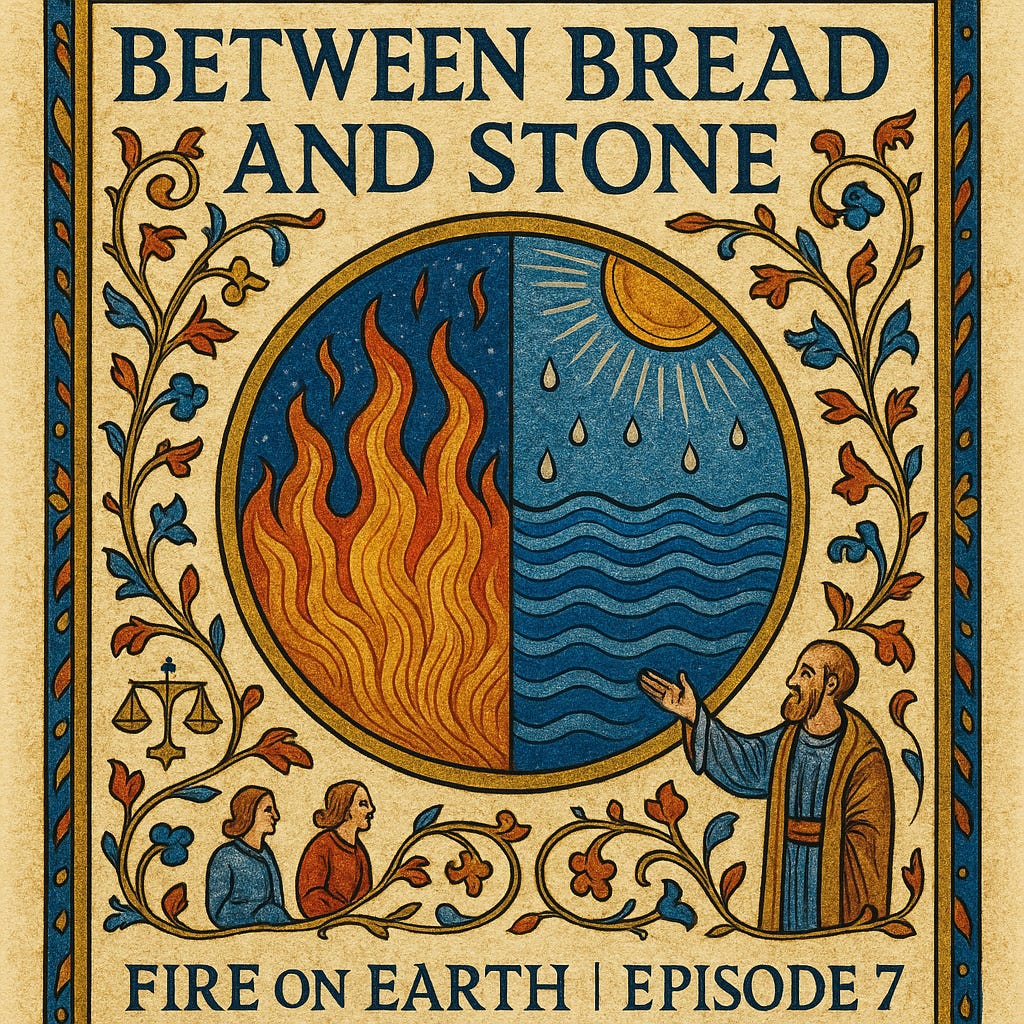
Fire on the Earth
from Between Bread and Stone Hosted by Stephen R. Brewer, PsyD
This week’s Gospel reading is one of the hardest sayings of Jesus — and one of the most easily misused. We like our Jesus gentle, meek, and mild. We like him to bless our reconciliations and smile over family dinners. We do not like him when he talks about fire and division. And yet, he says it plainly: his coming will not always bring peace — at least not the kind we picture. The peace of Christ is not the absence of conflict. It is the presence of truth, even when truth cuts across the lines we most want to keep tidy. Let’s turn to the Gospel… "I came to bring fire to the earth, and how I wish it were already kindled!I have a baptism with which to be baptized, and what stress I am under until it is completed!Do you think that I have come to bring peace to the earth? No, I tell you, but rather division!From now on five in one household will be divided, three against two and two against three;they will be divided: father against son and son against father, mother against daughter and daughter against mother, mother-in-law against her daughter-in-law and daughter-in-law against mother-in-law."He also said to the crowds, "When you see a cloud rising in the west, you immediately say, "It is going to rain'; and so it happens.And when you see the south wind blowing, you say, "There will be scorching heat'; and it happens.You hypocrites! You know how to interpret the appearance of earth and sky, but why do you not know how to interpret the present time?— Luke 12:49-56 (NRSV) In first-century Judea, Jesus was not speaking into a world of holiday dinners and suburban cul-de-sacs. He was speaking into an occupied land. Rome held military control. Religious authorities were deeply entangled with political power. Families were often divided — some cooperating with the occupiers for survival, others resisting at great cost. To follow Jesus was not to add a spiritual hobby to one’s life. It was to take sides. And taking sides always brings division. When Jesus speaks of fire, he’s invoking more than destruction — fire was also a symbol of purification. The prophets used it to describe God’s refining work, burning away what is false so that what is true might endure. But refinement is never painless. It requires the courage to face what must be consumed. In that world, as in ours, this meant confronting systems of injustice, hypocrisy, and hollow religion. It meant telling the truth about exploitation — and not everyone wanted to hear it. If we are honest, we still don’t. In our own day, “division” is often treated as a moral failure. We are told to keep the peace, to be polite, to avoid topics that might upset the family table. But the Gospel warns us: when peace depends on silence in the face of injustice, it is not Christ’s peace at all. Jesus challenges the crowd for their selective vision. They can read the weather in the sky — the clouds that mean rain, the wind that means heat — but they refuse to read the moral weather of their time. They ignore the signs that truth is in their midst, that God’s kingdom is pressing in. It is easier to predict the forecast than to name the injustice in our own homes, churches, and governments. In the early Christian communities, this passage would have been a sober reminder: following Jesus might cost them everything. Converts could be disowned by their families, cut off from economic support, or even betrayed to authorities. Yet they believed the fire was worth it — that the truth they followed was more enduring than the divisions it caused. And here we are, two thousand years later, still facing our own household divisions. Some are political: MAGA loyalists on one side, everyone else on the other. Some are economic: oligarchs who shape the rules for their own gain, and the rest of us who live under them. Some are cultural: fights over race, gender, history, and the right to even speak the truth about them. These aren’t abstract tensions. They play out in families, friendships, and churches. Thanksgiving tables have been split down the middle. Parents and children no longer speak. Entire congregations fracture over whether love should be conditional. And just as in the first century, these divisions are not only about differing opinions — they’re about allegiance. Who do we serve? Whose truth do we follow? Jesus’ words warn us: the decision to follow truth will not keep every relationship intact. In fact, it will disrupt some of them. Truth itself does not take sides. It stands on its own, unbending, refusing to be claimed by one faction or another. The fire he brings is not meant to destroy for destruction’s sake, but to refine — to burn away false peace so that real peace, rooted in justice, can emerge. Let’s return to the Gospel… “Do you think that I have come to bring peace to the earth? No, I tell you, but rather division!” In recent weeks, we’ve reflected on greed, on hospitality, on prayer. This week reminds us that living in Christ’s way is not always met with applause. Sometimes, it will be met with resistance from those we love most. But that resistance is not the end of the story. Fire destroys, yes — but it also clears the ground for something new to grow. Division can wound, but it can also free us from loyalties that keep us from justice. If we are to interpret our present time with honesty, we must ask: what fires need to burn away the false peace in our lives? And are we willing to stand in that heat until the work is done? May you have the courage to read the signs of your own time.May you welcome the refining fire that clears what is false.And may you trust that even in division, the peace of Christ is at work — a peace that passes understanding, because it is built on truth. Protected Speech | Views My Own Between Bread and Stone © 2025 Stephen Brewer. All rights reserved. Podcast audio and full text may be quoted for noncommercial purposes with attribution. Gospel text from the New Revised Standard Version Bible, copyright © 1989 the Division of Christian Education of the National Council of the Churches of Christ in the United States of America. Used by permission. All rights reserved. Get full access to Drawing the Line at percival84.substack.com/subscribe
Embed this episode
No transcript yet.