
EPISODE · Aug 8, 2025 · 14 MIN
Five Millennia in the Mountains: How the Southern Caucasus Held Its Genetic Ground
from Evolutionary Insights by Anthropology.net · host Anthropology.net
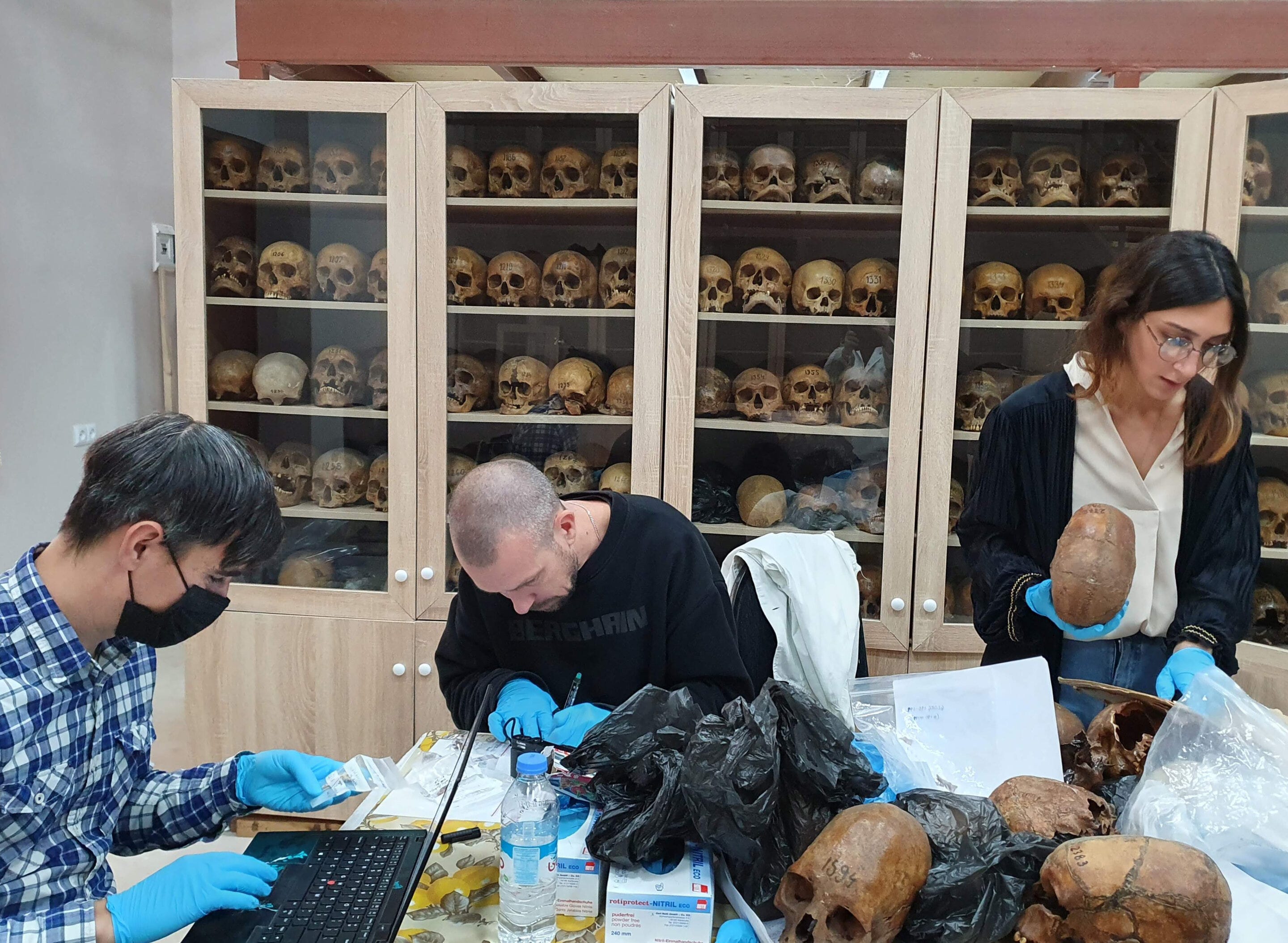
The Southern Caucasus has always sat at a strategic hinge point between Europe, the Near East, and Central Asia. Traders, pastoralists, and armies passed through its valleys for thousands of years. Yet, according to a new study in Cell, the people who lived there held onto a distinctive genetic identity for over 5,000 years.The research, led by the Max Planck Institute for Evolutionary Anthropology in collaboration with scholars from Georgia, Armenia, Norway, and Germany, analyzed the genomes of 230 individuals from 50 archaeological sites spanning from the Early Bronze Age, around 3500 BCE, through the early medieval period, after 500 CE.“The persistence of a deeply rooted local gene pool through several shifts in material culture is exceptional,” noted Harald Ringbauer, who led the population genetic analyses. “This stands out compared to other regions of Western Eurasia, where cultural transitions often came with large-scale population replacement.”Bronze Age Visitors, Enduring RootsAlthough the genetic signal remained remarkably stable, it was not completely sealed off. During the Late Bronze Age, the data revealed traces of migrants from Anatolia and the Eurasian steppe. These movements coincided with major cultural shifts, including changes in burial practices, the spread of mobile pastoralism, and the adoption of new technologies.These outside genetic contributions, however, often appear as brief episodes rather than permanent reshaping. Many migrant markers fade in subsequent generations, replaced once more by the dominant local profile.When Migration Becomes TraditionOne of the most striking examples of cultural exchange without wholesale population change comes from the early medieval Kingdom of Iberia, in what is now eastern Georgia. Archaeologists found numerous burials with intentionally deformed skulls—a custom long associated with nomadic groups from the Central Eurasian steppe, such as the Avars and Huns.“We identified numerous individuals with deformed skulls who were genetically Central Asian,” said lead author Eirini Skourtanioti. “Yet most who practiced this tradition were locals. This is a compelling example of the adoption of a migrant custom by the resident population.”The finding overturns earlier assumptions that such skull modifications necessarily marked immigrant identities. Instead, it appears to have been a borrowed practice that became embedded in local cultural life.Cities as CrossroadsBy Late Antiquity, urban centers and early Christian sites in eastern Georgia became gathering points for people of varied ancestries. Ancient DNA reveals that towns functioned as genuine melting pots, where local residents lived alongside individuals whose origins ranged far beyond the Caucasus.“Historical sources describe the Caucasus Mountains as both a barrier and a corridor for movement,” observed co-lead author Xiaowen Jia. “Our genetic data confirm that these urban centers were magnets for mobility.”Continuity Through ChangeTaken together, the findings portray the Southern Caucasus as a region where movement and exchange were constant, yet the core population’s genetic signature persisted across major political, cultural, and environmental changes.The work also demonstrates the power of integrating archaeogenetics with traditional archaeology, producing a picture that is both granular and deeply historical.Additional Related Research* Skourtanioti, E., et al. (2020). Genomic history of Neolithic to Bronze Age Anatolia, Northern Levant, and Southern Caucasus. Cell, 181(5), 1158–1175.e28. https://doi.org/10.1016/j.cell.2020.04.044* Wang, C. C., et al. (2019). Ancient human genome-wide data from a 3000-year interval in the Caucasus corresponds with eco-geographic boundaries. Nature Communications, 10, 590. https://doi.org/10.1038/s41467-018-08220-8* Lazaridis, I., et al. (2022). The genetic history of the Southern Arc: A bridge between West Asia and Europe. Science, 377(6609), eabm4247. https://doi.org/10.1126/science.abm4247* Margaryan, A., et al. (2020). The genomic origin of the Bronze Age Tarim Basin mummies. Nature, 599, 256–261. https://doi.org/10.1038/s41586-021-04052-7 This is a public episode. If you'd like to discuss this with other subscribers or get access to bonus episodes, visit www.anthropology.net/subscribe
Embed this episode
NOW PLAYING
Five Millennia in the Mountains: How the Southern Caucasus Held Its Genetic Ground
No transcript for this episode yet
Similar Episodes
No similar episodes found.
Similar Podcasts
No similar podcasts found.