
EPISODE · Jun 30, 2026 · 58 MIN
FiveStack: SCOTUS Hands Trump the Government
from FiveStack with Dean Blundell & Zev Shalev · host Zev Shalev, Anne P. Mitchell, Esq., and Dean Blundell
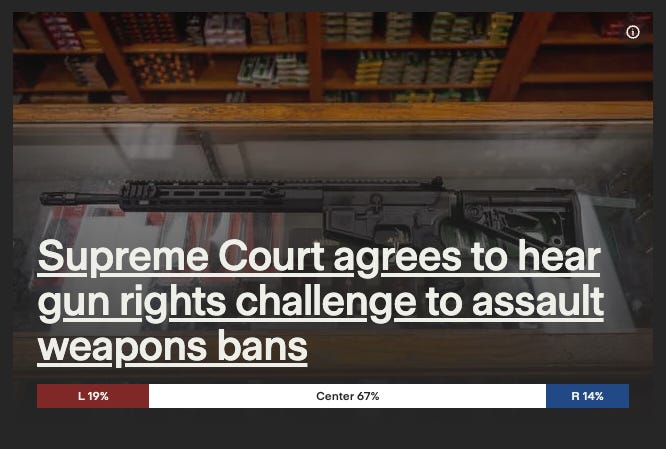
Today’s FiveStack is brought to you by GroundNews — FiveStack viewers get 40% off their Vantage plan.In forty-eight hours the Supreme Court closed its term and rewrote who runs the government. Six to three, again and again — a number that tells you how fixed this Court has become. It gave Donald Trump the agencies, opened the money spigot, and let the states decide who counts as a girl. Then it drew exactly two lines it would not let him cross: it would not erase the Fourteenth Amendment, and it would not hand him the Federal Reserve.On Tuesday’s Fivestack, Zev counted the five rulings down — least significant to most — with guest Anne P. Mitchell, the Stanford Law professor and federal-law author who writes Notes from the Front. (Dean Blundell was out sick; Mitchell stepped in at short notice.) What follows is the countdown, the words the justices actually wrote, and the impact measured in numbers.5️⃣ The Court Lets the States Decide Who’s a GirlFor three years Lindsey Hecox fought Idaho’s law to try out for the Boise State women’s track team, and a West Virginia middle-schooler, Becky Pepper-Jackson, fought to stay on her school squad. On June 30 the Court ended both fights at once, upholding state bans on transgender girls in girls’ and women’s sports. Kavanaugh wrote it. The vote was 6–3.Mitchell put her finger on the move that should trouble even people who welcome the result: the Court resurrected “separate but equal.” A century of race cases held that separate is inherently unequal. Here the majority says the opposite — that limiting girls’ teams to “biological females” is “substantially related” to an important government interest, and so it stands. The ruling leans on the meaning of “sex” when Title IX passed in 1972, before the country was having any conversation about gender identity. “It’s funny,” Mitchell noted, “how they only do that when it’s to their ideological advantage.”The reach is total. This is the Supreme Court, not a circuit — it is now the law of the land. Twenty-seven states already ban trans girls from school sports; every public school and university in them, K-12 through the NCAA, now operates on solid constitutional ground. Sotomayor, in dissent: “to the Court, the facts do not matter, even though the consequences are serious.” The majority, she wrote, lets states bar every transgender athlete “even if the facts show” no competitive advantage — moving the goalposts to answer the constitutional question without the record to support it.🎯 THE GROUND NEWS BLINDSPOT — The Next Fight Is Already HereThis week’s GroundNews.com’s Blindspot is the sequel the Court already greenlit: it granted review of the assault-weapons bans in Connecticut and Cook County, Illinois — the first direct ruling on AR-15-style rifles and high-capacity magazines, with about a dozen state bans hanging on it. Arguments come this fall. Mitchell, who says she hasn’t missed a call yet this term, expects the bans struck. Power, then money, now the guns — the same six justices, one case at a time.Sign up for the blindspot at groundnews.com/fivestack and get 40% off of their vantage plan.4️⃣ Trump Tried to End Birthright Citizenship — and LostOn day one of his second term Trump signed an order stripping citizenship from babies born on U.S. soil to undocumented and temporary residents. Eighteen months later Chief Justice Roberts told him no, 6–3: children born here to parents “unlawfully or temporarily present” are “subject to the jurisdiction” of the United States and “are citizens at birth.” The challengers’ reading, Roberts wrote, “commanded only a dissent in 1898, and neither time nor circumstance has changed the fact it is not the law.”Mitchell traced the stakes back to the worst day in the Court’s history. The Fourteenth Amendment exists because of Dred Scott — the 1857 ruling that Black Americans born on this soil were not citizens. The amendment was the country’s answer. Her takeaway: even a Supreme Court can be overruled by the people who wrote the Constitution to begin with. “They are only one of three — I argue four — branches of government,” she said. “The fourth being we the people.”The number behind the ruling is enormous. Roughly 255,000 to 260,000 babies a year — about one in nine U.S. births — had their citizenship riding on this case, and the order reached past the undocumented to the children of H-1B workers, international students, asylum seekers, and DACA recipients. It is Trump’s biggest defeat of the term. And the warning sits in the dissent: Thomas, joined by Gorsuch, wrote 90 pages arguing the other way. The three justices who wanted to read the amendment down are still on the bench.3️⃣ The Court Opens the Spigot — Unlimited Party MoneyA Watergate-era cap on how much a party could spend hand-in-glove with its own candidate just fell. In NRSC v. FEC, Kavanaugh wrote for a 6–3 majority that coordinated-spending limits “necessarily abridge political parties’ freedom of speech.” One of the original plaintiffs, back in 2022, was a Senate candidate named JD Vance — now the Vice President, who will run on a case he helped bring.Mitchell flagged a detail most coverage skipped: the suit was filed under Biden, but by the time it reached the Court, the Trump DOJ agreed with the plaintiffs. The justices had to appoint outside counsel to defend the limits at all — and you have to wonder how vigorous a defense the law got with no administration behind it. The result rewires the money. A single donor’s reach jumps from $7,000 given directly to a candidate to roughly $500,000 routed through the party — a 70-fold widening, by Justice Kagan’s math — and the party can now operate in lockstep with the campaign. Republicans are cheering louder than Democrats, Mitchell said, because “they’re the party of a massive amount of money behind the donors.”The throughline is Citizens United. That ruling freed the outside money; this one frees the inside money, the party and the candidate spending as one. Kagan, in dissent, warned it “ushers back in the same opportunities for quid pro quo corruption that the contribution limits were meant to check.” Watch the airwaves in contested districts as November approaches.2️⃣ The Fed Survives — But Read the Fine PrintHere the show did what Narativ exists to do: correct the headline. Every outlet reported that the Court let Lisa Cook keep her seat at the Federal Reserve. Mitchell stopped Zev cold. “That’s not what it says.”What the 5–4 ruling actually did was send Cook’s case back down. Trump moved to fire her over an allegation of mortgage fraud surfaced by Bill Pulte; the Court found she had never been given a chance to answer it, and remanded so she can present her defense. Along the way the majority wrote an exhaustive history of why the Fed, created by its own statute, has always stood apart — but it pointedly did not announce a blanket rule that Fed governors can only be fired for cause. As Mitchell put it, Trump probably wishes he had fired Cook without stating a reason at all. Had he done that, she’d have gone the way of Rebecca Slaughter.Why it ranks second on a list where it touches one person: this is the board that sets interest rates, that steers inflation, affordability, the direction of the whole economy. A president who can install a majority on the Federal Reserve can manipulate the cost of living heading into an election. The Court drew its second line here — not out of principle, but because even this majority knows a president who can fire the Fed chair on a whim can crash the bond market. The line held by a single vote.1️⃣ The 90-Year Wall Falls — Trump Can Fire Them AllThe biggest ruling of the term overturned a unanimous 1935 precedent. For ninety years, Humphrey’s Executor held that a president could not fire the members of independent agencies just for disagreeing with him. On June 29, in Trump v. Slaughter, Roberts erased it 6–3. The case began when Trump fired FTC commissioners Rebecca Slaughter and Alvaro Bedoya in 2025 with no cause, citing only Article II.Mitchell called the animus by name. Roberts has been gunning for Humphrey’s since 2010, chipping away case by case, shopping for the right plaintiff and the right moment for fifteen years — a Federalist Society long game, with Trump as the figurehead willing to bring the suit. The Chief Justice wrote his contempt into the opinion: “if anything more is left of Humphrey’s, the Court overrules it.” This was never really about Slaughter. It was about who is allowed to work in government.The impact is structural: more than two dozen independent agencies — the FTC, the SEC, the FCC, the NLRB, and the rest — lose their insulation. Congress built them bipartisan on purpose, so the referees couldn’t be fired for the call. Now they answer to one man. Mitchell offered her “cynical hope” — that Trump has already done most of the firing, so the damage may be priced in. Zev was less sanguine: a president who has spent his term gutting the government of anyone who opposes him will go as deep as the law now lets him. The enforcement machine has one master, and he has shown he will use it.ALSO FROM THE BENCHTwo rulings barely made the headlines, and Mitchell brought both to the table. In Chatri v. United States, the Court held that pulling a person’s cell-phone location data from Google is a Fourth Amendment search requiring a warrant — Americans have “a reasonable expectation of privacy in their cell phone location information.” Against an administration building a Palantir-fed database to geolocate people, that is a real limit. And in a quieter blow to Trump, the Court let states count mail-in ballots postmarked by Election Day, even if they arrive after — even as the USPS floats a rule demanding states hand over their voter rolls. Mitchell’s advice: use a drop box, not the mail.THE PATTERNRead these decisions as one move. The Court expanded executive power, opened the money, upheld the culture-war ban, and reached toward the guns — and where it stopped Trump, it stopped him narrowly and for reasons of self-protection, not principle. The Fourteenth Amendment was too plain to erase; the Fed was too dangerous to hand over. Everything the Constitution’s text or the bond market protected survived. Everything else moved toward the Oval Office. That is not a term of decisions. It is a transfer of power — and the only check left standing is the one the justices can’t touch: a November election.Today’s FiveStack is brought to you by GroundNews — FiveStack viewers get 40% off their Vantage plan.The fight isn’t over; it just got more expensive. Subscribe to Narativ for the intelligence behind the news — and Know Sooner.Guest: Anne P. Mitchell writes Notes from the Front at annpmitchell.substack.com.Thank you Lesley Jane Seymour, Robin Payes, Lalisa, Noble Blend, Michelle C. Funk, and many others for tuning into my live video with Anne P. Mitchell, Esq.! Join me for my next live video in the app. This is a public episode. If you'd like to discuss this with other subscribers or get access to bonus episodes, visit www.narativ.org/subscribe
Embed this episode
NOW PLAYING
FiveStack: SCOTUS Hands Trump the Government
No transcript for this episode yet
Similar Episodes
No similar episodes found.
Similar Podcasts
No similar podcasts found.