Flood: Who asked for what, when?
from Random Acts of Urbanism Hosted by Brigitte Pellerin
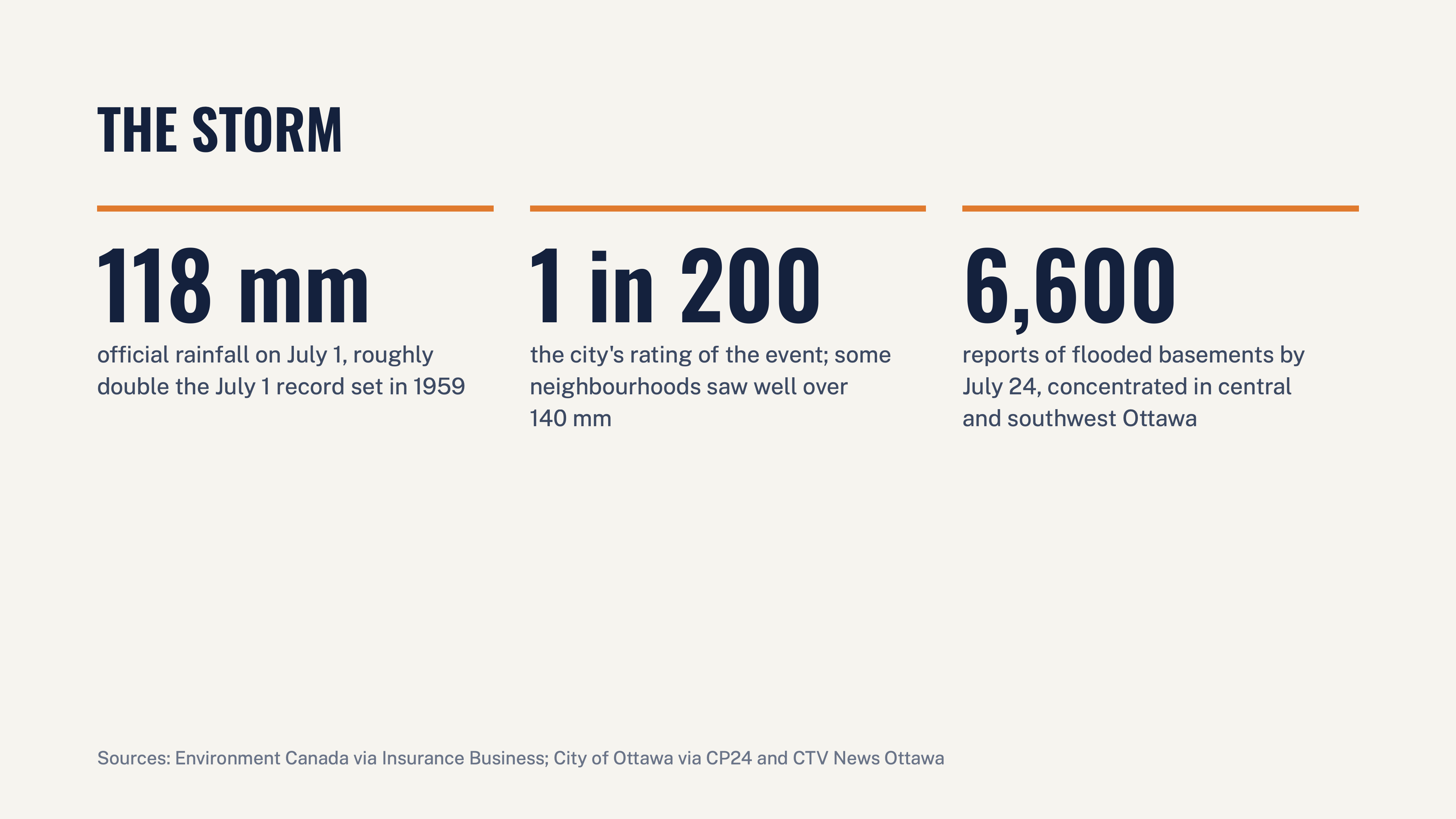
I do this work as an independent journalist and no outlet is paying me for it. You, my readers, are the ones funding it through paid subscriptions. Help me dig into stories that matter to you by becoming a paid subscriber or, if Substack isn’t your thing, by making a one-time or recurring contribution on my website. Thank you. If you were affected by the July 1 flood, you don’t need me to tell you how hard the past three months have been. The storm dropped 118 mm of rain on Ottawa, roughly double the previous July 1 record, set in 1959, and well over 140 mm in some neighbourhoods. The city called it a one-in-200-year event. By late July, 6,600 households had reported flooded basements. This wasn’t ordinary flooding. An enormous amount of rain fell in a very short time, and in many cases the city’s infrastructure simply couldn’t handle it. Sewers backed up into basements. Belongings were destroyed. Even if insurance eventually covers everything, going through that process is a nightmare. Which is why, when you lead a city, your first job in a moment like that is to get residents as much of the available help as possible, as fast as possible. Last week, Ontario’s Minister of Emergency Preparedness and Response, Jill Dunlop, said the City of Ottawa didn’t formally ask the province for help until July 9, eight days after the storm. She said it in answer to a question from Ottawa West–Nepean NDP MPP Chandra Pasma. Mayor Mark Sutcliffe’s campaign denies it. They say the city asked right away, and that the mayor was on the phone with Premier Doug Ford on the evening of July 1. And again on July 3. I have no reason to doubt the mayor was on the phone those nights, probably with other officials too. That’s normal; it’s what you’d expect. But a phone call isn’t necessarily a formal request for assistance. It may have been a heads-up that a request was coming. On the evening of July 1, everyone knew this was going to be a big problem, but nobody knew yet just how big. So the question is simple: who asked whom, for what, and when? I’ve filed access-to-information requests with both the city and the province, and I’ve put questions directly to the people involved. Formal requests can take a long time. With the election on October 26, I don’t think we should have to wait. Here’s what we know so far, and what we don’t. Two provincial programs, two very different jobs Ontario has two programs that matter here. Disaster Recovery Assistance for Ontarians (DRAO) helps residents, tenants, small owner-run businesses, farms and non-profits pay for disaster damage that insurance doesn’t cover. It’s not money that shows up right away: it comes after you’ve been through your insurance, which can take months on its own. It covers basic needs in a primary residence, with caps and deductibles, up to $250,000 per claimant. And it only applies inside an area the province designates. Crucially, the province doesn’t need a municipality to ask. The Minister of Municipal Affairs and Housing, Rob Flack (not Dunlop), decides whether and where to activate it, informed by the province’s own damage assessments and by information from the municipality. In practice, the city’s input carries a lot of weight. If everyone in the city’s emergency management, the mayor’s office and whoever else needs to weigh in shows up with a detailed formal request explaining why the program applies, surely that helps the province conclude that yes, this is what the program is for. Municipal Disaster Recovery Assistance (MDRA) reimburses the city for its own extraordinary costs, such as emergency response and repairs to roads, bridges and public buildings. This one does require the city to act: council must pass a resolution and submit an initial claim within 120 days of the disaster. The city’s eligible costs must reach at least 3% of its own-purpose tax levy. Above that threshold, the province pays 75% of eligible costs up to it and 95% beyond. What happened, day by day * July 1: The storm hits. According to the mayor’s campaign, Sutcliffe is on the phone with the Premier that evening. * July 3: Sutcliffe says he has spoken with Premier Ford about support for the city and residents. * July 5: Councillors Laine Johnson, Wilson Lo, David Hill and Sean Devine, along with MPPs Tyler Watt, Karen McCrimmon, Stephen Blais, Lucille Collard and John Fraser, publish an open letter asking the province to send its disaster assessment team and activate DRAO. The mayor is not a signatory. The ministry says it is assessing the situation. * July 6: At a news conference, Sutcliffe says he has spoken with ministers Dunlop and Flack about getting DRAO for residents. He also announces motions to boost the city’s Compassionate Grant, which pays $1,000 for sewer-backup flooding and had a budget of $150,000 a year. * July 9: The first formal request for help reaches the province, according to Dunlop. * July 10: Flack says he’s confident DRAO will be activated but gives no timeline. Coun. Laine Johnson says that eight days after the floods she is still looking for action and answers from both the city and the province, that the city was responsible for starting some of the requests, and that “all of that took too long.” * Around July 14: The province activates DRAO, but only around Graham Creek and Stillwater Creek: Bayshore, Qualicum, Leslie Park and Trend-Arlington. Residents there have until November 16 to apply. * July 15: Council approves the mayor’s motions: a partnership with the Red Cross worth up to $400,000, waived fees including building and demolition permits, more Compassionate Grant funding, more money for sump pumps and backflow valves, and legal help with insurance claims. Council also drops the rule limiting the grant to once every five years. * July 16: The Red Cross launches its Ottawa Floods Appeal. Around the same time, at the mayor’s request, the federal government agrees to match donations. * July 24: The city formally asks the province to expand the DRAO area. Paramedic Chief Pierre Poirier admits the first map the city gave the province was “fairly restrictive,” drawn before staff understood the full scope of the event. By then the city has received 1,679 grant applications and approved 824. * September 23: Council unanimously passes the mayor’s motion to apply for MDRA, seconded by Johnson, provided costs meet the threshold. The city is still tallying them. A second motion asks the province to review DRAO’s eligibility rules. CTV reports that the DRAO area still hasn’t been expanded. As far as I can tell, that small zone is still the only part of Ottawa approved for DRAO. If I’m wrong, I’d love to hear it. The people who fall through the cracks The two main programs were designed for different kinds of water. The city’s Compassionate Grant covers sewer backup only and explicitly excludes overland flooding. DRAO covers overland flooding, but sewer backup generally isn’t eligible, and it only applies inside the designated zone. So if water came in through your window wells and you live outside that zone, you may qualify for neither. That zone left out flooded neighbourhoods including Centrepointe, Crystal Beach and Parkwood Hills. It also excluded Kanata North, which had the highest number of storm-related service requests in the city. The province says it drew the area using information the city provided. How many households are in that gap? Nobody has said. What we don’t know When the city formally asked, and for what. Show us the email, the letter, the form, whatever it was. Surely somebody put a formal request for assistance in writing. I’d like to know what was asked, by whom and when. The minister says nothing arrived before July 9; the mayor says that’s not accurate. They can’t both be right, and we need the paperwork to settle it. That’s also why Jeff Leiper, the mayor’s main challenger, has asked for the paper trail. A lot of people want to see it. One wrinkle: Dunlop is the emergency preparedness minister, but it’s the Minister of Municipal Affa… Get full access to Random Acts of Urbanism by Brigitte Pellerin at randomactsofurbanism.substack.com/subscribe
Embed this episode
No transcript yet.