
EPISODE · Feb 19, 2024 · 2 MIN
Foundations of Blockchains (Lecture 9.2: Proof-of-Work)
from Higher Signal: Get Smarter. Faster. · host Higher Signal
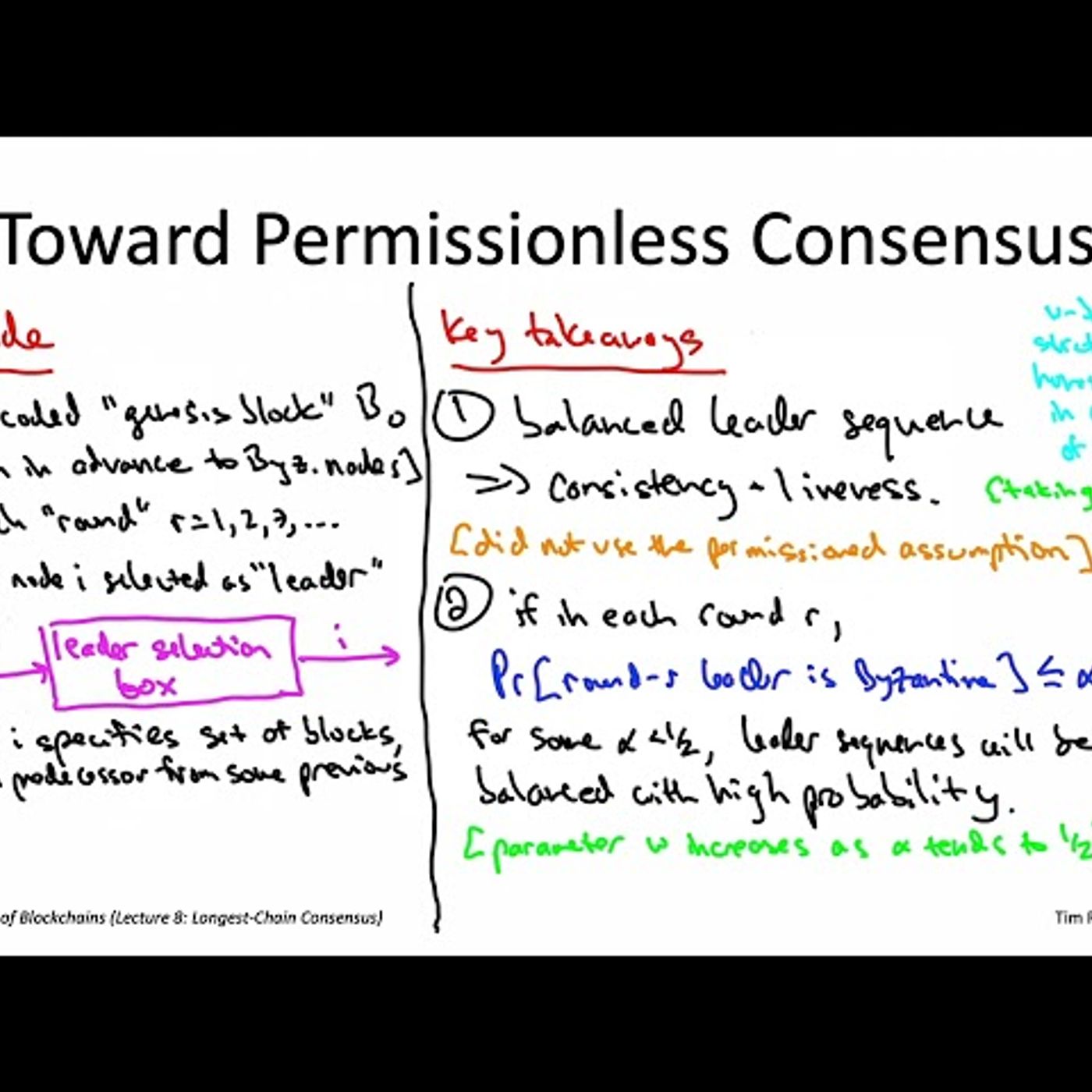
Alright, let's dive into the main takeaways from a discussion on proof-of-work and its role in blockchain consensus, especially the longest chain consensus. We'll cover three fundamental ideas: how the longest chain consensus is adapted to a permissionless environment using proof-of-work, the features and mechanics of proof-of-work, and finally how proof-of-work provides civil resistance which is essential for maintaining blockchain security and fairness.Here are the key principles:- Instead of having a pre-determined leader in blockchain rounds, use proof-of-work to have nodes elect themselves by solving computational puzzles.- For nodes looking to add a block to the blockchain, they should pre-commit their proposed block and its predecessor before knowing if their solution to the puzzle will be successful.- Instead of allowing Byzantine nodes to propose multiple conflicting blocks, design the proof-of-work system so that a node, once successful in solving a puzzle, can only propose one block per round.Now, let me quickly explain what proof-of-work means:- Proof-of-work is a system where the right to create a new block, and thus be the leader of a round in the longest chain consensus, is determined by solving a difficult computational puzzle.Here are a few memorable quotes from the podcast:- "The only thing we are missing is a permissionless version of the magenta box with the correct property."- "Every sort of choice of nonce is a new throw of a dart to this dartboard."- "The probability that any given guess succeeds, is two to the -80, which means that on average, you're going to be expecting to make two to the 80 distinct guesses before you actually find a solution"Core Takeaway:The issue to be solved here is adapting the longest chain consensus mechanism, which works well in a permissioned setting, to a permissionless setting like that found in most cryptocurrencies. The challenge is maintaining the security and functionality of the blockchain without a trusted authority to designate leaders in each round.It's important to understand this because without addressing this challenge, blockchains couldn't operate in a trustless and decentralized manner, which is one of their core advantages. Not solving this problem would mean we'd rely on central authorities, negating much of the blockchain's innovative impact.To solve this, proof-of-work provides a way for nodes to "elect" themselves as leaders by investing computational work to solve cryptographic puzzles. This process is crucial for enabling a decentralized consensus mechanism that can resist Sybil attacks—where one party creates many identities to gain a disproportionate amount of influence in a network—and ensures that the blockchain remains secure and fair, as each node has an equal opportunity to solve the puzzle and create the next block.Tags here: proof-of-work, longest chain consensus, permissionless blockchain, cryptographic puzzles, civil resistance, Byzantine nodes, hash functions
Embed this episode
NOW PLAYING
Foundations of Blockchains (Lecture 9.2: Proof-of-Work)
No transcript for this episode yet
Similar Episodes
No similar episodes found.
Similar Podcasts
No similar podcasts found.