
EPISODE · Oct 5, 2026 · 6 MIN
Founded Upon the Seas
from Reflections on the Psalms Podcast · host William Conley
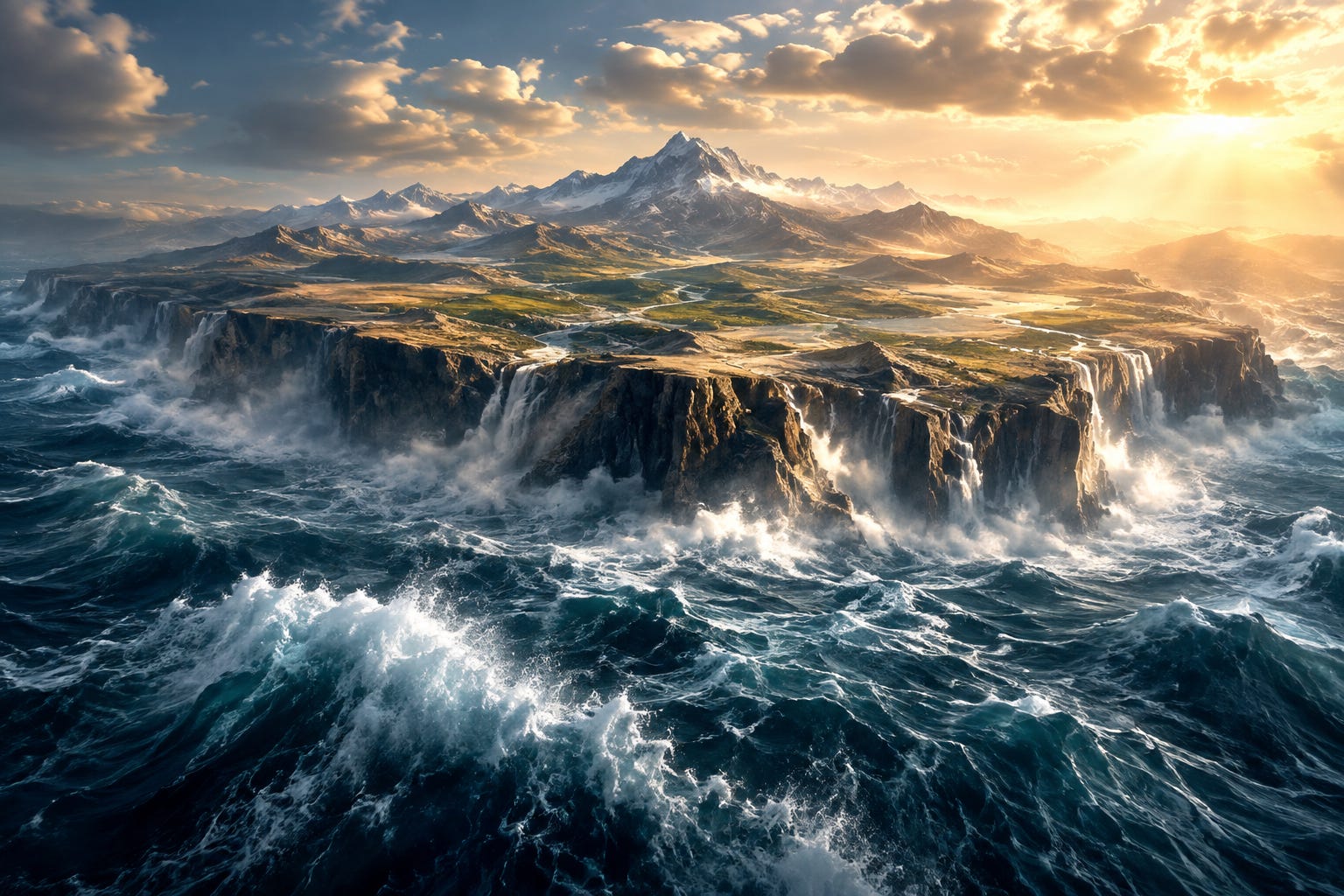
Today’s reflection on the Psalms comes from Psalm 24: “The earth is the LORD’s and the fullness thereof, the world and those who dwell therein, for he has founded it upon the seas and established it upon the rivers.” It may seem like a strange place to begin, but here you have this whole thing about water. Water, water everywhere. When you go back to Genesis, the forming of the world involves a division of the waters: waters above and waters below. Dry land appears, and we live between the waters. Scripture returns to this picture repeatedly. That is a different way of presenting the world from the contemporary picture of the universe, with space and light-years and everything we have come to know. The biblical picture is simple: waters above, waters below, and a place for us to live between them. You might understand this as poetic language, or you might take it as a literal description. I am not going to settle that argument here. I am saying that when we read the Bible, we have to learn its grammar. We have to recognize this picture and follow what Scripture does with it. Then you come to the Exodus. Israel passes between the waters on dry ground. Here is the creation pattern again: God divides the waters and makes a way for His people to walk. Or think of Nebuchadnezzar’s dream in Daniel 4. He sees a tree whose height reaches heaven and which is visible to the ends of the earth. Picture the whole earth spread out beneath this great tree. Is the world flat? Is it a globe? I am not entering that debate. This is a dream, and Daniel tells us that the tree represents the king and the reach of his dominion. We have to enter the picture to understand what it communicates. And I will go a little further: I actually prefer the biblical grammar of looking at creation. I do not have to turn every image into a claim about its physical structure to inhabit that world. Sometimes people dismiss poetry because they say it is not real. But poetry can express something profoundly real. An account of what something is made of does not exhaust the truth of what it is. The world presented in Genesis and throughout Scripture has this poetic grammar, and that grammar teaches us to see. We might also recover a little humility when we look at the heavens. In Job, God asks about the Pleiades, Orion, and the ordinances of heaven. Can Job bring out the constellations in their season? Can he govern them? I remember studying celestial navigation at the United States Merchant Marine Academy. You are on a moving ship, looking at heavenly bodies whose positions change with time, and yet you can take a sight, record the time, work through the calculations, and find your position. There is something wonderful about that. Amid all this movement, there is an order dependable enough to navigate by. One of my professors showed us some anomalies in celestial navigation. I remember him acknowledging that he could not explain why those particular things happened in light of what he understood about the heavens. But he could observe them, and he was going to teach us what he could observe. That stayed with me. You can know how to work with something, and know that it works, without having an explanation for everything you encounter. I could look outside, take a sight, and use the heavens to find my way across the sea. Perhaps that is part of why I like inhabiting the biblical picture of creation. The heavens declare God’s glory, and their appointed movements help us find our way. There is grandeur here, but there is also dependability. God has made a world in which we can live, walk, and even navigate an ocean. Modern astronomy has mapped and explained a great deal. But the average person may have very little familiarity with the sky. How many of us can identify the constellations or follow their movements through the seasons? In earlier times, some children learned these things as part of their education. Chaucer wrote instructions on using an astrolabe for a ten-year-old boy. Many of us have lost that familiarity with the heavens. Now an app like Stellarium can help us recover some of it. You look up, identify the stars, and begin to appreciate where they are and how they move. There is a whole creation beyond what usually occupies our attention. We know a great deal, but we do not understand everything. And even with all our science, we can lose an appreciation for the simplicity, majesty, and grandeur of God’s creation. I like living in the biblical world. There is terra firma beneath my feet. In Scripture’s poetic register, the earth is established and shall not be moved. There is a firmament above, dividing the waters and keeping them in their appointed places. God makes a habitable world and sustains it. And that brings us back to the division of the waters. In Genesis, God divides the waters, and dry land appears. In the Exodus, God divides the waters again, and His people pass through on dry ground. The creation grammar becomes the grammar of deliverance. The God who made a place for humanity to live makes a way for Israel to walk. That is why this matters. If we read past the waters as though they were just an odd detail, we miss the connection. The Exodus brings us back into the picture of creation: divided waters, dry ground, and life made possible by the word and power of God. I do not need to pit these biblical categories against modern science. I want to learn to see what Scripture is showing me. I have a place to stand, and God can make a way through the sea. There is heaven above and earth beneath. We live, so to speak, in Middle-earth. Scripture speaks of waters under the earth and of Sheol below. This is the world Scripture places before us, and I want to learn to see within its grammar. Something is fixed: God’s faithfulness. The God who establishes the earth upon the seas is the God who brings His people through them. “The earth is the LORD’s and the fullness thereof.” This ends the reflection on the Psalms for today. This is a public episode. If you would like to discuss this with other subscribers or get access to bonus episodes, visit william945.substack.com
Embed this episode
Ready to play
Founded Upon the Seas
No transcript for this episode yet
Similar Episodes
No similar episodes found.
Similar Podcasts
No similar podcasts found.