Founder Equity Dilution: Owning Less Than Your Option Pool
from The Innovation Attorney Podcast Hosted by The Innovation Attorney
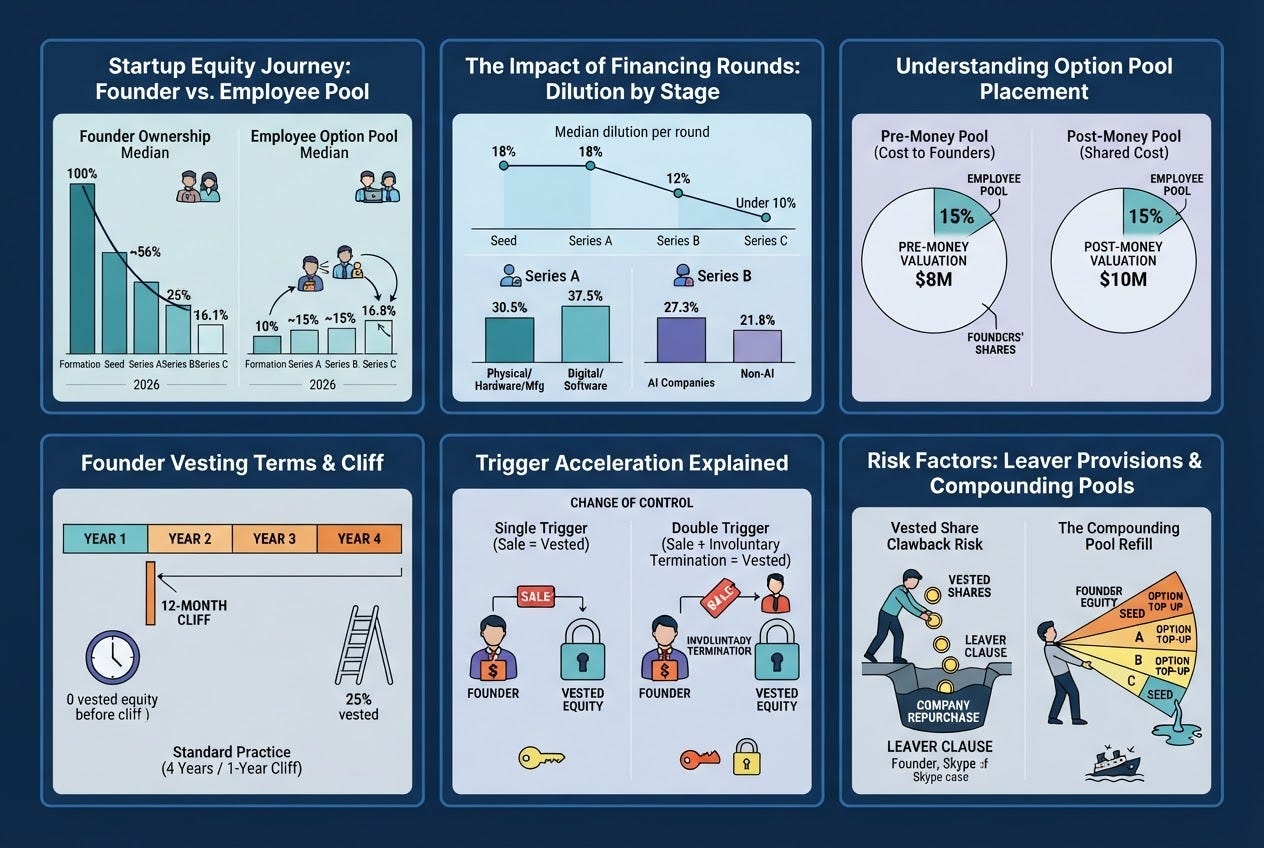
Founder Equity Pool Size and Vesting Terms at Company Formation A founder who accepts a ten to fifteen percent employee option pool at formation without negotiating its placement on a post money basis, and who signs a standard four year vesting schedule with no double trigger acceleration, risks reaching a Series C financing holding less equity than the pool created to hire the company’s own staff. Venture financings closed through 2026 show a median founder holding 16.1 percent of a venture backed company at the Series C stage against a median employee option pool of 16.8 percent of that same company. The gap opens earliest in the two decisions a founder controls completely at formation: the size and placement of the option pool, and the vesting and acceleration terms attached to the founder’s own stock. Executive Summary In 2026, the median startup founder holds 16.1 percent of a venture backed company whose own employee option pool holds 16.8 percent by the Series C round. A founder negotiating formation documents should fix the initial employee option pool at approximately 10 percent of fully diluted equity, sized against an eighteen month hiring plan, not an investor’s standard template, and should insist the pool sit on a post money basis so new investors share its cost. Founder vesting should run four years with a twelve month cliff, matching the term the venture industry’s own standard form documents recommend for every other option holder, paired with double trigger acceleration that vests the founder in full only if a change of control is followed by an involuntary termination or a material cut to title or pay. Median founder ownership falls from approximately 56 percent after a seed round to 36 percent after a Series A round, then into the high twenties or low twenties by a Series B round, before reaching 16.1 percent at Series C. Each decline compounds two separate mechanics: the capital raised at each round, and the employee pool that investors require the company to create or refresh immediately before that round prices. A founder who negotiates pool size once, at formation, and then accepts whatever pool refresh a term sheet proposes at every later round, surrenders control over the second mechanic entirely. The practice described below, sizing the pool to an actual hiring plan, placing it on a post money basis, and fixing founder vesting on terms no worse than the employee pool itself receives, reflects established market practice rather than an aggressive founder position, and it is available to any founder willing to negotiate it before signing a term sheet. Detailed Findings Capital Structure and Pool Sizing at Formation An employee option pool is almost always sized on a pre money basis at formation, which means the cost of creating it comes out of the founders’ side of the capitalization table before a new investor’s money is counted. A lead investor proposing a $2,000,000 seed investment on an $8,000,000 pre money valuation will routinely ask for a 15 percent pool to be added to that same pre money figure, so the investor’s ownership lands exactly where the term sheet states while the founders absorb the entire cost of the pool on top of the dilution the new money itself causes. Market practice through 2026 centers the initial pool between 10 and 15 percent of fully diluted equity, with 10 percent the single most common figure in seed stage financings, though a pool sized to an actual eighteen month hiring plan rather than to a generic percentage better protects a founder’s position than accepting whatever figure the term sheet proposes. A stack of convertible instruments compounds the same mechanic before a priced round ever happens. Three stacked Simple Agreements for Future Equity of $500,000, $1,000,000, and $1,000,000 on progressively higher valuation caps commit roughly 20.1 percent of the company before a lead investor prices anything, a figure that converts to approximately 14.3 percent of the capitalization table once the notes convert at the seed price. A founder who tracks only the headline percentage a term sheet quotes, without modeling the combined effect of the convertible stack and the incoming option pool, consistently underestimates the true cost of a seed round by a wide margin. Market and Valuation Context Across Financing Rounds Founders begin a company owning all of it. By the close of a seed round, the median founding team holds approximately 56 percent of the fully diluted capitalization, a decline driven in roughly equal part by the capital sold to seed investors and by the employee pool, which stands at a median of approximately 12.1 percent of the company by that point. A Series A round cuts the median founder position further, to 36 percent overall, with founders of physical, hardware, and manufacturing companies retaining a median of only 30.5 percent against 37.5 percent for founders of digital and software companies, a gap that reflects the larger teams and capital commitments that physical product development requires before a first commercial sale. By a Series B round, founders of artificial intelligence companies hold a median of 27.3 percent, against 21.8 percent for founders outside that category, reflecting the premium valuations and larger primary raises that rounds labeled as artificial intelligence commanded through 2025 and into 2026. The pattern inverts at Series C: founders hold a median of 16.1 percent of the company at that stage, while the employee option pool, refreshed at every intervening round to cover the hiring each new round of capital funds, holds a median of 16.8 percent, so the median Series C company’s own workforce owns more of the business than the people who started it. Dilution recorded across roughly 1,000 venture financings closed in the year to July 2026 shows the heaviest single round losses concentrated early: a median seed round costs the existing capitalization table approximately 18 percent, matched by an equally sized loss at Series A, before dropping to roughly 12 percent at Series B and under 10 percent at Series C. Because the earliest rounds carry the largest percentage losses and arrive before a founder has revenue or a competing term sheet to negotiate from, the decisions made at formation about pool size and vesting terms shape every subsequent round more than any single decision that follows them. Founder Vesting and Departure Risk The investor rights agreement that most United States venture financings start from recommends four year vesting with a one year cliff for every option granted after the financing closes. Although that provision by its terms addresses future hires, lead investors in priced rounds today routinely ask founders to adopt the identical schedule for their own already issued stock as a closing condition, carried out through a separate founder restricted stock purchase agreement executed at the same time as the financing. Vesting acceleration on a sale of the company comes in two forms. Single trigger acceleration vests some or all of a founder’s remaining shares immediately on the closing of a sale, regardless of what happens to the founder’s job afterward. Double trigger acceleration withholds that acceleration unless the sale is followed, within a fixed window ordinarily twelve months, by a second event, an involuntary termination without cause or a material reduction in title or compensation. Acquirers and the venture investors structuring a sale generally prefer double trigger provisions because they keep the founding team financially tied to the company through an integration period, and the provision protects the founder too: it closes off a buyer’s ability to force the founder out the day after closing while keeping the unvested stock. The limits of vesting protection are evident in a 2005 dispute between Facebook and cofounder Eduardo Saverin. Facebook restructured from a Florida limited liability company into a Delaware corporation and… This is a public episode. If you'd like to discuss this with other subscribers or get access to bonus episodes, visit theinnovationattorney.substack.com/subscribe
Embed this episode
No transcript yet.