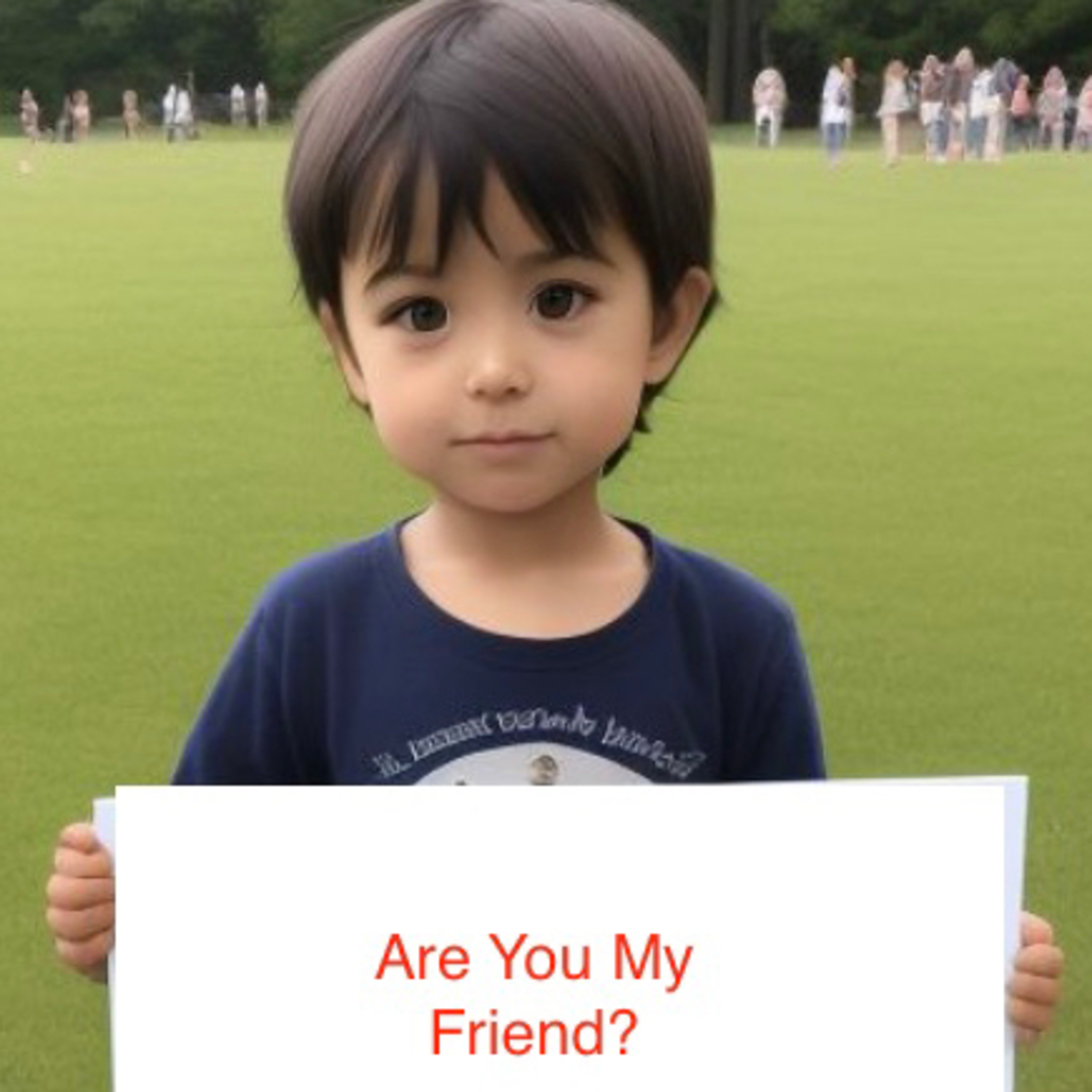
Welcome to the Tweed Trends podcast. Hey, Evette, what's trending today? Hey, I'm Evette, hey girl. And you are tuned in to Tweed Trends.
It's the quickest way to find out what's trending today. Friends, how many of us have them? Let's get started. Hey there, welcome back to Tweed Trends.
Today's episode is about friends. Now later on this week, I have an episode coming out about a young lady that's getting grief to strangers because they didn't have her back. Completely different topic, but it did kind of lead into today's topic talking about friends because in my opinion, friends are the ones that should definitely have your back strangers. I don't know.
That's a slippery slope there, but we'll get to that one later on in the week. Today we're talking about friends. Now, another thing that kind of led to today's topic is that school is starting again, and I overheard a conversation between my daughter and one of her friends. We'll get to that in a little bit.
Before we do, though, let's look at the definition of the word friend. One, because I want to make sure that the definition aligns with my own personal values and thoughts about what a friend is. So I don't remember which dictionary I found this definition in, but the definition is a person who one knows and with whom one has a bond of mutual affection. Yeah, so that definition doesn't do it for me.
I'm sorry. A friend is a lot more than someone who just knows me or that we have a bond of affection. No, I need my friend's definition to be a little bit more meatier than what they have here. So when I think about that, I think about the fact that pop culture has it right.
When people refer to a friend as their A1 from day one or a ride or die, that's my definition of what a friend should be. And maybe there's another word that describes it better and friend isn't it. But yeah, I need more for my friends. I need to be able to call a friend at two in the morning and they pick up the phone.
I need for a friend to hear me say I need and be like, I got you. I need a friend to be like, all right, I'm gonna meet you here. Don't tell me no more. We got this.
So yeah, this definition is not quite up to par about what I think a friend is. But nonetheless, that's the definition. So now that we've got that out in the open and we know what the definition of a friend is, now let's go to this conversation that I overheard. It's the first day of school, we're out at the bus stop, all the parents, all the kids and even some kids that were in the fifth grade last year that are going to the sixth grade.
So to give you an idea, our daughter is in the fifth grade this year, her friend, she's going to the sixth grade and another little fellow out there, he's going to the sixth grade. We're all out there as the sixth graders were heading back home to get their books so that they can come out to the bus stop to wait for the bus. For them, my daughter's friend gave her a hug and was like, it's going to be all right. So my ears immediately perked up because it's like, well, I don't recall my daughter saying anything about being concerned or having anxiety about this first day of school.
So what is she talking about? Then I will be here a little boy, say, oh, well, don't worry, it's not both of them, it's only one because one of them is coming to middle school with us. And I know exactly what they were talking about. So I leaned in a little bit closer to hear the rest of the conversation.
And what I heard was her friend comforting her about a situation that happened last school year where these two boys, their brothers, that ride their bus live not far from us, but aren't in the play group of the ones that come to this particular bus stop. They, for some reason, decided that they were going to verbally attack our daughter. And they attacked her on all things that made her black, her skin color, her hair, her hair texture, her eye color, everything about her. And they tried to tear her down with their words.
And all that did was light of fire inside of me. Now we went through the whole chain of command as far as the school goes. And who do you talk to about these things? We did not get to the point where we actually spoke to the parents.
But we were real close to it, real, real close to it. Part of my hesitation is that these two little boys are Indian, not to be confused with Native Americans. They're Indian. And I know that in recent times, I've had issues with Indian men.
And I've read about how they are with women in their society. And so I wonder, is it a woman thing? Is it a black thing? What is it about me that Indian men that I don't even know find it so simple and smooth to be rude and disrespectful?
And not even so much with words, but just with common curdices. If you see me walking with my family, and there's not really a gap in between us, but maybe a step between us. And you'd rather cut through, shoulder check me, knock me down, than to wait two steps for me to pass so that you can go behind me. You would let a door drop in my face, and not even flinch.
Like, you don't see me there. I walked up with you. We were walking side by side. OK, sure.
Maybe you don't want people to think that I'm with you. I don't want people to think that you're with me either. But anyway, I fall down a rabbit hole. Let me climb out and get back to the story.
Anyway, so this situation, though, did not sit well with me because our daughter is 10 years old. And she, with this situation, is having a problem that I had in high school. I experienced the exact same thing in high school. A friend of mine, she sat there and let this guy tear down my physical appearance and didn't have my back.
This was me getting this in high school. Here, I'm hearing about my 10-year-old going through the same situation. And her friend had a crush on the older brother, did not say anything. I asked my daughter about it.
And she's like, well, no, she didn't stick up for me. But afterwards, when we got off the bus, she gave me a hug and told me it was going to be all right. Same thing she did out at the bus stop going into this year. And in my mind, I'm like, well, that's not a friend.
That's not a friend. How can you be my friend, call yourself my friend. But in a situation where somebody that's cool with you attacks me and you don't have any words for them. You don't have any course correction.
You don't be like, I know you're not going to talk to my friend like that. If that's how you feel about her, forget me. Forget my name. Forget my number.
Don't talk to me. But no. She waited until out of the view of these people to then comfort our daughter. Wasn't a fan of that.
Same thing with me, although I didn't get an apology or anything. It was more of a, well, you know, that wasn't true. He was just saying that. So I kind of had to reevaluate.
So is this really my friend? When I think back to when I was in school, I don't remember that many of my friends needing someone to stand up for them. But in the situation that they did need somebody, I was there. And I know personally, I had a feeling this thing about me where I didn't want to be bullied.
So I tried to make my skin as thick as possible so that if somebody did bully me, they were going to get tired of bullying me because they'd realize that it didn't affect me. And they'd be like, you can say anything about that girl. And she's not going to care. When in reality, deep down inside, I cared about everything that was said about me.
I cared about all of it. But I couldn't let them see it. I could not let them see that they got to me. So in every situation that I was bullied, it didn't last long because people eventually were like, you know what?
Let's find somebody else who's going to actually react because she's not. Now, our daughter, on the other hand, she's only in the fifth grade. And every single year, there has been somebody, some friend of hers that has been bullied, someone has said something not nice. And she has been the one to stand up for them.
So you can only imagine my frustration and my irritation with hearing her come home and tell me stories about people that have said things to her or been mean to her. And I asked, so what did your friends say? Were any of your friends around? Yeah, they're around.
What did they say? Well, nobody said anything. Nobody stood up for you? No.
Wow. Really? And in every situation, it's been somebody there that she has stood up for in the past. So I look at this and I wonder, what are we doing wrong as a society?
We have these stop the bullying campaigns and everything. But it means nothing. If we're not going to stand up and do what we say we're going to do, we can't sit here and say stop bullying, stop bullying. But then we see bullying happen.
Everybody kind of, oh, oh, make way for the bully. We can't do that. And then I look at the parents. And it's like, OK, is it a parenting problem?
Are parents doing something wrong? Are we letting our children believe that they are princes and princesses and that whatever they say goes, and so therefore, they can talk to people any kind of way and treat them any kind of way? Because if so, then we need to fix that as well. But how do you fix something like this?
Well, start with self. You start teaching your children that if they see bullying happening, then they should say something. Even if they're afraid to say something to the bully themselves, go get help. Just like in that CPR situation.
Somebody tends to the body, but somebody else has to go get help. You'd have to call 911. You have to go to a place where there is a phone and call, find somebody, go get the AED. Somebody else has to go do something.
So if you can't be the one to have the hands-on help right there with the person in trouble, be the assistant. Go find somebody else that can't help. And then maybe we can actually do something with this bullying. Because like I said, it wasn't a thing where I grew up when I grew up.
It wasn't so bad. Now I'm not going to say that it didn't happen. But the way that it's just rampant now. And then on top of that, we have social media.
So let's not even get to the bullying on social media. But something has to change. Thanks so much for joining me for today's episode. Like I said earlier, that definition of the word friend, it needs to be beefed up a lot.
Or I just need to find a different word to describe what I want. But a friend isn't it if we have to go off of that definition. And I think all of us need that person is going to have our back, that's going to check on our well-being, that's going to see too with it. People just can't come up, doesn't say any old thing, any kind of way.
Use the idea of CPR, where if you don't have it in you, it's not in your personality to speak up and out against people and things, then you don't have to be the hands-on person. You can be the person that runs to go get help. You go get somebody that can do something. You get somebody with some power that can say the right things to this person to shut them down.
And to me, that's what a friend would do. Even if they're afraid, they find a way to make something happen. Because these types of things, when they go unchecked, then think about my daughter, for instance. As she gets older, if people continue to attack her for her looks, what's to say that this doesn't manifest on type of excessive grooming or refusal to be seen if she has a pimple or something like that?
Because all she can do is go back in her mind to the time when these boys said these mean things about her. And now she feels like she has to be perfect when she walks out, because that's the only way that people aren't going to attack her for being herself authentically. So let's keep that in mind. Let's make some moves.
Let's start the conversation. Maybe that's where it needs to happen. Maybe we need to start the conversation. So if you can't do that, here's what you can do.
Share today's episode with somebody, and then have a discussion about it, and see what you can do about it in your circle. Because to me, it's like that whole pebble in the pond. You drop it in there, and the ripples, they go from there. Maybe that's what we all need to do.
Start making some ripples, start having these conversations, and do something, because bullying is not going to stop itself. That's all I have. You know where to find me, that place that used to be called Twitter, Instagram, and I'm really trying to get on threads. I'm there, I just haven't posted anything.
So keep an eye out. I may flood threads with a bunch of things all at one time. But you know, hey, that's at H-E-E-V-E-T-T-E, or look for the hashtag tweet trends.