
EPISODE · Sep 13, 2025 · 27 MIN
From flickering fast to liquid glass: A quick history of transparency in design and video games (mrmcd25)
from Chaos Computer Club - recent audio-only feed · host aSyd🪿, Vijinx
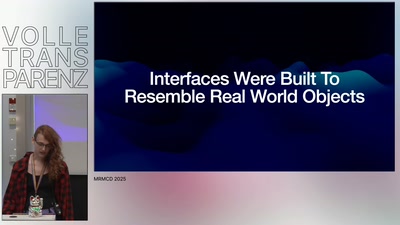
Transparency has been a feature in design for a long time –and in said time the tech powering it has advanced a lot. Where in the past, the relative slowness of the human eye was used to fake a transparency effect by switching between images, we now have complex simulations of light refraction happening in real time just to make window titles prettier. This talk aims to give a non-exhaustive look at how the tech has evolved over time and showcases some interesting examples of transparency being used in media. Transparency has been a way to make things look nice for a long time. Back in the 80s, it was still very difficult to accomplish a "real" transparency effect with commonly available hardware of the time, so developers needed to use tricks to make things look transparent when they really weren't. Those ranged from pre-rendering images, over averaging pixel colors, to switching the image faster than the human eye can notice and make it do the work of averaging what it's seeing. Time went on, and computers got faster, moving transparent design more and more into the mainstream. This reached a bit of a peak with the universally hated windows vista, after which transparent design went out of favor for a while, and everything turned flat in the years after. Until this year, when Apple unveiled their new design language, called liquid glass. People are joking that it is just bringing back windows vista, but people have been saying that the new version of macOS is apple's windows vista since the OS was still called OSX, and there is a lot more to liquid glass than it first appears. In this talk, we want to take you to a non-exhaustive journey through the history of transparent design and explain how different techniques worked, and didn't work, and what the current state of the art is. https://creativecommons.org/licenses/by-sa/4.0/ about this event: https://talks.mrmcd.net/2025/talk/W7LXPN/
What this episode covers
Transparency has been a feature in design for a long time –and in said time the tech powering it has advanced a lot. Where in the past, the relative slowness of the human eye was used to fake a transparency effect by switching between images, we now have complex simulations of light refraction happening in real time just to make window titles prettier. This talk aims to give a non-exhaustive look at how the tech has evolved over time and showcases some interesting examples of transparency being used in media. Transparency has been a way to make things look nice for a long time. Back in the 80s, it was still very difficult to accomplish a "real" transparency effect with commonly available hardware of the time, so developers needed to use tricks to make things look transparent when they really weren't. Those ranged from pre-rendering images, over averaging pixel colors, to switching the image faster than the human eye can notice and make it do the work of averaging what it's seeing. Time went on, and computers got faster, moving transparent design more and more into the mainstream. This reached a bit of a peak with the universally hated windows vista, after which transparent design went out of favor for a while, and everything turned flat in the years after. Until this year, when Apple unveiled their new design language, called liquid glass. People are joking that it is just bringing back windows vista, but people have been saying that the new version of macOS is apple's windows vista since the OS was still called OSX, and there is a lot more to liquid glass than it first appears. In this talk, we want to take you to a non-exhaustive journey through the history of transparent design and explain how different techniques worked, and didn't work, and what the current state of the art is. https://creativecommons.org/licenses/by-sa/4.0/ about this event: https://talks.mrmcd.net/2025/talk/W7LXPN/
NOW PLAYING
From flickering fast to liquid glass: A quick history of transparency in design and video games (mrmcd25)
No transcript for this episode yet
Similar Episodes
Mar 26, 2026 ·1m
Feb 8, 2026 ·4m
Jan 30, 2026 ·6m
Jan 2, 2026 ·47m